
Introduction
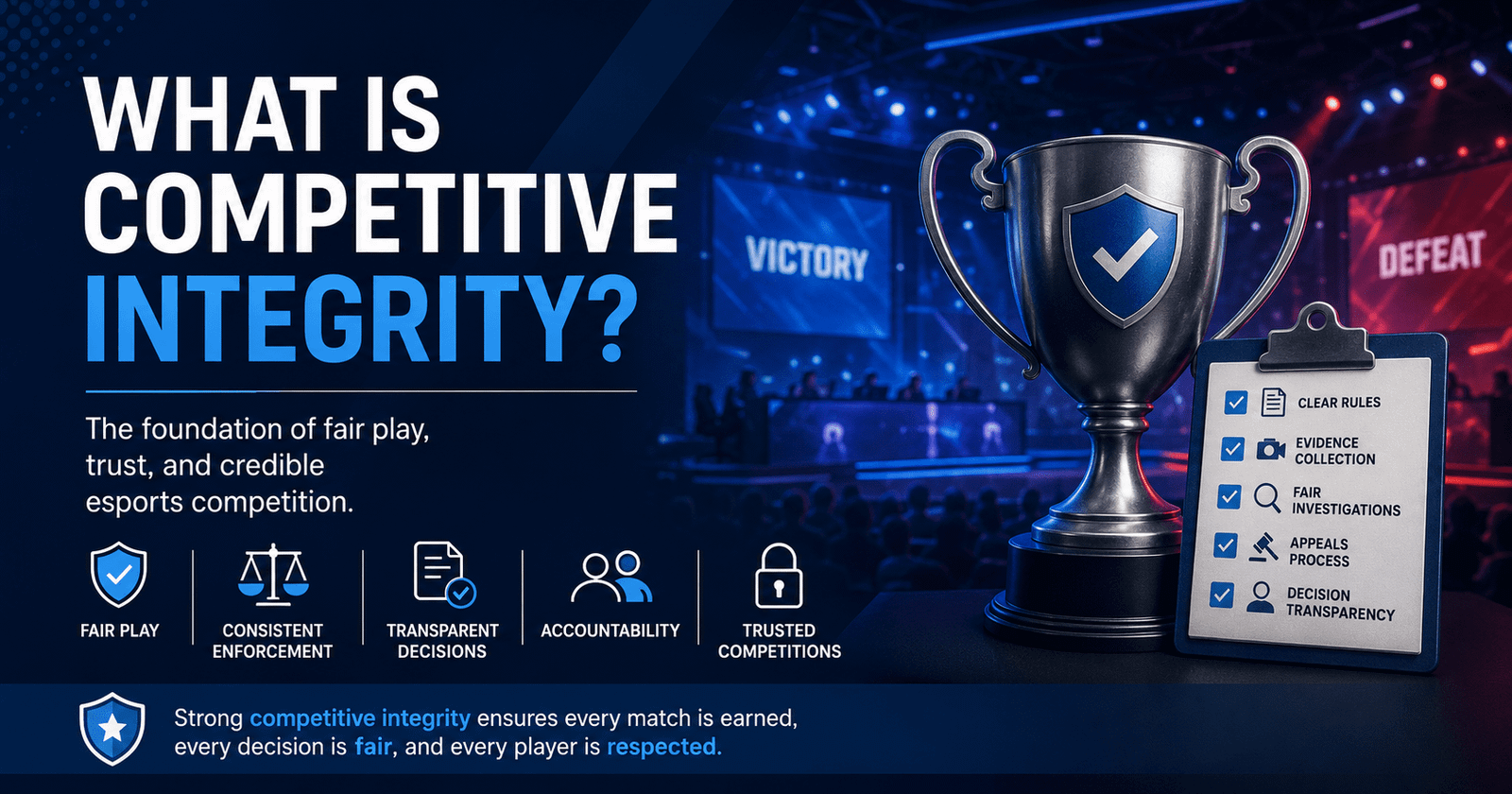
What is competitive integrity? – Competitive integrity is the foundation of fair esports competition. It ensures that every participant competes under the same rules, every decision is applied consistently, and every match outcome reflects legitimate player performance rather than manipulation, misconduct, or administrative inconsistency.
As esports continues to evolve into a global industry with professional leagues, amateur competitions, collegiate events, and community tournaments, maintaining competitive integrity has become one of the greatest responsibilities of tournament organizers. Prize pools are increasing, sponsors expect professionalism, and players demand transparency. Even a single poorly handled incident can damage the credibility of an entire competition.
Competitive integrity extends far beyond detecting cheating. It encompasses tournament governance, rules enforcement, dispute resolution, evidence management, administrative investigations, conflict-of-interest policies, appeals processes, and operational consistency. Every interaction between players, administrators, referees, and organizers contributes to the perception of whether a tournament is truly fair.
For tournament organizers, competitive integrity is not merely a desirable quality—it is an operational discipline that requires planning, documentation, accountability, and continuous improvement.
This guide explains what competitive integrity means, why it matters, how it differs from related concepts such as tournament integrity, and the practical steps organizers can take to build trustworthy competitions that inspire confidence among players, teams, sponsors, and spectators.



Executive Summary
Competitive integrity refers to the consistent application of rules, procedures, and governance practices that ensure every participant competes under equal conditions. It protects the legitimacy of tournament results by promoting fairness, transparency, accountability, and impartial decision-making.
In practice, competitive integrity includes:
- Clear tournament rules
- Consistent rules enforcement
- Transparent disciplinary procedures
- Proper evidence collection
- Fair administrative investigations
- Structured incident management
- Appeals processes
- Conflict-of-interest prevention
- Decision documentation
- Operational accountability
Organizations that prioritize competitive integrity reduce disputes, strengthen player confidence, protect their reputation, and create sustainable esports ecosystems.
While anti-cheat technologies may detect certain technical violations, competitive integrity addresses the broader administrative and operational framework required to ensure that every competitive decision is fair, consistent, and defensible.
Main Guide
What Is Competitive Integrity?
Competitive integrity is the consistent and impartial application of rules, governance, and operational procedures that ensure every participant has an equal opportunity to compete fairly.
The concept extends beyond preventing misconduct during gameplay. It encompasses every administrative decision that influences competitive outcomes, from player eligibility verification before an event to the handling of appeals after a tournament concludes.
A tournament may use advanced technical systems to reduce rule violations, but if disciplinary decisions are inconsistent, investigations lack evidence, or penalties vary depending on the teams involved, competitive integrity has already been compromised.
Competitive integrity therefore represents a complete governance framework rather than a single operational task.
Its primary objective is to ensure that tournament outcomes are determined by legitimate competitive performance rather than administrative inconsistency, favoritism, procedural weaknesses, or avoidable operational failures.
Core Characteristics of Competitive Integrity
High-integrity competitions consistently demonstrate several defining characteristics:
- Equal treatment for all participants
- Clearly documented tournament rules
- Transparent decision-making
- Consistent enforcement procedures
- Evidence-based investigations
- Independent administrative judgment
- Structured appeals mechanisms
- Comprehensive incident documentation
- Accountability for tournament officials
- Continuous operational improvement
Together, these characteristics create an environment where players trust the competition regardless of whether they win or lose.
Practical Example
Imagine two different teams submit identical roster violations before separate playoff matches.
In a tournament with weak competitive integrity, one team receives only a warning because of its popularity, while the other is disqualified despite committing the same violation.
In a tournament with strong competitive integrity, both cases follow the same documented investigation process, identical evidence requirements, identical review procedures, and identical disciplinary standards.
The difference is not simply fairness—it is consistency.
Recommended Internal Link
- What Is Tournament Integrity?
Related Topic
- Tournament Governance
Why Competitive Integrity Matters in Esports
Competitive integrity protects the credibility of tournaments by ensuring that rules, decisions, and disciplinary actions remain fair, transparent, and consistent for every participant.
Esports tournaments rely on trust.
Players trust that opponents follow the same rules.
Teams trust administrators to remain impartial.
Sponsors trust events to protect their investments.
Viewers trust that results represent genuine competition.
Without competitive integrity, every one of these relationships begins to weaken.
Benefits for Tournament Organizers
Strong competitive integrity produces measurable operational benefits.
| Benefit | Operational Impact |
|---|---|
| Consistent decision-making | Reduces administrative disputes |
| Transparent investigations | Builds participant confidence |
| Standardized procedures | Improves staff efficiency |
| Reliable documentation | Supports appeals and reviews |
| Fair enforcement | Protects tournament reputation |
| Professional governance | Attracts sponsors and partners |
Rather than reacting differently to each incident, organizers establish repeatable procedures that produce predictable and defensible outcomes.
Benefits for Players
Players benefit from competitive integrity because they understand:
- What behavior is expected
- Which rules apply equally to everyone
- How investigations are conducted
- How evidence is evaluated
- How disciplinary decisions are made
- How appeals can be submitted
This transparency reduces uncertainty and encourages greater confidence in tournament administration.
Benefits for Sponsors
Sponsors invest in competitions that protect their brand reputation.
Events known for inconsistent rulings, unresolved disputes, or controversial investigations become significantly less attractive to commercial partners.
Competitive integrity demonstrates organizational maturity and operational professionalism, making tournaments more appealing to sponsors seeking long-term partnerships.
Common Mistake
Many organizers assume competitive integrity begins only after an incident occurs.
In reality, competitive integrity starts during tournament planning through the creation of rules, operational procedures, staff training, governance structures, and documentation standards.
Waiting until problems arise almost always leads to inconsistent decisions.
Recommended Internal Link
- Why Anti-Cheat Software Alone Isn’t Enough
Related Topic
- Incident Management in Esports
Competitive Integrity vs. Tournament Integrity
Competitive integrity focuses on fair competition and consistent decision-making, while tournament integrity encompasses the broader operational systems that protect the legitimacy of an entire event.
Although these concepts are closely related, they are not interchangeable.
Competitive integrity addresses how competition itself remains fair.
Tournament integrity includes competitive integrity but also extends to the organizational processes, governance structures, operational workflows, and administrative controls that support an event from registration through post-tournament review.
A useful way to understand the relationship is to think of competitive integrity as one of the most important pillars within the broader framework of tournament integrity.
Competitive integrity asks questions such as:
- Are the rules enforced consistently?
- Were disciplinary decisions impartial?
- Was evidence evaluated fairly?
- Did every team compete under equal conditions?
Tournament integrity expands the scope by also asking:
- Were tournament operations properly documented?
- Were administrators accountable?
- Were incidents tracked throughout the event?
- Were appeals managed transparently?
- Were governance procedures followed?
- Were operational risks identified and mitigated?
This distinction is especially important for organizers who want to build long-term credibility. A tournament may maintain fair matches while still struggling with inconsistent communication, poor documentation, or weak operational governance. Conversely, strong operational processes without fair competitive enforcement also undermine participant trust.
The most successful esports organizations treat competitive integrity and tournament integrity as complementary disciplines rather than competing concepts.
Competitive integrity safeguards the fairness of competition itself, while tournament integrity ensures the entire event is managed through structured, transparent, and accountable operational practices.
Recommended Internal Link
- Tournament Integrity vs Competitive Integrity
Related Topic
- Administrative Investigations
The Core Principles of Competitive Integrity
Competitive integrity is built on a set of governance principles that guide every operational decision before, during, and after a tournament.
While every tournament differs in size and complexity, the strongest competitions consistently rely on the same foundational principles. These principles help organizers make consistent decisions, reduce disputes, and maintain the trust of every stakeholder involved.
1. Fairness
Every participant must compete under the same conditions.
This means applying identical eligibility requirements, match procedures, disciplinary standards, and tournament rules regardless of a player’s popularity, ranking, or organizational affiliation.
Fairness does not mean every outcome is identical—it means every decision follows the same process.
Common mistake: Making exceptions for well-known teams or high-profile matches.
2. Transparency
Players should understand how decisions are made.
Transparency includes publishing tournament rules, documenting disciplinary procedures, explaining penalties when appropriate, and communicating decisions clearly.
Organizers do not need to disclose confidential investigation details, but they should explain enough to demonstrate that proper procedures were followed.
Practical recommendation:
- Publish a complete rulebook before registration.
- Document every disciplinary decision.
- Explain appeals procedures in advance.
3. Consistency
The same incident should produce the same administrative response regardless of who is involved.
Consistency protects organizers from accusations of favoritism while making disciplinary decisions easier to defend.
Consistency requires standardized workflows instead of relying solely on administrator judgment.
4. Accountability
Tournament officials should be accountable for their decisions.
Administrative actions should be documented so they can be reviewed if questions arise later.
Good documentation protects both players and tournament staff.
5. Evidence-Based Decision Making
Disciplinary decisions should rely on verifiable evidence rather than assumptions or public opinion.
Evidence may include:
- Match recordings
- Server logs
- Screenshots
- Player reports
- Referee observations
- Communication records
- Tournament platform logs
The stronger the evidence collection process, the more trustworthy every investigation becomes.
6. Due Process
Participants deserve an opportunity to respond before significant disciplinary action is taken whenever circumstances permit.
Due process helps organizers avoid rushed decisions that may later require reversal.
Practical Example
During a regional tournament, a player is accused of exploiting an unintended game mechanic.
Instead of issuing an immediate penalty based on community reactions, administrators:
- Collect replay footage.
- Review server logs.
- Interview referees.
- Compare similar historical incidents.
- Apply the published rulebook.
- Document the final decision.
Even if some community members disagree with the outcome, the investigation demonstrates strong competitive integrity because the decision followed a structured process.
Recommended Internal Link
- Incident Management in Esports
Related Topic
- Evidence Collection
The Biggest Challenges to Competitive Integrity
Competitive integrity is most often weakened by inconsistent administration rather than isolated player misconduct.
Many organizers focus primarily on preventing cheating, but the greatest risks frequently arise from operational weaknesses.
The following table summarizes common challenges and their potential impact.
| Challenge | Risk to Competition | Recommended Mitigation |
|---|---|---|
| Inconsistent rule enforcement | Perception of favoritism | Standardized disciplinary procedures |
| Poor documentation | Difficult appeals | Centralized incident records |
| Incomplete evidence | Incorrect decisions | Structured evidence collection workflow |
| Staff bias | Loss of trust | Conflict-of-interest policies |
| Unclear rules | Increased disputes | Comprehensive tournament rulebook |
| Delayed investigations | Player frustration | Defined response timelines |
These risks affect tournaments of every size—from community events to international championships.
Common Operational Challenges
Inconsistent Rule Interpretation
Different referees may interpret the same rule differently if procedures are not standardized.
The solution is to create decision frameworks rather than relying on personal judgment.
Lack of Documentation
Without written records, organizers struggle to explain previous disciplinary decisions or maintain consistency across future tournaments.
Good documentation becomes institutional knowledge.
Emotional Decision Making
Administrators sometimes face intense pressure from players, teams, social media, or sponsors.
Competitive integrity requires evidence-based decisions instead of emotional reactions.
Resource Limitations
Smaller tournaments often have limited staff.
Rather than attempting to replicate professional league operations, organizers should prioritize repeatable workflows that scale with available resources.
Even simple documentation templates significantly improve operational consistency.
Recommended Internal Link
- Administrative Investigations
Related Topic
- Tournament Operations
Building Competitive Integrity into Tournament Operations
Competitive integrity should be integrated into daily tournament operations rather than treated as a separate activity.
Successful organizers establish integrity throughout every phase of the tournament lifecycle.
Before the Tournament
Preparation is where most integrity risks can be prevented.
Recommended actions include:
- Publish tournament rules.
- Define disciplinary procedures.
- Verify participant eligibility.
- Train tournament administrators.
- Establish evidence collection standards.
- Prepare incident reporting workflows.
- Define appeal procedures.
During the Tournament
Operational consistency becomes critical.
Administrators should:
- Record every incident.
- Preserve relevant evidence.
- Apply rules consistently.
- Communicate decisions professionally.
- Maintain investigation records.
- Track penalties using standardized procedures.
After the Tournament
Competitive integrity continues even after champions are crowned.
Post-event reviews help improve future tournaments by identifying:
- Frequently disputed rules
- Investigation delays
- Operational bottlenecks
- Appeals trends
- Documentation gaps
- Policy improvements
Continuous improvement transforms tournament administration into a repeatable governance process.
Best Practices for Maintaining Competitive Integrity
Strong competitive integrity depends on repeatable operational practices rather than individual expertise alone.
Organizations that consistently deliver fair competitions typically adopt the following best practices:
Establish Clear Governance
Create written policies covering:
- Player conduct
- Administrative authority
- Evidence standards
- Appeals
- Penalties
- Conflict-of-interest management
Written governance reduces ambiguity during high-pressure situations.


Standardize Investigation Procedures
Every investigation should follow a documented workflow instead of being improvised.
A consistent process generally includes:
- Incident reporting
- Initial assessment
- Evidence collection
- Administrative review
- Decision documentation
- Communication
- Appeals, if applicable
Train Tournament Staff
Even excellent procedures fail if administrators interpret them differently.
Regular training helps ensure:
- Consistent rule interpretation
- Professional communication
- Reliable evidence handling
- Objective decision-making
Maintain Centralized Records
Historical decisions improve future consistency.
A centralized integrity management system enables organizers to:
- Review previous investigations
- Compare similar incidents
- Track repeat offenders
- Improve governance over time
Encourage Transparency
Players should understand not only the rules but also the reasoning behind tournament procedures.
Transparency strengthens trust even when disciplinary decisions are unpopular.
Best Practices Checklist
Use this checklist before launching any competitive event:
- ✅ Tournament rules are publicly available.
- ✅ Eligibility requirements are documented.
- ✅ Incident reporting procedures are defined.
- ✅ Evidence collection standards are established.
- ✅ Appeals process is published.
- ✅ Administrators receive procedural training.
- ✅ Investigation workflow is documented.
- ✅ Conflict-of-interest policies are in place.
- ✅ Disciplinary actions are recorded consistently.
- ✅ Post-event review is scheduled.
Common Mistakes That Undermine Competitive Integrity
Most integrity failures result from administrative inconsistency rather than malicious intent.
Even experienced organizers occasionally introduce avoidable risks.
The following table highlights several common mistakes.
| Mistake | Why It Creates Problems | Better Approach |
|---|---|---|
| Changing rules during the tournament | Creates confusion and perceived unfairness | Finalize rules before registration |
| Issuing penalties without evidence | Damages credibility | Collect and verify evidence first |
| Applying different standards to different teams | Encourages accusations of favoritism | Use standardized disciplinary procedures |
| Poor documentation | Weakens future investigations | Record every integrity-related decision |
| Ignoring appeals | Reduces player confidence | Maintain structured appeals management |
| Making emotional decisions | Produces inconsistent outcomes | Follow documented governance processes |
Practical Example
A tournament administrator receives simultaneous reports from two opposing teams accusing each other of unsportsmanlike conduct.
Instead of immediately issuing penalties, the administrator follows the established workflow:
- Collects match recordings.
- Reviews referee notes.
- Interviews both teams.
- Applies the published code of conduct.
- Documents the findings.
- Issues a written decision.
Because the process is standardized, both teams recognize that the investigation was fair—even if one disagrees with the final ruling.
Recommended Internal Link
- Types of Cheating
Related Topic
- Appeals Management
Decision Framework
How to Evaluate Competitive Integrity in Your Tournament
Competitive integrity improves when organizers evaluate their operations using consistent governance criteria instead of relying on assumptions.
Use the following framework to assess the maturity of your tournament operations.
| Evaluation Area | Questions to Ask | Indicators of Strong Integrity |
|---|---|---|
| Rules | Are tournament rules complete and publicly available? | Comprehensive, accessible rulebook |
| Enforcement | Are penalties applied consistently? | Standardized disciplinary process |
| Evidence | Is every decision supported by documented evidence? | Evidence repository for every case |
| Investigations | Is there a defined investigation workflow? | Repeatable administrative procedures |
| Appeals | Can participants challenge decisions? | Formal appeals policy and timeline |
| Documentation | Are incidents recorded for future reference? | Centralized incident management system |
| Transparency | Are decisions communicated clearly? | Written explanations and documented outcomes |
| Continuous Improvement | Are tournaments reviewed after completion? | Regular governance reviews and policy updates |
Maturity Assessment
Ask yourself these questions after every tournament:
- Did every participant receive equal treatment?
- Were all penalties supported by evidence?
- Could another administrator reproduce the same decision using the available documentation?
- Were appeals handled according to policy?
- Did any incident expose weaknesses in tournament procedures?
If the answer to any of these questions is “No,” there is an opportunity to strengthen your competitive integrity processes before the next event.
Practical Examples
Scenario 1: Unauthorized Substitute Player
A team replaces one of its registered players moments before a playoff match without notifying tournament officials.
Poor Competitive Integrity
- Administrator allows the substitution because the match is already delayed.
- No documentation is created.
- Other teams later claim favoritism.
Strong Competitive Integrity
- Eligibility rules are reviewed.
- Team roster records are verified.
- Tournament policies are applied consistently.
- The decision is documented.
- Both teams receive the official explanation.
Lesson: Consistency matters more than convenience.
Scenario 2: Disputed Match Result
Following a close match, both teams submit conflicting reports regarding an alleged rule violation.
Poor Competitive Integrity
- Administrator decides based on community opinion.
- No evidence is collected.
- Players receive inconsistent explanations.
Strong Competitive Integrity
- Match recordings are preserved.
- Referee observations are reviewed.
- Both teams provide statements.
- Evidence is evaluated objectively.
- Decision is documented and communicated.
Lesson: Evidence should always guide administrative decisions.
Scenario 3: Repeated Unsportsmanlike Conduct
A player repeatedly violates the tournament code of conduct across several events.
Poor Competitive Integrity
- Previous incidents cannot be located.
- Administrators rely on memory.
- Penalties vary from tournament to tournament.
Strong Competitive Integrity
- Previous incidents are available in historical records.
- The investigation references documented behavior.
- Published disciplinary guidelines are followed.
- Penalties remain consistent across events.
Lesson: Historical documentation strengthens long-term governance.
Visual Checklist
Tournament Readiness Checklist
Before your tournament begins, confirm the following:
- ✅ Tournament rules are finalized.
- ✅ Player eligibility has been verified.
- ✅ Staff responsibilities are documented.
- ✅ Incident reporting procedures are available.
- ✅ Investigation workflow has been established.
- ✅ Evidence collection standards are defined.
- ✅ Appeals process has been published.
- ✅ Administrative communication templates are prepared.
- ✅ Conflict-of-interest policies are documented.
- ✅ Decision records will be stored centrally.
Post-Tournament Integrity Review Checklist
After the event concludes, evaluate your operations.
- ✅ All incidents were documented.
- ✅ Every disciplinary action includes supporting evidence.
- ✅ Appeals were processed within established timelines.
- ✅ Staff followed standardized procedures.
- ✅ Frequently disputed rules have been identified.
- ✅ Operational improvements have been documented.
- ✅ Governance policies have been updated where necessary.
- ✅ Lessons learned have been shared with administrators.
- ✅ Historical records have been archived.
- ✅ Improvement actions have been scheduled for the next tournament.
Tourney Guard
Competitive integrity is not achieved through a single policy or tool. It is the result of disciplined tournament administration, transparent governance, consistent rule enforcement, and well-documented operational processes.
As tournaments grow in size and complexity, manually managing incidents, investigations, evidence, disciplinary actions, and appeals becomes increasingly difficult.
Tourney Guard helps tournament organizers strengthen Tournament Integrity by providing structured workflows for incident management, evidence collection, administrative investigations, appeals management, decision documentation, and governance processes.
Rather than replacing tournament administrators, Tourney Guard supports them with the operational framework needed to deliver fair, transparent, and trustworthy competitions.
Frequently Asked Questions
What is competitive integrity?
Competitive integrity is the consistent application of rules, governance, and administrative procedures that ensure every participant competes under fair and equal conditions.
Why is competitive integrity important?
It protects the credibility of tournament results, builds player trust, reduces disputes, improves transparency, and strengthens the reputation of tournament organizers.
Is competitive integrity the same as tournament integrity?
No. Competitive integrity focuses specifically on ensuring fair competition and consistent decision-making. Tournament integrity is broader and includes governance, operational processes, compliance, incident management, and administrative oversight throughout the entire event lifecycle.
Does competitive integrity only involve cheating?
No. While cheating is one threat, competitive integrity also includes rule enforcement, eligibility verification, evidence collection, investigations, appeals, conflict-of-interest management, communication, and operational consistency.
How can small tournament organizers improve competitive integrity?
Even small tournaments can significantly improve integrity by publishing clear rules, documenting incidents, collecting evidence consistently, standardizing investigations, maintaining historical records, and establishing transparent appeals procedures.
How does Tourney Guard support competitive integrity?
Tourney Guard provides structured operational workflows that help organizers manage incidents, investigations, evidence, disciplinary actions, appeals, and governance in a consistent and transparent manner, strengthening overall tournament integrity.
Conclusion
Competitive integrity is the cornerstone of every credible esports competition. It ensures that tournament outcomes are determined by skill, preparation, and fair play—not by inconsistent administration, unclear procedures, or avoidable operational failures.
Strong competitive integrity is achieved through transparent governance, standardized investigations, evidence-based decision-making, comprehensive documentation, and consistent rules enforcement. These practices build confidence among players, teams, sponsors, officials, and spectators while protecting the long-term reputation of tournament organizers.
As esports continues to mature, expectations around professionalism and accountability will only increase. Organizers who invest in structured governance today will be better prepared to manage larger competitions, resolve disputes efficiently, and maintain trust across their communities.
Ultimately, competitive integrity is not simply about preventing problems. It is about creating an environment where every participant believes the competition is fair, every decision can be justified, and every tournament is managed with consistency, transparency, and professionalism.
When these principles become part of everyday tournament operations, competitive integrity evolves from an aspiration into a sustainable competitive advantage.
Recommended External Resources
These organizations publish guidance that supports professional Tournament Integrity programs:
- Esports Integrity Commission (ESIC) – Standards, codes of conduct, investigations, and integrity initiatives.
- International Olympic Committee (IOC) – Integrity frameworks applicable to competitive sports governance.
- International Betting Integrity Association (IBIA) – Best practices for integrity monitoring.
- NIST Cybersecurity Framework – Guidance for security governance and risk management.
- ISO 37301 Compliance Management Systems – International compliance management principles.
- World Anti-Doping Agency (WADA) – Governance and disciplinary process principles applicable beyond traditional sports.
Suggested Internal Links
Strengthen your internal linking strategy by connecting this article with:
- What Is Tournament Integrity? A Complete Guide for Esports Organizers
- Why Anti-Cheat Software Alone Isn’t Enough for Esports Tournaments
- Decision Transparency in Tournament Administration: The Complete Guide to Building Trust in Esports Competitions
- Tournament Integrity Best Practices: The Complete Guide for Esports Organizers
- Rules Enforcement in Esports Tournaments: The Complete Guide for Fair and Consistent Competition
- What Is Fair Play in Esports?