
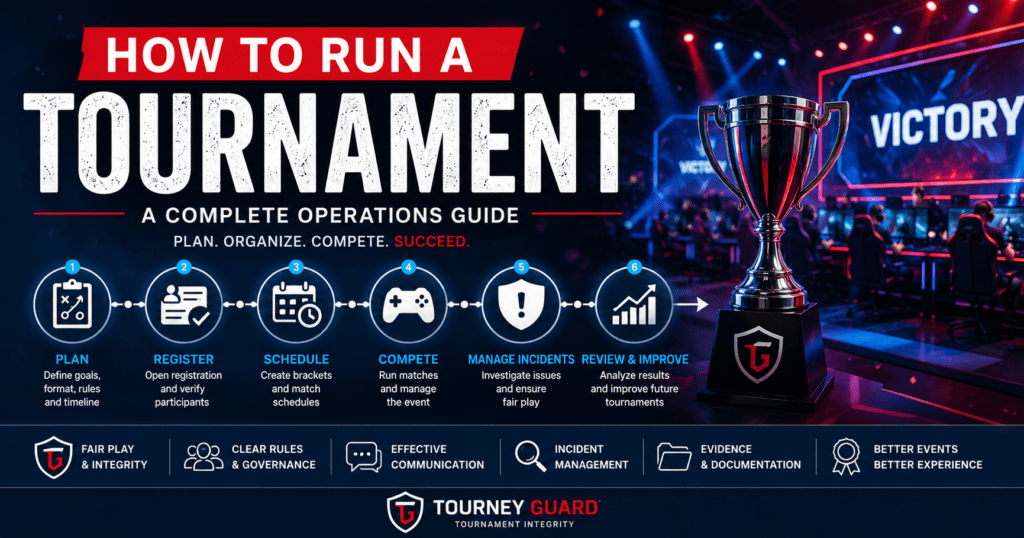
Introduction
Running an esports tournament involves far more than creating a bracket and inviting players. Successful competitions are built on structured Tournament Operations that ensure every participant experiences a fair, organized, and transparent event from registration to the final results.
Whether you’re organizing a local community competition, an online league, a collegiate championship, or a professional circuit, every tournament follows the same operational lifecycle. Planning, scheduling, player verification, match administration, incident response, and post-event analysis all contribute to the overall success of the competition.
Many first-time organizers focus almost exclusively on gameplay. However, experienced tournament administrators understand that the quality of the participant experience depends largely on everything happening behind the scenes. Poor communication, inconsistent rule enforcement, incomplete documentation, and inadequate incident handling can damage a tournament’s credibility even when the gameplay itself is excellent.
This is why learning How to Run a Tournament requires understanding operational processes rather than simply selecting a tournament platform. Tournament Operations provide the framework that enables organizers to coordinate staff, manage risks, enforce rules consistently, resolve disputes, and maintain Tournament Integrity throughout the event.
Modern esports tournaments also involve multiple stakeholders beyond players. Teams, sponsors, publishers, broadcasters, referees, volunteers, and spectators all depend on reliable tournament administration. Clear workflows and documented procedures help ensure every operational decision supports competitive fairness while minimizing unnecessary delays and confusion.
This comprehensive guide explains How to Run a Tournament using proven operational practices adopted by professional tournament organizers. From initial planning through post-event evaluation, you’ll learn the essential processes that create efficient, scalable, and trustworthy esports competitions.



Key Takeaways
- Running a tournament requires structured Tournament Operations.
- Planning begins long before player registration opens.
- Clearly defined objectives influence every operational decision.
- Tournament formats should match event goals and participant numbers.
- Rules, governance, and communication improve consistency.
- Registration and verification reduce operational risks.
- Incident Management protects competitive fairness.
- Documentation improves transparency and accountability.
- Continuous improvement strengthens future tournaments.
- Tournament Integrity is achieved through repeatable operational processes.
Executive Summary
Learning How to Run a Tournament involves much more than organizing matches. Professional Tournament Operations encompass every activity required to prepare, execute, monitor, and evaluate an esports competition while ensuring fairness, efficiency, and transparency.
Successful organizers begin by defining tournament objectives, selecting an appropriate competition format, establishing governance policies, preparing tournament rules, assigning staff responsibilities, and implementing standardized workflows for registration, scheduling, match administration, incident management, and post-event review.
Throughout the tournament lifecycle, administrators must coordinate players, teams, referees, broadcasters, sponsors, and technical personnel while maintaining consistent communication and documenting operational decisions. These structured processes reduce administrative risk, improve participant experience, and strengthen Tournament Integrity.
Rather than treating each tournament as a unique challenge, experienced organizers rely on repeatable operational frameworks that scale from community competitions to professional esports circuits. By following standardized procedures and continuously improving them after every event, organizations create tournaments that participants trust and want to join again.
Main Guide
What Does It Mean to Run a Tournament?
Running a tournament means managing every operational activity required to deliver a fair, organized, and successful competition from planning through post-event evaluation.
Many people associate tournament organization with creating brackets or scheduling matches. While these tasks are important, they represent only a small portion of Tournament Operations.
Professional organizers coordinate multiple operational areas simultaneously, including:
- Tournament planning
- Registration
- Team verification
- Rule enforcement
- Scheduling
- Match administration
- Incident Management
- Communication
- Evidence collection
- Results reporting
- Appeals
- Post-event analysis
Each operational area contributes to the participant experience and ultimately influences the tournament’s credibility.
Definition
Running a tournament is the coordinated management of people, processes, technology, policies, and communications that enable fair and efficient competition.
Why It Matters
Well-structured Tournament Operations reduce administrative errors, improve participant confidence, and ensure competitions remain organized even when unexpected situations occur.
Benefits
- Consistent tournament execution
- Better player experience
- Improved staff coordination
- Transparent decision-making
- Reduced operational risk
- Stronger Tournament Integrity
- Easier scalability
Challenges
Organizers commonly face:
- Tight schedules
- Limited staff
- Technical issues
- Rule disputes
- Communication delays
- Last-minute player changes
- Incident investigations
Preparing standardized operational workflows helps address these challenges before they affect competition.
Best Practice
Document operational procedures before registration begins rather than making administrative decisions during live competition.
Common Mistake
Focusing exclusively on match scheduling while neglecting governance, communication, and contingency planning.
Practical Example
A regional organizer successfully manages over 300 participants because registration, scheduling, referee assignments, incident reporting, and communication follow documented procedures rather than improvised decisions.
Recommended Internal Link
Tournament Operations
Related Topic
Tournament Administration
Why Is Tournament Planning the Foundation of Every Successful Tournament?
Effective tournament planning establishes the operational framework that guides every decision before, during, and after the competition.
Planning begins months—or at least several weeks—before the first match.
It includes defining goals, identifying stakeholders, estimating resources, assigning responsibilities, selecting technology, preparing schedules, and anticipating operational risks.
Without planning, administrators spend valuable time reacting to problems instead of executing the tournament efficiently.
Core Planning Areas
| Planning Area | Purpose |
|---|---|
| Objectives | Define tournament success |
| Budget | Allocate financial resources |
| Schedule | Coordinate tournament timeline |
| Staff | Assign operational responsibilities |
| Technology | Select tournament platforms and communication tools |
| Governance | Establish operational policies |
| Risk Management | Prepare contingency plans |
| Tournament Integrity | Define integrity procedures |
Planning creates alignment across every operational team involved in the tournament.
Why It Matters
Operational issues often originate long before tournament day.
Insufficient planning may lead to:
- Delayed matches
- Missing staff
- Conflicting schedules
- Unclear rules
- Poor participant communication
- Technical failures
- Administrative inconsistencies
Best Practice
Develop a written Tournament Operations plan that every administrator can access before the event begins.
Common Mistake
Assuming operational details can be resolved during the tournament.
Recommended Internal Link
Tournament Planning
Related Topic
Tournament Governance
How Do You Define Tournament Objectives?
Clear objectives guide operational decisions and help organizers measure tournament success beyond match results.
Every tournament serves a purpose.
Some competitions focus on community engagement, while others prioritize competitive qualification, talent development, marketing, sponsorship activation, or professional championships.
Objectives influence:
- Tournament format
- Registration requirements
- Rules
- Staffing
- Broadcast production
- Prize structure
- Communication strategy
- Operational complexity
Example Objectives
| Objective | Operational Impact |
| Community Building | Simplified registration and inclusive rules |
| Competitive Excellence | Comprehensive governance and officiating |
| Talent Identification | Detailed player evaluation |
| Brand Promotion | Enhanced broadcast production |
| League Qualification | Strict compliance and documentation |
Clearly defined objectives prevent operational decisions from conflicting with organizational priorities.
Best Practice
Document measurable success criteria before planning begins.
Examples include:
- Number of participants
- Tournament completion rate
- Schedule adherence
- Player satisfaction
- Incident response times
- Broadcast viewership
Common Mistake
Changing tournament goals after registration opens.
Practical Example
A university esports league prioritizes player development rather than prize money. As a result, administrators invest more resources in educational referee feedback and post-match reviews than broadcast production.
Recommended Internal Link
Tournament Governance
Related Topic
Competitive Integrity
How Do You Choose the Right Tournament Format?
The tournament format determines how participants compete and directly influences scheduling, staffing, fairness, and operational complexity.
Selecting the appropriate format depends on:
- Number of participants
- Available time
- Competitive objectives
- Budget
- Broadcast requirements
- Administrative capacity
Common formats include:
| Format | Advantages | Challenges |
| Single Elimination | Fast and simple | Limited second chances |
| Double Elimination | Greater competitive balance | Longer schedule |
| Round Robin | Comprehensive competition | Time intensive |
| Swiss System | Fair ranking for large events | More operational complexity |
| Group Stage + Playoffs | Balanced competitive experience | Requires careful scheduling |
Each format affects Tournament Operations differently.
For example, Double Elimination increases scheduling complexity but reduces the likelihood that a single early loss eliminates top-performing teams.
Best Practice
Choose the simplest format capable of meeting tournament objectives.
Common Mistake
Selecting complex tournament structures without sufficient administrative resources.
Practical Example
A weekend community tournament with 64 participants chooses Single Elimination to ensure completion within one day, while a seasonal league adopts Group Stages followed by Playoffs to maximize competitive fairness.
Recommended Internal Link
Tournament Formats
Related Topic
Bracket Management
Why Does Every Tournament Need an Operations Plan?
A Tournament Operations plan transforms strategic goals into documented procedures that administrators can execute consistently throughout the competition.
Planning defines what the tournament intends to achieve.
The Operations Plan defines how every activity will be performed.
A comprehensive Tournament Operations plan typically includes:
- Organizational structure
- Staff assignments
- Tournament timeline
- Match procedures
- Communication protocols
- Escalation paths
- Incident Management workflows
- Evidence collection procedures
- Emergency contacts
- Broadcast coordination
- Technical contingency plans
Rather than relying on individual experience, professional organizers document every recurring operational activity so administrators can follow consistent procedures regardless of tournament size.
Why Are Tournament Rules and Governance Essential?
Tournament rules and governance establish the standards that guide every operational and competitive decision throughout the event.
Well-written rules reduce ambiguity before competition begins. They define participant expectations, administrator authority, disciplinary procedures, eligibility requirements, and appeal mechanisms.
Governance ensures that these rules are applied consistently rather than subjectively.
A complete governance framework typically includes:
- Tournament rules
- Code of Conduct
- Eligibility requirements
- Player responsibilities
- Administrator responsibilities
- Penalty guidelines
- Incident escalation procedures
- Appeals process
Governance Components
| Component | Purpose |
|---|---|
| Tournament Rules | Define competition standards |
| Code of Conduct | Establish expected behavior |
| Eligibility Policy | Determine who may compete |
| Disciplinary Guidelines | Standardize penalties |
| Appeals Policy | Provide procedural fairness |
| Decision Authority | Clarify administrator responsibilities |
Why It Matters
Governance protects both organizers and participants by ensuring similar situations receive similar treatment.
Benefits
- Consistent rule enforcement
- Improved participant confidence
- Fewer disputes
- Easier investigations
- Transparent decision-making
Challenges
- Keeping rules easy to understand
- Updating policies over time
- Communicating rule changes effectively
Best Practice
Publish the complete rulebook before registration opens and avoid modifying competitive rules once participants have registered.
Common Mistake
Relying on unwritten rules or verbal agreements during live competition.
Practical Example
A team disputes an eligibility decision before playoffs. Because the organizer has documented policies and governance procedures, administrators resolve the issue quickly using predefined criteria rather than subjective judgment.
Recommended Internal Link
Tournament Governance
Related Topic
Tournament Compliance
How Should Registration and Player Verification Work?
Registration and player verification ensure eligible participants enter the tournament while reducing administrative and integrity risks.
Registration is more than collecting player names.
It establishes the official participant database that supports scheduling, communications, eligibility verification, match administration, and post-event reporting.
A structured registration process usually collects:
- Player information
- Team rosters
- Contact details
- Game identifiers
- Region
- Eligibility confirmations
- Rule acceptance
- Required documentation
Verification confirms that submitted information satisfies tournament requirements before competition begins.
Registration Workflow
| Stage | Objective |
|---|---|
| Registration Opens | Collect participant information |
| Submission Review | Validate completeness |
| Eligibility Verification | Confirm tournament requirements |
| Team Approval | Finalize participation |
| Confirmation | Notify approved participants |



Why It Matters
Early verification reduces last-minute operational problems that can delay matches or create disputes.
Benefits
- Accurate tournament records
- Reduced impersonation risk
- Faster check-in
- Better communication
- Improved scheduling
Common Mistake
Allowing participants to compete before completing verification.
Practical Example
During registration, administrators identify duplicate player accounts before brackets are generated, preventing eligibility disputes on tournament day.
Recommended Internal Link
Tournament Registration
Related Topic
Tournament Compliance
How Is Match Administration Managed?
Match administration coordinates every activity required to conduct competitive matches fairly, efficiently, and consistently.
Once competition begins, Tournament Operations shift toward live execution.
Administrators oversee:
- Match scheduling
- Check-in procedures
- Referee assignments
- Lobby creation
- Match verification
- Result reporting
- Technical issue coordination
- Incident escalation
Successful match administration depends on clearly documented procedures rather than improvised decisions.
Match Administration Workflow
| Stage | Responsibility |
|---|---|
| Player Check-In | Confirm attendance |
| Match Setup | Prepare competition environment |
| Match Monitoring | Observe gameplay and compliance |
| Result Submission | Record official outcome |
| Verification | Confirm accuracy |
| Progression | Advance brackets or standings |
Why It Matters
Even small administrative mistakes can delay schedules or create competitive disputes.
Best Practice
Standardize referee procedures so every match follows the same administrative process.
Common Mistake
Accepting unofficial match results without verification.
Practical Example
Following every match, referees confirm the reported result with both teams before updating the bracket, preventing disputes later in the tournament.
Recommended Internal Link
Tournament Administration
Related Topic
Bracket Management
Why Is Incident Management Part of Tournament Operations?
Incident Management ensures operational issues are handled consistently through documented workflows rather than improvised decisions.
Unexpected situations occur in nearly every tournament.
Examples include:
- Technical failures
- Rule violations
- Player misconduct
- Eligibility concerns
- Match disputes
- Administrative mistakes
Rather than resolving each issue differently, organizers follow standardized Incident Management procedures.
Typical stages include:
- Incident reporting
- Initial assessment
- Classification
- Evidence collection
- Investigation
- Administrative decision
- Communication
- Appeals (if necessary)
- Closure
Benefits
- Faster response
- Better documentation
- Improved consistency
- Greater transparency
Common Mistake
Making disciplinary decisions before collecting sufficient evidence.
Practical Example
A player reports suspected account sharing during playoffs. Administrators open an incident record, preserve evidence, review eligibility information, and complete an investigation before determining the outcome.
Recommended Internal Link
Incident Management
Related Topic
Administrative Investigations
How Do Communication and Coordination Keep a Tournament Running Smoothly?
Clear communication keeps participants informed, reduces uncertainty, and enables staff to coordinate efficiently throughout the tournament.
Communication failures frequently create more frustration than operational issues themselves.
Tournament organizers should establish communication channels before competition begins.
Typical audiences include:
- Players
- Team managers
- Referees
- Administrators
- Broadcast staff
- Sponsors
- Spectators
Communication Best Practices
| Audience | Information Required |
|---|---|
| Players | Match schedules, rules, updates |
| Teams | Administrative notices |
| Referees | Operational procedures |
| Broadcast Team | Match timing and delays |
| Staff | Incident updates and coordination |
Why It Matters
Participants are more likely to trust operational decisions when communication is timely and transparent.
Best Practice
Use standardized communication templates for recurring tournament announcements.
Common Mistake
Sharing inconsistent information across multiple communication channels.
Practical Example
A server maintenance delay occurs before semifinals. Administrators immediately notify teams, update the broadcast schedule, explain expected timelines, and document all communications.
Recommended Internal Link
Decision Transparency
Related Topic
Tournament Administration
Why Should Every Tournament End With a Post-Event Review?
Post-event reviews transform operational experience into continuous improvement for future tournaments.
Once the competition ends, organizers should evaluate every operational area.
Review topics include:
- Schedule performance
- Registration efficiency
- Match administration
- Incident response
- Communication
- Participant feedback
- Technical performance
- Staff coordination
- Rule effectiveness
Review Metrics
| Metric | Example |
|---|---|
| Registration Completion | 98% verified participants |
| Schedule Accuracy | Matches completed on time |
| Incident Response | Average response within 15 minutes |
| Appeals | Percentage successfully resolved |
| Player Satisfaction | Post-event survey results |
Why It Matters
Organizations improve by learning from completed tournaments rather than repeating the same operational mistakes.
Best Practice
Conduct structured review meetings within one week after the tournament concludes.
Common Mistake
Ending operational activities immediately after the championship match.
Practical Example
After reviewing incident reports, organizers identify recurring scheduling conflicts and adjust future check-in procedures to eliminate unnecessary delays.
Recommended Internal Link
Tournament Operations
Related Topic
Continuous Improvement
Best Practices
Plan Before You Announce
Complete operational planning before publishing tournament dates.
Preparation should include:
- Tournament rules
- Staff assignments
- Schedule
- Registration procedures
- Communication plans
- Incident Management workflows
Standardize Every Operational Process
Consistency improves fairness and simplifies administrator training.
Document procedures for:
- Registration
- Check-in
- Match administration
- Incident reporting
- Investigations
- Appeals
- Communications
Prioritize Communication
Inform participants early whenever schedules, procedures, or operational conditions change.
Transparency reduces confusion.
Document Every Important Decision
Maintain operational records for:
- Incident reports
- Rule interpretations
- Administrative decisions
- Appeals
- Match results
- Tournament metrics
Historical records improve future decision-making.
Measure Tournament Performance
Review operational metrics after every event.
Examples include:
- Registration accuracy
- On-time match completion
- Incident frequency
- Appeal outcomes
- Staff response times
- Participant satisfaction
Common Mistakes
Mistake 1: Starting Without a Written Operations Plan
Improvised administration creates inconsistent participant experiences.
Mistake 2: Publishing Incomplete Rules
Missing policies often lead to avoidable disputes during competition.
Mistake 3: Underestimating Staffing Requirements
Too few administrators increase response times and operational errors.
Mistake 4: Ignoring Incident Management
Unexpected situations require documented procedures rather than emotional reactions.
Mistake 5: Skipping the Post-Tournament Review
Organizations that never evaluate completed tournaments rarely improve operational quality.
Decision Framework
The complexity of Tournament Operations should match the tournament’s size, competitive goals, and organizational maturity.
| Tournament Type | Operational Focus | Recommended Processes |
|---|---|---|
| Community Tournament | Simplicity | Basic planning, registration, scheduling |
| School or Collegiate Event | Participant experience | Standardized operations and communication |
| Regional League | Competitive consistency | Governance, Incident Management, documentation |
| National Championship | Operational excellence | Full Tournament Operations framework |
| Professional Circuit | Scalability and transparency | Integrated Tournament Integrity program |
Evaluate your readiness by asking:
- Have tournament objectives been documented?
- Are rules complete and publicly available?
- Can participants register and verify eligibility easily?
- Are administrator responsibilities clearly assigned?
- Is Incident Management documented?
- Can operational decisions be explained consistently?
- Will the tournament be reviewed after completion?
If several answers are “no,” additional operational planning should be completed before registration opens.
Practical Examples
Scenario 1: Community Tournament
A local organizer plans a one-day event with 32 players.
Using standardized Tournament Operations, the organizer prepares:
- Registration forms
- Tournament rules
- Match schedule
- Referee assignments
- Communication templates
The tournament finishes on schedule with minimal operational issues.
Lesson
Even small tournaments benefit from structured operational planning.
Scenario 2: Regional League
A regional competition receives over 500 registrations.
Administrators implement:
- Player verification
- Automated scheduling
- Incident Management workflows
- Evidence collection procedures
- Appeals process
Despite several operational challenges, consistent procedures allow the tournament to continue without major disruption.
Lesson
Scalable Tournament Operations support organizational growth.
Scenario 3: Championship Finals
A technical issue interrupts the championship match.
Tournament administrators:
- Pause play
- Notify teams
- Preserve match state
- Coordinate technical recovery
- Resume competition according to documented procedures
- Record operational lessons after the event
Lesson
Prepared workflows reduce uncertainty during high-pressure situations.
Visual Checklist
Tournament Operations Readiness Checklist
Use this checklist before opening tournament registration to verify that your operational planning is complete.
✅ Planning
- ☐ Tournament objectives are documented.
- ☐ Budget and available resources are defined.
- ☐ Tournament format has been selected.
- ☐ Event timeline has been approved.
- ☐ Operational risks have been identified.
✅ Governance
- ☐ Tournament rules are published.
- ☐ Code of Conduct is available.
- ☐ Eligibility requirements are documented.
- ☐ Penalty guidelines are defined.
- ☐ Appeals process is documented.
✅ Registration
- ☐ Registration platform is tested.
- ☐ Player verification process is ready.
- ☐ Team rosters can be validated.
- ☐ Communication templates are prepared.
- ☐ Participant confirmations are automated where possible.
✅ Match Operations
- ☐ Match schedule is finalized.
- ☐ Referee assignments are complete.
- ☐ Bracket management procedures are documented.
- ☐ Result verification process is defined.
- ☐ Technical contingency plans are available.
✅ Tournament Integrity
- ☐ Incident Management workflow is documented.
- ☐ Evidence collection procedures are established.
- ☐ Administrative investigation process is ready.
- ☐ Decision authority is clearly assigned.
- ☐ Appeals management procedures are available.
Visual Checklist
Signs Your Tournament Operations Need Improvement
If several of these situations occur regularly, your Tournament Operations should be reviewed before organizing another event.
- ☐ Registration closes with incomplete player information.
- ☐ Match schedules change repeatedly.
- ☐ Rules are interpreted differently by administrators.
- ☐ Teams frequently dispute match results.
- ☐ Incident reports are undocumented.
- ☐ Evidence is collected after decisions are made.
- ☐ Communication is inconsistent.
- ☐ Appeals expose procedural mistakes.
- ☐ Administrators rely on personal judgment instead of documented workflows.
- ☐ Lessons learned are never reviewed after tournaments.
A professional Tournament Operations program addresses these issues through standardized planning, governance, documentation, and continuous improvement.
Build Better Tournament Operations with Structured Processes
Running a successful esports tournament requires more than organizing matches. It requires repeatable operational processes that support planning, governance, communication, Incident Management, evidence collection, and transparent decision-making.
Tourney Guard helps tournament organizers strengthen Tournament Operations by providing structured workflows for Tournament Integrity, Incident Management, Administrative Investigations, Evidence Collection, Appeals Management, and Decision Transparency. Rather than replacing existing tournament platforms, Tourney Guard complements them by helping organizers manage the operational processes that protect fair competition from registration through post-event review.
Frequently Asked Questions
What is the first step when learning how to run a tournament?
The first step is defining the tournament’s objectives. Clear goals influence the competition format, operational planning, staffing, communication, governance, and participant experience.
What are Tournament Operations?
Tournament Operations are the administrative processes that support every stage of a competition, including planning, registration, scheduling, match administration, Incident Management, communication, compliance, and post-event evaluation.
How important are tournament rules?
Tournament rules are essential because they establish consistent expectations for players, administrators, and officials. They also provide the foundation for investigations, disciplinary actions, and appeals.
Why is Incident Management important?
Incident Management ensures that unexpected situations—such as rule violations, technical failures, player misconduct, or eligibility disputes—are handled through structured workflows rather than improvised decisions.
How can tournament organizers improve participant trust?
Consistency, transparency, documented procedures, timely communication, and fair rule enforcement all contribute to greater participant confidence in tournament administration.
Should small community tournaments follow professional operational practices?
Yes.
While smaller events may not require the same level of operational complexity as professional circuits, adopting standardized planning, governance, and documentation early creates a strong foundation for future growth.
Conclusion
Learning How to Run a Tournament is ultimately about mastering Tournament Operations rather than simply organizing matches.
Successful tournaments begin with careful planning, clearly defined objectives, structured governance, effective communication, reliable registration processes, consistent match administration, and well-documented operational procedures. Throughout the event, Incident Management, evidence collection, and transparent decision-making help organizers respond fairly to unexpected situations while maintaining Tournament Integrity.
Professional organizers understand that every tournament is an opportunity to refine operational processes. By documenting decisions, reviewing performance metrics, and learning from completed events, they continuously improve future competitions and strengthen participant confidence.
Whether you are organizing your first community tournament or managing a large-scale esports circuit, investing in structured Tournament Operations creates competitions that are more efficient, transparent, scalable, and trusted by every stakeholder.
Recommended External Resources
The following organizations provide valuable guidance for tournament organizers and operational professionals:
- Esports Integrity Commission (ESIC) – Standards, codes of conduct, investigations, and integrity initiatives.
- International Olympic Committee (IOC) – Integrity frameworks applicable to competitive sports governance.
- International Betting Integrity Association (IBIA) – Best practices for integrity monitoring.
- NIST Cybersecurity Framework – Guidance for security governance and risk management.
- ISO 37301 Compliance Management Systems – International compliance management principles.
- World Anti-Doping Agency (WADA) – Governance and disciplinary process principles applicable beyond traditional sports.
Suggested Internal Links
Strengthen your internal linking strategy by connecting this article with:
- What Is Tournament Integrity? A Complete Guide for Esports Organizers
- Why Anti-Cheat Software Alone Isn’t Enough for Esports Tournaments
- 10 Common Types of Cheating in Esports Tournaments


