Introduction
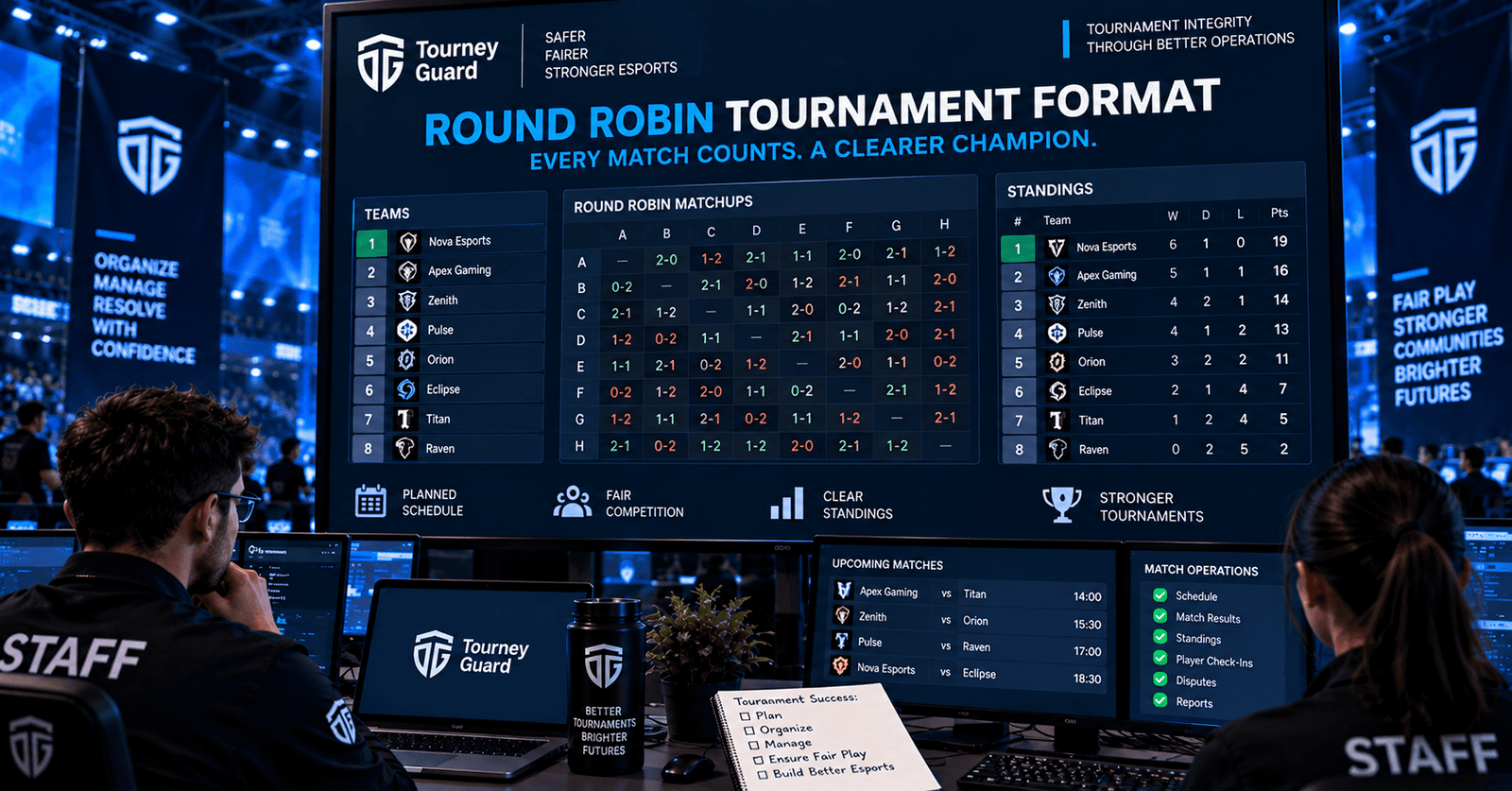
The Round Robin Tournament Format is one of the most structured ways to organize a competition because participants compete against a defined set of opponents rather than being eliminated after a single loss.
In a traditional round robin, every participant plays every other participant once. In a double round robin, participants face each opponent twice, often with the order or side assignments reversed when the game supports that distinction.
The format is straightforward conceptually, but its operational requirements grow rapidly as the number of participants increases.
With four teams, scheduling every matchup is relatively simple. With 16 teams, the number of matches becomes much larger. With dozens of participants, organizers must carefully manage schedules, venues or servers, match times, results, standings, tiebreakers, withdrawals, and potential disputes.
That makes round robin more than a simple scheduling method.
It is a tournament structure that requires predictable administration and accurate competitive records.
This guide explains how the Round Robin Tournament Format works, how to calculate match volume, how standings are determined, how tiebreakers should be designed, how it compares with Swiss and elimination formats, and what tournament organizers should consider before selecting it.



Key Takeaways
- A Round Robin Tournament Format requires participants to compete against a defined set of opponents.
- In a traditional single round robin, every participant plays every other participant once.
- A double round robin schedules each matchup twice.
- Match volume increases rapidly as the number of participants grows.
- The organizer should define scoring and tiebreakers before competition begins.
- Schedule design is one of the most important operational challenges.
- Accurate result recording is essential because every result contributes to the final standings.
- Withdrawals and forfeits require explicit rules.
- Round robin provides more direct head-to-head information than many elimination formats.
- Swiss can reduce the number of required rounds when the participant field becomes large.
- Technology can simplify scheduling, standings, result verification, and tournament records.
- The appropriate format depends on competitive objectives, field size, available time, and operational capacity.
What Is a Round Robin Tournament Format?
A Round Robin Tournament Format is a competition structure in which participants play against a defined group of opponents according to a predetermined schedule.
In a full single round robin, every participant faces every other participant exactly once.
For example, with four teams:
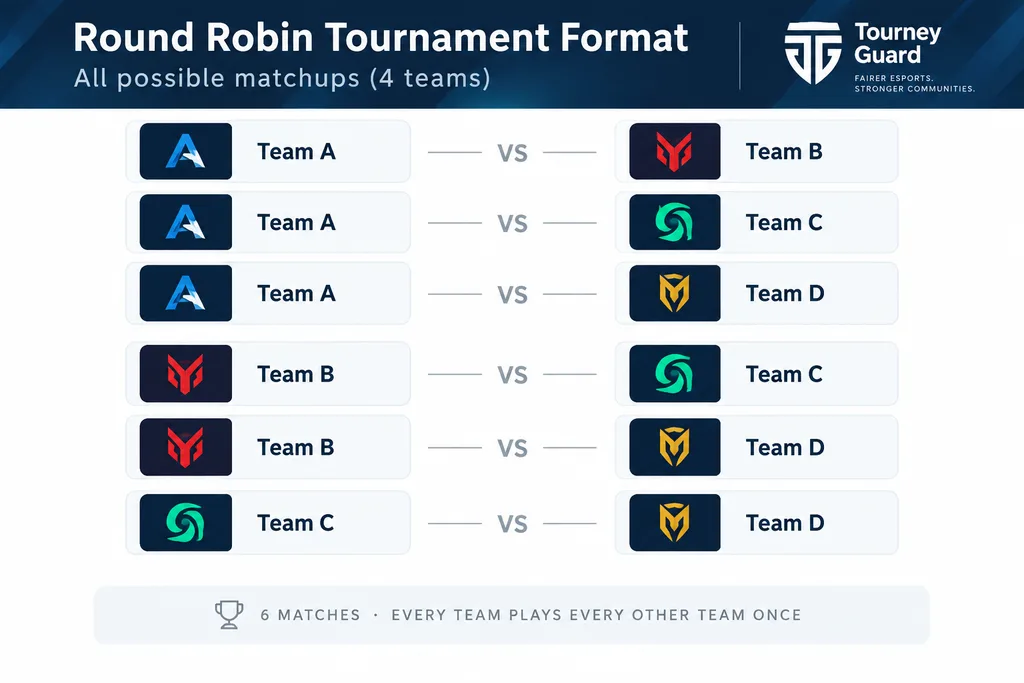
Every possible matchup appears exactly once.
The final standings are then calculated using the results of those matches.
A round robin therefore differs fundamentally from an elimination bracket.
In single elimination:
Loss
 ↓
Elimination
In round robin:
Loss
 ↓
Result Recorded
 ↓
Continue Playing
 ↓
Next Scheduled Match
A participant can therefore recover from an early loss through subsequent results.
Key principle: Round robin prioritizes complete or comprehensive matchup coverage rather than rapid elimination.
This makes it particularly useful when organizers want participants to have multiple opportunities to demonstrate performance against the field.
Why Does the Round Robin Format Matter?
The format matters because it gives organizers a predictable competitive structure.
Unlike Swiss, where future pairings depend on previous results, a round robin can be scheduled in advance.
That provides several operational advantages:
- Participants can know their opponents ahead of time.
- Match schedules can be published before competition.
- Venues and servers can be allocated in advance.
- Broadcast teams can prepare schedules.
- Staff can plan match administration.
- Participants can anticipate the full competition path.
However, predictability comes at a cost.
Every additional participant creates multiple additional matchups.
This creates a fundamental trade-off:
| Advantage | Operational Cost |
|---|---|
| Predictable schedule | Large number of matches |
| Every participant faces the field | Longer event duration |
| Easy-to-understand structure | More results to administer |
| Direct head-to-head competition | Greater scheduling complexity at scale |
| No immediate elimination | Higher infrastructure requirements |
| Complete matchup coverage | More opportunities for delays |
The format therefore works particularly well when the field size and available resources are compatible with the required match volume.
How Does a Round Robin Tournament Work?
A round robin generally follows a fixed competitive lifecycle.
1. Define Participants
The organizer establishes the confirmed participant list.
This should occur after registration and eligibility verification.
2. Generate the Schedule
Every required matchup is identified and assigned to a round, time, server, venue, or match slot.
3. Publish the Schedule
Participants receive the schedule and understand when and against whom they will compete.
4. Play Matches
Matches are completed according to the tournament rules.
5. Verify Results
Results are submitted and reviewed.
6. Update Standings
The verified result modifies the participant’s record and points.
7. Continue the Schedule
The next scheduled matches proceed.
8. Apply Tiebreakers
Once all required matches are completed, tied participants are separated according to the published tiebreak hierarchy.
The operational workflow can be summarized as:
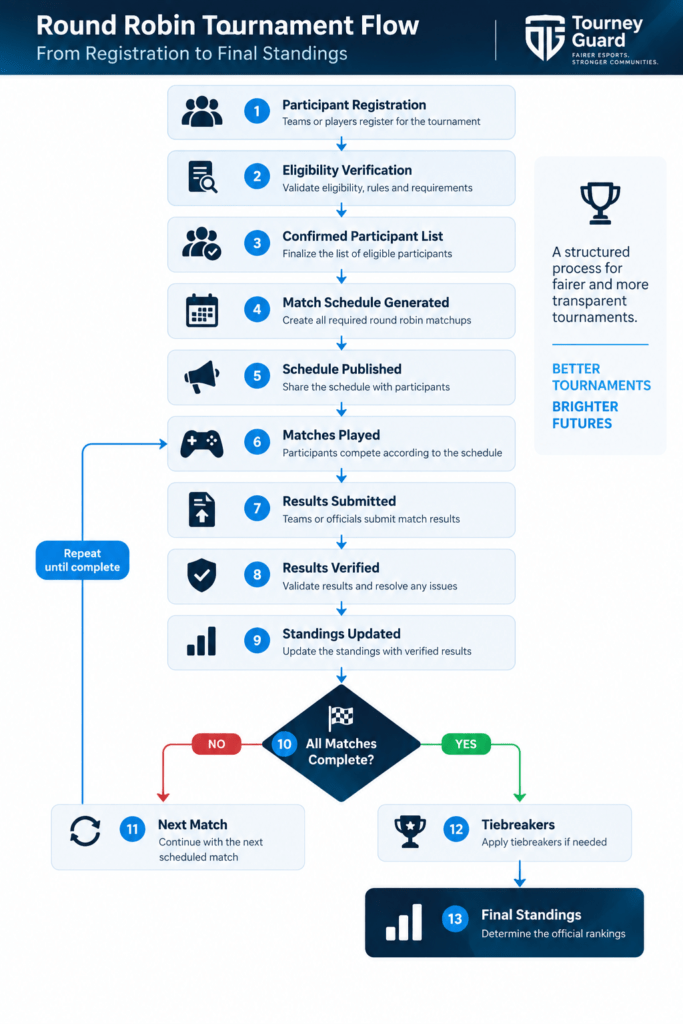
Operational principle: Because the schedule is largely predetermined, the main administrative challenge shifts from dynamic pairing to schedule execution and result integrity.
How Many Matches Does Round Robin Require?
The number of matches in a single round robin with n participants is:
n × (n − 1) ÷ 2
This calculation represents every unique pair of participants.
For example:
| Participants | Matches |
|---|---|
| 4 | 6 |
| 8 | 28 |
| 12 | 66 |
| 16 | 120 |
| 20 | 190 |
| 24 | 276 |
| 32 | 496 |
| 64 | 2,016 |
The growth is quadratic rather than linear.
That distinction is extremely important for tournament planning.
A tournament that doubles its participants does not simply require twice as many matches.
For example:
- 16 participants → 120 matches
- 32 participants → 496 matches
The participant count doubled, but the number of matches increased by more than four times.
This is one of the strongest reasons to evaluate the Round Robin Tournament Format against event duration and operational capacity before selecting it.
Single vs Double Round Robin
A single round robin gives each participant one match against every other participant.
A double round robin schedules each matchup twice.
For n participants, the double round robin requires:
n × (n − 1) matches.
| Participants | Single Round Robin | Double Round Robin |
|---|---|---|
| 4 | 6 | 12 |
| 8 | 28 | 56 |
| 12 | 66 | 132 |
| 16 | 120 | 240 |
| 20 | 190 | 380 |
The second matchup can provide additional competitive information and may be useful where side selection, map selection, server location, or other game-specific conditions could influence individual matches.
However, it also approximately doubles:
- Match volume.
- Scheduling requirements.
- Result administration.
- Broadcast requirements.
- Staff workload.
- Event duration.
When should an organizer consider double round robin?
A double round robin may be appropriate when:
- The field is relatively small.
- The competition has enough time.
- Competitive completeness is more important than event speed.
- The game benefits from repeated matchups.
- The organizer has sufficient staff and infrastructure.
It becomes considerably more demanding as the participant count increases.
How Are Standings Determined?
Standings are usually based on a predefined scoring system.
For example:
- Win = 3 points
- Draw = 1 point
- Loss = 0 points
But esports competitions can use different systems.
The tournament rules should clearly define the applicable scoring method.
Consider this example:
| Team | Wins | Draws | Losses | Points |
|---|---|---|---|---|
| Alpha | 5 | 0 | 1 | 15 |
| Bravo | 4 | 1 | 1 | 13 |
| Charlie | 4 | 0 | 2 | 12 |
| Delta | 3 | 1 | 2 | 10 |
The standings are straightforward when every participant has a different score.
The situation becomes more complex when two or more participants finish with identical points.
That requires tiebreakers.
What Are Round Robin Tiebreakers?
Tiebreakers are secondary ranking mechanisms used when participants have the same primary score.
Possible methods include:
- Head-to-head results.
- Game differential.
- Map differential.
- Round differential.
- Strength of schedule.
- Opponent performance.
- Additional playoff or deciding match.
The correct methodology depends on the game and competition.
The important requirement is transparency.
Participants should know how ties will be resolved before playing.
For example:
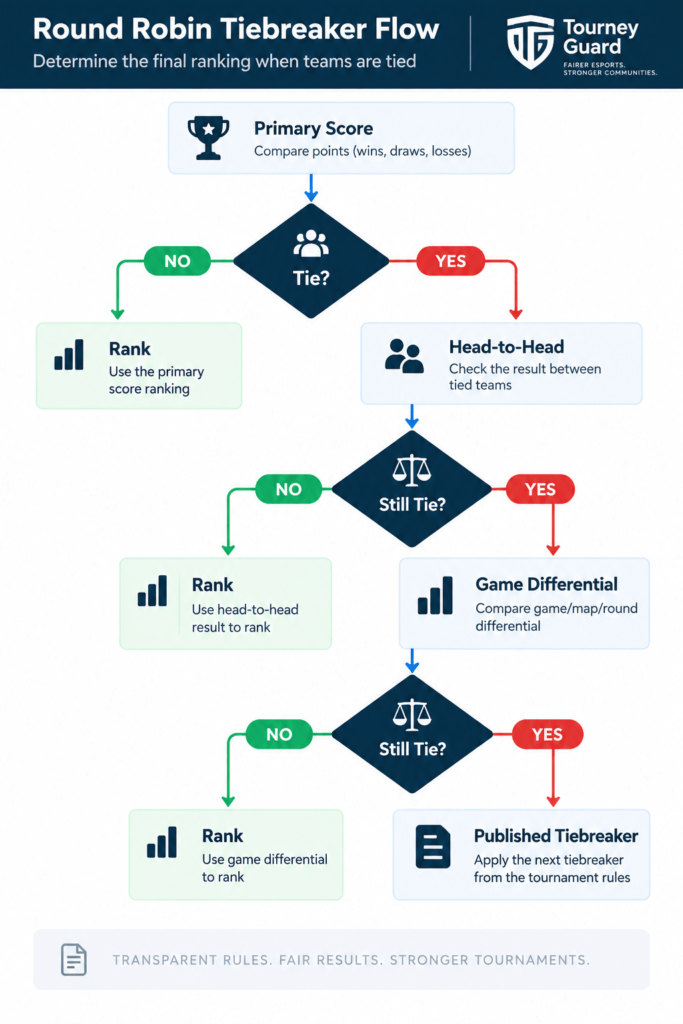
Governance principle: A tiebreaker should be a predefined tournament rule, not an improvised administrative decision made after the final match.
Round Robin vs Swiss Tournament Format
Both formats allow participants to play multiple matches, but their scheduling models are different.
| Round Robin | Swiss |
|---|---|
| Schedule can be predetermined | Pairings evolve between rounds |
| Participants can face every opponent | Participants face a limited subset |
| Match volume can become very large | Match volume is more controlled |
| Strong head-to-head coverage | Pairings often emphasize similar records |
| Fixed schedule | Dynamic schedule |
| Easier to predict opponents | More complex pairing administration |
| Can become impractical for large fields | Often more scalable for larger fields |
The choice therefore depends heavily on the purpose of the competition.
A round robin answers:
“How did every participant perform against the other participants?”
A Swiss structure answers a somewhat different operational question:
“How can we provide multiple competitive rounds without scheduling every possible matchup?”
Neither question is inherently better. They represent different tournament design objectives.
Round Robin vs Elimination Formats
Round robin also differs significantly from single and double elimination.
| Format | Loss Eliminates Participant? | Matchups | Scheduling |
|---|---|---|---|
| Single Elimination | Normally yes | Limited | Bracket-based |
| Double Elimination | Normally after second loss | Moderate | Bracket-based |
| Swiss | Normally no | Limited subset | Dynamic |
| Round Robin | No | Every required opponent | Predetermined |
This creates different participant experiences.
In an elimination tournament, every match can immediately affect whether a participant remains in the event.
In round robin, an individual loss is one result within a larger competitive record.
That can make the format particularly useful for leagues, qualification stages, and competitions where organizers want standings to reflect performance across multiple opponents.
How Should Organizers Schedule a Round Robin?
Scheduling is one of the most important parts of round robin administration.
A good schedule should consider:
- Number of participants.
- Number of available match stations.
- Match duration.
- Breaks.
- Broadcast requirements.
- Server availability.
- Staff availability.
- Travel or venue constraints.
- Participant rest periods.
- Technical support.
- Expected delays.
A theoretical schedule may contain enough match slots but still fail operationally if participants are required to play too many matches consecutively.
Example
Suppose:
- 8 teams.
- 28 total matches.
- 4 match stations.
- Average match duration: 45 minutes.
Theoretical minimum match-slot consumption is:
28 ÷ 4 = 7 time blocks
But seven blocks does not necessarily mean the event can be completed in five hours.
You also need to account for:
- Check-in.
- Setup.
- Delays.
- Breaks.
- Result verification.
- Technical incidents.
- Broadcast transitions.
- Participant movement.
Therefore, scheduling should include operational buffers.



Managing Withdrawals, Forfeits, and Disputes
A withdrawal can be more complicated in round robin than it initially appears.
Imagine that a team has already played six matches and then leaves the tournament.
The organizer must determine what happens to:
- Previously recorded results.
- Future scheduled matches.
- Standings.
- Opponents’ records.
- Tiebreakers.
- Potential advancement.
There is no single universal answer.
The tournament rules should define the treatment.
The same applies to forfeits.
A forfeit might result in:
- A win for the opponent.
- A specific score.
- No points.
- A special statistical treatment.
The rules must establish the applicable behavior.
Disputes should also follow a defined process.
For example:
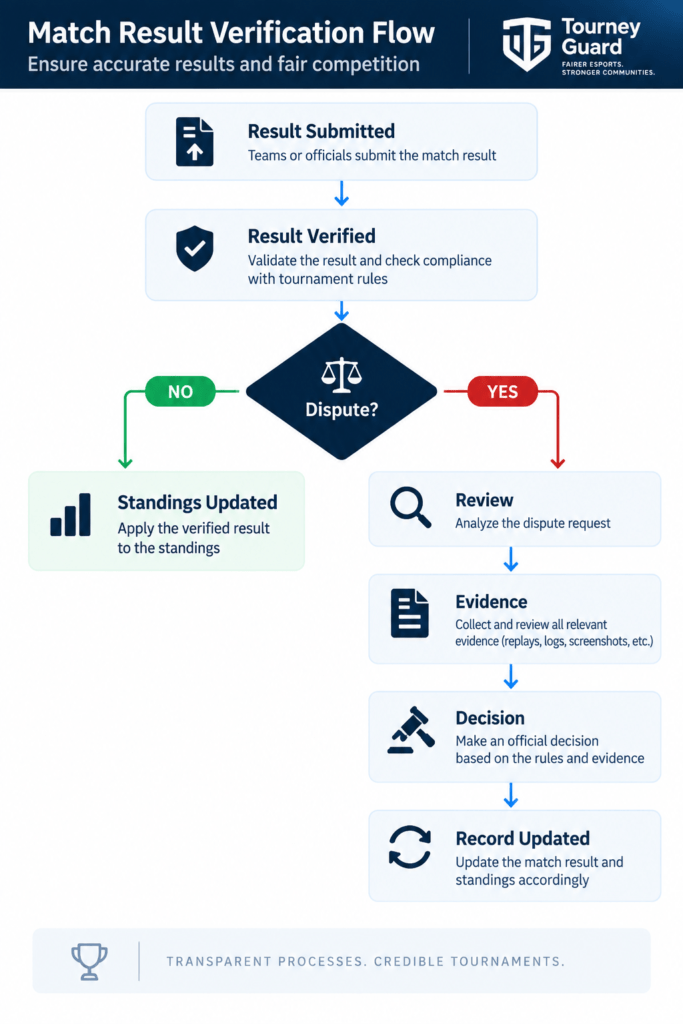
This protects the consistency of tournament administration.
Core Principles
A well-designed round robin should follow several principles.
1. Complete Schedule Definition
The organizer should know exactly which matchups are required.
2. Transparent Scoring
Participants should understand how match results translate into points.
3. Published Tiebreakers
Tie resolution should be defined before competition.
4. Accurate Results
Every match contributes to the standings.
5. Controlled Exceptions
Withdrawals, forfeits, postponed matches, and disputes should follow predefined procedures.
6. Operational Capacity
The organizer must have enough time, staff, infrastructure, and match capacity to complete the schedule.
Key insight: The theoretical simplicity of round robin can hide substantial operational complexity once the number of participants increases.
Best Practices
1. Calculate Match Volume Before Announcing the Format
Do not estimate the workload based only on participant count.
Calculate the actual number of matches.
2. Publish the Complete Schedule
Whenever practical, participants should have access to the schedule before competition.
3. Define Tiebreakers Before Registration Closes
This avoids ambiguity about final rankings.
4. Include Schedule Buffers
Assume that some matches will take longer than expected.
5. Define Result Verification
Establish who confirms results and how disputes are handled.
6. Define Withdrawal Rules
Do not improvise the treatment of a participant leaving halfway through the competition.
7. Preserve Match History
Maintain records of every completed match.
8. Separate Competitive and Administrative Status
A participant’s score should not be confused with eligibility, disciplinary status, or an open incident.
9. Communicate Schedule Changes
When a match changes time, venue, server, or opponent, record and communicate the change.
10. Plan for Technical Failures
Have procedures for server problems, disconnected players, delayed matches, and unavailable stations.
Common Mistakes
Mistake 1: Choosing Round Robin Without Calculating Match Volume
Why it happens: The format looks simple.
Consequence: The event becomes longer than expected.
How to avoid it: Calculate the exact number of matches before selecting the format.
Mistake 2: Treating Scheduling as a Simple Calendar Problem
Why it happens: Organizers focus only on fitting matches into available time.
Consequence: Participants may experience excessive consecutive matches or inadequate rest.
How to avoid it: Schedule around participants, infrastructure, staff, and operational buffers.
Mistake 3: Defining Tiebreakers Too Late
Why it happens: The organizer expects the primary score to determine everything.
Consequence: Multiple participants finish tied without a clearly accepted resolution method.
How to avoid it: Publish the complete tiebreak hierarchy before competition.
Mistake 4: Changing Rules After Results Are Known
Why it happens: An unexpected scenario occurs during the event.
Consequence: Participants may perceive the administration as inconsistent.
How to avoid it: Define exception procedures before the first match.
Mistake 5: Using Spreadsheets Without Version Control
Why it happens: A spreadsheet is initially sufficient for a small event.
Consequence: Multiple versions can produce conflicting standings or schedules.
How to avoid it: Maintain a single authoritative record.
Practical Example
Consider an esports tournament with 8 teams using a single round robin.
Each team must face the other seven teams.
The total number of matches is:
8 × 7 ÷ 2 = 28 matches
Suppose the organizer has four match stations.
At a theoretical level, four matches can occur simultaneously.
A simplified schedule might therefore look like:
| Round | Match 1 | Match 2 | Match 3 | Match 4 |
|---|---|---|---|---|
| 1 | A vs B | C vs D | E vs F | G vs H |
| 2 | A vs C | B vs D | E vs G | F vs H |
| 3 | A vs D | B vs C | E vs H | F vs G |
| 4 | A vs E | B vs F | C vs G | D vs H |
| 5 | A vs F | B vs E | C vs H | D vs G |
| 6 | A vs G | B vs H | C vs E | D vs F |
| 7 | A vs H | B vs G | C vs F | D vs E |
This gives each team seven matches.
After all matches are completed, suppose the standings are:
| Rank | Team | Record | Points |
|---|---|---|---|
| 1 | Alpha | 6–1 | 18 |
| 2 | Bravo | 5–2 | 15 |
| 3 | Charlie | 4–3 | 12 |
| 4 | Delta | 4–3 | 12 |
| 5 | Echo | 3–4 | 9 |
| 6 | Foxtrot | 3–4 | 9 |
| 7 | Golf | 2–5 | 6 |
| 8 | Hotel | 1–6 | 3 |
Charlie and Delta have identical records and points.
The organizer now applies the published tiebreaker.
Suppose the rules specify head-to-head result first.
If Charlie defeated Delta, Charlie receives the higher position.
The important point is not the specific tiebreaker.
It is that the organizer already defined the procedure before the competition began.
Now consider a different scenario.
During Round 5, one team experiences a technical problem and the match cannot be completed.
The organizer should not simply delete the match from the spreadsheet.
Instead, the incident should follow the tournament’s established procedure:
Technical Problem
       ↓
Incident Recorded
       ↓
Match Status Updated
       ↓
Resolution Determined
       ↓
Match Completed / Forfeit / Replay
       ↓
Result Verified
       ↓
Standings Updated
This demonstrates why tournament format and tournament operations cannot be treated as completely separate concerns.
The format defines what should happen competitively.
Operations define how the competition is administered consistently.
Decision Framework
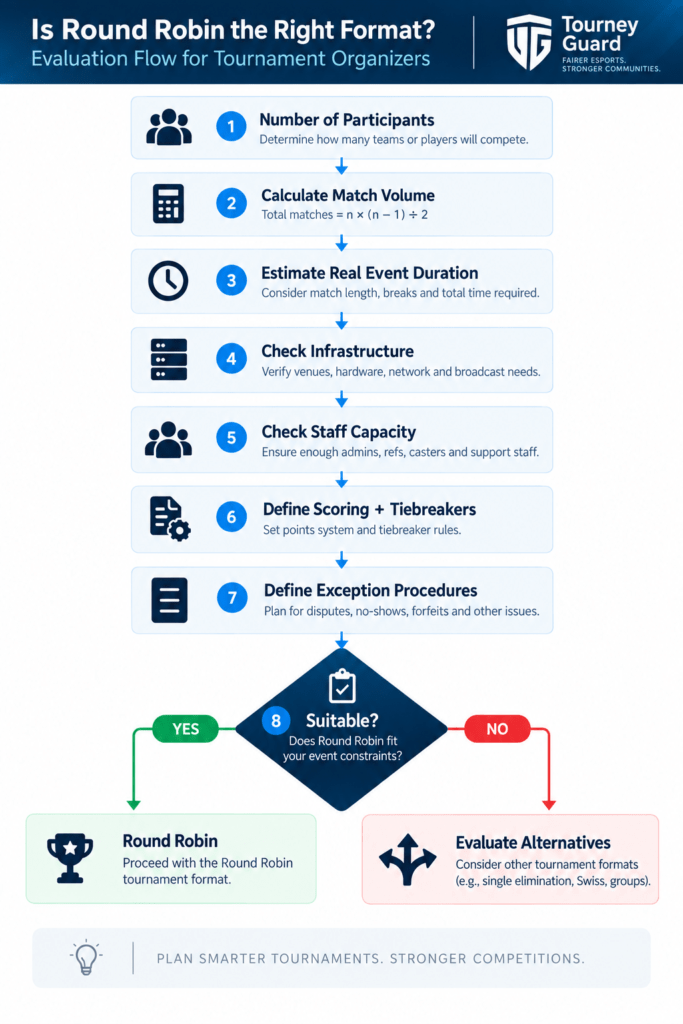
Before selecting a Round Robin Tournament Format, evaluate these questions.
1. How many participants are expected?
Calculate the total match volume.
2. How long does an average match take?
Use realistic historical match durations rather than theoretical minimums.
3. How many matches can run simultaneously?
Consider available:
- Servers.
- Stations.
- Staff.
- Referees.
- Broadcast resources.
4. Does every participant need to face every other participant?
If the answer is no, another format may reduce unnecessary match volume.
5. How important is complete head-to-head coverage?
If it is a core competitive objective, round robin may align well with the event design.
6. What happens if participants withdraw?
Define the treatment before competition.
7. How will ties be resolved?
Publish the tiebreak hierarchy.
8. Does the event have enough operational capacity?
Theoretical scheduling is not sufficient.
A useful decision model is:
Technology
Software becomes increasingly valuable as the participant field grows.
A tournament management system can centralize:
- Participant records.
- Eligibility status.
- Match schedules.
- Match assignments.
- Results.
- Standings.
- Tiebreak calculations.
- Schedule changes.
- Forfeits.
- Withdrawals.
- Disputes.
- Administrative decisions.
A useful architecture separates the competitive record from the administrative record.
Participant
     │
     ├── Eligibility
     │
     ├── Competitive Record
     │       ├── Matches
     │       ├── Wins
     │       ├── Losses
     │       └── Points
     │
     └── Administrative Record
             ├── Incidents
             ├── Disputes
             ├── Decisions
             └── Evidence
This separation is important because a tournament organizer may need to investigate an incident without changing the underlying match history.
Technology should also provide an authoritative source for standings.
If one administrator updates a spreadsheet while another publishes a different version, participants may see conflicting information.
A centralized system can reduce that risk by providing one controlled record.
KPIs
Tournament organizers can monitor operational metrics such as:
| KPI | What It Measures |
|---|---|
| Schedule Adherence | Whether matches start according to plan |
| Result Verification Time | Time required to confirm results |
| Match Completion Rate | Percentage of scheduled matches completed |
| Delayed Matches | Number of matches starting late |
| Rescheduled Matches | Frequency of schedule changes |
| Disputed Results | Number of challenged results |
| Standings Corrections | Number of ranking changes after publication |
| Forfeit Rate | Percentage of matches decided by forfeit |
| Participant Withdrawal Rate | Participants leaving before completion |
| Incident Resolution Time | Time required to resolve administrative incidents |
These metrics can reveal operational problems.
For example, repeated schedule delays may indicate that match-duration assumptions are too optimistic.
A high number of standings corrections may indicate weaknesses in result verification.
The purpose of measuring these indicators is not simply to create reports.
It is to identify where the tournament operation can become more predictable and reliable.
Checklist
Tournament Design Checklist
- ✓ Participant capacity established.
- ✓ Match volume calculated.
- ✓ Single or double round robin selected.
- ✓ Number of rounds defined.
- ✓ Match duration estimated.
- ✓ Available match capacity calculated.
- ✓ Scoring system documented.
- ✓ Tiebreakers documented.
- ✓ Withdrawal rules documented.
- ✓ Forfeit rules documented.
- ✓ Dispute procedures documented.
- ✓ Schedule-change procedures documented.
Round Administration Checklist
- ✓ Participants confirmed.
- ✓ Eligibility verified.
- ✓ Schedule published.
- ✓ Match assignments confirmed.
- ✓ Technical infrastructure checked.
- ✓ Match results collected.
- ✓ Results verified.
- ✓ Standings updated.
- ✓ Disputes recorded.
- ✓ Schedule changes communicated.
- ✓ Administrative decisions documented.
- ✓ Final standings verified.
Tourney Guard
Understanding the Round Robin Tournament Format is only the first step. Applying it consistently becomes more difficult as tournaments grow, particularly when organizers must coordinate large schedules, verify dozens or hundreds of results, manage delays, document disputes, and maintain an authoritative competitive record.
A round robin can generate a significant amount of operational information. When that information is distributed across spreadsheets, chat conversations, email, screenshots, and disconnected administrative records, it becomes harder to reconstruct what happened and why a particular decision was made.
Tourney Guard helps tournament organizers structure and manage processes related to Tournament Integrity, Tournament Administration, Incident Management, Evidence Collection, and transparent decision-making. For competitions with complex schedules, the goal is to help keep operational information organized and decisions traceable throughout the event.
If you want to apply a more structured approach to tournament operations, you can explore Tourney Guard with a free 30-day trial.
👉 Start Your 30-Day Free Trial →
FAQ
What is a Round Robin Tournament Format?
A Round Robin Tournament Format is a competition structure in which participants compete against a defined group of opponents. In a full single round robin, every participant plays every other participant once. The final standings are calculated from the results of those matches using the tournament’s published scoring and tiebreaking rules. Unlike elimination formats, losing a match normally does not immediately remove a participant from the competition. The format provides broad head-to-head coverage but requires increasingly more matches as the number of participants grows.
How many matches are in a round robin tournament?
For a single round robin with n participants, the number of matches is calculated as n × (n − 1) ÷ 2. For example, eight participants require 28 matches, while 16 participants require 120 matches. A double round robin schedules every matchup twice and therefore requires n × (n − 1) matches. Because match volume grows rapidly with participant count, organizers should calculate the total workload before selecting the format and compare it with available match stations, staff, event time, and infrastructure.
What is the difference between single and double round robin?
In a single round robin, each participant plays every other participant once. In a double round robin, each participant plays every other participant twice. The second matchup can provide additional competitive information and may be useful when game conditions such as side selection, map selection, or other variables can affect individual results. However, double round robin approximately doubles the number of matches and therefore requires more time, staff, infrastructure, and scheduling capacity. The appropriate choice depends on the objectives and operational resources of the tournament.
How are standings determined in a round robin tournament?
Standings are determined using the scoring system established by the tournament rules. A common structure might award different values for wins, draws, and losses, but esports competitions can use different systems. Once primary scores are calculated, participants with equal scores may be separated using tiebreakers. These can include head-to-head results, game or map differential, opponent performance, or another published criterion. The important requirement is that the scoring system and tiebreak hierarchy are defined before competition begins so participants understand how final rankings will be established.
What happens if two teams finish with the same score?
When two or more teams finish with the same primary score, the tournament applies the published tiebreaker system. Depending on the competition, the first tiebreaker might be head-to-head performance, game differential, map differential, strength of schedule, or another defined measure. The tournament rules should establish the complete hierarchy before matches begin. If participants remain tied after the published criteria are applied, the rules should also explain whether an additional match, playoff, or another procedure will determine the final ranking.
Is round robin suitable for large esports tournaments?
Round robin can become difficult to operate as the participant field grows because the number of required matches increases rapidly. Sixteen participants require 120 matches in a single round robin, while 32 require 496. The format may therefore become impractical when event time, match infrastructure, staffing, or broadcast capacity is limited. For larger fields, organizers may consider structures such as Swiss, group stages, or combinations of group and elimination stages. The appropriate choice depends on the desired competitive coverage and operational constraints.
Can a participant withdraw from a round robin tournament?
Yes, but the consequences should be defined in the tournament rules. A participant may withdraw after completing some matches, which creates questions about previous results, future scheduled matches, standings, opponents, and tiebreakers. Different competitions may handle withdrawals differently. Some may preserve completed results, while others may apply specific rules to all matches involving the withdrawn participant. The important requirement is consistency: the organizer should establish the withdrawal procedure before competition rather than creating a new rule after the situation occurs.
What is the difference between round robin and Swiss?
Round robin uses a predetermined set of matchups, while Swiss generally uses results from previous rounds to determine subsequent pairings. A full round robin gives participants broad or complete head-to-head coverage but can require a very large number of matches. Swiss limits the number of rounds and therefore the total match volume, but introduces more complex dynamic pairing administration. Round robin is therefore strongly associated with comprehensive matchup coverage, while Swiss is designed to provide multiple competitive rounds without requiring every participant to face every other participant.
Conclusion
The Round Robin Tournament Format provides one of the clearest ways to measure performance across a defined competitive field.
Its fundamental strength is comprehensive matchup coverage: participants compete against every required opponent, producing a substantial body of head-to-head results from which standings can be calculated.
That same strength creates its primary limitation.
Match volume grows rapidly as the participant field increases.
For tournament organizers, choosing round robin should therefore begin with mathematics and operational planning rather than preference.
Calculate the number of matches.
Estimate realistic match duration.
Determine available simultaneous match capacity.
Plan for delays, disputes, technical problems, withdrawals, and result verification.
Then define scoring and tiebreakers before competition begins.
A successful round robin is not simply a list of matches. It is a coordinated system in which schedule, results, standings, rules, and administrative decisions must remain consistent throughout the event.
When the competitive structure and operational processes are designed together, round robin can provide participants with a transparent and comprehensive competitive experience.
Recommended External Resources
These organizations publish guidance that supports professional Tournament Integrity programs:
- Esports Integrity Commission (ESIC) – Standards, codes of conduct, investigations, and integrity initiatives.
- International Olympic Committee (IOC) – Integrity frameworks applicable to competitive sports governance.
- International Betting Integrity Association (IBIA) – Best practices for integrity monitoring.
- NIST Cybersecurity Framework – Guidance for security governance and risk management.
- ISO 37301 Compliance Management Systems – International compliance management principles.
- World Anti-Doping Agency (WADA) – Governance and disciplinary process principles applicable beyond traditional sports.
Suggested Internal Links
Strengthen your internal linking strategy by connecting this article with:
- What Is Tournament Integrity? A Complete Guide for Esports Organizers
- Why Anti-Cheat Software Alone Isn’t Enough for Esports Tournaments
- 10 Common Types of Cheating in Esports Tournaments