
Introduction
For many tournament organizers, the first response to concerns about competitive fairness is simple: install an anti-cheat solution. While anti-cheat technologies play an important role in identifying certain forms of cheating, they represent only one component of a much larger Tournament Integrity ecosystem.
Modern esports competitions face a wide variety of integrity risks that cannot be solved through software alone. Match manipulation, account sharing, identity fraud, collusion, stream sniping, administrative misconduct, rule disputes, evidence preservation, appeals, and inconsistent disciplinary decisions all require structured operational processes rather than purely technical detection.
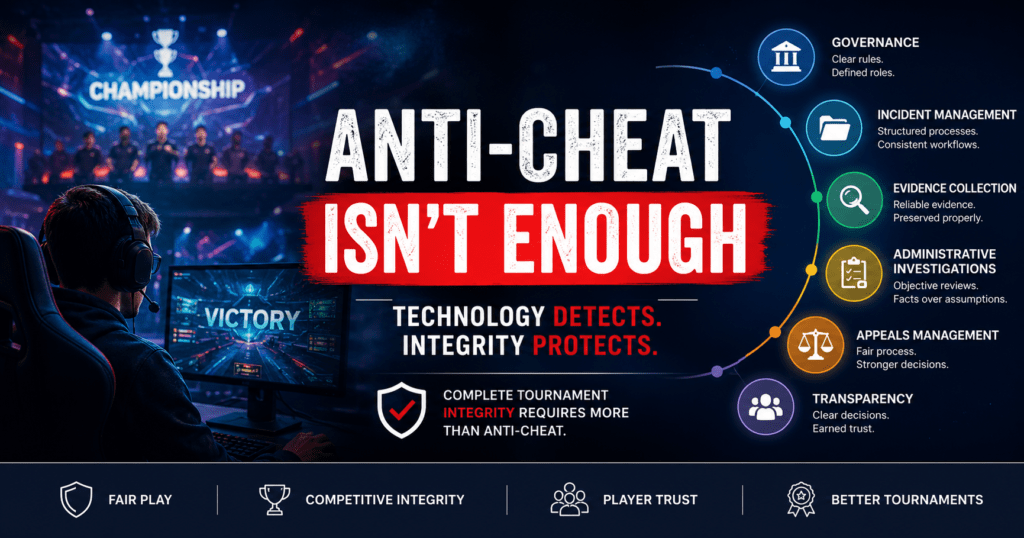
This is why Anti-Cheat Isn’t Enough has become an increasingly important concept for tournament organizers, leagues, publishers, and competitive communities. Maintaining fair competition requires governance, documented procedures, transparent investigations, consistent enforcement, and reliable evidence management alongside technical detection systems.
Organizations that rely exclusively on anti-cheat software often discover that many of the most damaging integrity incidents occur outside the scope of automated detection. A player may violate eligibility requirements, manipulate tournament brackets, exploit unclear rules, coordinate with teammates to influence outcomes, or appeal disciplinary actions based on incomplete evidence. None of these situations can be resolved solely through software.
Tournament Integrity is therefore an operational discipline rather than a single technology. It combines people, processes, policies, documentation, and supporting platforms to ensure every competitive decision is fair, consistent, transparent, and defensible.
This guide explains why Anti-Cheat Isn’t Enough, explores the limitations of detection technologies, and demonstrates how a complete Tournament Integrity framework helps organizers manage competitive risks throughout the entire tournament lifecycle.
Key Takeaways
- Anti-cheat software detects only a subset of integrity violations.
- Tournament Integrity extends beyond technical detection into governance and operations.
- Fair competition depends on consistent procedures, not isolated tools.
- Administrative investigations require structured evidence collection.
- Transparent disciplinary processes improve trust among players and communities.
- Rule enforcement must remain consistent across all participants.
- Appeals require documented decisions supported by verifiable evidence.
- Tournament organizers benefit from standardized operational workflows.
- Integrity programs should evolve continuously as competitive environments change.
- Sustainable competitive ecosystems rely on both technology and human oversight.
Executive Summary
Anti-Cheat Isn’t Enough because competitive integrity depends on far more than detecting prohibited software.
Although anti-cheat technologies remain valuable for identifying specific forms of cheating, many integrity incidents involve administrative, procedural, or behavioral issues that software cannot evaluate. Examples include player eligibility disputes, identity verification, collusion, tournament rule violations, evidence disputes, match investigations, appeals, and inconsistent enforcement of tournament policies.
A mature Tournament Integrity program addresses these challenges through standardized operational processes. Rather than relying solely on automated detection, organizers establish documented procedures for incident reporting, evidence preservation, case review, disciplinary decisions, appeals management, and communication with participants.
This broader approach creates consistency across tournaments while improving trust among players, teams, sponsors, publishers, and spectators. Decisions become easier to explain because they are supported by documented evidence rather than subjective judgment.
The objective is not to replace anti-cheat software. Instead, it is to integrate technical detection into a comprehensive Tournament Integrity framework that combines governance, investigation workflows, decision transparency, and continuous operational improvement.
Main Guide
Why Is Anti-Cheat Isn’t Enough?
Anti-cheat software addresses technical cheating, but Tournament Integrity protects the entire competitive ecosystem through governance, investigations, evidence management, and consistent rule enforcement.
Many organizers mistakenly equate competitive fairness with cheat detection. While detecting unauthorized software is important, tournaments involve numerous operational activities that determine whether competition remains fair from registration through the final match.
Consider everything that happens before a single game begins:
- Player registration
- Identity verification
- Eligibility validation
- Tournament seeding
- Rule acceptance
- Roster approval
- Schedule management
None of these processes are handled by anti-cheat software, yet failures in any of them may compromise the legitimacy of an event.
During competition, organizers must also manage:
| Anti-Cheat Can Help | Requires Tournament Integrity Operations |
|---|---|
| Cheat software detection | Incident investigations |
| Memory modification alerts | Evidence collection |
| Suspicious technical activity | Witness interviews |
| Device monitoring | Rule interpretation |
| Security validation | Appeals management |
| Some exploit detection | Administrative decisions |
The distinction becomes even more significant after an incident occurs. Detecting suspicious activity does not automatically answer critical operational questions:
- What tournament rule was violated?
- How severe was the violation?
- Was the evidence sufficient?
- Were previous cases handled consistently?
- Should the penalty be a warning, forfeiture, suspension, or disqualification?
- Can the decision withstand an appeal?
These questions require structured governance rather than automated detection.
What Does Tournament Integrity Actually Mean?
Tournament Integrity is the structured management of competitive fairness through documented rules, consistent enforcement, transparent investigations, and accountable decision-making.
Tournament Integrity encompasses every administrative process that protects fair competition before, during, and after an event.
It is not limited to identifying misconduct. Instead, it establishes repeatable systems that allow organizers to investigate incidents objectively, document findings, apply proportional penalties, and communicate decisions transparently.
A comprehensive Tournament Integrity program generally includes several interconnected operational areas:
| Operational Area | Primary Objective |
| Governance | Define policies and responsibilities |
| Tournament Rules | Establish consistent expectations |
| Incident Management | Track reported violations |
| Evidence Collection | Preserve reliable information |
| Administrative Investigations | Review incidents objectively |
| Case Management | Document every investigation |
| Decision Review | Ensure fairness and consistency |
| Appeals Management | Provide procedural accountability |
| Compliance Reporting | Maintain historical records |
These components work together to create repeatable operational standards that reduce inconsistency and improve trust across competitive communities.
Importantly, Tournament Integrity is proactive rather than reactive. Instead of responding differently to every controversy, organizers prepare standardized procedures before incidents occur, allowing staff to manage disputes efficiently under pressure.
Anti-Cheat vs Tournament Integrity
Anti-cheat software protects the game environment, while Tournament Integrity protects the competition itself. Both are valuable, but they solve different problems.
The confusion between these concepts often leads organizers to underestimate operational risks.
Anti-cheat systems focus on detecting technical violations inside the game environment. Tournament Integrity focuses on ensuring that every competitive decision—from player registration to disciplinary action—is handled fairly and consistently.
The comparison below illustrates the difference:
| Anti-Cheat | Tournament Integrity |
| Technical detection | Operational governance |
| Software-focused | Competition-focused |
| Detects certain cheats | Manages every integrity incident |
| Automated alerts | Human investigation supported by evidence |
| Game security | Tournament fairness |
| Technical enforcement | Administrative enforcement |
| Limited historical context | Complete case history |
| Individual events | Entire tournament lifecycle |
Rather than competing approaches, they complement one another.
When integrated effectively, anti-cheat technology provides valuable technical evidence, while Tournament Integrity processes determine how that evidence should be interpreted, documented, reviewed, and ultimately translated into fair administrative decisions.
This separation of responsibilities improves consistency while reducing the likelihood of arbitrary rulings or procedural disputes.
Which Integrity Risks Cannot Be Solved by Anti-Cheat Alone?
Many of the most significant tournament risks involve human behavior, administrative processes, and governance challenges rather than detectable software manipulation.
Tournament organizers increasingly face integrity issues that occur entirely outside the scope of technical detection systems.
Examples include:
Account Sharing
Players may compete using another individual’s account without triggering anti-cheat alerts. Resolving these cases requires identity verification, registration records, communication logs, and administrative investigation.
Smurfing and Eligibility Violations
A participant may technically comply with game security requirements while violating tournament eligibility rules related to ranking, residency, age restrictions, or competitive divisions.
These incidents require documented policies and manual review rather than software detection.
Collusion
Teams or players may cooperate to influence tournament outcomes without using prohibited software. Match behavior, communication evidence, historical context, and tournament rules become essential during investigations.
Stream Sniping
Although technology may indicate suspicious gameplay patterns, determining intent often requires reviewing video evidence, broadcast delays, timestamps, and witness reports.
Administrative Errors
Tournament integrity can also be compromised through operational mistakes such as:
- Incorrect bracket updates
- Rule inconsistencies
- Unequal penalty application
- Missing evidence
- Poor documentation
- Delayed communication
- Unclear appeal procedures
None of these issues can be resolved through anti-cheat technology alone.
As tournaments continue to grow in scale and professionalism, organizers increasingly recognize that protecting competitive integrity requires a comprehensive operational framework capable of managing both technical and non-technical incidents consistently.
The Operational Pillars That Prove Anti-Cheat Isn’t Enough
Tournament Integrity depends on multiple operational disciplines working together throughout the tournament lifecycle.
An effective integrity program does not rely on a single technology or a single administrator. Instead, it combines standardized processes that ensure every incident is handled consistently, transparently, and fairly.
The following pillars create a comprehensive Tournament Integrity framework.
1. Governance
Governance establishes the policies, responsibilities, authority levels, and decision-making processes that guide tournament operations.
A governance framework typically defines:
- Roles and responsibilities
- Integrity policies
- Conflict-of-interest procedures
- Escalation paths
- Investigation standards
- Documentation requirements
Why it matters
Without governance, identical incidents may receive different outcomes depending on who reviews them.
Common mistake
Allowing administrators to make disciplinary decisions without documented procedures.
Recommended Internal Link
What Is Tournament Integrity?
Related Topic
Tournament Governance
2. Incident Management
Every integrity concern should enter a structured workflow rather than being discussed through scattered Discord messages or private conversations.
A standardized incident process usually includes:
- Incident reporting
- Initial assessment
- Evidence collection
- Investigation
- Decision review
- Communication
- Appeals (if applicable)
- Case closure
Benefits
- Consistency
- Accountability
- Faster response times
- Better documentation
- Historical tracking
Common mistake
Attempting to investigate incidents before collecting all available evidence.
Recommended Internal Link
Incident Management in Esports
Related Topic
Administrative Investigations
3. Evidence Collection
Evidence is the foundation of every fair decision.
Reliable investigations may include:
- Match recordings
- Tournament logs
- Screenshots
- Server logs
- Replay files
- Chat records
- Witness statements
- Registration information
- Platform activity
- Administrative notes
Evidence should always be preserved before disciplinary action is taken.
Why it matters
Poor evidence management often leads to inconsistent decisions and unsuccessful appeals.
Common mistake
Making decisions based solely on community opinion or social media discussions.
Recommended Internal Link
Evidence Collection Best Practices
Related Topic
Case Management
4. Administrative Investigations
An investigation seeks to establish facts rather than confirm assumptions.
Professional investigations typically answer:
- What happened?
- Which rules apply?
- What evidence supports the allegation?
- What evidence contradicts it?
- Are additional witnesses required?
- Has this happened previously?
- What precedent exists?
This structured approach minimizes bias while improving confidence in final decisions.
Common mistake
Starting with a conclusion and searching only for supporting evidence.
Recommended Internal Link
Administrative Investigations
Related Topic
Decision Transparency
5. Appeals Management
Even well-documented decisions should include a structured appeal process.
Appeals help ensure:
- Procedural fairness
- New evidence review
- Consistent interpretation
- Organizational credibility
An appeal should evaluate whether:
- Procedures were followed.
- Evidence was sufficient.
- Rules were interpreted correctly.
- Penalties were proportional.
Appeals are not simply opportunities to disagree—they are quality assurance for integrity programs.
Recommended Internal Link
Appeals Management
Related Topic
Competitive Governance
Building Repeatable Tournament Integrity Processes
Repeatable workflows reduce human error and improve consistency across every tournament.
Professional organizers avoid improvisation by documenting every operational step before an incident occurs.
A simplified Tournament Integrity workflow may resemble the following:
| Stage | Primary Objective | Expected Output |
|---|---|---|
| Report Received | Register the incident | Incident record |
| Initial Review | Assess severity | Investigation assignment |
| Evidence Collection | Gather supporting material | Evidence package |
| Investigation | Analyze findings | Investigation report |
| Decision Review | Validate consistency | Final ruling |
| Communication | Inform stakeholders | Official decision |
| Appeals | Review procedural concerns | Appeal outcome |
| Closure | Archive documentation | Historical case record |
This repeatable workflow ensures that every case follows the same operational standards regardless of the tournament size.
Why Transparency Builds Competitive Trust
Transparent decision-making strengthens confidence in tournament administration without compromising investigative integrity.
Players rarely expect every ruling to favor them.
What they expect is that decisions are:
- Consistent
- Documented
- Explainable
- Based on evidence
- Applied equally
Transparency does not require publishing confidential evidence.
Instead, organizers should clearly explain:
- Which rule was violated
- What investigative process was followed
- Which evidence categories were considered
- Why the selected penalty was appropriate
- Whether appeal options exist
This approach improves community trust while protecting sensitive information.
Common Transparency Practices
| Good Practice | Poor Practice |
|---|---|
| Publish tournament rules before competition | Modify rules during the event |
| Document disciplinary decisions | Make verbal decisions only |
| Explain penalties consistently | Use vague explanations |
| Maintain historical records | Lose investigation history |
| Offer structured appeals | Handle appeals informally |
Best Practices
Build Integrity Processes Before the Tournament Starts
Waiting until the first major controversy is too late.
Prepare:
- Tournament rules
- Investigation procedures
- Evidence requirements
- Escalation workflows
- Appeals process
- Communication templates
Standardize Every Investigation
Every incident should follow the same workflow regardless of:
- Tournament size
- Player popularity
- Prize pool
- Community pressure
Consistency improves credibility.
Document Every Decision
Each case should include:
- Incident summary
- Applicable rules
- Evidence reviewed
- Findings
- Decision rationale
- Penalty applied
- Appeal status
Historical documentation improves future consistency.
Separate Evidence from Opinion
Community discussions may provide useful leads, but disciplinary decisions should rely on verifiable evidence rather than speculation.
Continuously Improve Policies
Tournament Integrity evolves alongside competitive ecosystems.
Review completed investigations regularly to identify:
- Process improvements
- Rule ambiguities
- Investigation delays
- Documentation gaps
- Training opportunities
Common Mistakes
Mistake 1: Believing Anti-Cheat Solves Every Integrity Problem
Technical detection addresses only one category of competitive risk.
Operational governance remains essential.
Mistake 2: Making Decisions Without Documentation
Undocumented decisions become difficult to defend during disputes or appeals.
Mistake 3: Investigating Incidents Informally
Using Discord chats as the primary investigation platform creates fragmented records and inconsistent outcomes.
Mistake 4: Applying Different Standards to Different Players
Consistency is fundamental to competitive fairness.
Rules should apply equally regardless of player reputation.
Mistake 5: Ignoring Appeals
Appeals provide procedural accountability and improve long-term trust.
Organizations that eliminate appeals often create greater controversy rather than reducing it.
Decision Framework
Choosing the right Tournament Integrity approach depends on organizational maturity rather than tournament size.
| Organization Type | Primary Challenge | Recommended Integrity Focus |
|---|---|---|
| Community Tournament | Limited staff | Standardized incident workflows |
| Amateur League | Growing participation | Evidence collection and documentation |
| Regional Organizer | Multiple events | Case management and governance |
| National League | Consistency across tournaments | Investigation procedures and appeals |
| Professional Circuit | High competitive stakes | Full Tournament Integrity program with documented governance |
Before implementing new tools or procedures, organizers should ask:
- Can we investigate incidents consistently?
- Are our tournament rules documented?
- Do we preserve evidence correctly?
- Can we explain every disciplinary decision?
- Would our process withstand an external review?
- Do we maintain historical case records?
- Is there a clear appeal process?
If the answer to several of these questions is “no,” strengthening operational integrity should become a priority before expanding technical enforcement.
Practical Examples
Scenario 1: Identity Fraud During Playoffs
A player qualifies legitimately but allows another individual to compete during the semifinal.
The anti-cheat system detects no prohibited software.
The organizer reviews:
- Registration records
- Identity verification
- Voice communications
- Gameplay timing
- Streaming footage
- Witness statements
Following a documented investigation, the participant is disqualified based on eligibility violations—not software detection.
Lesson
Operational investigations resolve integrity issues that technology alone cannot identify.
Scenario 2: Collusion Between Teams
Two teams intentionally influence match outcomes to obtain favorable playoff positions.
No cheating software is involved.
Tournament administrators examine:
- Match history
- Competitive behavior
- Tournament context
- Team communications (when available)
- Historical precedents
- Applicable tournament rules
After reviewing the evidence, administrators issue proportionate penalties supported by documented findings.
Lesson
Fair competition requires governance and investigative procedures in addition to technical security.
Scenario 3: Contested Disciplinary Decision
A player receives a suspension for repeated rule violations.
The player submits new evidence during the appeal.
Because the organizer maintains complete investigation records, reviewers can evaluate:
- Original evidence
- Newly submitted material
- Investigation timeline
- Decision rationale
- Rule interpretation
The appeal confirms the original ruling and publishes a procedural explanation that increases community confidence.
Lesson
Transparent case management strengthens trust even when disciplinary decisions remain unchanged.
Visual Checklist
Tournament Integrity Readiness Checklist
Use this checklist before every tournament to ensure your operational integrity program is prepared.
✅ Governance
- ☐ Tournament rules are published before registration.
- ☐ Roles and responsibilities are clearly assigned.
- ☐ Code of Conduct is publicly available.
- ☐ Conflict-of-interest policy is documented.
- ☐ Penalty guidelines are standardized.
✅ Incident Management
- ☐ Incident reporting process is defined.
- ☐ Cases receive unique identifiers.
- ☐ Escalation procedures are documented.
- ☐ Severity levels are standardized.
- ☐ Investigation workflow is documented.
✅ Evidence Collection
- ☐ Match replays are preserved.
- ☐ Screenshots are timestamped.
- ☐ Chat logs are retained.
- ☐ Witness statements follow a standard format.
- ☐ Evidence access is restricted and auditable.
✅ Administrative Investigations
- ☐ Every allegation is reviewed objectively.
- ☐ Applicable rules are identified before decisions.
- ☐ Findings are documented.
- ☐ Decisions include written justification.
- ☐ Previous similar cases are reviewed for consistency.
✅ Appeals
- ☐ Appeal deadlines are defined.
- ☐ Appeals follow documented procedures.
- ☐ Independent reviewers are assigned when appropriate.
- ☐ Appeal outcomes are documented.
- ☐ Final decisions are archived.
Visual Checklist
Signs That Anti-Cheat Isn’t Enough
If your tournament experiences any of these situations, technical detection alone will not solve the problem.
- ☐ Rule interpretation disputes
- ☐ Player eligibility questions
- ☐ Identity verification issues
- ☐ Account sharing
- ☐ Match manipulation
- ☐ Collusion
- ☐ Stream sniping investigations
- ☐ Administrative mistakes
- ☐ Appeals
- ☐ Community trust concerns
- ☐ Inconsistent disciplinary decisions
- ☐ Missing investigation documentation
If several boxes apply, your organization likely needs a structured Tournament Integrity program rather than relying solely on anti-cheat software.
Call to Action
Build Tournament Integrity Beyond Technical Detection
Anti-cheat technology remains an important component of competitive security, but it is only one piece of a comprehensive integrity strategy.
As tournaments grow in size and complexity, organizers need repeatable operational processes that support consistent investigations, structured evidence collection, transparent decision-making, and effective governance.
Tourney Guard helps tournament organizers strengthen Tournament Integrity by providing structured workflows for incident management, administrative investigations, evidence collection, case documentation, appeals management, and decision transparency. Instead of replacing anti-cheat solutions, it complements them by supporting the operational processes required to protect fair competition throughout the entire tournament lifecycle.
Frequently Asked Questions
Is anti-cheat software still important?
Yes. Anti-cheat software plays a valuable role in identifying technical forms of cheating. However, it addresses only one category of integrity risk and should be integrated into a broader Tournament Integrity framework.
What types of incidents cannot be solved by anti-cheat?
Examples include:
- Identity fraud
- Account sharing
- Player eligibility violations
- Rule disputes
- Administrative errors
- Match manipulation
- Collusion
- Appeals
- Evidence management
- Governance issues
These situations require documented operational processes rather than automated detection alone.
What is the difference between anti-cheat and Tournament Integrity?
Anti-cheat focuses on detecting prohibited software or technical exploits within the game environment.
Tournament Integrity focuses on ensuring every competitive decision—from registration and investigations to disciplinary actions and appeals—is handled fairly, consistently, and transparently.
Why is evidence collection so important?
Reliable evidence enables organizers to make objective decisions, defend disciplinary actions, and resolve appeals consistently. Without structured evidence management, even correct decisions may be questioned.
Do small tournaments need Tournament Integrity processes?
Yes.
While smaller events may not require complex operational structures, every tournament benefits from documented rules, incident reporting procedures, evidence preservation, and consistent decision-making.
Implementing these practices early makes it easier to scale operations as tournaments grow.
Can Tournament Integrity replace anti-cheat software?
No.
Tournament Integrity and anti-cheat technologies solve different problems.
The strongest competitive environments combine technical detection with operational governance, investigations, and transparent administration.
Conclusion
The statement “Anti-Cheat Isn’t Enough” reflects an important reality for modern esports.
Technical detection software remains essential for identifying many forms of cheating, but competitive fairness depends on much more than technology alone.
Tournament organizers must also manage governance, rule enforcement, evidence collection, administrative investigations, disciplinary consistency, appeals, and transparent communication.
Organizations that invest in these operational capabilities build stronger competitive ecosystems, improve community trust, reduce inconsistency, and make disciplinary decisions that withstand scrutiny.
Rather than viewing anti-cheat as the complete solution, successful organizers recognize it as one component of a comprehensive Tournament Integrity strategy. By combining technical detection with structured operational processes, tournaments become more resilient, transparent, and fair for every participant.
Learn More
To continue exploring Tournament Integrity, consider these topics:
- What Is Tournament Integrity?
- Tournament Integrity vs Competitive Integrity
- Incident Management in Esports
- Administrative Investigations
- Evidence Collection
- Appeals Management
- Tournament Governance
- Types of Cheating
- Fair Play in Esports
- Tournament Compliance
Suggested Knowledge Hub Articles
| Suggested Article | Suggested Anchor Text | Placement | Reason for Linking |
|---|---|---|---|
| What Is Tournament Integrity? | tournament integrity | Introduction | Defines the core concept. |
| Tournament Integrity vs Competitive Integrity | tournament integrity vs competitive integrity | Section comparing concepts | Clarifies terminology. |
| Types of Cheating in Esports | types of cheating | Integrity risks section | Explains technical and non-technical violations. |
| Incident Management in Esports | incident management | Operational pillars | Expands investigation workflows. |
| Administrative Investigations | administrative investigations | Investigation section | Covers investigative methodology. |
| Evidence Collection Best Practices | evidence collection | Evidence section | Details documentation standards. |
| Appeals Management | appeals management | Appeals section | Explains procedural fairness. |
| Tournament Governance | tournament governance | Governance section | Explores organizational policies. |
| Fair Play in Esports | fair play | Conclusion | Connects integrity with sportsmanship. |
| Tournament Compliance | tournament compliance | Best Practices | Describes policy adherence. |
| Rules Enforcement in Esports | rules enforcement | Decision Framework | Explains consistent disciplinary action. |
| Decision Transparency | decision transparency | Transparency section | Reinforces trust and accountability. |
Recommended External Resources
These organizations publish guidance that supports professional Tournament Integrity programs:
- Esports Integrity Commission (ESIC) – Standards, codes of conduct, investigations, and integrity initiatives.
- International Olympic Committee (IOC) – Integrity frameworks applicable to competitive sports governance.
- International Betting Integrity Association (IBIA) – Best practices for integrity monitoring.
- NIST Cybersecurity Framework – Guidance for security governance and risk management.
- ISO 37301 Compliance Management Systems – International compliance management principles.
- World Anti-Doping Agency (WADA) – Governance and disciplinary process principles applicable beyond traditional sports.
Suggested Internal Links
Strengthen your internal linking strategy by connecting this article with: