
Introduction
Every administrative decision made during an esports tournament should be supported by reliable, verifiable information. Whether organizers are responding to a rule violation, investigating suspected misconduct, reviewing a technical issue, or resolving a participant dispute, the quality of the final decision depends on the quality of the evidence collected.
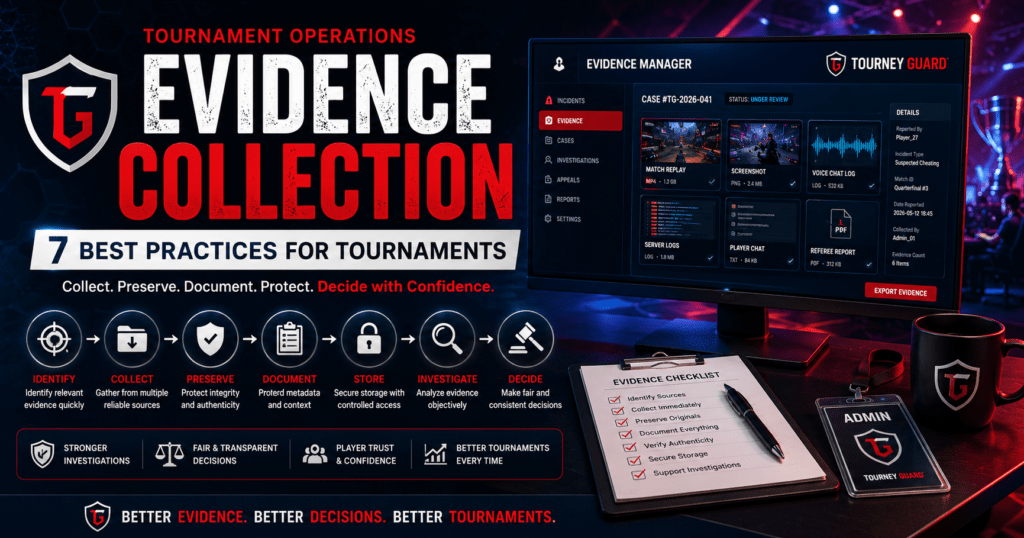
Evidence Collection is the structured process of identifying, preserving, organizing, and documenting information that supports operational and integrity-related investigations. It plays a central role in Tournament Operations, ensuring that administrative decisions are objective, consistent, transparent, and defensible.
Without standardized Evidence Collection procedures, tournament organizers risk making decisions based on assumptions, incomplete information, or conflicting accounts. This can lead to inconsistent rule enforcement, unsuccessful appeals, damaged participant trust, and long-term reputational harm.
Modern esports competitions generate large volumes of information. Match replays, server logs, screenshots, chat records, video recordings, registration data, referee reports, and witness statements all have the potential to become evidence when incidents occur. However, collecting evidence is not simply about gathering files. Organizers must also verify authenticity, maintain documentation, preserve integrity, and ensure information remains available throughout investigations and appeals.
Within Tournament Operations, Evidence Collection works alongside Incident Management, Administrative Investigations, Tournament Governance, and Appeals Management to create a complete operational framework for Tournament Integrity. Together, these disciplines help organizers respond fairly to incidents while reducing bias and improving accountability.
This guide explains how Evidence Collection supports professional tournament administration, explores evidence management best practices, and demonstrates how structured documentation improves operational consistency across every stage of the tournament lifecycle.
Key Takeaways
- Evidence Collection supports objective Tournament Operations.
- Reliable evidence improves administrative investigations.
- Proper documentation strengthens Tournament Integrity.
- Evidence should be preserved before decisions are made.
- Standardized procedures reduce operational inconsistency.
- Chain of custody improves evidence reliability.
- Documentation supports transparent appeals.
- Historical records improve future investigations.
- Digital evidence requires secure storage.
- Evidence Collection is essential for fair decision-making.
Executive Summary
Evidence Collection is the structured process of gathering, preserving, documenting, organizing, and protecting information that supports operational and integrity-related decisions throughout a tournament.
Within Tournament Operations, evidence may originate from gameplay, tournament administration, technical systems, communications, participant registration, or official reports. Proper Evidence Collection ensures that investigations rely on verifiable facts rather than assumptions or incomplete information.
Professional organizers establish documented procedures that define what evidence should be collected, how it should be preserved, who may access it, and how it should be referenced throughout Incident Management, Administrative Investigations, Appeals Management, and Tournament Governance.
Rather than reacting differently to every situation, mature organizations follow repeatable Evidence Collection workflows that improve consistency, strengthen participant trust, and create an auditable history of operational decisions.
When combined with structured investigations and transparent governance, Evidence Collection becomes one of the most valuable operational capabilities for maintaining Tournament Integrity.
Main Guide
What Is Evidence Collection?
Evidence Collection is the structured process of identifying, preserving, documenting, organizing, and protecting information used to support tournament investigations and administrative decisions.
Evidence Collection begins the moment an incident is reported or detected.
Its purpose is not to prove guilt or innocence. Instead, it seeks to preserve objective information that investigators can evaluate fairly before making decisions.
Evidence may originate from numerous sources throughout Tournament Operations, including:
- Match recordings
- Replay files
- Server logs
- Tournament platforms
- Screenshots
- Player communications
- Voice recordings
- Referee reports
- Registration records
- Administrative documentation
Professional Evidence Collection focuses on preserving information exactly as it existed at the time of the incident while minimizing the risk of alteration or loss.
Definition
Evidence Collection is the operational discipline responsible for acquiring and protecting information that may support investigations, disciplinary actions, compliance reviews, and appeals.
Why It Matters
Objective evidence enables tournament organizers to explain decisions clearly and apply tournament rules consistently.
Benefits
- Stronger investigations
- Improved transparency
- Better decision quality
- Consistent rule enforcement
- Reliable appeals
- Historical documentation
- Increased participant confidence
Challenges
- Time-sensitive evidence
- Multiple evidence sources
- Digital authenticity
- Secure storage
- Privacy considerations
- Documentation accuracy
Best Practice
Begin Evidence Collection immediately after an incident is reported to reduce the likelihood of losing critical information.
Common Mistake
Waiting until an investigation begins before preserving evidence.
Practical Example
A participant reports suspected account sharing immediately after a playoff match. Administrators preserve replay files, registration records, login history, screenshots, and communication logs before reviewing the allegation, ensuring investigators evaluate complete and reliable information.
Recommended Internal Link
Incident Management
Related Topic
Administrative Investigations
Why Is Evidence Collection Critical for Tournament Operations?
Evidence Collection enables tournament organizers to make consistent, defensible decisions based on verified information rather than assumptions.
Tournament Operations involve numerous administrative decisions.
Examples include:
- Rule enforcement
- Match disputes
- Eligibility verification
- Technical incident review
- Participant misconduct
- Appeals
- Compliance investigations
Every one of these activities benefits from reliable evidence.
Without standardized Evidence Collection procedures, organizers may reach different conclusions when reviewing similar situations because information is incomplete or inconsistent.
Operational Areas Supported by Evidence Collection
| Operational Area | Example Evidence |
|---|---|
| Incident Management | Incident reports and timelines |
| Administrative Investigations | Match recordings and witness statements |
| Tournament Governance | Rule documentation |
| Appeals Management | Historical case files |
| Tournament Compliance | Registration records |
| Match Administration | Official result reports |
Evidence Collection therefore becomes a foundational operational capability rather than a standalone investigative activity.
Why It Matters
Reliable evidence improves consistency across tournaments while reducing operational risk.
Best Practice
Create Evidence Collection procedures before the tournament begins so administrators know exactly which information must be preserved.
Common Mistake
Allowing evidence requirements to vary depending on the administrator handling the incident.
Recommended Internal Link
Tournament Operations
Related Topic
Tournament Integrity
What Types of Evidence Should Tournament Organizers Collect?
Tournament organizers should collect both technical and administrative evidence to ensure investigations consider every relevant source of information.
Not all evidence comes from gameplay.
Operational evidence frequently provides context that technical evidence alone cannot explain.
Common evidence categories include:
Technical Evidence
Generated automatically by systems or platforms.
Examples include:
- Server logs
- Replay files
- Match telemetry
- Tournament platform records
- Authentication logs
Visual Evidence
Captured manually or automatically.
Examples include:
- Screenshots
- Video recordings
- Broadcast footage
- Camera recordings
- Match clips
Administrative Evidence
Created by tournament staff.
Examples include:
- Referee reports
- Incident records
- Administrative notes
- Tournament schedules
- Penalty documentation
Participant Evidence
Provided directly by players or teams.
Examples include:
- Witness statements
- Communication logs
- Appeal submissions
- Supporting documentation
Registration Evidence
Collected before competition.
Examples include:
- Registration forms
- Identity verification
- Eligibility documents
- Team rosters
Each category contributes different perspectives during investigations and should be preserved according to documented operational procedures.
Evidence Categories
| Evidence Type | Primary Purpose |
| Technical | Verify system activity |
| Visual | Confirm observable events |
| Administrative | Document operational actions |
| Participant | Provide contextual information |
| Registration | Verify eligibility and identity |
Practical Example
During an eligibility dispute, investigators review player registration records, roster submissions, referee notes, match recordings, and communication logs together rather than relying on a single evidence source.
Recommended Internal Link
Tournament Registration
Related Topic
Tournament Compliance
What Is the Evidence Collection Lifecycle?
Evidence Collection follows a repeatable lifecycle that protects information from the moment an incident is reported until the case is permanently archived.
Professional Tournament Operations treat evidence as an operational asset requiring standardized management.
A typical Evidence Collection lifecycle includes:
| Stage | Objective | Output |
| Identification | Recognize relevant evidence | Evidence inventory |
| Collection | Secure information | Evidence package |
| Verification | Confirm authenticity | Verified evidence |
| Documentation | Record metadata | Evidence log |
| Storage | Preserve integrity | Secure repository |
| Review | Support investigations | Investigation file |
| Retention | Archive completed cases | Historical records |
Every stage contributes to maintaining evidence reliability while supporting transparent administrative decision-making.
How Can Tournament Organizers Preserve Evidence Integrity?
Evidence integrity ensures that collected information remains accurate, complete, authentic, and trustworthy throughout the investigation and appeals process.
Collecting evidence is only the first step. Organizers must also protect it from accidental modification, loss, unauthorized access, or incomplete documentation.
If evidence cannot be shown to be authentic and properly preserved, its value during an investigation may be significantly reduced.
Professional Tournament Operations establish procedures that preserve both the content and the context of every piece of evidence.
Core Principles of Evidence Integrity
| Principle | Purpose |
|---|---|
| Authenticity | Verify the evidence is genuine |
| Accuracy | Preserve original information |
| Completeness | Collect all relevant materials |
| Traceability | Record who collected and accessed evidence |
| Confidentiality | Restrict unauthorized access |
| Availability | Ensure evidence remains accessible throughout the case |
Maintaining these principles improves confidence in administrative decisions and strengthens procedural fairness.
Why It Matters
Evidence integrity helps investigators demonstrate that conclusions are based on reliable information rather than altered or incomplete records.
Best Practice
Store original evidence separately from working copies used during investigations.
Common Mistake
Editing screenshots, renaming files without documentation, or overwriting original recordings.
Practical Example
Following a match dispute, administrators immediately preserve the original replay file in a secure repository while investigators analyze a duplicate copy. The original remains unchanged throughout the investigation.
Recommended Internal Link
Administrative Investigations
Related Topic
Decision Transparency
What Documentation Should Accompany Every Piece of Evidence?
Every item of evidence should include standardized documentation that explains what it is, where it came from, and how it relates to the investigation.
Evidence without context is often difficult to interpret.
Documentation should answer essential questions before investigators begin reviewing the information.
Typical metadata includes:
- Case number
- Evidence identifier
- Date collected
- Time collected
- Collector
- Source
- Description
- Related incident
- Storage location
- Access history
Evidence Documentation Example
| Field | Example |
|---|---|
| Case ID | TG-2026-041 |
| Evidence ID | EV-008 |
| Source | Match Replay |
| Collected By | Tournament Administrator |
| Date | 2026-07-15 |
| Description | Replay from Quarterfinal Match 3 |
Consistent documentation improves collaboration among administrators and simplifies future reviews.
Why It Matters
Well-documented evidence reduces confusion during investigations and appeals.
Common Mistake
Saving evidence without recording when or how it was collected.
Practical Example
An administrator uploads screenshots to the investigation system but also records the match identifier, timestamp, reporting player, and related rule reference, making the evidence immediately understandable for investigators.
Recommended Internal Link
Case Management
Related Topic
Incident Management
How Is Evidence Used During Administrative Investigations?
Evidence provides investigators with objective information that supports fair, consistent, and transparent administrative decisions.
Administrative investigations evaluate facts rather than assumptions.
Evidence helps investigators answer questions such as:
- What happened?
- When did it occur?
- Which tournament rules apply?
- What information supports the allegation?
- Is additional evidence required?
- Are previous similar cases available?
Investigators often combine multiple evidence sources to understand the complete context of an incident.
Investigation Workflow
| Stage | Evidence Activity |
|---|---|
| Incident Report | Initial evidence identified |
| Collection | Information preserved |
| Verification | Authenticity confirmed |
| Analysis | Evidence reviewed |
| Findings | Conclusions documented |
| Decision | Administrative action supported |
Why It Matters
Multiple evidence sources reduce bias and improve confidence in final decisions.
Best Practice
Review corroborating evidence rather than relying on a single screenshot or witness statement.
Common Mistake
Drawing conclusions before reviewing all available information.
Practical Example
An allegation of stream sniping is investigated using broadcast recordings, match timelines, player communications, spectator reports, and replay files instead of relying solely on gameplay footage.
Recommended Internal Link
Administrative Investigations
Related Topic
Tournament Integrity
How Does Evidence Collection Support Appeals?
Reliable evidence enables appeal reviewers to evaluate administrative decisions objectively using documented information rather than memory or opinion.
Appeals are an essential quality assurance mechanism within Tournament Operations.
They verify that:
- Procedures were followed
- Evidence was sufficient
- Tournament rules were applied consistently
- Administrative decisions were proportionate
Appeal reviewers should have access to the complete evidence package rather than summaries or verbal explanations.
Evidence Required During Appeals
| Evidence Category | Purpose |
|---|---|
| Investigation Report | Review administrative findings |
| Original Evidence | Validate conclusions |
| Rule References | Confirm policy application |
| Decision Documentation | Explain administrative reasoning |
| Appeal Submission | Evaluate new information |
Why It Matters
Structured Evidence Collection allows organizations to defend decisions confidently while remaining open to legitimate procedural corrections.
Common Mistake
Closing investigations without preserving evidence for possible appeals.
Practical Example
A suspended player submits new supporting information during an appeal. Because all original evidence and investigative documentation were preserved, reviewers evaluate both the original findings and the newly submitted material objectively.
Recommended Internal Link
Appeals Management
Related Topic
Decision Transparency
Why Should Evidence Be Retained After a Tournament Ends?
Historical evidence supports future investigations, administrator training, policy improvements, and organizational consistency.
Evidence remains valuable long after an individual case is closed.
Archived evidence allows organizers to:
- Compare similar cases
- Train new administrators
- Improve investigation procedures
- Review recurring operational issues
- Support compliance reviews
- Maintain institutional knowledge
Retention policies should define:
- Storage duration
- Access permissions
- Archive procedures
- Secure disposal methods
- Legal and privacy requirements
Benefits of Evidence Retention
- Improved consistency
- Better governance
- Faster future investigations
- Organizational learning
- Stronger accountability
Common Mistake
Deleting investigation files immediately after disciplinary decisions become final.
Practical Example
Reviewing archived evidence reveals recurring registration issues across several tournaments. Organizers improve registration verification procedures before the next competitive season.
Recommended Internal Link
Tournament Governance
Related Topic
Continuous Improvement
Best Practices
Collect Evidence Immediately
Evidence is most reliable when preserved as soon as an incident is reported.
Delays increase the risk of:
- Lost recordings
- Missing logs
- Altered files
- Incomplete witness recollections
Standardize Evidence Procedures
Every administrator should follow the same Evidence Collection process regardless of:
- Tournament size
- Incident severity
- Participant reputation
- Prize pool
Consistency improves fairness.
Protect Original Files
Always preserve original evidence separately from investigation copies.
Working copies may contain annotations or analysis, but originals should remain unchanged.
Document Every Collection Activity
Record:
- Collector
- Date
- Source
- Description
- Related incident
- Storage location
- Access history
This documentation supports investigations and appeals.
Review Evidence Procedures Regularly
Evaluate completed investigations to identify opportunities for improving:
- Collection speed
- Documentation quality
- Storage practices
- Administrator training
- Operational consistency
Common Mistakes
Mistake 1: Waiting Too Long to Collect Evidence
Digital information may disappear quickly if it is not preserved immediately.
Mistake 2: Relying on a Single Evidence Source
Multiple independent sources improve investigation reliability.
Mistake 3: Failing to Document Metadata
Evidence without context is difficult to interpret correctly.
Mistake 4: Allowing Unauthorized Access
Uncontrolled access may compromise evidence integrity and participant confidence.
Mistake 5: Deleting Historical Case Files
Archived evidence provides valuable organizational knowledge that improves future Tournament Operations.
Decision Framework
The complexity of Evidence Collection should reflect the operational maturity and competitive requirements of the tournament.
| Tournament Type | Evidence Requirements | Recommended Capability |
|---|---|---|
| Community Tournament | Screenshots and match reports | Basic documentation |
| Amateur League | Replay files and incident records | Standardized Evidence Collection |
| Regional Competition | Multiple evidence sources | Secure evidence repository |
| National Championship | Comprehensive documentation | Formal investigation support |
| Professional Circuit | High-volume digital evidence | Full Evidence Management integrated with Tournament Integrity |
Evaluate your current process using these questions:
- Can administrators identify evidence consistently?
- Are evidence collection procedures documented?
- Is original evidence preserved securely?
- Is metadata recorded for every evidence item?
- Can investigators locate historical evidence quickly?
- Are appeal reviewers able to access complete case files?
- Are retention policies clearly defined?
If several answers are “no,” strengthening Evidence Collection should become a priority within your Tournament Operations program.
Practical Examples
Scenario 1: Suspected Match Manipulation
Tournament administrators receive reports suggesting unusual gameplay during a semifinal.
Evidence collected includes:
- Replay files
- Match telemetry
- Broadcast recordings
- Referee observations
- Player communications
Investigators analyze all evidence before reaching a conclusion.
Lesson
Multiple evidence sources improve investigative accuracy.
Scenario 2: Eligibility Dispute
A team challenges the eligibility of an opposing player.
Administrators preserve:
- Registration records
- Identity verification documents
- Tournament roster
- Administrative approvals
- Communication history
The investigation confirms compliance with tournament policies.
Lesson
Administrative evidence can be just as important as gameplay evidence.
Scenario 3: Appeal Following Player Suspension
After disciplinary action is issued, a player files an appeal supported by additional screenshots.
Appeal reviewers compare:
- Original investigation evidence
- New submission
- Tournament rules
- Administrative findings
- Previous similar cases
The review confirms the original decision while documenting additional observations for future policy improvements.
Lesson
Well-preserved evidence supports fair and transparent appeal processes.
Visual Checklist
Evidence Collection Readiness Checklist
Use this checklist before every tournament to ensure your Evidence Collection process is prepared to support Incident Management, Administrative Investigations, and Tournament Integrity.
✅ Preparation
- ☐ Evidence Collection procedures are documented.
- ☐ Administrators understand collection standards.
- ☐ Evidence storage locations are configured.
- ☐ Access permissions are assigned.
- ☐ Retention policies are defined.
✅ Collection
- ☐ Every incident receives a unique case number.
- ☐ Evidence is collected immediately.
- ☐ Original files are preserved.
- ☐ Evidence sources are documented.
- ☐ Metadata is recorded consistently.
✅ Documentation
- ☐ Every evidence item has a unique identifier.
- ☐ Collection date and time are recorded.
- ☐ Collector information is documented.
- ☐ Related incident references are included.
- ☐ Storage location is recorded.
✅ Security
- ☐ Original evidence is protected.
- ☐ Access is restricted to authorized personnel.
- ☐ Backup procedures are available.
- ☐ Audit history is maintained.
- ☐ Archived evidence remains accessible.
✅ Investigation Support
- ☐ Investigators can retrieve evidence quickly.
- ☐ Appeal reviewers have access to complete case files.
- ☐ Evidence packages are organized consistently.
- ☐ Historical cases are searchable.
- ☐ Lessons learned are documented.
Visual Checklist
Signs Your Evidence Collection Process Needs Improvement
Review your current Tournament Operations.
If several of these statements apply, your Evidence Collection procedures should be strengthened.
- ☐ Evidence is collected after investigations begin.
- ☐ Screenshots lack timestamps or context.
- ☐ Original files are overwritten.
- ☐ Administrators store evidence in personal folders.
- ☐ Metadata is incomplete.
- ☐ Historical investigations cannot be reconstructed.
- ☐ Appeals frequently request missing evidence.
- ☐ Different administrators collect different types of evidence.
- ☐ Access to evidence is not controlled.
- ☐ Evidence retention policies do not exist.
These indicators often lead to inconsistent investigations, weaker administrative decisions, and reduced participant confidence.
Improve Tournament Integrity Through Structured Evidence Collection
Reliable Evidence Collection is one of the most valuable capabilities within modern Tournament Operations.
By standardizing how evidence is identified, preserved, documented, and reviewed, tournament organizers strengthen investigations, improve decision transparency, and build greater confidence among players, teams, publishers, and competitive communities.
Tourney Guard helps organizations strengthen Tournament Integrity by supporting structured Evidence Collection, Incident Management, Administrative Investigations, Case Management, Appeals Management, and Decision Transparency. Rather than replacing tournament platforms, Tourney Guard complements them by providing repeatable operational workflows that help administrators make consistent, evidence-based decisions throughout the tournament lifecycle.
Frequently Asked Questions
What is Evidence Collection in Tournament Operations?
Evidence Collection is the structured process of identifying, preserving, documenting, organizing, and protecting information that supports investigations and administrative decisions throughout a tournament.
What types of evidence should tournament organizers collect?
Depending on the incident, organizers may collect:
- Match replays
- Server logs
- Screenshots
- Broadcast recordings
- Chat logs
- Voice communications
- Referee reports
- Registration records
- Witness statements
- Administrative documentation
Using multiple evidence sources improves investigative reliability.
Why is Evidence Collection important?
Evidence Collection ensures that disciplinary actions, investigations, and appeals are based on verifiable information rather than assumptions, speculation, or incomplete records.
Should original evidence ever be modified?
No.
Original evidence should always remain unchanged.
Investigators should analyze duplicate copies while preserving original files in secure storage.
How long should evidence be retained?
Retention periods depend on tournament policies, organizational requirements, legal obligations, and potential appeal timelines.
Professional organizers typically maintain historical evidence long enough to support future investigations, compliance reviews, and operational learning.
How does Evidence Collection improve Tournament Integrity?
Reliable Evidence Collection enables objective investigations, consistent rule enforcement, transparent administrative decisions, stronger appeals, and continuous operational improvement, making it a foundational component of Tournament Integrity.
Conclusion
Evidence Collection is far more than saving screenshots or downloading replay files. It is a structured operational discipline that enables tournament organizers to make fair, transparent, and well-supported decisions throughout the competition lifecycle.
Professional Tournament Operations depend on reliable evidence to investigate incidents, enforce tournament rules, resolve disputes, evaluate appeals, and continuously improve administrative processes. Without standardized Evidence Collection procedures, even experienced administrators may struggle to maintain consistency across investigations.
By combining structured documentation, secure evidence preservation, standardized metadata, and repeatable operational workflows, organizers create investigations that participants trust and decisions that withstand scrutiny.
As esports competitions continue to grow in complexity and visibility, organizations that invest in mature Evidence Collection processes strengthen not only individual investigations but the overall credibility of their Tournament Operations and Tournament Integrity programs.
Recommended External Resources
The following organizations provide valuable guidance for tournament organizers and operational professionals:
- Esports Integrity Commission (ESIC) – Standards, codes of conduct, investigations, and integrity initiatives.
- International Olympic Committee (IOC) – Integrity frameworks applicable to competitive sports governance.
- International Betting Integrity Association (IBIA) – Best practices for integrity monitoring.
- NIST Cybersecurity Framework – Guidance for security governance and risk management.
- ISO 37301 Compliance Management Systems – International compliance management principles.
- World Anti-Doping Agency (WADA) – Governance and disciplinary process principles applicable beyond traditional sports.
Suggested Internal Links
Strengthen your internal linking strategy by connecting this article with: