
Introduction
The world of esports is not built around a single game.
It is a collection of competitive ecosystems, each with its own rules, gameplay mechanics, tournament formats, professional teams, player roles and audiences.
Understanding the Major Esports Titles Explained in this article means more than knowing the names of popular games. It means understanding why certain games became important competitive platforms and how their competitive structures differ.
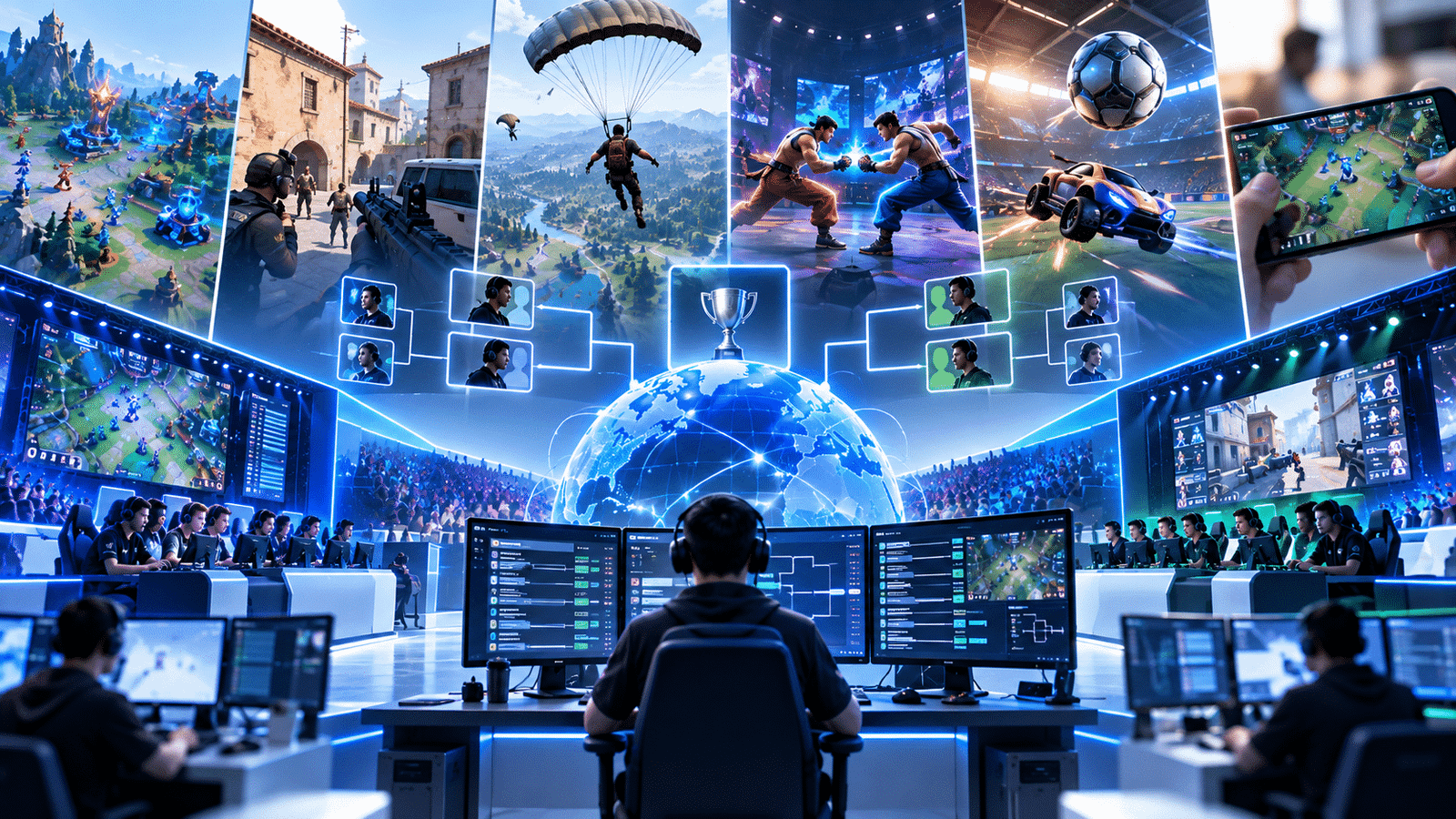
The modern esports landscape includes several major genres:
- Multiplayer Online Battle Arenas (MOBAs)
- Tactical shooters
- Battle royale games
- Sports and racing games
- Fighting games
- Mobile esports
- Strategy games
In 2026, the competitive landscape includes established titles such as League of Legends, Counter-Strike 2, Dota 2 and VALORANT, alongside major mobile ecosystems such as Mobile Legends: Bang Bang and PUBG Mobile. The Esports World Cup 2026 itself features 24 titles across a wide range of genres, illustrating how broad the esports ecosystem has become.
The goal is not to rank these games.
Instead, this guide explains what makes each competitive ecosystem different.

Major Esports Titles Explained
What Makes an Esports Title “Major”?
There is no single official definition of a “major esports title.”
A game can be considered major because of a combination of factors such as:
- Large competitive communities.
- Professional leagues or tournament circuits.
- International championships.
- Significant tournament participation.
- Large audiences.
- Professional teams and players.
- Long-term competitive support.
- Strong publisher involvement.
- Established tournament infrastructure.
This distinction matters.
A game can be extremely popular among casual players without having a large professional esports ecosystem.
Conversely, a competitive title may have a relatively specialized audience while maintaining a very mature tournament structure.
Therefore, popularity and competitive maturity are not exactly the same thing.
League of Legends
League of Legends is one of the most established esports titles in the world.
It is a MOBA, where two teams compete to destroy the opposing team’s main structure while managing objectives, resources and strategic positioning.
The competitive structure revolves heavily around teams.
Players generally have specialized roles, and success depends on coordination as much as individual mechanical ability.
Why it matters in esports
League of Legends helped popularize the model of a persistent professional ecosystem consisting of:
Regional competition → qualification → international competition → championship
Its ecosystem includes professional leagues, regional competitions and the World Championship.
League also demonstrates how a publisher can build a long-term competitive structure around a single game.
Its scale remains significant. Esports Charts reported League of Legends as the most-watched esports title in 2025 by peak concurrent viewership, with more than 6.7 million peak viewers.
Competitive characteristics
- Team-based.
- Strategic.
- Role-oriented.
- Season-based.
- Strong regional structure.
- International championships.
For tournament organizers, League illustrates the operational complexity that appears when competition becomes a persistent professional ecosystem.
Counter-Strike 2
Counter-Strike 2 represents one of the most important competitive shooter ecosystems.
It is a tactical first-person shooter where teams compete through rounds with different objectives.
Unlike games based heavily around character abilities, Counter-Strike emphasizes:
- Tactical execution.
- Economy management.
- Positioning.
- Team coordination.
- Communication.
- Mechanical precision.
Its tournament ecosystem is also distinctive.
Rather than relying on one centralized league structure, the competitive scene includes numerous independent organizers and major events.
The Major concept is particularly important to Counter-Strike’s identity.
In 2026, Counter-Strike remained one of the leading esports titles. Esports Charts reported that the IEM Cologne Major 2026 reached 2.75 million peak viewers, helping Counter-Strike become one of the most-watched esports titles of the first half of the year.
Competitive characteristics
- Team-based.
- Round-based.
- Tactical.
- Economy-driven.
- Multiple tournament organizers.
- Strong international circuit.
For tournament operations, Counter-Strike is an excellent example of how a decentralized competitive ecosystem can generate a large number of tournaments and participants.
Dota 2
Dota 2 is another major MOBA and one of the most established competitive games.
Like League of Legends, it involves teams competing around objectives and a central base.
However, its gameplay and competitive ecosystem are distinctly different.
One of its most recognizable characteristics is The International, historically one of the most prominent events in esports.
Dota 2 has also become known for large-scale international competition and significant prize pools.
In 2025, Dota 2 remained among the leading esports titles by both audience and prize money.
Competitive characteristics
- Team-based.
- Highly strategic.
- Complex gameplay.
- International competition.
- Strong tournament identity.
- Historically significant prize pools.
Dota 2 demonstrates how a single championship can become a central reference point for an entire competitive ecosystem.
VALORANT
VALORANT is a tactical shooter developed by Riot Games.
It combines traditional tactical shooting mechanics with characters that have distinct abilities.
This creates a competitive environment where teams must balance:
- Mechanical skill.
- Tactical execution.
- Ability management.
- Communication.
- Strategy.
VALORANT has developed a structured international competitive ecosystem through the VALORANT Champions Tour (VCT).
Its competitive model is therefore particularly useful for understanding modern publisher-led esports.
In 2025, VALORANT ranked among the world’s leading esports titles by viewership, and it continues to maintain a major international tournament ecosystem.
Competitive characteristics
- Team-based.
- Tactical.
- Character abilities.
- Structured competitive circuit.
- Regional and international competition.
Fortnite
Fortnite represents a different competitive model.
Its competitive ecosystem has included battle royale competitions, where large numbers of players compete in the same match.
This creates different tournament-management requirements from traditional 5-versus-5 esports.
Organizers may need to consider:
- Large participant fields.
- Placement points.
- Elimination points.
- Multiple matches.
- Aggregate scoring.
- Qualification thresholds.
Fortnite also demonstrates how a game originally associated strongly with mainstream gaming can develop a substantial professional competitive ecosystem.
It remained among the major esports titles by tournament activity and prize money in 2025.
Competitive characteristics
- Large participant fields.
- Individual and team competition.
- Placement-based scoring.
- Multiple-match formats.
- Battle royale structure.
Mobile Legends: Bang Bang
The esports landscape is not limited to PC and console gaming.
Mobile Legends: Bang Bang (MLBB) is one of the most important examples of mobile esports.
Its competitive ecosystem is particularly significant in Southeast Asia and other mobile-first markets.
The game’s professional structure includes regional leagues and international competitions.
Its scale is reflected in recent viewership data. Esports Charts reported MLBB as the most-watched esports title during the first half of 2026, driven heavily by the M7 World Championship.
Competitive characteristics
- Mobile-first.
- Team-based.
- MOBA.
- Regional leagues.
- International championships.
- Strong Asian competitive ecosystem.
This is an important reminder that the global esports market cannot be understood only through traditional PC esports.
PUBG Mobile
PUBG Mobile is another major mobile esports ecosystem.
It brings the battle royale model to mobile devices, creating competitions based on survival, placement and eliminations.
This creates different tournament requirements from conventional team-based games.
A tournament organizer may need to aggregate results across multiple matches rather than determine a winner from a single elimination bracket.
PUBG Mobile was among the highest-viewed esports titles in 2025, with more than 1.3 million peak viewers according to Esports Charts data reported by Dot Esports.
Competitive characteristics
- Mobile.
- Battle royale.
- Large participant fields.
- Placement scoring.
- Multiple-match competition.
- Team and individual performance factors.
Rocket League
Rocket League demonstrates that competitive esports does not have to resemble a traditional shooter or strategy game.
Its core concept combines football with vehicle-based gameplay.
Despite the unusual premise, its competitive environment is highly skill-based and structured.
Professional competition generally emphasizes:
- Team coordination.
- Mechanical skill.
- Positioning.
- Timing.
- Fast decision-making.
Rocket League has developed an established international competitive circuit and remains part of the major global esports calendar.
Competitive characteristics
- Team-based.
- Sports-inspired.
- Fast-paced.
- Mechanical.
- Structured tournament circuit.
Rainbow Six Siege
Tom Clancy’s Rainbow Six Siege represents another important tactical shooter ecosystem.
Its competitive identity is built around tactical decision-making, team coordination and map control.
Unlike simpler competitive shooters, teams must often account for:
- Operator selection.
- Defensive setups.
- Map destruction.
- Information gathering.
- Tactical execution.
The result is a competition where strategy and preparation can be as important as mechanical ability.
Rainbow Six Siege also maintains an established international tournament ecosystem and remains part of major multi-title esports events.
Competitive characteristics
- Team-based.
- Tactical.
- Operator-based.
- Strategy-heavy.
- Structured international competition.
Fighting Games: Street Fighter and TEKKEN
Fighting games represent one of the oldest competitive gaming traditions.
Titles such as Street Fighter 6 and TEKKEN 8 use a fundamentally different competitive model from team-based esports.
Matches generally focus on individual players.
This creates a simpler participant structure:
Player A vs. Player B
But simpler does not mean easier to operate.
Tournament organizers still need to manage:
- Registration.
- Seeding.
- Brackets.
- Match scheduling.
- Results.
- Stage progression.
- Disputes.
Fighting games are therefore an important reminder that tournament complexity can come from scale and administration, not only from game mechanics.
Street Fighter 6 and TEKKEN 8 are among the fighting games featured in the 2026 Esports World Cup.
Call of Duty
Call of Duty represents another major competitive shooter ecosystem.
The franchise has supported different competitive modes and formats over time, including traditional multiplayer competition and battle royale through Warzone.
This makes Call of Duty particularly interesting from an esports perspective because the competitive ecosystem can span different game modes.
The 2026 Esports World Cup includes both Call of Duty: Black Ops 7 and Call of Duty: Warzone, demonstrating the breadth of the franchise’s competitive presence.
Competitive characteristics
- Shooter.
- Team-based competition.
- Multiple competitive formats.
- Traditional multiplayer.
- Battle royale ecosystem.


Apex Legends
Apex Legends is another major battle royale title with an established professional competitive scene.
Its format introduces additional complexity because teams compete simultaneously in large matches while accumulating results across a series of games.
Tournament scoring therefore becomes critical.
A team may not need to win every individual match.
Instead, performance can accumulate through:
- Placement.
- Eliminations.
- Match points.
- Series performance.
Apex Legends remains part of major international esports events, including the 2026 Esports World Cup.
Why Different Esports Titles Require Different Tournament Structures
One of the most important lessons from these games is that there is no universal tournament format for esports.
Consider the differences.
| Game type | Typical competitive model | Operational challenge |
|---|---|---|
| MOBA | Team vs. team | Series, standings and qualification |
| Tactical shooter | Round-based team competition | Scheduling and match administration |
| Battle royale | Multiple participants | Aggregate scoring |
| Fighting game | Individual competition | Brackets and seeding |
| Sports esports | Team or individual | Seasons and playoff structures |
| Mobile MOBA | Team competition | Regional and international circuits |
The game influences the tournament structure.
A fighting game may work naturally with a single-elimination bracket.
A league-based MOBA may require a regular season, standings and playoffs.
A battle royale tournament may require multiple matches and a cumulative scoring system.
This is why tournament organizers cannot simply copy one competition model across every esport.
The Publisher Matters Too
Another important difference between esports titles is the role played by the publisher.
Some competitive ecosystems are highly centralized.
The publisher may control:
- Tournament rules.
- Competitive circuits.
- Qualification.
- Broadcast rights.
- Branding.
- Professional leagues.
Others have historically supported a more decentralized tournament ecosystem, where multiple organizers operate competitions throughout the year.
This distinction affects tournament operations.
A centralized ecosystem may provide standardized infrastructure but impose strict requirements.
A decentralized ecosystem can provide greater flexibility but may require organizers to build more of their own operational processes.
Why Tournament Organizers Need to Understand the Game
Tournament administration cannot be separated completely from the game itself.
An organizer needs to understand the competitive mechanics well enough to design appropriate procedures.
For example:
A tactical shooter
May require rules covering maps, rounds, substitutions, technical pauses and server conditions.
A battle royale
May require scoring rules, placement systems, match series and tie-breakers.
A fighting game
May require seeding, bracket progression, match stations and player scheduling.
A MOBA
May require series structures, draft rules, substitutions, standings and qualification criteria.
The better the organizer understands the competitive model, the better the tournament can be designed and administered.
What Major Esports Titles Have in Common
Despite their differences, the largest competitive ecosystems share several characteristics.
A defined competitive objective
Players know what they must achieve to win.
A ruleset
Participants need clear rules governing the competition.
A repeatable format
The competition can be organized consistently.
Measurable results
Performance can be recorded and compared.
A competitive community
Players and teams have reasons to continue participating.
Tournament infrastructure
Organizers can operate competitions at scale.
Spectator value
The competition can attract an audience.
Competitive integrity
Participants need confidence that the rules will be applied consistently.
This last element becomes increasingly important as tournaments grow.
Why Understanding Esports Titles Matters for Tournament Operations
For someone outside esports, games such as League of Legends, Counter-Strike 2, Dota 2 and VALORANT may simply appear to be popular games.
From a tournament-operations perspective, they are very different systems.
Each one introduces its own combination of:
- Players.
- Teams.
- Match formats.
- Rules.
- Qualification.
- Scheduling.
- Scoring.
- Evidence.
- Incidents.
- Appeals.
- Administrative decisions.
The game determines much of the competitive context.
The tournament system turns that context into an organized competition.
That is why understanding the major esports titles is also a foundation for understanding esports operations.
The Esports Landscape Will Continue to Change
The list of major esports titles is not permanent.
Games rise.
Competitive communities grow.
New publishers enter the market.
Existing ecosystems change their formats.
Some titles lose competitive relevance while others gain new audiences.
The 2026 Esports World Cup illustrates this diversity particularly well, bringing together 24 titles spanning MOBAs, shooters, battle royale, fighting games, sports, strategy and mobile esports.
For tournament organizers, adaptability is therefore essential.
The goal should not be to build processes that work for only one game.
It should be to build operational capabilities that can adapt to different competitive environments.
Tourney Guard
Tournament Integrity Across Different Esports
Major esports titles may have completely different gameplay mechanics, but they share one fundamental requirement:
Participants need to trust the competition.
Whether a tournament involves a League of Legends series, a Counter-Strike match, a Fortnite scoring system or a fighting-game bracket, organizers need clear processes for managing rules, incidents and decisions.
This is where Tourney Guard fits.
Tourney Guard is focused on Tournament Integrity and Tournament Operations, helping organizers establish structured processes around:
- Tournament rules.
- Participant management.
- Incident reporting.
- Evidence collection.
- Administrative decisions.
- Rule enforcement.
- Competitive integrity.
The objective is not to treat esports integrity as simply an anti-cheat problem.
Integrity is broader.
It is about ensuring that the competition is organized, understandable, consistent and trustworthy.
Different games may require different tournament formats.
But every tournament benefits from reliable operational foundations.
Tourney Guard helps build those foundations.
FAQ
What are the major esports titles?
Major esports titles are games with established competitive ecosystems, professional players and teams, significant tournaments, audiences and long-term competitive infrastructure. Examples include League of Legends, Counter-Strike 2, Dota 2, VALORANT, Fortnite, Mobile Legends: Bang Bang, PUBG Mobile, Rocket League, Rainbow Six Siege and others.
What is the most popular esports game?
There is no single answer because popularity can be measured in different ways, including peak viewers, total hours watched, prize money, active players or geographic reach. League of Legends, Mobile Legends: Bang Bang and Counter-Strike have recently been among the leading titles depending on the metric and period analyzed.
What are the main esports genres?
Major esports genres include MOBAs, tactical shooters, battle royale games, fighting games, sports games, racing games, strategy games and mobile esports.
Why are League of Legends and Dota 2 important esports titles?
Both helped establish the modern professional MOBA ecosystem. They feature team-based competition, strategic gameplay, professional teams and major international tournaments.
What makes Counter-Strike different from League of Legends?
Counter-Strike 2 is a tactical shooter built around rounds, economy management and team execution. League of Legends is a MOBA built around longer team-based matches, character roles, objectives and strategic progression.
Is Fortnite a major esport?
Yes. Fortnite has an established competitive ecosystem with professional tournaments and large-scale events. Its battle royale format also creates tournament structures that differ considerably from traditional team-based esports.
Is mobile gaming part of esports?
Absolutely. Mobile titles such as Mobile Legends: Bang Bang and PUBG Mobile have developed major professional competitive ecosystems, particularly across Asian and other mobile-first markets.
Why do different esports need different tournament formats?
The mechanics of each game determine how competition works. A fighting game may use a traditional bracket, while a battle royale may require multiple matches and cumulative scoring. Tournament formats need to reflect the competitive characteristics of each title.
What role does competitive integrity play across esports?
Competitive integrity provides the foundation for trustworthy competition. It includes clear rules, consistent enforcement, incident management, evidence, transparent decisions and effective dispute processes.
Conclusion
The world of esports is not one competition.
It is a collection of competitive ecosystems built around very different games.
League of Legends and Dota 2 demonstrate the complexity of professional MOBAs.
Counter-Strike 2 and VALORANT demonstrate the depth of tactical team competition.
Fortnite, PUBG Mobile and Apex Legends demonstrate how battle royale competition requires different scoring and tournament structures.
Street Fighter 6 and TEKKEN 8 demonstrate the enduring importance of individual competition.
And Mobile Legends: Bang Bang demonstrates how mobile gaming has become a major part of the global esports landscape.
The common factor is not the gameplay.
It is the existence of a structured competitive environment.
As esports continues to grow, understanding the games is only the beginning.
Tournament organizers must also understand formats, rules, participants, scoring, incidents, evidence and competitive integrity.
Different games require different approaches.
But every competitive environment needs the same foundation:
clear rules, consistent administration and trust in the competition.
That is what turns a game into an esport—and a tournament into a credible competitive event.
Recommended External Resources
These organizations publish guidance that supports professional Tournament Integrity programs:
- Esports Integrity Commission (ESIC) – Standards, codes of conduct, investigations, and integrity initiatives.
- International Olympic Committee (IOC) – Integrity frameworks applicable to competitive sports governance.
- International Betting Integrity Association (IBIA) – Best practices for integrity monitoring.
- NIST Cybersecurity Framework – Guidance for security governance and risk management.
- ISO 37301 Compliance Management Systems – International compliance management principles.
- World Anti-Doping Agency (WADA) – Governance and disciplinary process principles applicable beyond traditional sports.
Suggested Internal Links
Strengthen your internal linking strategy by connecting this article with:
- What Is Tournament Integrity? A Complete Guide for Esports Organizers
- Why Anti-Cheat Software Alone Isn’t Enough for Esports Tournaments
- 10 Common Types of Cheating in Esports Tournaments