Introduction
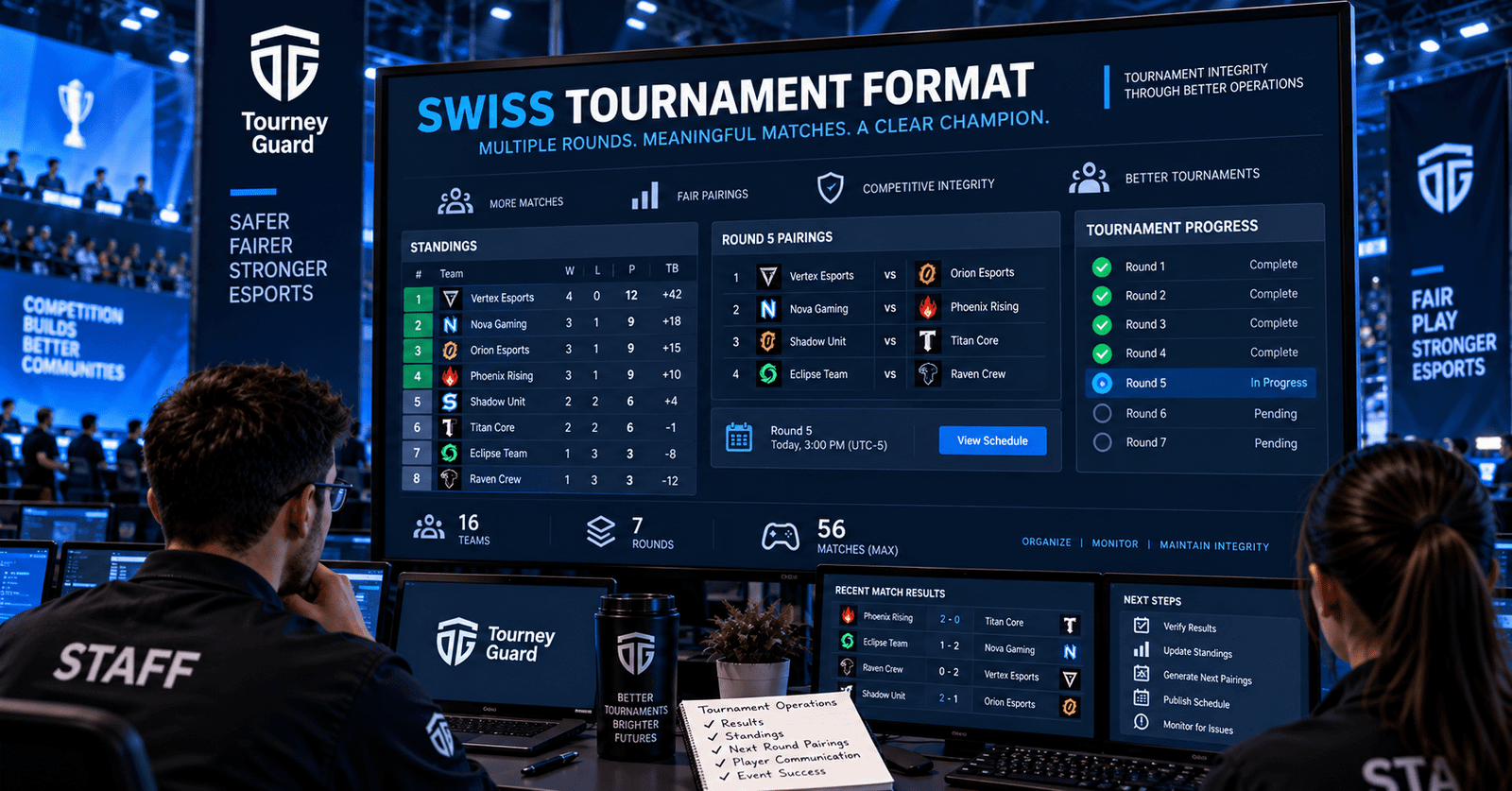
Swiss Tournament Format is a competition structure that allows participants to play multiple rounds without requiring every competitor to face every other competitor.
Instead of eliminating a player or team after a single loss, Swiss tournaments generally keep participants active throughout a predefined number of rounds. Pairings are usually created based on current performance, so competitors with similar records tend to meet as the tournament progresses.
This makes the format particularly useful when an organizer wants more meaningful matches than a knockout tournament can provide, but does not have enough time or resources for a full round-robin competition.
The format, however, introduces an important operational challenge: pairings change according to previous results.
That means organizers must manage scores, previous opponents, pairing rules, tiebreakers, player or team eligibility, withdrawals, scheduling, and result verification throughout the event.
A Swiss tournament can therefore be easy for participants to understand while still requiring sophisticated administration behind the scenes.
This guide explains how the Swiss Tournament Format works, how pairings are generated, how scoring and tiebreakers affect standings, how organizers should manage rounds, and how to avoid common administrative problems.
Key principle: A Swiss tournament does not eliminate competitors after every loss; instead, it progressively creates pairings based on performance.



Key Takeaways
- A Swiss tournament uses multiple rounds without requiring every participant to play every other participant.
- Participants generally remain active throughout the scheduled rounds.
- Pairings are commonly based on current tournament records.
- Competitors with similar scores are generally paired when the pairing system permits.
- The number of rounds is defined before or during tournament design according to the competition’s rules.
- A loss normally affects a participant’s score rather than immediately eliminating them.
- Tiebreakers can be important when several participants finish with the same score.
- Participants should generally not be paired against the same opponent more than once.
- Bye rules are required when an odd number of participants remain in a round.
- Pairing algorithms can vary significantly between tournament systems.
- Accurate result reporting is essential because every round influences subsequent pairings.
- A Swiss tournament requires stronger score and pairing administration than a fixed knockout bracket.
What Is a Swiss Tournament Format?
A Swiss Tournament Format is a multi-round tournament structure where participants compete for a predetermined number of rounds and are generally paired according to their current performance.
Unlike single elimination, a participant does not normally leave the competition after one loss.
A simplified progression looks like this:
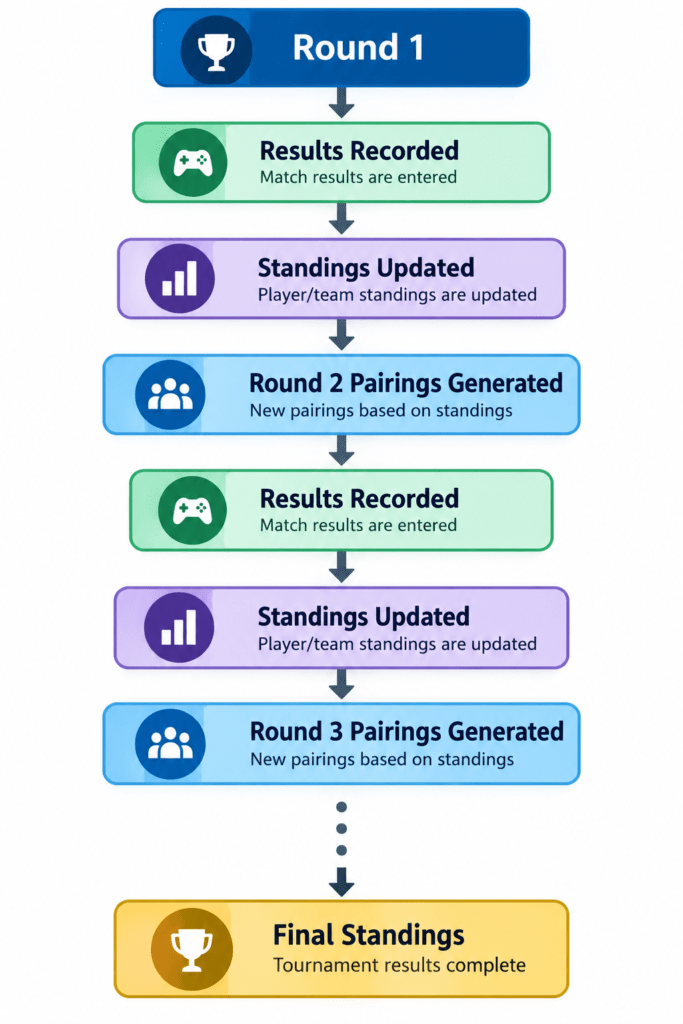
The important distinction is that the next round depends on the results of the previous round.
For example, after Round 1, participants might have records such as:
| Participant | Record |
|---|---|
| Team Alpha | 1–0 |
| Team Bravo | 1–0 |
| Team Charlie | 0–1 |
| Team Delta | 0–1 |
The next round would generally attempt to pair competitors with comparable records.
This produces a tournament in which the competitive context evolves throughout the event.
Why Does the Swiss Format Matter?
The Swiss format matters because it balances competitive volume with event efficiency.
A round-robin tournament requires every participant to face every other participant. As the field grows, the number of matches increases rapidly.
Single elimination has the opposite characteristic: the number of matches is relatively low, but competitors can be eliminated quickly.
Swiss sits between these structures.
| Format | Participation After Loss | Match Volume | Pairing Complexity |
|---|---|---|---|
| Single Elimination | Normally ends | Lower | Lower |
| Double Elimination | Continues after first loss | Higher | Medium–High |
| Swiss | Normally continues | Moderate | High |
| Round Robin | Continues through schedule | High | Medium |
The Swiss approach is therefore useful when organizers want participants to receive multiple competitive opportunities while keeping the total number of rounds manageable.
For players and teams, this can create a more informative tournament record because standings develop over several matches rather than being determined by a single result.
For organizers, however, the benefit comes with an operational requirement:
The pairing process must be reliable.
How Does a Swiss Tournament Work?
A typical Swiss tournament follows five fundamental stages:
1. Registration
Participants register and complete any required eligibility checks.
2. Initial Pairing
The organizer generates the first-round pairings according to the tournament rules.
The first round may use:
- Seeding.
- Randomization.
- Qualification results.
- Ranking.
- Another predefined method.
3. Match Results
Participants complete their matches and submit results.
4. Standings Update
Results are verified and reflected in the standings.
5. Next Pairing
The pairing system uses the updated standings and pairing rules to generate the next round.
The cycle continues until the scheduled number of rounds has been completed.
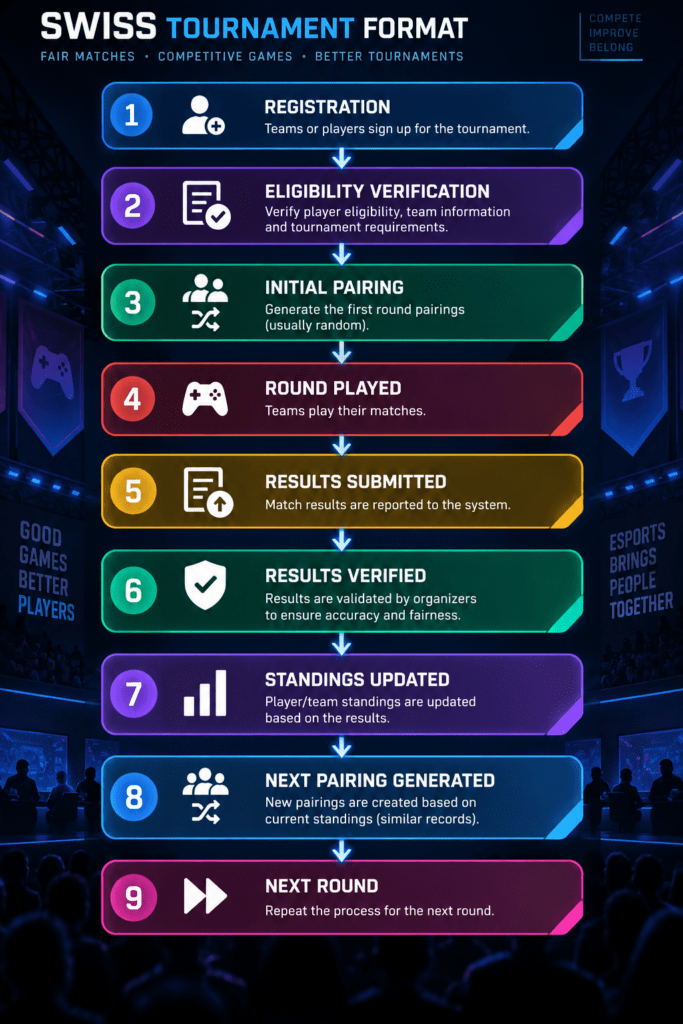
Operational principle: In a Swiss tournament, the result of one round is an input to the next round.
That makes result accuracy particularly important.
How Are Swiss Tournament Pairings Created?
Pairings are generally created using participants’ current records while respecting the tournament’s pairing rules.
For example, after several rounds, the standings might look like:
| Participant | Score |
|---|---|
| Team A | 4–0 |
| Team B | 3–1 |
| Team C | 3–1 |
| Team D | 2–2 |
| Team E | 2–2 |
| Team F | 1–3 |
| Team G | 1–3 |
| Team H | 0–4 |
The pairing system would generally seek appropriate opponents within comparable score groups.
However, there is no single universal Swiss pairing algorithm.
Different games, tournament platforms, and organizations can use different pairing methodologies.
Pairing rules can address:
- Score groups.
- Previous opponents.
- Color or side balance where applicable.
- Avoiding repeat matchups.
- Bye allocation.
- Seeding.
- Floaters between score groups.
- Late registrations.
- Withdrawals.
Therefore, an organizer should never simply tell participants that pairings are “Swiss” without explaining the applicable pairing rules.
What Are Score Groups?
A score group contains participants with the same or similar tournament score.
For example:
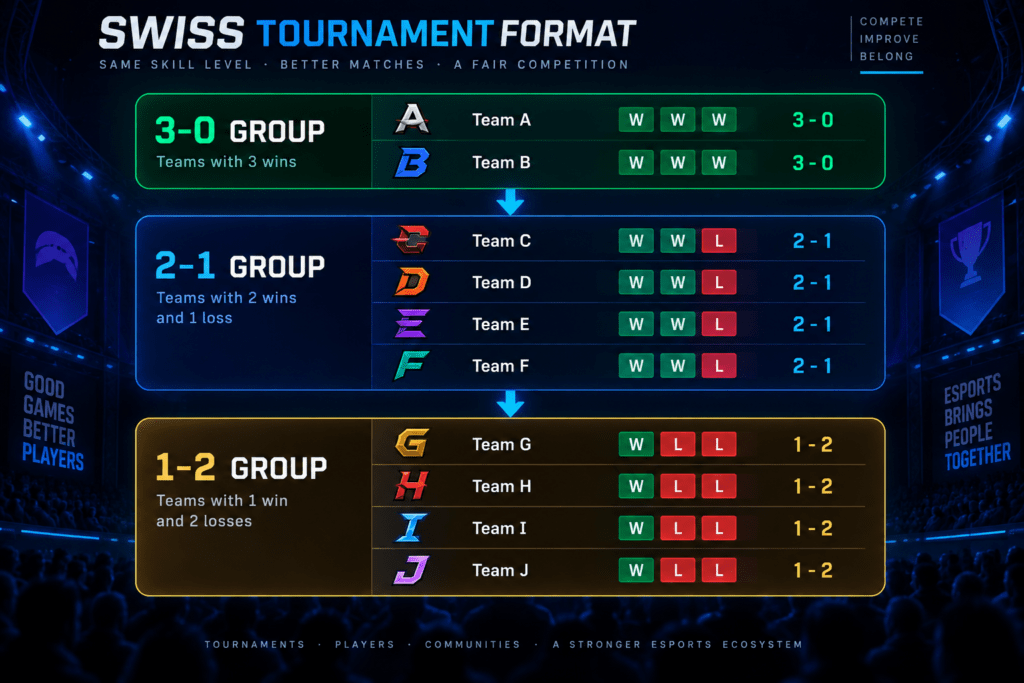
The pairing system attempts to create matches within these groups where possible.
But an exact pairing is not always possible.
For example, a score group could contain an odd number of participants. A participant may therefore need to be paired with someone from another score group according to the tournament’s pairing rules.
This is sometimes described as a float between score groups.
The important point for organizers is that score-based pairing is a framework, not simply:
“Always pair the two highest-ranked players.”
A properly defined system must account for multiple constraints simultaneously.
How Does Scoring Work?
Swiss tournaments require a scoring system to determine standings.
A simple system could award:
- Win = 1 point
- Draw = 0.5 points
- Loss = 0 points
But esports competitions can use different scoring systems.
For example:
- Win = 3 points
- Draw = 1 point
- Loss = 0 points
Or a game-specific scoring model.
The exact scoring system should therefore be defined in the tournament rules.
Example
Suppose an event uses:
Win = 3 points
Loss = 0 points
After four rounds:
| Team | Results | Points |
|---|---|---|
| Alpha | W-W-W-W | 12 |
| Bravo | W-W-W-L | 9 |
| Charlie | W-W-L-L | 6 |
| Delta | W-L-L-L | 3 |
The standings are easy to understand.
The complexity begins when several participants finish with the same score.
That is where tiebreakers become important.
What Are Swiss Tournament Tiebreakers?
Tiebreakers are additional criteria used to separate participants who have the same primary score.
Possible tiebreak systems vary significantly between tournaments.
Examples include:
- Opponent-based performance.
- Strength of schedule.
- Buchholz-style calculations.
- Sonneborn-Berger-style calculations.
- Game or map differential.
- Head-to-head results.
- Secondary match statistics.
Not every tiebreaker is appropriate for every game.
The critical principle is:
The tiebreaker methodology must be published before participants compete.
Suppose four teams finish with nine points:
| Team | Primary Score |
|---|---|
| Alpha | 9 |
| Bravo | 9 |
| Charlie | 9 |
| Delta | 9 |
If the tournament does not explain how ties are resolved, the final standings can become controversial even when every match was administered correctly.
Governance principle: A transparent tiebreaker is part of the tournament rules, not merely an administrative detail added after competition ends.
How Many Rounds Should a Swiss Tournament Have?
There is no single universal number of rounds that applies to every Swiss tournament.
The appropriate number depends on:
- Number of participants.
- Competitive objectives.
- Desired ability to differentiate standings.
- Match duration.
- Available event time.
- Scoring system.
- Qualification requirements.
- Whether the Swiss stage feeds into playoffs.
An organizer should determine the number of rounds before publishing the format.
For a large field, adding rounds generally provides more opportunities for standings to differentiate.
However, additional rounds also mean:
- More matches.
- More staff workload.
- Longer event duration.
- More result processing.
- More scheduling dependencies.
The goal is therefore not simply to maximize the number of rounds.
It is to choose a number that supports the tournament’s competitive objective within its operational constraints.
Swiss Tournament Format vs Round Robin
Swiss and round robin are both multi-round formats, but they solve different operational problems.
| Swiss Tournament | Round Robin |
|---|---|
| Participants play a limited number of rounds | Participants can play every other participant |
| Pairings change according to results | Pairings can be predetermined |
| Does not require every matchup | Every required matchup is scheduled |
| More suitable for larger fields | Match volume grows rapidly with field size |
| Dynamic pairings | Fixed pairing matrix |
| Strong administrative dependency | Strong scheduling dependency |
For example, with 32 teams, a complete round robin would require every team to play 31 opponents.
A Swiss tournament can provide a defined number of rounds instead.
This makes Swiss particularly useful when the organizer wants to handle a larger field without scheduling every possible matchup.
Swiss Tournament Format vs Elimination Formats
Swiss differs from elimination formats in a fundamental way.
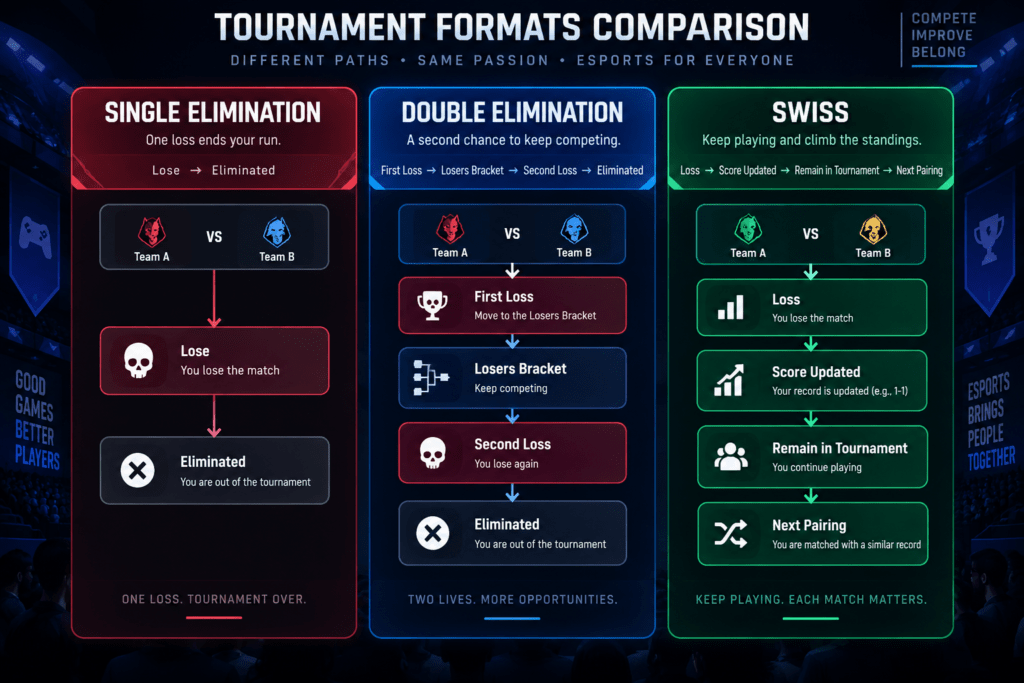
This distinction affects the participant experience.
A Swiss tournament generally allows a participant to recover from a poor result and continue accumulating points.
However, that does not mean every participant has identical competitive circumstances after each round. Pairings, previous opponents, scoring, and tiebreakers influence the final standings.



How Are Byes Managed?
A bye may be necessary when the number of active participants is odd.
For example:
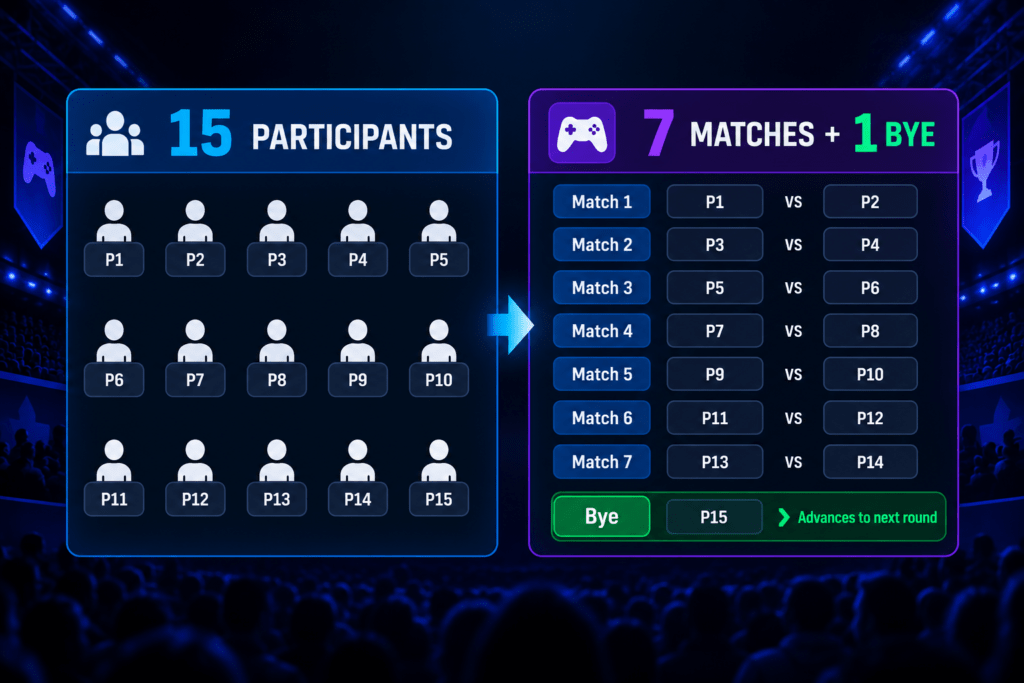
One participant does not play that round and receives whatever bye treatment the tournament rules define.
The rules should specify:
- Who receives the bye.
- Whether the bye provides points.
- Whether the same participant can receive another bye.
- How the bye affects tiebreakers.
- Whether a bye is assigned randomly or according to pairing rules.
Bye allocation becomes increasingly important when participants have unequal numbers of played matches.
Important: A bye is not automatically equivalent to a normal match victory. Its scoring and tiebreaker treatment must be defined by the tournament rules.
How Should Withdrawals Be Handled?
Swiss tournaments need a defined withdrawal process.
A participant might:
- Withdraw before a round.
- Withdraw after a round.
- Fail to appear.
- Become ineligible.
- Be disqualified.
- Stop competing voluntarily.
The tournament rules should establish how each case affects:
- Current standings.
- Future pairings.
- Opponent records.
- Tiebreakers.
- Remaining rounds.
A withdrawal can be particularly important because it changes the number of participants available for future pairings.
The pairing system should therefore use an authoritative participant status rather than relying on informal communication.
Best Practices
1. Publish the pairing methodology
Participants should understand how pairings are generated.
This does not necessarily require publishing the full technical implementation, but the governing principles should be clear.
2. Define scoring before registration
Publish:
- Win value.
- Loss value.
- Draw value if applicable.
- Bonus points if any.
- Penalties if applicable.
3. Define tiebreakers in advance
Do not introduce a new tiebreaking method after the final round.
4. Prevent unnecessary repeat matchups
Where the pairing system allows it, participants should not repeatedly face the same opponent.
5. Define bye rules
Specify who can receive a bye and how it affects standings.
6. Verify results before generating the next round
This is one of the most important operational controls.
An incorrect result can produce incorrect standings, which can then produce incorrect pairings.
7. Freeze the round before competition
Once pairings are officially published, changes should follow a controlled process.
8. Record pairing decisions
Maintain enough information to reconstruct how a pairing was generated when questions arise.
9. Communicate standings clearly
Participants should be able to understand:
- Their score.
- Their record.
- Their position.
- Their next opponent.
- Their next match time.
10. Separate eligibility from competitive score
A participant can have a valid score while an eligibility or disciplinary issue is under review.
These should be represented as different administrative states.
Common Mistakes
Mistake 1: Calling a tournament “Swiss” without defining the rules
Why it happens: Organizers assume everyone understands Swiss.
Consequence: Participants may have different expectations about pairings, scoring, or tiebreakers.
Avoid it: Publish the specific implementation.
Mistake 2: Generating pairings from unverified results
Why it happens: Organizers want to start the next round quickly.
Consequence: One incorrect result can affect multiple pairings.
Avoid it: Establish a result-verification checkpoint.
Mistake 3: Changing the tiebreaker after competition begins
Why it happens: The organizer discovers that the original method does not separate tied participants as expected.
Consequence: Participants may question the final standings.
Avoid it: Define the tiebreak hierarchy before the first round.
Mistake 4: Ignoring repeat opponents
Why it happens: Manual pairing becomes increasingly difficult as the tournament progresses.
Consequence: Participants may encounter opponents they have already faced.
Avoid it: Use a pairing system that tracks previous matchups.
Mistake 5: Treating a bye as an ordinary victory
Why it happens: The organizer needs a simple way to represent an unplayed round.
Consequence: Scores or tiebreakers may become distorted.
Avoid it: Define bye treatment explicitly.
Mistake 6: Manually modifying pairings without documentation
Why it happens: Operational problems require intervention.
Consequence: It becomes difficult to explain why the final pairing differed from the generated pairing.
Avoid it: Record the reason, authority, and effect of manual changes.
Practical Example
Consider an esports tournament with 16 teams using a Swiss structure.
The organizer schedules 5 rounds.
The tournament begins with Round 1.
Round 1
All 16 teams play.
After results are verified:
- 8 teams win.
- 8 teams lose.
The standings now contain two broad performance groups.
Round 2
The pairing system uses the updated records to generate the next round.
Teams with comparable results are generally paired according to the tournament’s pairing methodology.
After Round 2, the records may look like:
| Record | Teams |
|---|---|
| 2–0 | 4 |
| 1–1 | 8 |
| 0–2 | 4 |
Round 3
The pairing process repeats.
Participants with similar records are generally paired where possible, while the system also considers previous opponents and other pairing constraints.
By Round 4, the standings may look like:
| Team | Record |
|---|---|
| Alpha | 4–0 |
| Bravo | 3–1 |
| Charlie | 3–1 |
| Delta | 3–1 |
| Echo | 2–2 |
| Foxtrot | 2–2 |
After the final round, several teams might finish with the same primary score.
The published tiebreaker system is then applied.
For example:
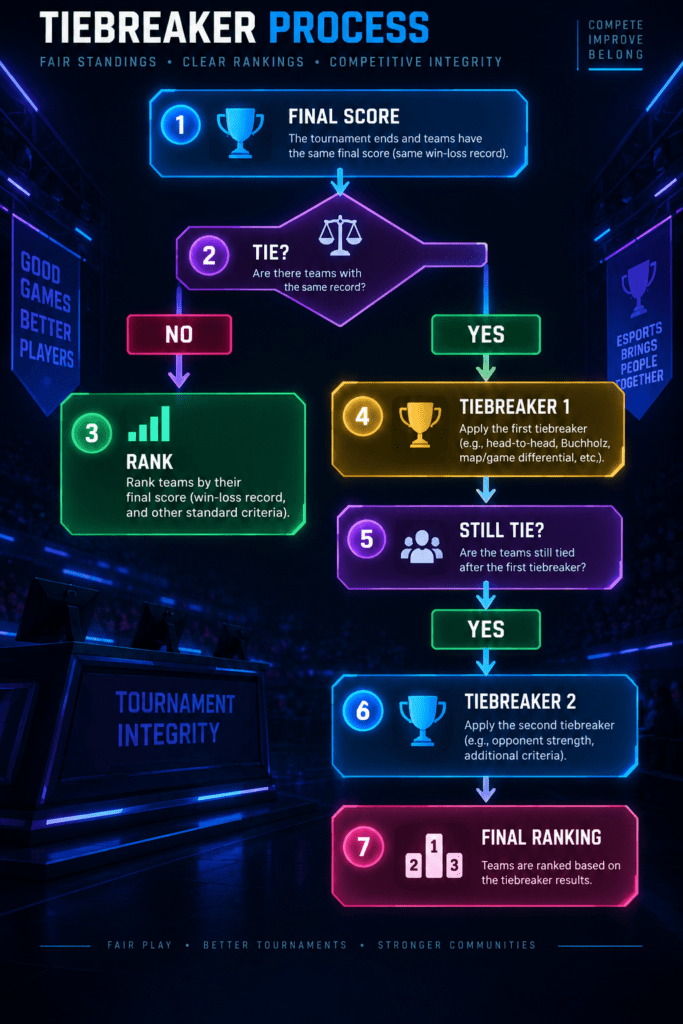
The tournament can then use the final standings to determine:
- Champion.
- Playoff qualification.
- Seeding.
- Advancement.
- Elimination from a subsequent stage.
The operational lesson
Imagine that Team Alpha’s Round 3 result was incorrectly recorded as a loss instead of a win.
That error would affect:
- Alpha’s score.
- Alpha’s ranking.
- The Round 4 pairing.
- Alpha’s potential opponent.
- That opponent’s pairing.
- Potential downstream standings.
- Potential tiebreaker calculations.
This illustrates why result verification is not just an administrative convenience in Swiss tournaments.
It is part of the competitive process.
Decision Framework
Before selecting a Swiss tournament, organizers should evaluate six questions.
1. Do participants need multiple matches?
If participants should remain active after losses, Swiss may fit the event structure.
2. Is a full round robin impractical?
If the field is too large for every participant to face every opponent, Swiss can provide multiple rounds without requiring every possible matchup.
3. Can the organization support dynamic pairings?
Staff or software must reliably generate and publish new pairings after every round.
4. Are scoring and tiebreakers sufficiently defined?
If standings can affect advancement, unclear scoring rules can become a governance problem.
5. Can results be verified quickly?
The next round depends on the current standings.
6. Is the event prepared for administrative intervention?
The tournament should have defined procedures for:
- Disputed results.
- Withdrawals.
- Forfeits.
- Eligibility issues.
- Pairing corrections.
- Technical failures.
Decision principle: Swiss is most effective when the organizer can combine multiple competitive rounds with disciplined score, pairing, and tournament administration.
Technology
Technology can significantly reduce the operational burden of Swiss tournaments, particularly as the participant count increases.
A tournament-management system can maintain a centralized representation of:
- Participants.
- Eligibility status.
- Current score.
- Match history.
- Previous opponents.
- Pairings.
- Results.
- Round status.
- Standings.
- Tiebreakers.
- Administrative decisions.
A useful architecture separates several states:
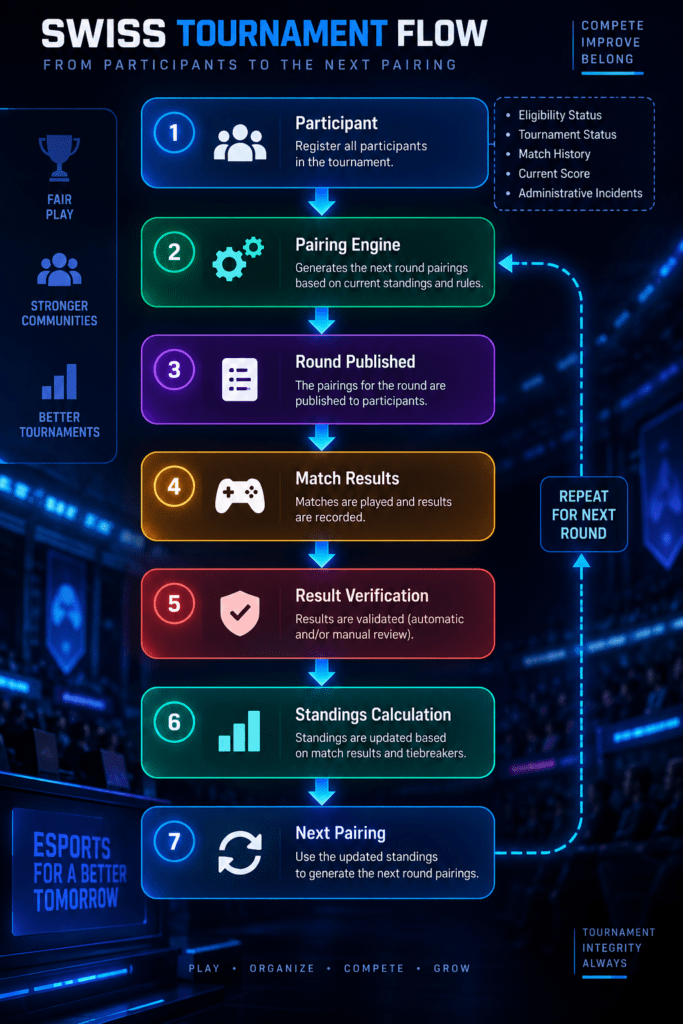
This separation is valuable because competitive state and administrative state are not necessarily the same thing.
For example, a team can have a 3–1 competitive record while an unrelated eligibility review is still pending.
Software should therefore help organizers manage these states independently rather than combining everything into a single status field.
Technology should support the tournament rules—not silently replace them.
KPIs for Swiss Tournament Operations
Organizers can monitor several operational indicators.
| KPI | What It Measures |
|---|---|
| Result Verification Time | Time between result submission and confirmation |
| Pairing Generation Time | Time required to produce the next round |
| Pairing Corrections | Number of manually corrected pairings |
| Disputed Results | Number of results challenged |
| Repeat Pairings | Number of unintended repeat matchups |
| Bye Distribution | How byes are distributed across participants |
| Schedule Adherence | Difference between planned and actual round timing |
| Standings Corrections | Number of post-publication ranking changes |
| Withdrawal Rate | Participants leaving before tournament completion |
These metrics can help organizers identify operational weaknesses.
For example, a high number of pairing corrections may indicate that the pairing rules, participant data, or manual workflow needs improvement.
Checklist
Tournament Design Checklist
- ✓ Swiss format is explicitly defined.
- ✓ Number of rounds is established.
- ✓ Initial pairing methodology is documented.
- ✓ Pairing rules are documented.
- ✓ Scoring system is published.
- ✓ Tiebreakers are published.
- ✓ Repeat-opponent rules are defined.
- ✓ Bye rules are defined.
- ✓ Withdrawal rules are defined.
- ✓ Forfeit rules are defined.
- ✓ Eligibility requirements are documented.
- ✓ Advancement criteria are documented if Swiss feeds into playoffs.
Round Administration Checklist
- ✓ Participant status is verified.
- ✓ Previous-round results are collected.
- ✓ Results are verified.
- ✓ Standings are updated.
- ✓ Pairings are generated.
- ✓ Pairing constraints are validated.
- ✓ Pairings are reviewed before publication.
- ✓ Match times are communicated.
- ✓ Round status is recorded.
- ✓ Disputes are documented.
- ✓ Manual changes are authorized.
- ✓ Final standings are preserved.
Tourney Guard
Understanding the Swiss Tournament Format is only the beginning. Applying it consistently becomes more challenging as the number of participants increases and every round depends on accurate results, current standings, previous matchups, pairing rules, and timely administrative decisions.
For organizers, managing these processes manually can lead to scattered records, spreadsheet-based standings, undocumented pairing changes, inconsistent incident handling, and difficulty reconstructing why a participant received a particular pairing or ranking.
Tourney Guard helps tournament organizers structure and manage the operational processes surrounding Tournament Integrity, Tournament Administration, Incident Management, Evidence Management, and transparent decision-making. For tournaments using dynamic formats such as Swiss, structured administration can help keep competitive information and supporting decisions organized throughout the event.
If you want to explore how a structured tournament operations approach can support your events, you can start with a free 30-day trial.
👉 Start Your 30-Day Free Trial →
FAQ
What is a Swiss Tournament Format?
A Swiss Tournament Format is a multi-round competition structure in which participants play a predetermined number of rounds rather than facing every other participant. Pairings generally take current performance into account, so participants with similar records are commonly paired as the tournament progresses. Unlike single elimination, a participant normally remains in the competition after a loss. The exact pairing algorithm, scoring system, number of rounds, bye rules, and tiebreakers vary between tournaments, so organizers should publish the specific rules governing their implementation.
How does a Swiss tournament work?
A Swiss tournament typically begins with an initial round of pairings. After the matches are completed, results are verified and standings are updated. The next round’s pairings are then generated using the updated standings and the tournament’s pairing rules. This cycle continues for the scheduled number of rounds. Participants generally remain active regardless of individual results, although withdrawals, forfeits, disqualifications, or other tournament rules can change a participant’s status. The final standings are determined using the published scoring and tiebreaking system.
Does losing eliminate you in a Swiss tournament?
Normally, no. A loss in a Swiss tournament generally affects a participant’s score or record but does not immediately eliminate them. The participant continues into subsequent rounds and can potentially improve their final standing through later results. However, tournament-specific rules can define exceptions involving forfeits, withdrawals, disqualifications, eligibility decisions, or other administrative circumstances. Participants should therefore review the official tournament rules to understand exactly how losses and other outcomes affect continued participation.
How are pairings determined in a Swiss tournament?
Swiss pairings are generally generated using participants’ current records while considering additional constraints such as previous opponents, score groups, bye requirements, and the specific pairing methodology selected by the organizer. There is no single universal algorithm used by every Swiss tournament. Some systems can also consider seeding or other game-specific requirements. Because the pairing process can directly affect future competition, organizers should document the governing principles and use a reliable process for generating, reviewing, and publishing each round’s pairings.
What are tiebreakers in a Swiss tournament?
Tiebreakers are secondary criteria used to rank participants who finish with the same primary score. Depending on the tournament, tiebreakers may consider opponent performance, strength of schedule, head-to-head results, game or map differential, or another defined statistic. Different games and tournament systems use different methodologies. The important governance requirement is that the tiebreak hierarchy be established before competition begins. Changing the methodology after results are known can create disputes because participants may have competed under different expectations about how final rankings would be determined.
How many rounds should a Swiss tournament have?
There is no universal number of rounds for every Swiss tournament. The appropriate number depends on the number of participants, event duration, match length, competitive objectives, scoring system, and whether the Swiss stage determines advancement to another phase. More rounds provide additional opportunities for standings to separate, but they also increase match volume and administrative workload. Organizers should choose the number of rounds before publishing the tournament rules and verify that the available staffing, venue, technology, and schedule can support the complete competition.
What happens when there is an odd number of participants?
When an odd number of participants are active in a round, one participant generally receives a bye. The tournament rules should specify how the bye is assigned and how it affects the participant’s score and tiebreakers. Organizers may also define restrictions to prevent the same participant from repeatedly receiving byes. A bye should not automatically be treated as a normal match victory unless the tournament’s rules explicitly say so. Transparent bye management helps participants understand why one competitor did not play during a particular round.
Can teams face the same opponent twice in a Swiss tournament?
Swiss pairing systems generally attempt to avoid repeat matchups when the tournament rules and available pairings allow it. However, avoiding repeats can become more difficult in later rounds, especially when the participant field is small or score groups become highly constrained. The specific pairing algorithm determines how such situations are handled. Organizers should define the repeat-opponent policy and use a pairing system that maintains match history. If a repeat pairing becomes unavoidable under the published rules, the tournament staff should have a documented procedure for handling it.
Conclusion
The Swiss Tournament Format provides a practical structure for competitions that need multiple rounds without requiring every participant to face every other participant.
Its defining characteristic is dynamic progression: results from one round influence the pairings of the next.
That creates an engaging competitive structure while avoiding the immediate elimination associated with knockout formats.
But it also creates an important operational dependency.
Accurate results produce accurate standings.
Accurate standings produce appropriate pairings.
Appropriate pairings produce meaningful subsequent rounds.
Scoring, tiebreakers, byes, withdrawals, repeat opponents, and administrative decisions all need to be defined before competition begins.
For tournament organizers, the central lesson is therefore simple:
A Swiss tournament is not just a pairing format. It is an operational system in which every round depends on the integrity of the information produced by the previous one.
When the rules are transparent and the administrative process is disciplined, Swiss tournaments can provide participants with multiple competitive opportunities while remaining manageable for organizers.
Recommended External Resources
These organizations publish guidance that supports professional Tournament Integrity programs:
- Esports Integrity Commission (ESIC) – Standards, codes of conduct, investigations, and integrity initiatives.
- International Olympic Committee (IOC) – Integrity frameworks applicable to competitive sports governance.
- International Betting Integrity Association (IBIA) – Best practices for integrity monitoring.
- NIST Cybersecurity Framework – Guidance for security governance and risk management.
- ISO 37301 Compliance Management Systems – International compliance management principles.
- World Anti-Doping Agency (WADA) – Governance and disciplinary process principles applicable beyond traditional sports.
Suggested Internal Links
Strengthen your internal linking strategy by connecting this article with:
- What Is Tournament Integrity? A Complete Guide for Esports Organizers
- Why Anti-Cheat Software Alone Isn’t Enough for Esports Tournaments
- 10 Common Types of Cheating in Esports Tournaments