
Introduction
What Is Tournament Integrity? Tournament Integrity is the foundation of every successful esports competition. Whether you’re organizing a local community tournament or managing an international championship with thousands of participants, players expect one thing above all else: a fair, transparent, and trustworthy competitive environment where every decision is supported by consistent rules and professional tournament administration.
Modern esports tournaments face challenges far beyond technical operations. Disputes between players, allegations of unfair behavior, evidence management, administrative investigations, rule enforcement, and transparent decision-making have become essential responsibilities for tournament organizers.
Without structured Tournament Integrity processes, even well-organized events risk losing credibility. A single poorly handled incident can damage a tournament’s reputation, reduce player confidence, discourage sponsors, and weaken community trust.
This is why professional tournament organizers increasingly invest in standardized operational procedures, clear governance models, comprehensive documentation, and consistent incident management.
In this guide, you’ll learn what Tournament Integrity is, why it matters, how it differs from Competitive Integrity, the key principles behind effective tournament administration, and the best practices used by leading esports organizations.
You’ll also discover practical frameworks that help organizers create transparent competitions where every decision is supported by evidence, documented procedures, and fair administrative processes.



What Is Tournament Integrity?
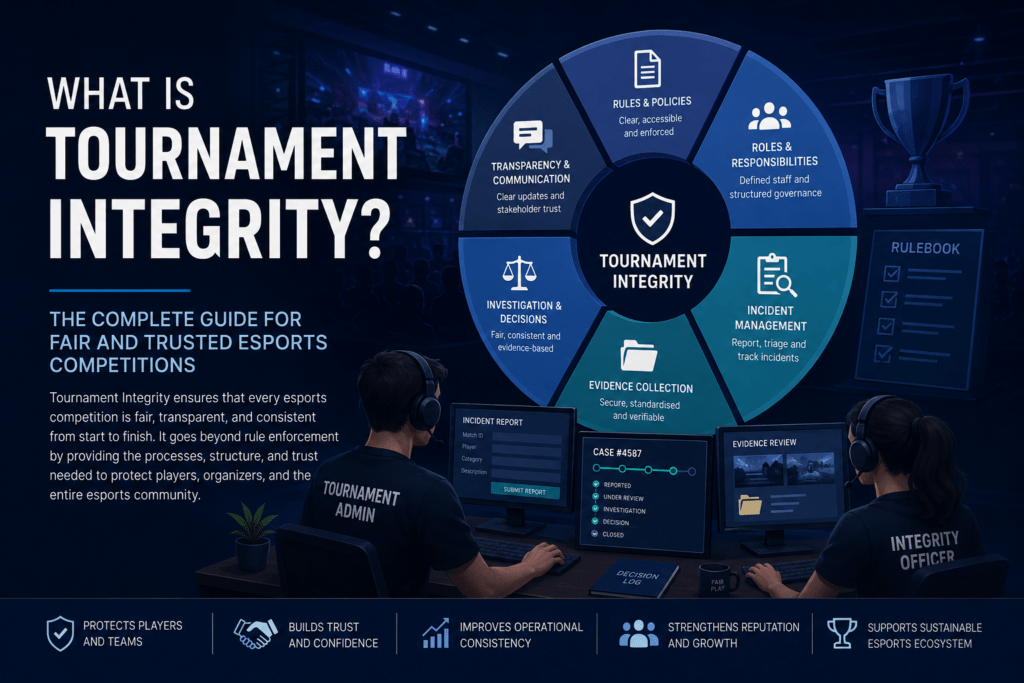
Tournament Integrity refers to the collection of policies, procedures, operational practices, and governance frameworks that ensure esports competitions are conducted fairly, consistently, transparently, and professionally.
Its primary objective is to protect the legitimacy of every tournament by ensuring that all participants compete under the same rules and that any incidents are managed through documented and impartial processes.
Tournament Integrity is not a single activity or software solution. Instead, it is an operational discipline that spans the entire lifecycle of a tournament—from planning and rule creation to post-event reviews.
A mature Tournament Integrity program typically includes:
- Clear tournament regulations
- Consistent rule enforcement
- Incident reporting procedures
- Evidence collection standards
- Administrative investigations
- Decision documentation
- Appeals management
- Staff accountability
- Transparent communication
- Continuous process improvement
These elements work together to create an environment where participants understand not only the rules but also how decisions will be made when disputes or unexpected situations occur.
Why Tournament Integrity Matters Beyond the Game
Many people assume that Tournament Integrity only becomes important when an incident occurs during a match. In reality, What Is Tournament Integrity is a question that extends far beyond gameplay. Tournament Integrity influences every stage of an esports competition, from the first announcement of the event to the final post-tournament review.
A well-designed Tournament Integrity framework establishes clear expectations for players, teams, administrators, referees, and tournament officials before competition even begins. It defines responsibilities, communication channels, investigation procedures, and documentation standards that help organizers manage complex situations consistently.
Without these processes, tournament staff often rely on subjective judgment or informal communication, increasing the risk of inconsistent rulings. By understanding What Is Tournament Integrity, organizers can replace reactive decision-making with structured governance that protects the credibility of the competition and builds long-term trust among participants.
Tournament Integrity Is About Trust
Trust is one of the most valuable assets an esports tournament can earn.
Players invest time preparing for competitions.
Teams invest resources.
Sponsors invest money.
Fans invest attention.
Each of these stakeholders expects organizers to operate fairly, consistently, and professionally.
Tournament Integrity provides the governance framework that supports these expectations.
Without it, tournament administration often becomes reactive, inconsistent, and vulnerable to accusations of bias.
With it, organizers establish predictable processes that improve confidence across the entire competitive ecosystem.
Who Benefits from Tournament Integrity?
Tournament Integrity creates value for every stakeholder involved in an esports event.
Players gain confidence that rules will be applied consistently and that reported incidents will be reviewed fairly.
Teams benefit from transparent investigations and documented administrative decisions that reduce uncertainty during disputes.
Tournament administrators improve operational efficiency by following standardized procedures rather than improvising solutions under pressure.
Sponsors are more likely to support competitions that demonstrate professional governance and accountability.
Spectators and the esports community also benefit because transparent tournament operations increase confidence in competitive results and strengthen the reputation of the event.
Understanding What Is Tournament Integrity means recognizing that it protects not only the outcome of matches but also the trust that connects every participant within the esports ecosystem.
Tournament Integrity Covers More Than Rule Enforcement
Many people assume Tournament Integrity simply means enforcing tournament rules.
In reality, it encompasses every administrative process that contributes to fair competition.
Examples include:
| Area | Purpose |
|---|---|
| Tournament Governance | Defines organizational responsibilities |
| Rulebook Management | Establishes competition rules |
| Incident Reporting | Allows issues to be formally documented |
| Evidence Collection | Preserves objective information |
| Administrative Investigations | Reviews reported incidents |
| Decision Documentation | Records rationale behind rulings |
| Appeals Process | Provides procedural fairness |
| Tournament Operations | Ensures consistent execution |
These interconnected processes help reduce uncertainty while increasing transparency.
Why Tournament Integrity Matters
Esports has evolved into a highly competitive global industry involving professional organizations, sponsors, publishers, tournament operators, and millions of players.
As tournaments become larger and more complex, organizers must handle a growing number of operational and administrative challenges.
Examples include:
- Match disputes
- Eligibility questions
- Rule interpretation
- Unsportsmanlike conduct
- Scheduling conflicts
- Evidence disputes
- Administrative errors
- Communication failures
Without structured procedures, these issues often lead to inconsistent decisions that undermine confidence in the competition.
Tournament Integrity provides a repeatable framework for addressing these situations fairly and transparently.
What Is Tournament Integrity in Real-World Esports Events?
Understanding What Is Tournament Integrity becomes much easier when examining how it applies to real-world tournament operations. Every esports event, regardless of its size, relies on administrative processes that ensure competitions are conducted fairly and consistently.
For example, before a tournament begins, organizers establish eligibility requirements, publish the official rulebook, define disciplinary procedures, and assign tournament officials to specific responsibilities. During the event, Tournament Integrity guides how incident reports are submitted, how evidence is collected, who investigates each case, and how final decisions are documented and communicated.
After the tournament concludes, organizers review completed cases to identify operational improvements, update tournament policies, and refine investigation procedures for future events. This continuous improvement cycle demonstrates that What Is Tournament Integrity is not simply a response to problems—it is an ongoing governance framework that strengthens every aspect of tournament administration.
Whether managing a local community competition or an international esports championship, organizations that understand What Is Tournament Integrity are better prepared to deliver transparent, accountable, and trusted competitive experiences for players, teams, sponsors, and spectators alike.
Benefits of Strong Tournament Integrity
Organizations that prioritize Tournament Integrity often experience significant operational advantages.
Greater player confidence
Participants understand how incidents will be managed.
Improved transparency
Every important decision is documented and supported by evidence.
Operational consistency
Tournament staff follow standardized procedures instead of making ad hoc decisions.
Better sponsor confidence
Professional governance demonstrates organizational maturity.
Reduced conflicts
Clear processes minimize misunderstandings and disputes.
Stronger reputation
Consistently fair tournaments build long-term credibility within the esports community.
Long-Term Benefits for Tournament Organizers
Organizations that invest in Tournament Integrity often experience improvements that extend well beyond a single competition.
Standardized operational procedures reduce administrative errors, improve communication between tournament staff, and simplify the investigation of incidents. Historical case documentation allows organizers to maintain consistency across future events while continuously refining their policies.
Another significant advantage is organizational maturity. As tournaments grow in size, manually managing reports, evidence, and disciplinary actions becomes increasingly difficult. A structured Tournament Integrity approach provides scalable administrative processes that help organizations deliver professional esports competitions year after year.
Ultimately, understanding What Is Tournament Integrity enables organizers to create sustainable tournament operations built on fairness, accountability, and continuous improvement.
Tournament Integrity Benefits Across the Tournament Lifecycle
| Tournament Stage | Integrity Contribution |
| Planning | Defines governance and policies |
| Registration | Ensures eligibility verification |
| Competition | Supports consistent rule enforcement |
| Incident Handling | Standardizes investigations |
| Decision Making | Improves transparency |
| Appeals | Ensures procedural fairness |
| Post-Tournament Review | Identifies operational improvements |
How Tournament Integrity Supports Every Stage of an Event
Tournament Integrity should never be viewed as an isolated activity performed only during disputes. Instead, it serves as the operational framework that guides every phase of tournament administration.
Before the tournament begins, integrity policies help define participant eligibility, competition rules, and staff responsibilities. During the event, structured workflows ensure that incidents are reported, investigated, and resolved consistently. After the tournament concludes, organizers can review documented cases to identify lessons learned and improve future competitions.
This continuous lifecycle demonstrates why What Is Tournament Integrity is such an important concept for organizations seeking to deliver reliable and trusted esports events.
Ready to Protect Your Tournament?
Strengthen tournament integrity with better incident management, evidence collection, and transparent decision-making.
Common Misconceptions About Tournament Integrity
Several misconceptions continue to create confusion within the esports industry.
One of the most common is the belief that Tournament Integrity only involves detecting cheating. While preventing unfair advantages is certainly important, Tournament Integrity encompasses a much broader set of operational responsibilities, including governance, investigations, evidence management, communication, and administrative decision-making.
Another misconception is that Tournament Integrity is only necessary for large international events. In reality, local community tournaments, collegiate leagues, amateur competitions, and professional championships all benefit from consistent operational processes.
Finally, some organizers believe that Tournament Integrity requires complex technology. Although specialized platforms can improve efficiency, the foundation of What Is Tournament Integrity lies in clear policies, documented procedures, and transparent administration rather than software alone.


Tournament Integrity Is Not an Anti-Cheat System
One of the most common misconceptions is that Tournament Integrity is synonymous with cheat detection.
This is incorrect.
Anti-cheat technologies focus on identifying unauthorized software or technical violations during gameplay.
Tournament Integrity is much broader.
It encompasses the operational, administrative, and governance processes that ensure competitions remain fair, transparent, and professionally managed regardless of the specific type of incident.
For example, Tournament Integrity also addresses:
- Player misconduct
- Administrative disputes
- Rule interpretation
- Evidence evaluation
- Staff accountability
- Decision consistency
- Appeals management
- Documentation standards
Technology can support these processes, but Tournament Integrity is fundamentally about structured governance rather than software-based detection.
This distinction is especially important because trustworthy competitions depend not only on identifying technical violations but also on ensuring that every administrative decision is handled fairly, documented appropriately, and communicated transparently.
Practical Example of Tournament Integrity
Imagine that two teams disagree over whether a substitute player was eligible to participate in an official playoff match.
Instead of making an immediate decision based on assumptions, tournament officials follow their documented Tournament Integrity process. The incident is reported, classified, assigned to an administrator, and investigated using available evidence such as registration records, match logs, screenshots, and official communications.
The investigation confirms that the substitute player was registered after the roster lock deadline. Tournament officials review the applicable rules, document the findings, communicate the decision to both teams, and archive the case for future reference.
This example illustrates What Is Tournament Integrity in practice. Rather than relying on subjective opinions, organizers follow transparent procedures that ensure every decision is evidence-based, consistent, and professionally documented.
Conclusion
Understanding What Is Tournament Integrity is essential for any organization that wants to deliver fair, transparent, and trusted esports competitions. Tournament Integrity extends beyond individual matches by providing the governance, operational procedures, and administrative frameworks that support every stage of a tournament.
From rulebook management and participant eligibility to incident reporting, evidence collection, administrative investigations, and transparent decision-making, Tournament Integrity helps ensure that every participant is treated fairly and consistently.
As esports continues to evolve, professional tournament organizers must adopt structured integrity processes that protect both competitive fairness and organizational credibility. By implementing documented procedures and continuously improving tournament operations, organizers can create competitions that inspire confidence among players, teams, sponsors, and the broader esports community.
Learn More About Esports Integrity
To learn more about integrity standards and professional esports governance, explore resources from:
These organizations publish guidance on fair competition, governance, disciplinary procedures, and integrity standards used across the esports industry.
Suggested Internal Links
Strengthen your internal linking strategy by connecting this article with: