
Introduction
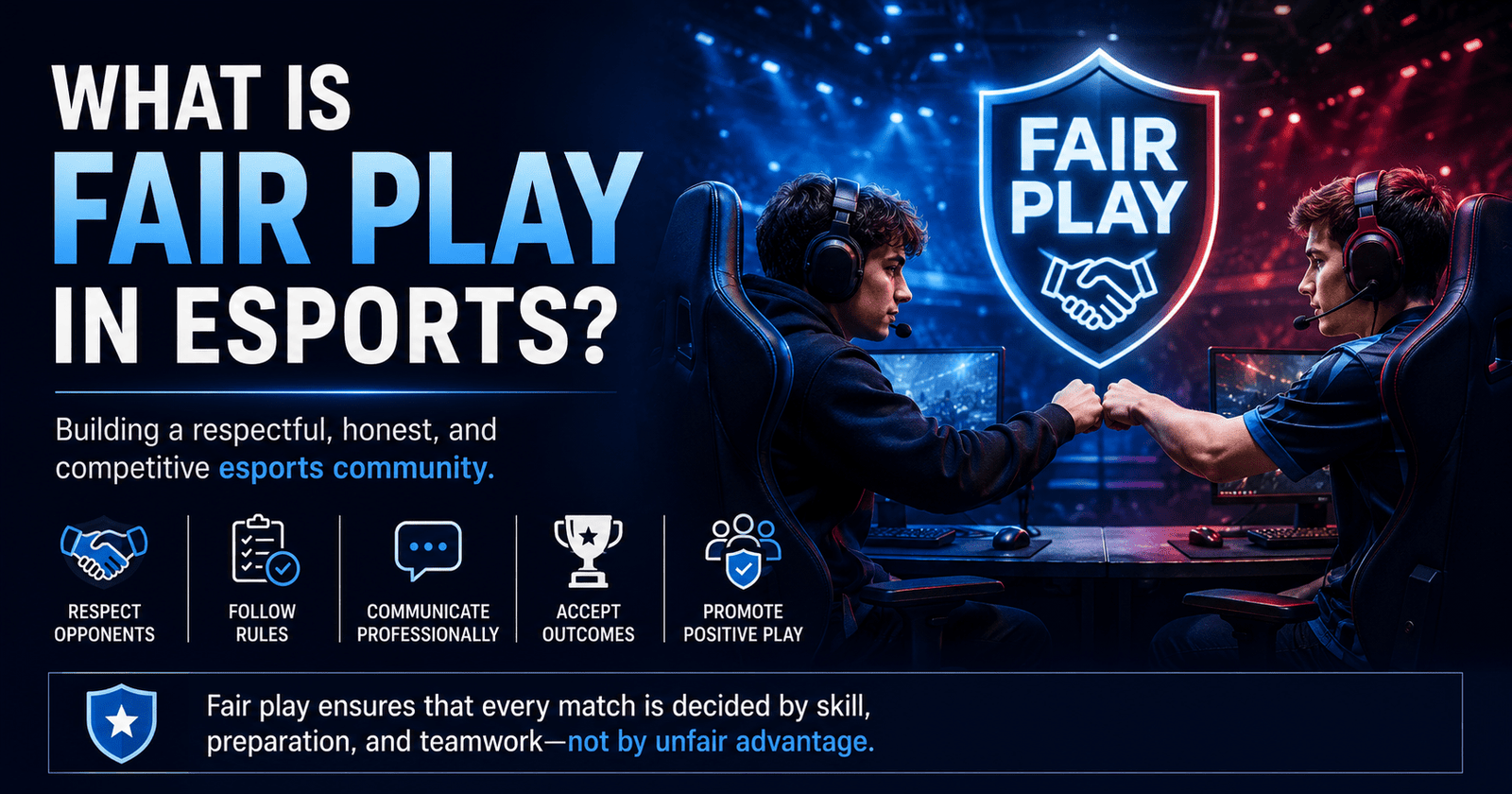
What is fair play in esports – Fair play is one of the most fundamental principles of competitive esports. It represents the commitment of every participant to compete honestly, respect the rules, treat opponents with respect, and preserve the spirit of competition. While tournament rules define what competitors can and cannot do, fair play reflects the mindset and behavior that make those rules meaningful.
As esports has grown into a global industry with professional organizations, collegiate leagues, community tournaments, and international championships, maintaining fair play has become increasingly important. Tournament organizers are expected to provide an environment where victories are earned through skill, teamwork, preparation, and strategic decision-making—not through unsportsmanlike conduct, exploitation, intimidation, or unethical behavior.
Fair play extends beyond simply avoiding cheating. It includes respecting tournament officials, communicating professionally, accepting administrative decisions, reporting incidents honestly, following tournament procedures, and contributing to a positive competitive environment. These behaviors strengthen player confidence while improving the credibility of the tournament itself.
For organizers, promoting fair play requires more than publishing a rulebook. It involves creating clear expectations, applying rules consistently, encouraging sportsmanship, and establishing governance processes that reward ethical competition while addressing misconduct in a transparent and impartial manner.
This guide explains what fair play means in esports, why it matters, how it differs from competitive integrity, and how tournament organizers can foster a culture where fairness becomes an integral part of every competition.


Executive Summary
Fair play in esports is the commitment to compete honestly, respectfully, and according to the established rules while preserving the integrity and spirit of competition.
It is demonstrated through behaviors such as:
- Respecting tournament rules
- Treating opponents professionally
- Accepting administrative decisions
- Demonstrating good sportsmanship
- Reporting incidents honestly
- Avoiding unsportsmanlike conduct
- Respecting referees and tournament staff
- Following tournament procedures
- Maintaining ethical competitive behavior
- Supporting a positive competitive environment
Fair play benefits everyone involved in a tournament. Players compete under equal expectations, administrators manage fewer disputes, sponsors associate with trustworthy events, and communities develop greater confidence in tournament governance.
While tournament integrity focuses on operational governance and competitive integrity emphasizes consistent rule enforcement, fair play centers on the conduct and ethical responsibilities of every participant throughout the competition.
Main Guide
What Is Fair Play in Esports?
Fair play in esports is the commitment to compete honestly, respectfully, and ethically while following tournament rules and respecting fellow competitors, officials, and the competitive process.
Although many people associate fair play solely with avoiding cheating, its scope is significantly broader.
Fair play reflects the values that guide player behavior before, during, and after every match. It influences how competitors communicate, respond to adversity, interact with tournament administrators, and accept both victory and defeat.
Players who demonstrate fair play understand that winning should always result from legitimate competitive performance rather than exploiting loopholes, intimidating opponents, or manipulating tournament procedures.
For tournament organizers, fair play serves as one of the foundations of a healthy competitive ecosystem. It reduces unnecessary conflicts, promotes respectful interactions, and helps create an environment where competitors trust both one another and the tournament administration.
Rather than functioning as a single tournament rule, fair play becomes a cultural standard that shapes every aspect of competitive participation.
Core Characteristics of Fair Play
Strong fair play is reflected through consistent behaviors rather than isolated actions.
Its defining characteristics include:
- Respect for tournament rules
- Honest competition
- Professional communication
- Respect toward opponents
- Respect toward referees
- Acceptance of legitimate decisions
- Ethical competitive conduct
- Responsibility for personal actions
- Positive contribution to the competitive environment
- Commitment to sportsmanship
Together, these principles create competitions where participants focus on demonstrating skill rather than exploiting weaknesses in tournament administration.
Practical Example
During a decisive playoff match, a player notices that an opponent has experienced a temporary technical issue before the game officially begins.
Instead of attempting to gain an unfair advantage by immediately requesting the match start, the player notifies the referee and allows tournament officials to resolve the situation according to the published procedures.
No tournament rule specifically required this action.
However, it demonstrates excellent fair play because the player prioritized the integrity of the competition over obtaining an avoidable competitive advantage.
Recommended Internal Link
- What Is Competitive Integrity?
Related Topic
- Tournament Ethics
Why Fair Play Matters in Esports
Fair play creates an environment where competition is decided by skill, preparation, and teamwork while fostering trust among players, officials, sponsors, and spectators.
Esports tournaments rely on more than written rules.
They depend on participants choosing to compete with honesty, professionalism, and mutual respect.
Without fair play, tournaments experience more disputes, increased hostility, greater administrative workload, and declining community confidence.
When competitors consistently demonstrate sportsmanship, tournament operations become smoother, investigations become less frequent, and disciplinary actions become more objective.
Benefits for Tournament Organizers
Encouraging fair play generates significant operational advantages.
| Benefit | Organizational Impact |
|---|---|
| Fewer disputes | Reduced administrative workload |
| Better player behavior | More professional tournament environment |
| Higher community trust | Stronger tournament reputation |
| Improved governance | Easier rules enforcement |
| Greater sponsor confidence | Enhanced commercial credibility |
| Positive player experience | Increased participant retention |
Fair play reduces the need for reactive administration by encouraging responsible behavior before problems arise.
Benefits for Players
Players benefit when tournaments actively promote fair play because they compete in an environment where:
- Opponents follow the same expectations.
- Respectful communication is encouraged.
- Rules are applied consistently.
- Unsportsmanlike conduct is addressed.
- Administrative decisions are transparent.
- Competition remains focused on skill.
These conditions improve both the competitive experience and long-term community engagement.
Benefits for the Esports Community
Communities are more likely to support tournaments that consistently demonstrate fair play.
Professional conduct encourages healthier online discussions, improves relationships between players and organizers, and contributes to the long-term sustainability of competitive ecosystems.
Sponsors, content creators, educational institutions, and amateur organizations are also more willing to participate in environments known for professionalism and ethical competition.
Common Mistake
Many organizers assume fair play is automatically achieved once tournament rules are published.
In reality, fair play requires continuous reinforcement through communication, education, consistent administration, and visible leadership from tournament officials.
Rules establish expectations.
Culture determines whether those expectations become everyday behavior.
Recommended Internal Link
- What Is Tournament Integrity?
Related Topic
- Tournament Governance
Fair Play vs. Competitive Integrity
Fair play focuses on the behavior and ethical responsibilities of participants, while competitive integrity focuses on ensuring that tournament administration consistently protects fair competition.
Although these concepts are closely connected, they address different aspects of esports governance.
Fair play is primarily behavioral.
Competitive integrity is primarily administrative.
Players demonstrate fair play by respecting opponents, following tournament rules, communicating professionally, and competing honestly.
Tournament organizers demonstrate competitive integrity by enforcing rules consistently, conducting impartial investigations, documenting decisions, and managing disputes transparently.
Both concepts reinforce one another.
Competitions where players embrace fair play generate fewer incidents.
Competitions with strong competitive integrity encourage players to maintain fair play because they trust that misconduct will be handled consistently.
Neither concept can fully succeed without the other.
Key Differences
| Fair Play | Competitive Integrity |
| Focuses on participant behavior | Focuses on tournament governance |
| Encourages ethical competition | Ensures consistent rule enforcement |
| Promotes sportsmanship | Promotes administrative consistency |
| Shapes player culture | Shapes organizational processes |
| Reduces misconduct through values | Reduces disputes through governance |
Understanding this distinction helps organizers build tournaments that combine positive player behavior with professional administrative practices.
Together, fair play and competitive integrity establish the trust required for successful esports competitions.
Recommended Internal Link
- Tournament Integrity vs Competitive Integrity
Related Topic
- Code of Conduct
The Core Principles of Fair Play in Esports
Fair play is sustained by principles that encourage ethical behavior, respect, and responsibility throughout every stage of competition.
Tournament rules define acceptable conduct, but fair play is demonstrated through the daily actions of players, coaches, team managers, referees, and tournament staff. These principles create an environment where competition is respected regardless of the final result.
1. Respect for the Rules
Rules establish the foundation of every fair competition.
Participants should understand the tournament regulations before competing and follow them consistently without attempting to exploit ambiguities or procedural loopholes.
Respecting the rules also means accepting eligibility requirements, scheduling procedures, communication policies, and disciplinary processes.
Common mistake: Assuming that anything not explicitly prohibited is automatically acceptable.
2. Respect for Opponents
Healthy competition requires mutual respect.
Players should recognize that every opponent deserves the same opportunity to compete under equal conditions, regardless of skill level, reputation, or previous rivalries.
Respect includes:
- Professional communication
- Avoiding harassment
- Avoiding intimidation
- Respecting match procedures
- Accepting legitimate victories and defeats
3. Honesty
Honesty strengthens trust throughout the tournament.
Players should:
- Report incidents truthfully.
- Avoid false accusations.
- Cooperate during investigations.
- Provide accurate information when requested.
- Respect tournament reporting procedures.
Dishonest behavior often creates more damage than the original incident itself.
4. Sportsmanship
Good sportsmanship reflects maturity and professionalism.
Examples include:
- Congratulating opponents after matches.
- Remaining respectful during defeats.
- Avoiding toxic behavior.
- Supporting a positive competitive atmosphere.
- Accepting referee decisions respectfully.
Sportsmanship demonstrates that success is measured not only by victories but also by character.
5. Responsibility
Every participant is responsible for their own conduct.
Blaming teammates, administrators, or opponents for avoidable misconduct weakens accountability and damages tournament culture.
Professional competitors accept responsibility for their actions and strive to improve continuously.
6. Respect for Tournament Officials
Tournament referees and administrators play an essential role in maintaining fair competition.
Participants should:
- Follow official instructions.
- Communicate respectfully.
- Cooperate during investigations.
- Respect published procedures.
- Use the appeals process appropriately when disagreements arise.
Disrespect toward officials often escalates situations that could otherwise be resolved efficiently.
Practical Example
During a semifinal match, a player notices that an opponent accidentally joins the wrong lobby before the match begins.
Rather than remaining silent to gain a potential competitive advantage, the player informs the referee so the mistake can be corrected before play starts.
This action demonstrates honesty, sportsmanship, and respect for the competition, even though it offers no direct benefit to the player making the report.
Recommended Internal Link
- What Is Competitive Integrity?
Related Topic
- Sportsmanship in Esports
Common Threats to Fair Play
Fair play is most often challenged by behaviors that prioritize winning over ethical competition.
Not every threat involves deliberate cheating. Many issues arise from poor sportsmanship, lack of professionalism, or misunderstanding tournament expectations.
The table below summarizes common threats.
| Threat | Impact on Competition | Recommended Response |
|---|---|---|
| Toxic communication | Damages tournament environment | Enforce code of conduct |
| Unsportsmanlike behavior | Reduces player confidence | Consistent disciplinary action |
| Intentional exploitation of loopholes | Creates unfair advantages | Clarify tournament rules |
| False accusations | Complicates investigations | Require evidence-based reporting |
| Disrespect toward officials | Disrupts tournament operations | Professional communication policies |
| Refusal to follow procedures | Delays tournament administration | Standardized enforcement |
Many of these issues can be prevented through education and clear expectations before the tournament begins.
Unsportsmanlike Conduct
Unsportsmanlike behavior includes actions that violate the spirit of competition without necessarily breaking a technical game rule.
Examples include:
- Deliberately provoking opponents.
- Excessive verbal abuse.
- Match disruption.
- Repeated disrespect toward officials.
- Harassing players after matches.
Although these actions may not always influence gameplay directly, they undermine the competitive environment.
Exploiting Procedural Weaknesses
Some participants attempt to gain advantages by exploiting unclear administrative procedures rather than gameplay itself.
Examples include:
- Intentionally delaying matches.
- Manipulating scheduling rules.
- Withholding relevant information.
- Misusing tournament reporting systems.
Clear governance policies reduce these risks significantly.
Poor Communication
Many disputes begin because players misunderstand tournament procedures rather than intentionally violating them.
Organizers should communicate:
- Tournament expectations
- Reporting procedures
- Appeals process
- Code of conduct
- Administrative timelines
Clear communication prevents unnecessary conflict.
Recommended Internal Link
- Incident Management in Esports
Related Topic
- Tournament Rules


Promoting Fair Play Throughout the Tournament Lifecycle
Fair play should be encouraged before, during, and after every tournament rather than addressed only when misconduct occurs.
Building a culture of fair competition requires proactive administration.
Before the Tournament
Organizers should establish expectations by:
- Publishing a code of conduct.
- Explaining tournament rules.
- Defining acceptable behavior.
- Providing reporting procedures.
- Training tournament officials.
- Communicating disciplinary policies.
Education is often the most effective preventive measure.
During the Tournament
Tournament staff should actively reinforce fair play by:
- Monitoring player behavior.
- Addressing misconduct promptly.
- Applying rules consistently.
- Communicating professionally.
- Recording incidents.
- Supporting respectful interactions.
Visible consistency encourages participants to follow the same standards.
After the Tournament
Fair play should continue beyond the final match.
Post-event reviews help identify:
- Behavioral trends
- Frequently reported issues
- Policy improvements
- Educational opportunities
- Future governance enhancements
Continuous improvement strengthens tournament culture over time.
Best Practices for Encouraging Fair Play
Fair play flourishes when organizers combine clear expectations with consistent leadership and transparent governance.
The following practices help create healthier esports competitions.
Publish a Code of Conduct
Every tournament should define expected participant behavior.
An effective code of conduct covers:
- Respectful communication
- Harassment policies
- Sportsmanship expectations
- Reporting procedures
- Penalty framework
- Appeals process
Lead by Example
Tournament officials should model the professionalism they expect from participants.
Respectful communication from administrators encourages similar behavior from players.
Reward Positive Behavior
Recognition can be as valuable as disciplinary action.
Examples include:
- Community recognition
- Sportsmanship awards
- Public appreciation
- Positive feedback
Celebrating good conduct reinforces tournament culture.
Educate Participants
Many behavioral issues stem from misunderstandings rather than intentional misconduct.
Educational resources help players understand:
- Why fair play matters.
- How investigations work.
- How to report incidents.
- How appeals are handled.
- What constitutes unacceptable conduct.
Maintain Consistent Enforcement
Participants quickly lose confidence when similar incidents receive different responses.
Consistency demonstrates professionalism and strengthens trust.
Best Practices Checklist
Before launching your next tournament, verify the following:
- ✅ Tournament rules are published.
- ✅ Code of conduct is available.
- ✅ Sportsmanship expectations are clearly explained.
- ✅ Incident reporting process is documented.
- ✅ Officials receive behavioral guidance.
- ✅ Communication standards are defined.
- ✅ Penalties are applied consistently.
- ✅ Appeals procedures are published.
- ✅ Player education materials are available.
- ✅ Post-event review has been planned.
Common Mistakes That Undermine Fair Play
Fair play is weakened by inconsistent expectations, poor communication, and reactive administration.
Many organizers unintentionally create environments where unsportsmanlike conduct becomes more likely.
The following mistakes are among the most common.
| Mistake | Why It Creates Problems | Better Practice |
|---|---|---|
| Assuming players know expected behavior | Creates inconsistent conduct | Publish a detailed code of conduct |
| Ignoring minor misconduct | Encourages escalation | Address issues early and consistently |
| Applying penalties inconsistently | Reduces confidence | Follow standardized procedures |
| Poor communication | Causes unnecessary disputes | Explain expectations before competition |
| Rewarding only victories | Undervalues sportsmanship | Recognize ethical behavior as well |
| Treating fair play as an afterthought | Weakens tournament culture | Integrate it into tournament planning |
Practical Example
Following a heated group-stage match, two players exchange disrespectful messages in the tournament chat.
Instead of issuing immediate penalties based solely on screenshots shared on social media, tournament officials:
- Review the complete conversation.
- Collect statements from both players.
- Evaluate whether tournament policies were violated.
- Apply the published code of conduct consistently.
- Document the outcome.
By following a structured process, organizers reinforce both fair play and confidence in tournament administration.
Decision Framework
How to Evaluate Fair Play in Your Tournament
Fair play can be measured by evaluating participant behavior, administrative consistency, and the overall competitive environment throughout the tournament.
Use the following framework to assess whether your event promotes a genuine culture of fair play.
| Evaluation Area | Questions to Ask | Indicators of Strong Fair Play |
|---|---|---|
| Tournament Rules | Are behavioral expectations clearly documented? | Public rulebook and code of conduct |
| Player Conduct | Do participants communicate respectfully? | Low incidence of misconduct reports |
| Sportsmanship | Do players demonstrate respect before and after matches? | Positive interactions between competitors |
| Rule Compliance | Are participants following tournament procedures? | Few procedural violations |
| Reporting Culture | Are incidents reported honestly and responsibly? | Accurate, evidence-based reports |
| Administrative Response | Are behavioral issues handled consistently? | Standardized disciplinary workflow |
| Community Environment | Does the tournament encourage respectful competition? | Positive player feedback |
| Continuous Improvement | Are behavioral trends reviewed after each event? | Regular policy updates and staff training |
Self-Assessment Questions
After every tournament, ask the following:
- Did players understand the expected standards of behavior?
- Were incidents handled consistently?
- Were participants treated with professionalism and respect?
- Did tournament staff model the behavior they expected from competitors?
- Were any recurring behavioral issues identified for future improvement?
Answering these questions honestly helps organizers continuously strengthen fair play and improve the overall tournament experience.
Practical Examples
Scenario 1: Respecting an Administrative Pause
During a championship match, a referee pauses the game because of a verified technical issue affecting one team.
Poor Fair Play
- Players complain publicly.
- Opponents pressure administrators to continue.
- Toxic comments appear in tournament chat.
Strong Fair Play
- Both teams cooperate with officials.
- Players wait for instructions.
- Communication remains respectful.
- Match resumes according to tournament procedures.
Lesson: Respect for officials is an essential part of fair play.
Scenario 2: Honest Incident Reporting
A player notices that an opponent accidentally violates a minor tournament procedure.
Poor Fair Play
- The player exaggerates the incident to obtain a harsher penalty.
- Incomplete information is submitted.
- Social media accusations begin before administrators investigate.
Strong Fair Play
- The player reports only factual information.
- Evidence is submitted objectively.
- Tournament officials investigate independently.
- The final decision follows published procedures.
Lesson: Honest reporting protects both competitors and tournament credibility.
Scenario 3: Accepting Defeat Professionally
A team loses a close grand final after an administrative review confirms the official match result.
Poor Fair Play
- Players publicly insult tournament staff.
- False accusations spread online.
- Community discussions become hostile.
Strong Fair Play
- Team requests clarification respectfully.
- Appeals process is used appropriately.
- Final decision is accepted professionally.
- Players congratulate the winners.
Lesson: Sportsmanship is demonstrated most clearly after difficult losses.
Visual Checklist
Pre-Tournament Fair Play Checklist
Before your tournament begins, confirm that the following elements are in place:
- ✅ Tournament rules have been published.
- ✅ Code of conduct is available to all participants.
- ✅ Sportsmanship expectations are clearly explained.
- ✅ Reporting procedures are documented.
- ✅ Tournament officials understand behavioral policies.
- ✅ Penalties are clearly defined.
- ✅ Appeals process is communicated.
- ✅ Communication guidelines are established.
- ✅ Players know how to report misconduct.
- ✅ Behavioral expectations are reinforced during registration.
Post-Tournament Fair Play Review Checklist
After the tournament, evaluate your event using this checklist:
- ✅ Behavioral incidents were documented.
- ✅ Disciplinary decisions were applied consistently.
- ✅ Appeals were handled professionally.
- ✅ Participants received respectful communication.
- ✅ Frequent behavioral issues were identified.
- ✅ Staff reviewed lessons learned.
- ✅ Code of conduct improvements were documented.
- ✅ Future educational opportunities were identified.
- ✅ Community feedback was collected.
- ✅ Governance improvements were scheduled.
Tourney Guard
Fair play is more than good sportsmanship—it is a fundamental component of trustworthy esports competitions. It encourages ethical behavior, strengthens player confidence, reduces unnecessary disputes, and supports the long-term credibility of tournament organizers.
As tournaments become larger and more complex, maintaining fair play requires structured operational processes that help administrators manage behavioral incidents consistently and transparently.
Tourney Guard helps tournament organizers strengthen Tournament Integrity through structured workflows for incident management, evidence collection, administrative investigations, appeals management, decision documentation, and governance. By supporting consistent operational practices, Tourney Guard enables organizers to build competitions where fair play is reinforced through transparent administration and accountable decision-making.
Frequently Asked Questions
What is fair play in esports?
Fair play in esports is the commitment to compete honestly, respectfully, and ethically while following tournament rules and respecting opponents, officials, and the competitive process.
Why is fair play important?
Fair play promotes trust, reduces disputes, improves the player experience, supports tournament credibility, and helps ensure that match outcomes are determined by skill rather than unethical behavior.
Is fair play the same as competitive integrity?
No. Fair play focuses on the behavior and ethical responsibilities of participants, while competitive integrity focuses on the governance, consistency, and administrative processes that ensure competitions remain fair.
Can fair play exist without tournament rules?
No. Fair play depends on clearly defined rules and expectations. While ethical behavior is important, participants need transparent standards that explain acceptable conduct and how violations are addressed.
How can tournament organizers encourage fair play?
Organizers can encourage fair play by publishing a code of conduct, educating participants, training tournament staff, communicating expectations clearly, enforcing rules consistently, documenting incidents, and providing transparent appeals procedures.
How does Tourney Guard support fair play?
Tourney Guard supports fair play by helping organizers manage incidents, collect evidence, document investigations, administer appeals, and maintain transparent governance processes that reinforce consistent tournament administration.
Conclusion
Fair play is one of the defining characteristics of professional esports competitions. It represents the shared commitment of players, teams, officials, and organizers to compete with honesty, respect, responsibility, and integrity.
While tournament rules establish the framework for competition, fair play gives those rules meaning through the everyday actions of participants. Respectful communication, ethical decision-making, sportsmanship, and honest reporting all contribute to a healthier and more sustainable competitive environment.
For tournament organizers, promoting fair play requires more than reacting to misconduct. It involves creating a culture where expectations are clear, behavior is consistently reinforced, and every administrative decision reflects transparency, fairness, and accountability.
As esports continues to grow worldwide, tournaments that actively promote fair play will be better positioned to build lasting trust with players, attract sponsors, strengthen their communities, and establish a reputation for professionalism.
Ultimately, fair play is not simply about following the rules—it is about protecting the spirit of competition itself. When combined with strong governance, consistent rule enforcement, and transparent tournament operations, fair play becomes one of the most valuable assets any esports organization can cultivate.
Recommended External Resources
These organizations publish guidance that supports professional Tournament Integrity programs:
- Esports Integrity Commission (ESIC) – Standards, codes of conduct, investigations, and integrity initiatives.
- International Olympic Committee (IOC) – Integrity frameworks applicable to competitive sports governance.
- International Betting Integrity Association (IBIA) – Best practices for integrity monitoring.
- NIST Cybersecurity Framework – Guidance for security governance and risk management.
- ISO 37301 Compliance Management Systems – International compliance management principles.
- World Anti-Doping Agency (WADA) – Governance and disciplinary process principles applicable beyond traditional sports.
Suggested Internal Links
Strengthen your internal linking strategy by connecting this article with: