Introduction
Creating an Incident Response Plan is one of the most important responsibilities for any esports tournament organizer committed to maintaining tournament integrity. While many organizers invest heavily in tournament rules, anti-cheat software, and production quality, far fewer dedicate the same level of planning to how incidents should actually be managed when they occur.
Every competitive event—whether a local community tournament or an international championship—will eventually face unexpected situations. A cheating allegation, a player dispute, technical failure, rule violation, identity concern, or administrative error can quickly escalate if organizers are forced to improvise their response. Without predefined procedures, similar incidents may receive different outcomes, creating perceptions of inconsistency and unfairness.
An Incident Response Plan provides tournament officials with a structured framework for identifying, documenting, investigating, resolving, and communicating incidents consistently. Rather than relying on individual judgment under pressure, organizers follow established procedures that protect competitive integrity while improving transparency and accountability.
More importantly, an effective response plan protects everyone involved. Players understand how reports are handled, administrators know their responsibilities, sponsors gain confidence in the tournament’s governance, and the community sees that decisions are based on documented processes rather than opinions.
This guide explains how to create an Incident Response Plan specifically designed for esports tournaments, including its essential components, operational workflows, best practices, and the governance principles that make investigations fair, repeatable, and trustworthy.
What Is an Incident Response Plan?
An Incident Response Plan is a documented operational framework that defines how tournament staff should respond whenever an incident threatens the integrity, fairness, or normal operation of a competition.
Unlike a tournament rulebook, which explains what the rules are, an Incident Response Plan explains how organizers enforce those rules when something goes wrong.
It answers questions such as:
- Who receives incident reports?
- How should evidence be collected?
- Who investigates the case?
- What standards of proof should be applied?
- Who has authority to issue sanctions?
- How are players informed?
- How are appeals managed?
- How should documentation be archived?
Instead of leaving these decisions to individual staff members during stressful situations, the plan establishes repeatable procedures that every tournament official can follow.
A well-designed Incident Response Plan transforms incident handling from an improvised reaction into a standardized administrative process.
Incident Response Plans vs. Tournament Rulebooks
Many organizers mistakenly assume their tournament rulebook already serves as an incident management guide. In reality, the two documents serve different purposes.
| Tournament Rulebook | Incident Response Plan |
|---|---|
| Defines tournament rules | Defines operational procedures |
| Explains prohibited behavior | Explains how reports are managed |
| Lists penalties | Describes investigation workflow |
| Guides participants | Guides tournament staff |
| Focuses on compliance | Focuses on administration |
Both documents complement each other.
The rulebook establishes expectations for participants, while the Incident Response Plan ensures those expectations are enforced consistently.
Without both, tournament governance remains incomplete.
What Types of Incidents Should the Plan Cover?
A comprehensive Incident Response Plan should address every category of incident that could affect tournament integrity.
Common examples include:
Competitive Integrity Incidents
- Cheating allegations
- Unauthorized software
- Exploiting game bugs
- Match manipulation
- Smurfing
- Account sharing
- Coaching violations
Administrative Incidents
- Incorrect tournament seeding
- Rule interpretation disputes
- Scheduling conflicts
- Player eligibility questions
- Registration errors
- Roster violations
Technical Incidents
- Server outages
- Replay failures
- Connection instability
- Hardware malfunctions
- Streaming interruptions
Conduct Violations
- Harassment
- Toxic behavior
- Threats
- Offensive language
- Unsportsmanlike conduct
Evidence-Related Incidents
- Missing match recordings
- Altered screenshots
- Incomplete reports
- Disputed timestamps
- Anonymous allegations
The objective is not to predict every possible incident but to establish a repeatable process that can adapt to different situations.
Why Creating an Incident Response Plan Matters
Tournament integrity is measured not only by the quality of competition but also by the quality of governance behind it.
When incidents occur, organizers are evaluated on their response just as much as the outcome itself.
A structured Incident Response Plan creates confidence across the entire competitive ecosystem.
For Players
Players want assurance that:
- Reports are taken seriously.
- Evidence is reviewed objectively.
- Rules are applied consistently.
- Similar cases receive similar outcomes.
- Appeals are available when appropriate.
Without these guarantees, players quickly lose trust in tournament administration.
For Tournament Officials
Officials often work under significant time pressure.
Without documented procedures they may:
- Miss important evidence.
- Forget required documentation.
- Apply inconsistent sanctions.
- Communicate conflicting information.
- Delay investigations unnecessarily.
A response plan removes uncertainty by providing step-by-step operational guidance.
For Tournament Organizers
From an organizational perspective, standardized procedures reduce operational risk.
Benefits include:
- Faster investigations
- Better documentation
- Lower administrative workload
- Improved staff coordination
- Consistent decision-making
- Easier onboarding for new administrators
- Stronger governance maturity
Instead of depending on a few experienced staff members, the organization develops repeatable institutional knowledge.
For Sponsors and Partners
Sponsors increasingly expect esports events to demonstrate professional governance.
An organized incident management process signals that organizers take competitive integrity seriously.
Transparent operational procedures help protect brand reputation while reducing controversy around tournament decisions.
For the Community
Communities rarely expect tournaments to avoid every incident.
They do expect organizers to handle incidents fairly.
When investigations appear inconsistent or opaque, speculation quickly replaces facts.
A documented Incident Response Plan increases transparency and demonstrates that tournament decisions follow established procedures rather than personal opinions.
Over time, this consistency becomes one of the strongest indicators of a professionally managed competition.
Core Principles of an Effective Incident Response Plan
Every successful Incident Response Plan is built on a small number of governance principles. These principles ensure that procedures remain fair, repeatable, and defensible regardless of the type of incident being investigated.
1. Consistency
Every similar incident should follow the same investigation process.
Consistency reduces bias and improves trust.
It also allows organizers to compare historical cases when making decisions.
Questions to ask include:
- Does every report use the same submission process?
- Are evidence requirements standardized?
- Are sanctions based on documented policies?
- Can another administrator reproduce the same decision?
Consistency is one of the strongest foundations of tournament integrity.
2. Timeliness
Delayed investigations create uncertainty.
Players may continue competing while under investigation, brackets may advance before evidence is reviewed, and important information can be lost over time.
An Incident Response Plan should define expected response times for each stage of the investigation, including:
- Report acknowledgment
- Initial assessment
- Evidence collection
- Investigator assignment
- Decision issuance
- Appeal submission
Establishing service expectations helps organizers balance thorough investigations with the operational pace of a live tournament.
3. Objectivity
Investigations should be based on verifiable evidence rather than assumptions, popularity, or public pressure.
Officials must evaluate:
- Match recordings
- Game logs
- Screenshots
- Communication records
- Tournament logs
- Witness statements
Objective evidence should always take precedence over speculation or community sentiment.
4. Accountability
Every action taken during an investigation should be documented.
This includes:
- Who received the report
- When actions were performed
- What evidence was reviewed
- Which officials participated
- Why decisions were reached
- What sanctions were applied
Maintaining a complete audit trail supports transparency, simplifies future reviews, and strengthens organizational governance.
5. Transparency
Transparency does not require publishing every internal detail of an investigation.
Instead, it means ensuring that participants understand:
- How incidents are reported.
- What process will be followed.
- Who is responsible for investigations.
- What outcomes are possible.
- Whether appeals are available.
Clear communication reduces confusion and reinforces confidence in tournament administration.
6. Continuous Improvement
An Incident Response Plan should never remain static.
After each tournament, organizers should review completed investigations to identify:
- Recurring incident types
- Process bottlenecks
- Documentation gaps
- Communication issues
- Opportunities for automation
- Lessons learned
Updating procedures based on real operational experience ensures that the response plan evolves alongside the tournament and continues to support high standards of competitive integrity.
Building an Incident Response Framework
An effective Incident Response Plan is more than a written policy—it is an operational framework that guides tournament staff from the moment an incident is reported until the case is officially closed.
Rather than relying on individual experience or ad hoc decisions, organizers should establish a repeatable workflow that every administrator follows, regardless of the tournament size or incident type.
The framework below can be adapted for online tournaments, LAN events, leagues, or seasonal competitions.
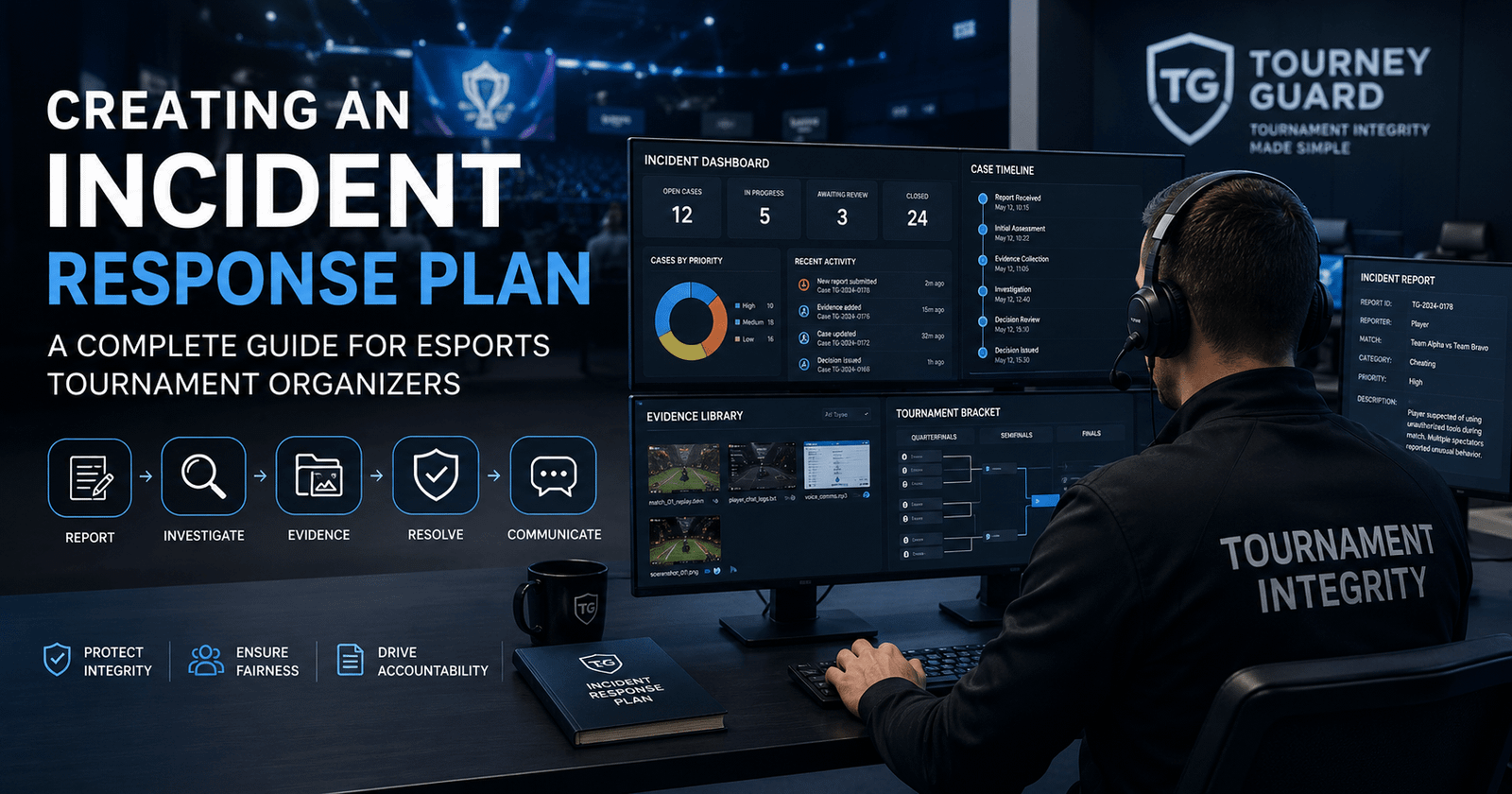
The Incident Response Lifecycle
Every incident should progress through a defined lifecycle.
A standardized lifecycle helps ensure that no critical step is overlooked while maintaining consistency across investigations.
Incident Report
        ↓
Initial Assessment
        ↓
Case Creation
        ↓
Evidence Collection
        ↓
Investigation
        ↓
Decision Review
        ↓
Official Decision
        ↓
Communication
        ↓
Appeal (if applicable)
        ↓
Case Closure
        ↓
Post-Incident Review
Each stage has a specific objective and designated responsibilities.
Step 1: Incident Reporting
Every investigation begins with a report.
The easier it is for participants to report concerns, the more likely organizers are to identify issues before they escalate.
An Incident Response Plan should clearly define:
- Who can submit reports
- Accepted reporting channels
- Required information
- Reporting deadlines
- Anonymous reporting policy
- Evidence submission requirements
A standard incident report should capture information such as:
- Tournament name
- Match identifier
- Date and time
- Reporter identity
- Players involved
- Description of the incident
- Supporting evidence
- Witnesses (if any)
- Urgency level
Using standardized forms ensures investigators receive consistent information regardless of who submits the report.
Best Practice
Avoid allowing incident reports through scattered communication channels such as direct messages, personal emails, or social media.
Instead, establish a single official reporting process that automatically records every submission.
Step 2: Initial Assessment
Not every report requires a full investigation.
The first administrative review determines whether the report is:
- Valid
- Complete
- Actionable
- Within tournament jurisdiction
During this stage, officials answer questions such as:
- Does the report contain enough information?
- Is additional evidence required?
- Does the incident violate tournament rules?
- Is immediate intervention necessary?
For example:
Immediate Response Required
- Active cheating during a live match
- Threats toward participants
- Match-fixing concerns
- Tournament server compromise
Standard Investigation
- Rule interpretation disputes
- Unsportsmanlike conduct
- Administrative mistakes
- Minor technical complaints
Classifying incidents early helps organizers allocate resources appropriately.
Step 3: Case Registration
Once a report is accepted, it should become an official investigation.
Every case should receive:
- Unique case number
- Creation timestamp
- Assigned investigator
- Current status
- Priority level
- Incident category
For example:
Case ID:
TG-2026-0043

Category:
Competitive Integrity

Priority:
High

Status:
Evidence Collection

Assigned Investigator:
Tournament Integrity Officer
Maintaining unique case identifiers improves traceability throughout the tournament.
Step 4: Evidence Collection
Evidence is the foundation of every investigation.
Without reliable evidence, administrators risk making inconsistent or incorrect decisions.
Evidence may include:
Digital Evidence
- Match replays
- Video recordings
- Tournament logs
- Game server logs
- Voice communications
- Chat logs
- Screenshots
Administrative Evidence
- Registration records
- Roster history
- Rule acknowledgments
- Previous disciplinary actions
Human Evidence
- Witness statements
- Referee observations
- Staff reports
- Player interviews
Every piece of evidence should include:
- Source
- Collection date
- Collector
- Original format
- Verification status
Documenting this information strengthens credibility and supports future appeals.
Chain of Custody
Large tournaments should maintain a simple chain of custody for evidence.
For every file collected, record:
- Who obtained it
- When it was collected
- Where it was stored
- Whether it was modified
- Who accessed it
Although chain-of-custody procedures are often associated with legal investigations, they are equally valuable in esports governance because they preserve confidence in the integrity of the evidence.
Step 5: Investigation
This is where administrators analyze all available information before reaching a conclusion.
Investigators should avoid making assumptions based on:
- Community opinion
- Social media discussions
- Player popularity
- Sponsor influence
- Public pressure
Instead, investigations should answer objective questions.
Examples include:
- What happened?
- Which rules apply?
- What evidence supports the allegation?
- Are alternative explanations possible?
- Does evidence meet the required standard?
- Have similar cases occurred previously?
A structured investigation produces decisions that can be defended with documented reasoning rather than subjective judgment.
Investigation Techniques
Experienced tournament administrators often combine several investigative methods.
Timeline Reconstruction
Create a chronological sequence of events.
Example:
- Match begins
- Player disconnects
- Suspicious activity reported
- Replay reviewed
- Administrator contacted
- Decision issued
Timelines frequently reveal inconsistencies that isolated evidence may overlook.
Evidence Corroboration
Never rely on a single source whenever multiple sources are available.
For example:
Instead of trusting only one screenshot:
- Compare replay footage
- Review chat logs
- Examine referee notes
- Verify timestamps
- Interview witnesses
Multiple independent sources increase confidence in the investigation’s findings.
Rule Mapping
Every conclusion should reference specific tournament rules.
Rather than stating:
“The player acted unfairly.”
Document:
“The evidence indicates a violation of Rule 5.3 (Unauthorized External Assistance).”
This approach reduces ambiguity and improves transparency.
Step 6: Decision Review
Before issuing sanctions, another senior official—or an integrity committee for larger tournaments—should review the investigation.
A secondary review helps identify:
- Missing evidence
- Inconsistent reasoning
- Misinterpreted rules
- Excessive penalties
- Procedural errors
This additional layer of oversight improves fairness and reduces the likelihood of avoidable appeals.
Step 7: Official Decision
Every decision should be documented in a standardized format.
A decision record typically includes:
- Case number
- Summary of findings
- Evidence reviewed
- Applicable rules
- Decision rationale
- Sanctions (if applicable)
- Effective date
- Appeal instructions
Clear documentation ensures that participants understand not only the outcome but also how the conclusion was reached.
Step 8: Communication
One of the most common sources of controversy is poor communication.
Players should receive decisions that are:
- Clear
- Professional
- Respectful
- Consistent
- Based on documented facts
Avoid emotional language or speculation.
Instead of:
“We believe you cheated.”
Use:
“After reviewing the available evidence, tournament officials determined that Rule 4.2 was violated. The resulting sanction is…”
Professional communication reinforces confidence in the investigation process.
Step 9: Appeals Process
No Incident Response Plan is complete without an appeals process.
Appeals should not exist to restart investigations indefinitely.
Instead, they provide an opportunity to review whether:
- New evidence exists.
- Procedures were followed correctly.
- Rules were interpreted appropriately.
- Significant administrative errors occurred.
The plan should specify:
- Appeal deadlines
- Submission requirements
- Eligible grounds for appeal
- Review authority
- Final decision process
A structured appeals process demonstrates accountability while preventing unnecessary delays.
Roles and Responsibilities
Clearly assigning responsibilities prevents confusion during high-pressure situations.
| Role | Primary Responsibilities |
|---|---|
| Tournament Organizer | Overall governance and policy approval |
| Tournament Administrator | Case management and coordination |
| Referee | Observe matches and submit reports |
| Integrity Officer | Lead investigations and evaluate evidence |
| Technical Staff | Preserve logs and technical evidence |
| Appeals Committee | Review disputed decisions |
| Communications Lead | Deliver official decisions and updates |
Even small tournaments benefit from assigning these responsibilities, even if one individual fulfills multiple roles.
Common Mistakes When Creating an Incident Response Plan
Many organizers recognize the importance of incident management but still struggle because of preventable planning mistakes.
Mistake 1: Defining Rules Without Defining Procedures
Knowing what constitutes a violation is not enough.
Without documented procedures, staff may handle similar cases differently, leading to inconsistent outcomes and reduced trust.
Mistake 2: Collecting Evidence Too Late
Digital evidence can disappear quickly.
Replay files, chat logs, temporary server logs, and streaming footage may be overwritten or deleted if not preserved immediately.
The response plan should define clear timelines and responsibilities for evidence collection.
Mistake 3: Assigning Investigations to Interested Parties
Investigators should avoid handling cases where they have personal relationships, competitive interests, or other conflicts that could affect impartiality.
When conflicts arise, the case should be reassigned.
Mistake 4: Poor Documentation
If an investigation is not documented, it becomes difficult to justify decisions, respond to appeals, or learn from previous cases.
Every action should leave a documented audit trail.
Mistake 5: Failing to Review Closed Cases
Once a case is resolved, many organizers simply move on.
Instead, every significant investigation should conclude with a brief retrospective to identify lessons learned and opportunities to improve future procedures.
Best Practices for an Effective Incident Response Plan
Organizations with mature tournament governance often share the same operational habits.
Some of the most valuable best practices include:
- Standardize every incident report using structured templates.
- Define investigation timelines before the tournament begins.
- Maintain centralized evidence repositories.
- Require documented reasoning for every disciplinary decision.
- Train staff on incident procedures before the first match.
- Conduct periodic tabletop exercises using hypothetical scenarios.
- Review and update the Incident Response Plan after each event.
- Track recurring incident types to improve prevention strategies.
- Separate investigation responsibilities from final decision-making whenever possible.
- Maintain historical records to ensure consistent treatment across tournaments.
These practices reduce operational uncertainty while improving fairness, transparency, and organizational maturity.
How Technology Supports Incident Response
As tournaments grow, managing incidents with spreadsheets, chat applications, and shared folders becomes increasingly difficult.
Modern tournament operations benefit from platforms that centralize the entire incident lifecycle.
Technology can help organizers:
- Receive standardized incident reports.
- Automatically assign case numbers.
- Track investigation progress.
- Store evidence securely.
- Maintain complete audit trails.
- Monitor response timelines.
- Record sanctions consistently.
- Manage appeals from a single workspace.
- Produce governance reports for internal review.
Rather than replacing human judgment, technology supports consistent execution of the procedures defined in the Incident Response Plan.
This becomes especially valuable for organizations running multiple tournaments simultaneously or coordinating investigations across distributed administrative teams.
KPIs for Measuring Incident Response Effectiveness
An Incident Response Plan should not be considered complete simply because it exists. Like any operational process, it must be measured and continuously improved.
Tracking key performance indicators (KPIs) helps tournament organizers evaluate how efficiently incidents are handled, identify bottlenecks, and strengthen governance over time.
Below are some of the most valuable metrics for tournament operations.
| KPI | Why It Matters |
|---|---|
| Average Incident Response Time | Measures how quickly reports are acknowledged. |
| Average Investigation Duration | Tracks the efficiency of investigations. |
| Cases Closed Within SLA | Indicates operational consistency. |
| Appeals Rate | Reveals whether decisions are generally accepted. |
| Appeal Reversal Rate | Measures the quality and fairness of investigations. |
| Evidence Completeness Rate | Shows how often investigations begin with sufficient evidence. |
| Repeat Incident Rate | Identifies recurring integrity issues. |
| Investigator Workload | Helps balance assignments across staff. |
| Documentation Completeness | Ensures every case includes the required records. |
| Incident Resolution Satisfaction | Can be gathered through post-event surveys to assess participant confidence. |
Monitoring these KPIs over multiple tournaments enables organizers to make data-driven improvements instead of relying on assumptions.
Incident Response Plan Checklist
Use the following checklist before launching any tournament.
✓ An Incident Response Plan has been documented and approved.
✓ Tournament staff understand their incident response responsibilities.
✓ Official reporting channels have been established.
✓ Standard incident report forms are available.
✓ Evidence collection procedures are documented.
✓ Evidence storage locations are secure and centralized.
✓ Case numbering standards are defined.
✓ Incident priority levels have been established.
✓ Investigation procedures are documented.
✓ Decision review requirements are defined.
✓ Appeal procedures are published.
✓ Communication templates have been prepared.
✓ Incident response timelines are documented.
✓ Audit trail requirements are established.
✓ Post-incident review meetings are scheduled after the tournament.
✓ Staff members have completed incident response training.
✓ Historical cases are retained for future reference and consistency.
Completing this checklist before the tournament begins significantly reduces operational uncertainty when incidents occur.
Frequently Asked Questions
1. What is the purpose of an Incident Response Plan in esports?
An Incident Response Plan provides tournament staff with a structured process for handling incidents consistently and fairly. Instead of making decisions under pressure, organizers follow predefined procedures for reporting, investigating, documenting, resolving, and reviewing cases. This improves competitive integrity, transparency, and trust among players, officials, and sponsors.
2. How is an Incident Response Plan different from a tournament rulebook?
A tournament rulebook explains what participants are allowed or prohibited from doing, while an Incident Response Plan explains how tournament staff enforce those rules when incidents occur. The rulebook defines expectations; the response plan defines operational procedures.
3. Should small community tournaments have an Incident Response Plan?
Absolutely. While smaller events may not require complex governance structures, they still benefit from standardized reporting, evidence collection, and investigation procedures. Even a simplified Incident Response Plan helps organizers make fair, consistent decisions and reduces confusion during disputes.
4. Who should investigate tournament incidents?
The investigation should be handled by individuals with appropriate authority and no conflicts of interest. Depending on the tournament size, this may be a Tournament Administrator, an Integrity Officer, or an Investigation Committee. Separating investigators from final decision-makers can further improve fairness and accountability.
5. How often should an Incident Response Plan be updated?
The plan should be reviewed after every tournament or competitive season. Organizers should incorporate lessons learned from completed investigations, update procedures based on recurring issues, revise communication practices, and adjust workflows as tournament operations evolve.
Conclusion
Creating an Incident Response Plan is one of the most valuable investments an esports organization can make to strengthen tournament governance and competitive integrity.
Incidents are inevitable in competitive environments, but inconsistent responses are not.
By defining clear reporting procedures, standardized investigation workflows, evidence management practices, communication protocols, and appeal mechanisms before the tournament begins, organizers can respond with confidence instead of improvisation.
More importantly, a well-designed Incident Response Plan builds trust. Players gain confidence that reports will be handled fairly, officials work within a consistent framework, sponsors recognize professional governance, and communities see that decisions are based on documented procedures rather than individual opinions.
As tournaments continue to grow in scale and complexity, structured incident management is no longer optional—it is an essential component of modern tournament administration.
Ready to Put Your Incident Response Plan into Practice?
Designing an Incident Response Plan is an important first step, but consistently applying it across multiple tournaments becomes increasingly challenging as operations expand. Manual processes, scattered evidence, disconnected communications, inconsistent investigations, and spreadsheet-based tracking can quickly make even the best procedures difficult to follow.
This is where Tourney Guard helps tournament organizers operationalize their governance framework. As a Tournament Integrity Platform, Incident Management Platform, Tournament Administration Platform, and Evidence Management Platform, Tourney Guard centralizes incident reporting, investigation workflows, evidence organization, audit trails, and case management—helping organizers apply consistent administrative practices throughout every event.
If you’re ready to transform documented procedures into repeatable operational workflows, explore how Tourney Guard can support your tournaments.
👉 Start Your 30-Day Free Trial →
Recommended External Resources
These organizations publish guidance that supports professional Tournament Integrity programs:
- Esports Integrity Commission (ESIC) – Standards, codes of conduct, investigations, and integrity initiatives.
- International Olympic Committee (IOC) – Integrity frameworks applicable to competitive sports governance.
- International Betting Integrity Association (IBIA) – Best practices for integrity monitoring.
- NIST Cybersecurity Framework – Guidance for security governance and risk management.
- ISO 37301 Compliance Management Systems – International compliance management principles.
- World Anti-Doping Agency (WADA) – Governance and disciplinary process principles applicable beyond traditional sports.
Suggested Internal Links
Strengthen your internal linking strategy by connecting this article with: