
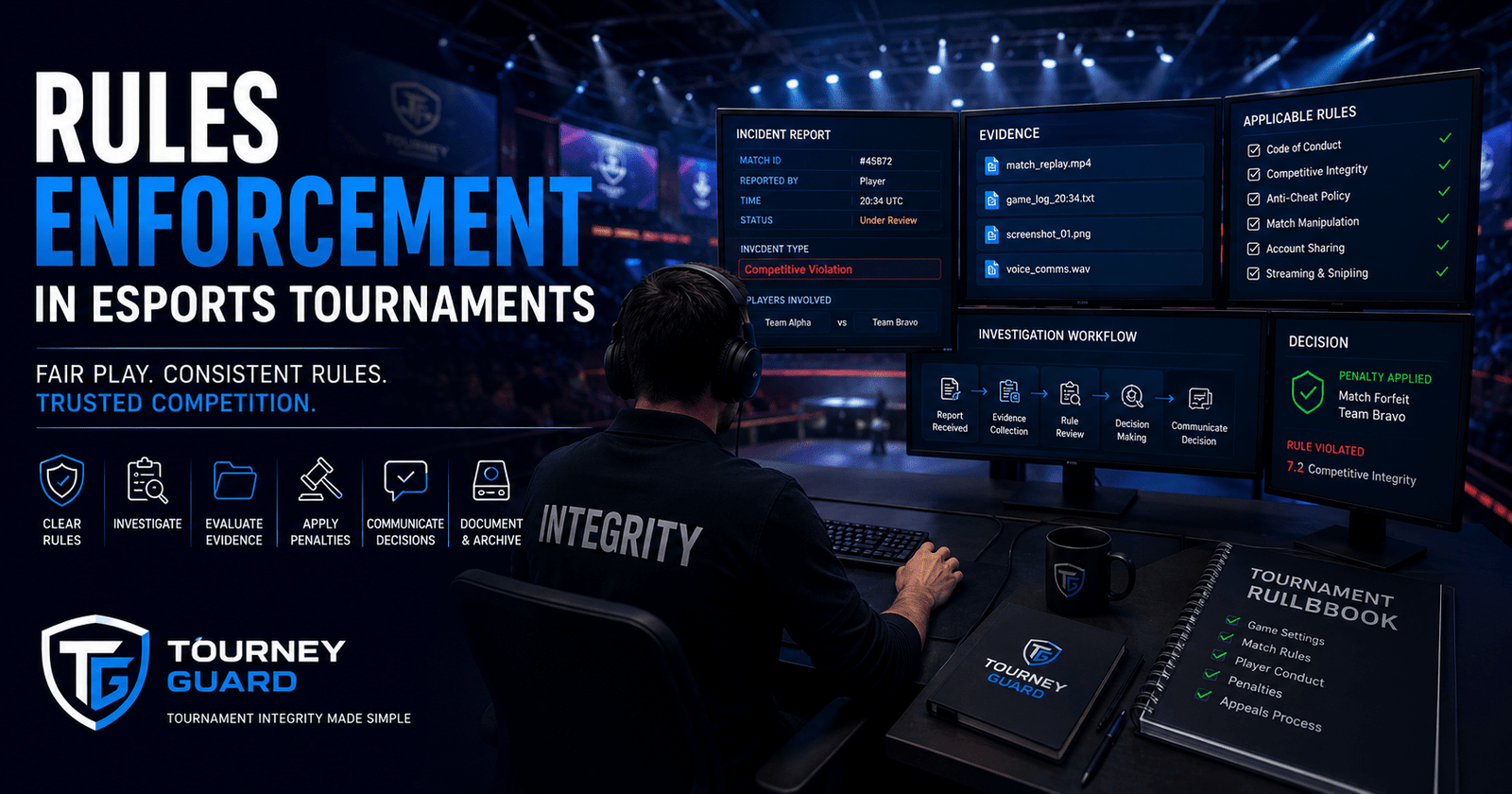
Introduction
Every successful esports tournament relies on more than skilled players, exciting matches, and reliable technology. Behind every credible competition is a structured system that ensures tournament rules are applied fairly, consistently, and transparently. This process is known as rules enforcement, and it plays a critical role in maintaining tournament integrity.
Regardless of whether an event is a small community competition or an international championship, players expect organizers to enforce the published rules without favoritism or inconsistency. When violations are handled differently from one case to another, trust begins to erode. Participants may question administrative decisions, spectators may doubt the legitimacy of results, and sponsors may become hesitant to associate with the event.
Unfortunately, rules enforcement is often misunderstood. Many organizers believe enforcement simply means issuing penalties whenever someone breaks a rule. In reality, effective enforcement is a structured administrative process that begins long before a violation occurs. It includes creating clear rules, training tournament staff, documenting incidents, evaluating evidence, communicating decisions, and maintaining consistent standards throughout the entire event.
Professional tournament operations recognize that enforcement is not about punishment—it is about protecting competitive fairness while ensuring that every participant receives equal treatment.
This guide explains what Rules Enforcement in Esports Tournaments means, why it matters, the principles that support effective enforcement, and how organizers can implement consistent administrative procedures that strengthen tournament integrity.
What Is Rules Enforcement in Esports Tournaments?
Rules Enforcement in Esports Tournaments is the process of applying tournament rules consistently, fairly, and transparently whenever a situation requires administrative action. It ensures that published policies are followed throughout the competition and that similar violations receive comparable treatment regardless of the players or teams involved.
Enforcement extends beyond issuing penalties. It encompasses the complete decision-making process, including:
- Identifying potential rule violations.
- Collecting and reviewing relevant evidence.
- Interpreting the applicable tournament rules.
- Determining the appropriate administrative response.
- Communicating decisions to affected participants.
- Recording outcomes for future reference and consistency.
Because tournaments involve numerous matches, officials, and participants, organizers cannot rely on individual judgment alone. Without documented procedures, two referees may interpret the same incident differently, leading to inconsistent outcomes that undermine confidence in the competition.
Effective rules enforcement transforms tournament governance from subjective decision-making into a structured operational process.
Why Rules Enforcement Is Essential
Rules only have value when they are applied consistently.
Publishing a detailed rulebook may establish expectations, but those expectations become meaningless if organizers fail to enforce them objectively. Players quickly notice inconsistencies, particularly when similar situations produce different outcomes.
Strong enforcement benefits every stakeholder involved in an esports tournament.
Players
Players gain confidence that victories and defeats are determined by skill rather than inconsistent administration. Knowing that every competitor is held to the same standards encourages greater trust in the tournament.
Tournament Staff
Referees and administrators benefit from having clear procedures that reduce uncertainty during difficult situations. Instead of making subjective decisions under pressure, staff members can follow established workflows supported by documented policies.
Tournament Organizers
Organizers reduce operational risk by ensuring that investigations, penalties, and appeals follow repeatable processes. Consistent enforcement also protects the reputation of the tournament and minimizes unnecessary disputes.
Sponsors and Partners
Organizations investing in esports seek professionally managed competitions. Transparent enforcement demonstrates operational maturity and helps reassure sponsors that tournament outcomes are credible and well-governed.
The Community
Spectators, content creators, and community members expect competitions to be fair. Transparent administration reinforces confidence in tournament results and strengthens the long-term reputation of the event.
The Core Principles of Effective Rules Enforcement
Successful enforcement is built on several fundamental principles. These principles guide administrative decisions and help organizers maintain fairness even in complex situations.
Consistency
Consistency is the foundation of tournament governance.
If two players commit the same violation under similar circumstances, they should generally receive similar outcomes. Consistent enforcement eliminates perceptions of favoritism and allows participants to understand how rules are applied in practice.
Maintaining consistency becomes easier when organizers document previous cases and develop standardized decision-making procedures instead of relying solely on individual judgment.
Fairness
Fair enforcement means evaluating each incident objectively based on the available evidence and the published tournament rules.
Administrative decisions should never be influenced by:
- Player popularity
- Team reputation
- Sponsorship status
- Community pressure
- Social media reactions
Instead, decisions should focus on factual information, applicable rules, and documented procedures.
Fairness does not necessarily mean identical outcomes in every case. Context matters. Organizers may consider factors such as intent, competitive impact, previous violations, or mitigating circumstances, provided these considerations are applied consistently.
Transparency
Participants should understand not only what decision was made but also why it was made.
Transparent enforcement includes:
- Clearly published tournament rules.
- Well-defined penalty guidelines.
- Documented investigation procedures.
- Professional communication of decisions.
- Accessible appeal processes.
Transparency reduces misunderstandings and increases confidence in administrative decisions, even when participants disagree with the outcome.
Accountability
Every enforcement action should be documented.
Administrative records should explain:
- The incident.
- Evidence reviewed.
- Rules applied.
- Individuals involved.
- Final decision.
- Reasoning behind the outcome.
Documentation protects both tournament organizers and participants while creating valuable historical references for future tournaments.
Accountability also supports internal reviews, staff training, and continuous improvement after the event concludes.
Common Types of Rule Violations
Although every tournament has its own policies, many esports competitions encounter similar categories of rule violations.
Understanding these categories helps organizers prepare consistent enforcement procedures before the tournament begins.
Competitive Violations
These violations directly affect competitive fairness.
Examples include:
- Unauthorized assistance during matches.
- Stream sniping.
- Account sharing.
- Match manipulation.
- Exploiting prohibited game mechanics.
- Intentional disconnect abuse.
Because these incidents may influence match outcomes, they often require comprehensive investigations supported by strong evidence.
Administrative Violations
Administrative violations relate to tournament operations rather than gameplay itself.
Examples include:
- Missing scheduled check-in times.
- Late match arrivals.
- Incorrect roster submissions.
- Failure to complete required registrations.
- Unauthorized substitutions.
While these violations may appear less severe, inconsistent enforcement can create operational challenges and perceptions of unfair treatment.
Behavioral Violations
Professional conduct is essential for maintaining a healthy competitive environment.
Behavioral violations may include:
- Harassment.
- Offensive language.
- Unsportsmanlike conduct.
- Threats toward officials.
- Disruptive behavior during tournament operations.
Many organizations establish separate codes of conduct that complement the competitive rulebook and provide additional guidance for handling behavioral issues.
Technical Violations
Technology introduces its own set of challenges.
Examples include:
- Unauthorized software.
- Improper hardware configurations.
- Connection manipulation.
- Failure to follow technical setup requirements.
- Unauthorized peripherals where restricted.
Technical incidents often require collaboration between tournament administrators and technical staff to determine whether a violation occurred intentionally or resulted from legitimate technical issues.
The Rules Enforcement Process
Professional tournament organizers do not enforce rules through improvised decisions. Instead, they follow a structured administrative workflow that ensures every incident is handled consistently, regardless of who reports it or who is involved.
Although the exact procedures may differ between organizations, most mature tournament operations follow the same fundamental lifecycle.
Step 1: Receive the Incident Report
Rules enforcement begins when a potential violation is reported.
Reports may originate from various sources, including:
- Players
- Team managers
- Referees
- Tournament administrators
- Anti-cheat systems
- Match observers
- Community reports
- Automated tournament platforms
Every report should be logged immediately rather than handled informally through private conversations or chat messages.
A standardized incident report should capture information such as:
- Date and time
- Match identifier
- Reporter
- Players involved
- Description of the incident
- Initial evidence provided
- Current status
Creating a consistent reporting format ensures that investigators begin every case with the same minimum information, reducing the likelihood of overlooking critical details.
Step 2: Perform an Initial Assessment
Not every report requires a full investigation.
Before allocating resources, administrators should conduct an initial assessment to determine:
- Does the report describe a possible rule violation?
- Is sufficient information available?
- Does additional evidence need to be requested?
- Is immediate action required to preserve tournament integrity?
Some reports can be resolved quickly because they involve simple administrative issues, while others require extensive review.
The purpose of this stage is not to determine guilt but to establish the appropriate investigation path.
Step 3: Collect and Verify Evidence
Evidence is the foundation of effective rules enforcement.
Administrative decisions should never rely solely on assumptions or community opinion.
Instead, investigators should gather all relevant information before reaching conclusions.
Evidence may include:
- Match replays
- Video recordings
- Tournament server logs
- Screenshots
- Voice communications
- Official referee observations
- Streaming footage
- Player statements
- Anti-cheat reports
- Platform logs
Whenever possible, evidence should be preserved in its original format to maintain authenticity.
Multiple independent sources often provide a more reliable understanding of what occurred than relying on a single screenshot or witness account.
Step 4: Identify the Applicable Rules
Once evidence has been collected, investigators must determine which tournament rules apply.
This step is frequently underestimated.
Administrators should avoid making decisions based on what they believe is “fair” if the published rules provide specific guidance.
Questions to consider include:
- Which rule addresses this situation?
- Does the rule clearly prohibit the reported behavior?
- Are there exceptions?
- Have similar situations occurred previously?
Referring directly to the official rulebook helps maintain consistency across multiple tournaments and different administrative teams.
Step 5: Determine the Appropriate Administrative Response
Only after reviewing both the evidence and the applicable rules should organizers determine the appropriate outcome.
Possible responses may include:
- No action required
- Official warning
- Match restart
- Game loss
- Match forfeit
- Point deduction
- Temporary suspension
- Tournament disqualification
- Permanent ban, when authorized by tournament policy
The selected response should always be proportional to the severity of the violation and consistent with previous decisions involving similar circumstances.
Step 6: Communicate the Decision
A professionally managed tournament communicates decisions clearly and respectfully.
Effective communication should explain:
- What was investigated.
- Which rules were applied.
- What evidence was reviewed.
- What decision was reached.
- Whether an appeal is available.
Participants are more likely to accept unfavorable outcomes when they understand how the decision was reached.
Transparency reduces unnecessary disputes and demonstrates professionalism.
Step 7: Archive the Case
Every completed investigation should become part of the tournament’s administrative history.
Archived cases provide valuable information for:
- Future investigations
- Appeal reviews
- Staff training
- Policy improvements
- Decision consistency
Historical records also help organizers identify recurring problems that may require updates to tournament rules or operational procedures.
Common Challenges in Rules Enforcement
Even experienced tournament organizers encounter situations where applying rules consistently becomes difficult. Understanding these challenges in advance allows organizations to develop procedures that minimize confusion and improve decision-making.
Ambiguous Rules
One of the most common sources of inconsistency is unclear wording within the tournament rulebook.
Rules that use subjective language such as “unsportsmanlike behavior,” “reasonable conduct,” or “excessive delay” without providing definitions leave room for interpretation. Different referees may reach different conclusions even when reviewing the same incident.
To reduce ambiguity, organizers should include practical examples whenever possible and define important terms within the rulebook. Clear language not only improves enforcement but also helps players understand expectations before the tournament begins.
Time Pressure During Live Events
Live tournaments often require administrators to make decisions quickly so matches can continue on schedule.
While rapid responses are sometimes necessary, rushing investigations increases the risk of inconsistent or inaccurate decisions.
Organizers should establish predefined emergency procedures for situations requiring immediate action, while allowing more complex incidents to undergo a complete investigation when appropriate.
Separating operational urgency from investigative quality is essential for maintaining competitive integrity.
Incomplete Evidence
Not every incident comes with perfect evidence.
Players may submit partial screenshots, recordings may be unavailable, or witnesses may provide conflicting accounts of what occurred.
Rather than filling gaps with assumptions, administrators should evaluate the reliability of each source and document any limitations identified during the investigation.
If available evidence is insufficient to establish a violation, organizers should avoid imposing penalties that cannot be reasonably supported.
Consistent standards of proof strengthen the credibility of the enforcement process.
External Pressure
Modern esports tournaments operate in an environment where administrative decisions are often discussed publicly within minutes.
Social media, livestream chats, and community forums can generate significant pressure on tournament staff to act quickly or impose severe penalties.
Professional organizers must remain independent.
Administrative decisions should be based on published rules and verified evidence—not public opinion.
Allowing external pressure to influence enforcement undermines both fairness and organizational credibility.
Building a Consistent Decision Framework
One of the most effective ways to improve rules enforcement is to establish a structured framework for evaluating incidents.
Rather than relying solely on personal judgment, administrators can assess each case using consistent evaluation criteria.
A typical framework considers factors such as:
Severity of the Violation
How serious was the rule breach?
Did it have a minor administrative impact or did it compromise competitive fairness?
Intent
Was the action intentional, reckless, or accidental?
Intent does not always determine whether a violation occurred, but it may influence the appropriate administrative response when permitted by tournament policy.
Competitive Impact
Did the violation affect the outcome of a game or match?
Incidents that materially influence competitive results generally require stronger administrative responses than procedural errors with no competitive impact.
Previous Violations
Has the participant committed similar violations during the tournament or in previous events governed by the same organization?
Progressive disciplinary systems often distinguish between first-time offenses and repeated misconduct.
Mitigating Circumstances
Some situations may justify additional consideration.
Examples include:
- Verified technical failures.
- Miscommunication caused by tournament staff.
- Force majeure events.
- Unexpected platform outages.
Mitigating circumstances should never excuse rule violations automatically, but they may influence how organizers apply tournament policies when the rulebook allows discretion.
Using a documented evaluation framework improves consistency across multiple administrators and reduces the likelihood of arbitrary decision-making.
Best Practices for Implementing Rules Enforcement
Establishing tournament rules is only the beginning. The real challenge lies in applying those rules consistently across every match, every participant, and every administrator. Organizations that excel in tournament integrity rely on structured operational practices rather than individual judgment alone.
The following best practices can help organizers build a professional rules enforcement system that scales as tournaments grow in size and complexity.
Publish Rules Before Registration Opens
Players should understand the tournament rules before they decide to participate.
Publishing the complete rulebook before registration opens allows participants to review eligibility requirements, match procedures, prohibited conduct, penalty structures, and appeal processes in advance.
Changing rules during an active tournament should be avoided whenever possible. If changes become necessary due to exceptional circumstances, organizers should communicate them clearly to all participants and document the effective date of the revision.
Transparency begins long before the first match is played.
Train Referees and Tournament Staff
Even the best rulebook cannot guarantee consistent enforcement if tournament officials interpret policies differently.
Before every event, organizers should conduct staff training covering:
- Tournament rules and updates.
- Incident reporting procedures.
- Evidence collection standards.
- Communication guidelines.
- Escalation processes.
- Decision documentation.
Providing staff with practical case studies and previous tournament examples helps improve consistency when real incidents occur.
Standardize Administrative Procedures
Every incident should follow the same workflow regardless of who reports it.
Standard operating procedures reduce uncertainty and ensure that administrators perform investigations using consistent methods.
A typical workflow includes:
- Incident reported.
- Initial assessment completed.
- Evidence collected.
- Applicable rules identified.
- Administrative review performed.
- Decision documented.
- Participants notified.
- Case archived.
Standardization improves both efficiency and fairness.
Maintain Complete Documentation
Documentation is often overlooked during live tournaments, but it becomes invaluable when questions arise after decisions have been made.
Each case should include:
- Incident report.
- Evidence references.
- Investigation notes.
- Applicable rules.
- Decision rationale.
- Penalty applied.
- Date and responsible administrators.
Maintaining complete records creates an institutional memory that helps future staff resolve similar situations consistently.
Review Decisions After the Tournament
Continuous improvement is an essential component of tournament integrity.
After each event, organizers should review completed investigations to identify:
- Frequently reported violations.
- Rules that caused confusion.
- Inconsistent administrative decisions.
- Areas requiring additional referee training.
- Opportunities to improve tournament policies.
Post-event reviews transform operational experience into long-term organizational knowledge.
Rules Enforcement Checklist
The following checklist summarizes the essential elements of an effective rules enforcement program.
Before launching your next tournament, verify that you can answer “yes” to each item.
- ✓ A complete rulebook has been published before registration.
- ✓ Players acknowledge the tournament rules.
- ✓ Referees receive standardized training.
- ✓ Incident reporting procedures are documented.
- ✓ Evidence collection follows consistent standards.
- ✓ Administrative decisions are recorded.
- ✓ Participants receive clear explanations of rulings.
- ✓ Appeals procedures are available when applicable.
- ✓ Completed investigations are archived.
- ✓ Tournament staff conduct a post-event operational review.
Organizations that consistently follow these practices are better prepared to manage complex situations while maintaining participant confidence.
How Technology Supports Rules Enforcement
As esports tournaments continue to grow, manual administration becomes increasingly difficult.
Large competitions may involve hundreds of matches, multiple referees, dozens of incident reports, and extensive evidence collected from various sources. Managing this information through spreadsheets, chat platforms, or scattered documents can quickly become inefficient and increase the risk of inconsistency.
Dedicated tournament integrity platforms help organizers centralize administrative operations by providing structured workflows for incident management.
These platforms may assist with:
- Centralized incident reporting.
- Secure evidence management.
- Investigation tracking.
- Decision documentation.
- Appeal management.
- Administrative audit trails.
- Historical case references.
- Operational reporting.
Technology does not replace tournament officials. Instead, it supports administrators by ensuring that investigations follow consistent procedures and that important information remains organized throughout the tournament lifecycle.
Platforms such as Tourney Guard are designed around this philosophy, helping tournament organizers strengthen integrity through structured governance rather than relying solely on reactive enforcement.
Frequently Asked Questions
What is rules enforcement in esports tournaments?
Rules enforcement is the process of applying tournament rules fairly, consistently, and transparently whenever a participant violates published policies. It includes investigations, evidence review, decision-making, communication, and documentation.
Why is consistent rules enforcement important?
Consistency ensures that similar situations receive similar outcomes. This strengthens player trust, protects tournament credibility, and reduces accusations of favoritism or arbitrary decision-making.
Should every incident result in a penalty?
No. Some investigations may conclude that no rule violation occurred or that available evidence is insufficient to support administrative action. Fair enforcement requires evaluating every case objectively before determining an outcome.
How should organizers handle appeals?
Appeals should follow documented procedures that define eligibility, submission deadlines, required evidence, and review responsibilities. Whenever possible, appeals should be reviewed by administrators who were not directly responsible for the original decision.
What role does documentation play in rules enforcement?
Documentation provides accountability, supports appeals, improves staff training, and helps organizers maintain consistent decision-making across multiple tournaments. Well-documented investigations also create valuable historical references for future events.
Conclusion
Effective Rules Enforcement in Esports Tournaments is one of the cornerstones of tournament integrity. While a well-written rulebook establishes expectations, it is the consistent application of those rules that ultimately determines whether participants perceive a competition as fair and professionally managed.
Successful organizers recognize that enforcement is not simply about issuing penalties. It is a structured administrative process that includes incident reporting, evidence collection, objective investigations, transparent communication, and thorough documentation. By following standardized procedures, tournament staff can reduce subjectivity, improve operational efficiency, and ensure that similar cases receive comparable treatment.
As the esports industry continues to mature, expectations surrounding governance and competitive fairness will only increase. Organizers who invest in strong rules enforcement practices today will be better positioned to host trusted competitions, attract long-term partners, and build lasting credibility within their communities.
Ultimately, fair competition depends not only on the skill of the players but also on the professionalism of the systems that govern every tournament.
Strengthen Your Tournament Rules Enforcement
Publishing a rulebook is only the first step toward building a fair competition. Consistent Rules Enforcement in Esports Tournaments requires structured workflows, organized evidence, documented investigations, and transparent decision-making that can be applied consistently across every event.
As tournaments grow, managing incidents through spreadsheets, chat messages, or scattered documents becomes increasingly difficult. Centralizing tournament operations helps organizers improve consistency, reduce administrative errors, and maintain a complete history of every investigation and decision.
Tourney Guard is built specifically for tournament organizers who want to professionalize their integrity operations. From incident reporting and evidence management to investigation tracking and administrative decision records, the platform helps create repeatable processes that strengthen competitive integrity without adding unnecessary complexity.
Explore how Tourney Guard can help your organization build fairer, more transparent esports tournaments.
👉 Learn More About Tourney Guard →
Recommended External Resources
These organizations publish guidance that supports professional Tournament Integrity programs:
- Esports Integrity Commission (ESIC) – Standards, codes of conduct, investigations, and integrity initiatives.
- International Olympic Committee (IOC) – Integrity frameworks applicable to competitive sports governance.
- International Betting Integrity Association (IBIA) – Best practices for integrity monitoring.
- NIST Cybersecurity Framework – Guidance for security governance and risk management.
- ISO 37301 Compliance Management Systems – International compliance management principles.
- World Anti-Doping Agency (WADA) – Governance and disciplinary process principles applicable beyond traditional sports.
Suggested Internal Links
Strengthen your internal linking strategy by connecting this article with: