
Introduction
How to Run a Fair Online Esports Tournament is a question every organizer eventually faces. Whether you’re hosting a small community competition or a large-scale championship, fairness is the foundation of a successful event.
Players expect equal opportunities to compete. Sponsors expect professional operations. Spectators expect legitimate results. Meeting these expectations requires much more than simply creating a bracket and starting matches.
A fair tournament is built on clear rules, consistent administration, transparent decision-making, and structured operational processes that protect Tournament Integrity from beginning to end.
Many organizers focus exclusively on anti-cheat technology, but competitive fairness depends on much more. Registration procedures, player verification, incident management, evidence collection, referee consistency, and communication all contribute to a trusted tournament experience.
In this guide, you’ll learn how to run a fair online esports tournament by applying proven operational practices used by professional organizers to strengthen competitive integrity and build lasting trust with players and the community.
What Makes an Esports Tournament Fair?
Fairness in esports means that every participant competes under the same rules, receives equal treatment, and trusts the tournament administration to make objective decisions.
A fair tournament protects players from both technical and administrative risks.
Core elements include:
- Clear tournament rules.
- Consistent referee decisions.
- Transparent investigations.
- Equal player eligibility.
- Reliable match administration.
- Structured incident management.
- Fair appeal procedures.
Without these elements, even technically successful tournaments may lose credibility.
Why Tournament Integrity Matters
Tournament Integrity is the foundation of every successful esports competition.
When organizers consistently apply rules and document administrative decisions, players gain confidence that outcomes are determined by skill rather than inconsistency or favoritism.
Strong Tournament Integrity provides benefits for every stakeholder.
For players:
- Equal competitive opportunities.
- Fair investigations.
- Transparent decisions.
For organizers:
- Fewer disputes.
- Faster investigations.
- Better operational efficiency.
For sponsors:
- Greater confidence in tournament professionalism.
- Stronger brand association.
- Reduced reputational risk.
For communities:
- Increased trust.
- Better player retention.
- Stronger long-term tournament growth.
Planning Before the Tournament Begins
Most tournament problems begin long before the first match starts.
Professional organizers invest significant time preparing operational processes before registration even opens.
Preparation should include:
- Tournament format selection.
- Rulebook creation.
- Staff assignments.
- Referee responsibilities.
- Communication channels.
- Incident reporting procedures.
- Evidence collection guidelines.
- Appeal policies.
Preparation reduces uncertainty once competition begins.
Building Clear Tournament Rules
Tournament rules should answer every important operational question before players ask it.
A complete rulebook should define:
Player Eligibility
- Age requirements.
- Region restrictions.
- Team registration.
- Identity verification.
Match Rules
- Match format.
- Maps.
- Side selection.
- Time limits.
- Disconnect policies.
Competitive Integrity Policies
- Prohibited software.
- Account sharing.
- Stream sniping.
- Ghosting.
- Match fixing.
- Unsportsmanlike conduct.
Administrative Procedures
- Incident reporting.
- Evidence submission.
- Investigation process.
- Appeals.
- Penalties.
Clear rules reduce uncertainty while helping tournament officials make consistent decisions.
Verifying Players and Teams
Player verification is often overlooked in amateur tournaments.
However, verifying participants helps prevent several common integrity issues.
Recommended verification measures include:
- Identity confirmation.
- Team roster validation.
- Registration review.
- Account ownership verification.
- Eligibility confirmation.
Verification strengthens Tournament Integrity before matches even begin and reduces opportunities for administrative disputes later in the competition.
The next section explores how professional organizers manage matches, handle incidents, communicate with players, and maintain fairness throughout the entire tournament lifecycle.
Managing Matches Professionally
Knowing how to run a fair online esports tournament means ensuring every match is administered consistently.
Even small inconsistencies during match execution can lead to disputes, player frustration, and questions about competitive integrity.
Professional match administration includes:
- Scheduled match check-ins.
- Identity confirmation before matches.
- Referee availability.
- Match start verification.
- Score validation.
- Replay collection.
- Match result confirmation.
Every completed match should leave behind sufficient documentation to resolve future questions if necessary.
Establish Match-Day Procedures
Every match should follow the same operational sequence.
Example checklist:
- Players check in.
- Teams verify rosters.
- Referee confirms attendance.
- Tournament rules reviewed.
- Match begins.
- Results verified.
- Evidence archived.
Standardization minimizes administrative errors.
Handling Incidents Fairly
No tournament is completely free from disputes.
Professional organizers prepare incident management procedures before the first match begins.
Common incidents include:
- Suspected cheating.
- Player misconduct.
- Technical interruptions.
- Rule violations.
- Score disputes.
- Stream sniping reports.
- Account sharing.
- Match protests.
Rather than improvising responses, every incident should follow a documented workflow.
Recommended Incident Workflow
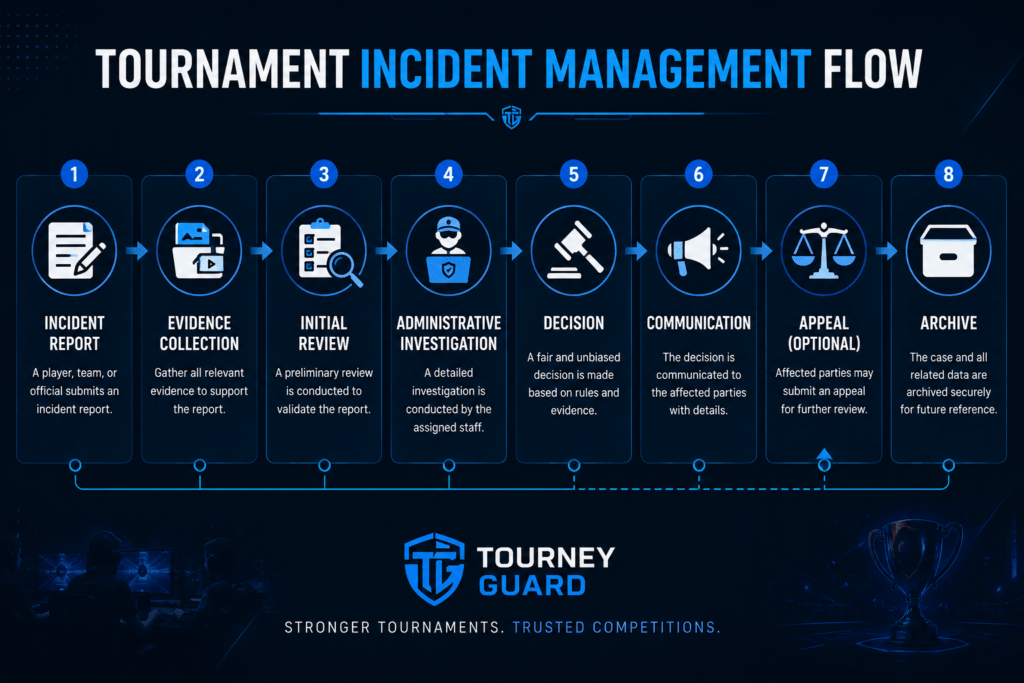
Using the same workflow for every case improves fairness and creates a complete administrative history.
Collect Objective Evidence
Evidence should always support administrative decisions.
Useful evidence includes:
- Match recordings.
- Replay files.
- Screenshots.
- Chat logs.
- Server logs.
- Referee observations.
- Player statements.
- Tournament platform logs.
Avoid making decisions based solely on opinions or social media discussions.
Objective evidence protects both organizers and participants.
Apply Tournament Rules Consistently
Consistency is one of the strongest indicators of professional tournament operations.
When similar incidents receive different penalties, player confidence declines quickly.
Tournament officials should always answer four questions before issuing a decision:
- Which rule applies?
- Was the rule violated?
- What evidence supports the conclusion?
- Which penalty does the rulebook specify?
Rule-based decisions reduce subjectivity and improve transparency.
Communicating with Participants
Communication is often overlooked when discussing Tournament Integrity.
Players deserve timely and professional updates regarding:
- Match schedules.
- Rule changes.
- Incident status.
- Investigation progress.
- Administrative decisions.
- Appeals.
Clear communication prevents misunderstandings and demonstrates organizational maturity.
Best Communication Practices
Professional organizers should:
- Respond promptly.
- Use respectful language.
- Explain decisions clearly.
- Reference tournament rules.
- Provide appeal instructions when applicable.
Transparency builds trust, even when participants disagree with the outcome.
Best Practices for Tournament Operations
Successful tournaments rely on operational consistency rather than improvisation.
The following checklist summarizes best practices used by experienced organizers.
| Area | Best Practice |
|---|---|
| Registration | Verify player eligibility |
| Rules | Publish a complete rulebook |
| Administration | Assign qualified referees |
| Match Operations | Use standardized procedures |
| Incident Management | Follow documented workflows |
| Evidence | Archive all supporting material |
| Decisions | Base rulings on written rules |
| Appeals | Establish a formal review process |
| Communication | Keep participants informed |
| Documentation | Maintain complete audit trails |
Applying these practices creates a more professional tournament experience for everyone involved.
Common Mistakes That Reduce Tournament Fairness
Even well-intentioned organizers sometimes undermine competitive integrity through avoidable mistakes.
Examples include:
Unclear Tournament Rules
Players should never have to guess how a situation will be handled.
Inconsistent Referee Decisions
Similar incidents should produce similar outcomes.
Poor Evidence Collection
Missing screenshots or replay files make investigations significantly more difficult.
Informal Incident Reporting
Reports submitted through direct messages often lack the information needed for a proper investigation.
Delayed Administrative Responses
Slow decisions may interrupt tournament progression and frustrate participants.
Inadequate Documentation
Every investigation should be recorded for future reference.
Building Long-Term Tournament Trust
The most respected esports tournaments earn trust over time.
Players return because they believe competitions are administered fairly.
Sponsors continue investing because tournament operations demonstrate professionalism.
Communities grow because organizers consistently enforce the rules.
Fairness is not created by a single policy.
It is created by hundreds of consistent administrative decisions made throughout every tournament.
That consistency is what ultimately strengthens Tournament Integrity and distinguishes professional organizers from casual event hosts.
How Tourney Guard Supports Tournament Organizers
Running a fair tournament requires more than technical expertise.
Organizers must coordinate registrations, verify participants, manage incidents, collect evidence, communicate with players, document administrative decisions, and maintain transparency throughout the competition.
As tournaments grow, these responsibilities quickly become difficult to manage using spreadsheets, chat applications, and disconnected tools.
Tourney Guard helps organizers centralize tournament operations through structured Tournament Integrity workflows.
Instead of replacing tournament officials, Tourney Guard supports them with organized processes that improve consistency, documentation, and accountability.
With Tourney Guard, organizers can:
- Centralize tournament incident reports.
- Manage evidence from multiple sources.
- Track investigations from beginning to end.
- Document referee decisions.
- Maintain complete audit trails.
- Standardize operational workflows.
- Improve communication between tournament staff.
- Build greater trust among players, teams, and sponsors.
Professional tournaments are built on consistent operations, and technology helps organizers apply those standards efficiently.
Final Thoughts
Learning how to run a fair online esports tournament goes far beyond scheduling matches and enforcing technical rules.
Fair competitions are built through preparation, clear communication, transparent investigations, consistent rule enforcement, and professional tournament administration.
Players trust organizers who apply the rules consistently.
Sponsors support competitions that demonstrate operational maturity.
Communities grow around tournaments that prioritize fairness and transparency.
Tournament Integrity is not achieved through a single policy or tool.
It is the result of hundreds of consistent operational decisions made throughout every stage of the tournament lifecycle.
By implementing the practices described in this guide, organizers can build competitions that players respect, communities trust, and sponsors confidently support.
Ready to Protect Your Tournament?
Strengthen tournament integrity with better incident management, evidence collection, and transparent decision-making.
Frequently Asked Questions (FAQ)
What makes an online esports tournament fair?
A fair tournament ensures every participant competes under the same rules, receives equal treatment, and has access to transparent administrative processes. Fairness depends on Tournament Integrity, consistent rule enforcement, evidence-based investigations, and professional tournament operations.
Why is Tournament Integrity important?
Tournament Integrity protects the credibility of competitive events by ensuring rules are applied consistently, investigations follow documented procedures, and every administrative decision is supported by objective evidence rather than personal opinion.
Should every tournament have written rules?
Yes.
A complete tournament rulebook helps participants understand eligibility requirements, prohibited behavior, penalties, match procedures, and appeal rights before the competition begins.
Clear rules significantly reduce disputes.
How should organizers handle tournament incidents?
Every incident should follow a standardized workflow that includes reporting, evidence collection, investigation, decision-making, communication, appeals when applicable, and case archiving.
Consistency is essential.
What evidence should organizers collect?
Useful evidence includes:
- Match recordings
- Screenshots
- Replay files
- Chat logs
- Referee observations
- Server logs
- Player statements
Objective evidence improves investigation quality and supports transparent decisions.
Can anti-cheat software guarantee fair tournaments?
No.
Anti-cheat technology helps detect unauthorized software but cannot manage administrative processes such as incident investigations, player disputes, appeals, or evidence documentation.
Professional Tournament Integrity requires both technology and structured operations.
How can organizers improve player trust?
Players trust tournaments that apply rules consistently, communicate decisions clearly, document investigations, and treat every participant equally.
Transparency is often the strongest driver of long-term community confidence.
Learn More About Esports Integrity
To learn more about integrity standards and professional esports governance, explore resources from:
These organizations publish guidance on fair competition, governance, disciplinary procedures, and integrity standards used across the esports industry.
Suggested Internal Links
Strengthen your internal linking strategy by connecting this article with: