Introduction
As esports continues to evolve into a global industry, tournament organizers face increasing expectations from players, teams, sponsors, and communities. Running a successful competition is no longer limited to scheduling matches and enforcing rules. Today’s tournaments require a governance framework that promotes fairness, accountability, transparency, and consistency across every administrative decision.
This is where Tournament Governance Best Practices become essential.
Tournament governance provides the structure that defines how competitions are managed, how decisions are made, who has authority, and how tournament policies are enforced. It establishes the standards that guide administrators before, during, and after every event, ensuring that competitions are conducted professionally and that participants are treated fairly.
Without effective governance, even well-organized tournaments can suffer from inconsistent rule enforcement, unclear responsibilities, poor communication, and disputes that damage the credibility of the competition.
Professional tournament governance creates confidence. Players trust that rules will be applied equally. Administrators have clear procedures to follow. Sponsors recognize a professionally managed event. Communities gain confidence that tournament outcomes are supported by transparent and accountable processes.
This guide explains the Tournament Governance Best Practices that every esports organizer should implement to build fair, transparent, and professionally governed competitions that can scale from community events to international championships.
What Is Tournament Governance?
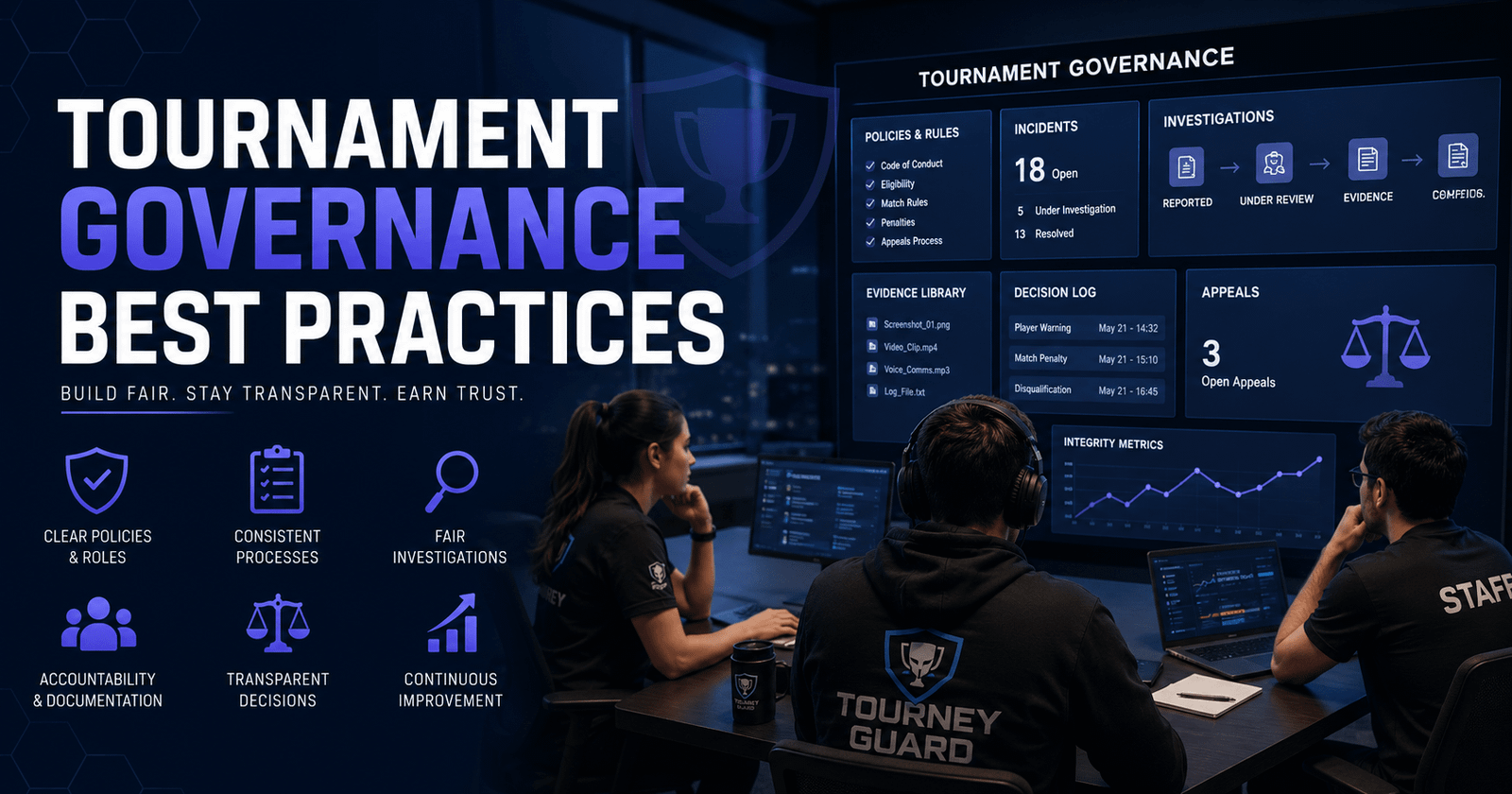
Tournament Governance is the system of policies, responsibilities, procedures, and decision-making processes that guide how an esports tournament is administered and supervised.
Rather than focusing solely on gameplay, governance establishes the framework that determines how organizers manage competition throughout its entire lifecycle.
Tournament governance typically defines:
- Administrative responsibilities.
- Tournament policies.
- Rule enforcement procedures.
- Incident management workflows.
- Investigation processes.
- Appeals procedures.
- Communication standards.
- Decision-making authority.
- Documentation requirements.
- Accountability mechanisms.
In simple terms, tournament governance answers questions such as:
- Who is responsible for making administrative decisions?
- How should incidents be investigated?
- How are tournament rules enforced?
- How can participants appeal decisions?
- How should administrators document their actions?
Without governance, tournament administration becomes inconsistent and dependent on individual judgment rather than established operational standards.
Why Tournament Governance Matters
Strong governance benefits every stakeholder involved in an esports competition.
It provides a consistent operational framework that protects tournament integrity while reducing administrative uncertainty.
Players
Players want confidence that every participant competes under the same rules.
Governance ensures that administrative decisions are based on published policies rather than subjective opinions.
Tournament Staff
Clear governance gives referees and administrators well-defined responsibilities.
Instead of making improvised decisions, staff members can follow standardized procedures that improve consistency and reduce operational stress.
Tournament Organizers
Professional governance reduces organizational risk.
Documented policies make tournaments easier to manage while improving communication, investigation quality, and decision consistency.
Sponsors and Partners
Commercial partners prefer competitions that demonstrate professionalism.
Transparent governance reduces reputational risk and signals that the tournament operates according to established standards.
The Community
Communities expect tournaments to be fair.
Well-governed competitions build trust by showing that every administrative decision follows documented procedures instead of arbitrary judgment.
The Core Principles of Tournament Governance
Effective governance is built upon several foundational principles that guide tournament administration.
Fairness
Every participant should receive equal treatment regardless of:
- Reputation.
- Team affiliation.
- Community popularity.
- Sponsorship relationships.
- Competitive status.
Fairness requires administrators to apply tournament rules consistently while evaluating incidents objectively.
Transparency
Participants should understand how administrative decisions are made.
Transparency includes:
- Published tournament rules.
- Clear investigation procedures.
- Documented administrative decisions.
- Accessible appeals processes.
- Professional communication.
Transparency strengthens confidence even when participants disagree with specific outcomes.
Accountability
Tournament governance requires administrators to document important decisions and accept responsibility for their actions.
Accountability includes:
- Investigation records.
- Evidence documentation.
- Decision summaries.
- Administrative audit trails.
- Post-event reviews.
Documented governance protects both organizers and participants.
Consistency
Consistency is one of the strongest indicators of professional governance.
Similar incidents should receive similar treatment regardless of:
- Tournament size.
- Match importance.
- Player identity.
- Administrator assigned.
Consistency builds predictability and improves participant trust.
Continuous Improvement
Governance should evolve over time.
Every tournament provides opportunities to improve:
- Policies.
- Procedures.
- Communication.
- Staff training.
- Investigation quality.
- Administrative workflows.
Professional organizations review their governance processes after every event.
The Building Blocks of Tournament Governance
Strong governance depends on multiple interconnected components working together rather than isolated administrative practices.
Governance Policies
Every tournament should establish documented policies covering:
- Tournament objectives.
- Administrative authority.
- Participant responsibilities.
- Codes of conduct.
- Competition rules.
- Enforcement procedures.
- Appeals.
Policies provide the foundation upon which every operational decision is made.
Defined Roles and Responsibilities
Governance requires clear organizational structure.
Typical roles include:
- Tournament Director.
- Tournament Administrator.
- Referees.
- Integrity Officers.
- Appeals Committee.
- Technical Administrators.
Each role should have clearly documented responsibilities to prevent confusion during competition.
Standard Operating Procedures
Policies explain what should happen.
Procedures explain how it should happen.
Examples include procedures for:
- Incident reporting.
- Evidence collection.
- Administrative investigations.
- Rules enforcement.
- Appeals.
- Decision publication.
Standardized procedures reduce inconsistency across multiple administrators.
Decision-Making Framework
Governance should clearly establish:
- Who can issue warnings?
- Who approves disqualifications?
- Who conducts investigations?
- Who reviews appeals?
- Who has final authority?
Defined decision authority prevents uncertainty during high-pressure situations.
Documentation Standards
Professional governance depends on documentation.
Administrators should consistently record:
- Incident reports.
- Evidence reviewed.
- Investigation findings.
- Administrative decisions.
- Appeal outcomes.
- Operational reviews.
Documentation creates organizational knowledge while supporting transparency and accountability.
Tournament Governance Best Practices
Strong tournament governance is not created through individual decisions alone. It results from implementing repeatable administrative practices that promote fairness, accountability, consistency, and transparency across every stage of a competition.
The following best practices form the foundation of professional tournament governance and help organizers build competitions that players and partners can trust.
1. Establish a Clear Governance Structure
Every tournament should begin with a clearly defined governance model.
Participants should understand:
- Who oversees the tournament.
- Who enforces tournament rules.
- Who investigates incidents.
- Who reviews appeals.
- Who has final decision-making authority.
Clearly assigning responsibilities eliminates confusion during high-pressure situations and prevents conflicting administrative decisions.
A governance structure should be documented before registration opens and made available to both tournament staff and participants.
2. Publish Comprehensive Tournament Policies
Governance depends on documented policies rather than unwritten expectations.
Every tournament should publish policies covering:
- Tournament rules.
- Code of Conduct.
- Player eligibility.
- Match procedures.
- Administrative investigations.
- Rules enforcement.
- Appeals.
- Penalty guidelines.
- Communication expectations.
Policies should remain easily accessible throughout the tournament and use language that participants can easily understand.
Well-written policies reduce disputes because expectations are established before competition begins.
3. Define Standard Operating Procedures
Policies explain what should happen.
Procedures explain how it should happen.
Professional tournament governance relies on standardized operational procedures for activities such as:
- Player registration.
- Check-in verification.
- Match administration.
- Incident reporting.
- Evidence collection.
- Investigation workflows.
- Administrative decision-making.
- Appeals handling.
- Post-event reviews.
When every administrator follows the same procedures, governance becomes more predictable and consistent.
4. Separate Operational and Governance Responsibilities
One of the most common governance mistakes is assigning every responsibility to a single administrator.
Professional tournaments distinguish between operational management and governance.
For example:
Tournament Operations
Responsible for:
- Match scheduling.
- Broadcast coordination.
- Technical support.
- Bracket management.
- Player communication.
Tournament Governance
Responsible for:
- Rule enforcement.
- Incident investigations.
- Administrative decisions.
- Appeals.
- Policy interpretation.
- Competitive integrity.
Separating these responsibilities reduces conflicts of interest while improving investigation quality.
5. Standardize Administrative Decision-Making
Governance should never depend entirely on individual judgment.
Instead, every investigation should follow the same decision-making process.
A standardized workflow typically includes:
- Incident reported.
- Incident documented.
- Evidence collected.
- Applicable rules identified.
- Administrative investigation completed.
- Decision documented.
- Participants informed.
- Appeal opportunity provided.
- Investigation archived.
This approach improves consistency across multiple tournaments and different administrative teams.
6. Maintain Complete Documentation
Documentation is the foundation of accountability.
Every important administrative action should be recorded.
Documentation should include:
- Incident reports.
- Evidence references.
- Investigation summaries.
- Applicable rules.
- Administrative reasoning.
- Final decisions.
- Appeals.
- Operational notes.
Complete records allow organizers to review previous cases and maintain consistent governance over time.
7. Conduct Governance Reviews After Every Tournament
Governance should continuously improve.
After each tournament, administrators should review:
- Number of incidents.
- Investigation timelines.
- Appeals submitted.
- Administrative consistency.
- Communication effectiveness.
- Rule ambiguities.
- Staff performance.
- Participant feedback.
These reviews help organizations refine their governance framework before future events.
Governance Models in Esports
Not every tournament requires the same governance structure.
The complexity of governance should increase alongside the size and importance of the competition.
Community Tournaments
Small tournaments often rely on a limited administrative team.
Typical governance includes:
- One tournament administrator.
- One or two referees.
- Informal incident management.
- Basic documentation.
Although simpler, these tournaments still benefit from documented rules and standardized administrative procedures.
Regional Competitions
As tournaments grow, governance becomes more structured.
Regional events often include:
- Tournament Director.
- Administrative team.
- Multiple referees.
- Dedicated incident investigations.
- Standardized documentation.
- Appeals procedures.
Governance becomes increasingly important as prize pools and participant expectations grow.
Professional Championships
Large esports competitions require comprehensive governance frameworks.
Professional governance commonly includes:
- Tournament Director.
- Tournament Administration Team.
- Referee Department.
- Integrity Officers.
- Appeals Committee.
- Technical Operations Team.
- Compliance procedures.
- Formal documentation standards.
- Administrative audit trails.
At this level, governance becomes an operational discipline rather than an administrative task.
Common Governance Mistakes
Even experienced tournament organizers make governance mistakes that reduce participant confidence.
Recognizing these problems allows organizations to improve before they affect tournament credibility.
Undefined Administrative Authority
When participants do not know who has authority to make decisions, confusion quickly develops.
Governance should clearly define:
- Decision authority.
- Escalation procedures.
- Appeal responsibilities.
- Investigation ownership.
Clear authority improves both efficiency and accountability.
Inconsistent Rule Interpretation
Two administrators reviewing similar incidents should reach similar conclusions whenever possible.
Inconsistent interpretations often occur because:
- Procedures are undocumented.
- Staff training is inconsistent.
- Previous cases are unavailable.
- Policies contain ambiguous language.
Historical documentation and standardized workflows help reduce these inconsistencies.
Poor Communication
Governance depends on communication.
Participants should receive timely updates regarding:
- Schedule changes.
- Administrative investigations.
- Rule clarifications.
- Appeals.
- Final decisions.
Professional communication reduces uncertainty and strengthens confidence in tournament administration.
Reactive Governance
Some organizers only develop governance procedures after problems occur.
Professional organizations prepare governance frameworks before the tournament begins.
Preparation allows administrators to respond calmly and consistently when unexpected situations arise.
Building a Governance Framework
Organizations seeking long-term operational maturity should establish a governance framework that clearly defines how tournaments will be administered.
A practical framework includes the following components.
Governance Policies
Define the rules, responsibilities, and principles that guide tournament administration.
Organizational Structure
Document every administrative role and its responsibilities.
Operational Procedures
Standardize every recurring administrative process.
Investigation Standards
Define how incidents are reported, investigated, documented, and resolved.
Decision Standards
Establish consistent criteria for administrative decision-making.
Appeals Procedures
Provide participants with structured opportunities to request independent reviews.
Continuous Improvement
Review governance performance after every tournament and update policies accordingly.
Organizations that consistently maintain these six elements create governance systems that remain effective even as tournaments become larger and more complex.
Why Governance Is a Competitive Advantage
Many organizers view governance as administrative overhead.
In reality, it is a competitive advantage.
Strong governance allows organizations to:
- Build player confidence.
- Attract sponsors.
- Improve operational efficiency.
- Reduce disputes.
- Strengthen competitive integrity.
- Scale tournaments more effectively.
- Train new administrators consistently.
- Demonstrate professionalism.
Over time, governance becomes part of an organization’s reputation.
Players often return to tournaments where administrative processes are predictable, transparent, and fair—not simply because of the prize pool, but because they trust the people running the competition.
The Role of Technology in Tournament Governance
As esports tournaments continue to grow in complexity, maintaining strong governance through manual processes becomes increasingly difficult.
Tournament organizers must manage policies, participant records, incident reports, evidence, investigations, administrative decisions, appeals, and historical documentation—often across multiple tournaments and administrative teams.
Without centralized systems, information quickly becomes fragmented across spreadsheets, messaging platforms, cloud storage, and email threads. This fragmentation increases the likelihood of inconsistent decision-making, incomplete documentation, and communication errors.
Technology helps tournament organizers standardize governance by providing structured workflows that ensure every administrative process follows the same professional methodology.
Modern governance platforms can support:
- Tournament policy management.
- Incident reporting.
- Evidence repositories.
- Administrative investigations.
- Rules enforcement workflows.
- Decision documentation.
- Appeals management.
- Administrative audit trails.
- Historical case management.
- Governance reporting and analytics.
Rather than replacing administrators, technology enables them to apply governance consistently while reducing repetitive administrative work and improving operational visibility across every tournament.
Organizations that adopt structured governance platforms are often better prepared to scale operations without sacrificing fairness, accountability, or transparency.
Measuring Tournament Governance Performance
Professional governance should be continuously evaluated using measurable indicators rather than assumptions.
Monitoring governance metrics helps organizers identify recurring problems, improve administrative procedures, and demonstrate operational maturity over time.
Useful governance metrics include:
Administrative Metrics
- Average incident response time.
- Average investigation duration.
- Administrative decision turnaround time.
- Appeal resolution time.
- Documentation completion rate.
Governance Metrics
- Number of reported incidents.
- Percentage of documented investigations.
- Consistency of administrative decisions.
- Appeals submitted.
- Appeals upheld.
- Rule clarification requests.
- Policy revisions after tournaments.
Organizational Metrics
- Player satisfaction.
- Referee consistency.
- Administrative workload.
- Communication effectiveness.
- Tournament completion without governance disputes.
Reviewing these indicators after every tournament allows organizations to improve governance systematically instead of reacting only after major problems occur.
Tournament Governance Best Practices Checklist
Before launching your next tournament, verify that your governance framework includes the following elements.
Governance Structure
- ✓ Tournament governance model documented.
- ✓ Administrative responsibilities clearly assigned.
- ✓ Decision authority defined.
- ✓ Appeals reviewers designated.
Policies
- ✓ Tournament Rulebook published.
- ✓ Code of Conduct available.
- ✓ Rules enforcement procedures documented.
- ✓ Appeals policy published.
- ✓ Participant responsibilities communicated.
Administration
- ✓ Incident reporting process established.
- ✓ Investigation procedures standardized.
- ✓ Evidence collection guidelines documented.
- ✓ Decision templates prepared.
- ✓ Administrative records maintained.
Continuous Improvement
- ✓ Governance review scheduled.
- ✓ Tournament metrics collected.
- ✓ Participant feedback analyzed.
- ✓ Policy updates documented.
- ✓ Staff training planned for future events.
Organizations that consistently complete this checklist establish a governance framework capable of supporting fair, transparent, and scalable esports competitions.
Frequently Asked Questions
What is tournament governance?
Tournament governance is the framework of policies, procedures, responsibilities, and decision-making processes that guide how esports competitions are administered. It ensures tournaments are managed fairly, consistently, and transparently throughout their entire lifecycle.
Why are Tournament Governance Best Practices important?
Tournament Governance Best Practices help organizers create predictable administrative processes, reduce operational risks, improve consistency, strengthen tournament integrity, and build trust among players, sponsors, and the esports community.
What is the difference between tournament governance and tournament administration?
Tournament governance defines the policies, authority, and procedures that guide tournament management. Tournament administration applies those governance principles through daily operational activities such as player management, incident investigations, rule enforcement, and communication.
Governance establishes the framework.
Administration executes it.
Can small tournaments benefit from governance practices?
Absolutely.
Even community tournaments benefit from documented rules, clearly assigned responsibilities, standardized investigations, and transparent communication. Establishing governance early makes it easier to scale tournaments professionally as they grow.
How often should tournament governance be reviewed?
Governance should be reviewed after every tournament.
Post-event reviews help organizers identify policy gaps, improve procedures, strengthen administrator training, and refine governance practices based on operational experience.
Conclusion
Implementing strong Tournament Governance Best Practices is essential for organizing fair, transparent, and professionally managed esports competitions. While tournament rules define expectations, governance provides the operational framework that ensures those rules are applied consistently, decisions are documented, and administrative responsibilities are clearly understood.
Professional governance extends beyond rule enforcement. It encompasses policies, organizational structure, standardized procedures, investigations, appeals, communication, and continuous improvement. Together, these elements create an environment where participants trust the competition because they trust the processes behind it.
As esports continues to mature, governance will become an increasingly important differentiator for tournament organizers. Organizations that invest in structured governance today will be better positioned to manage larger events, attract commercial partners, reduce operational risk, and build long-term credibility within the competitive gaming community.
Ultimately, successful tournaments are not defined solely by exciting matches—they are defined by the professionalism, accountability, and consistency of the governance systems that support every competition.
Build Stronger Tournament Governance with Tourney Guard
Effective tournament governance requires more than well-written policies. It depends on structured workflows, organized documentation, transparent investigations, and consistent administrative decision-making that can be applied across every event.
As tournaments grow, managing governance through spreadsheets, chat messages, and disconnected documents becomes increasingly difficult. Centralizing governance processes helps organizers improve consistency, reduce administrative errors, and maintain a complete history of every incident, investigation, appeal, and decision.
Tourney Guard is designed specifically to support professional tournament governance. From incident reporting and evidence management to investigation tracking, decision documentation, appeals, and administrative audit trails, the platform helps organizers implement governance best practices through repeatable and transparent operational workflows.
Discover how Tourney Guard helps esports organizations build stronger governance, protect tournament integrity, and manage competitions with confidence.
👉 Learn More About Tourney Guard →
Recommended External Resources
These organizations publish guidance that supports professional Tournament Integrity programs:
- Esports Integrity Commission (ESIC) – Standards, codes of conduct, investigations, and integrity initiatives.
- International Olympic Committee (IOC) – Integrity frameworks applicable to competitive sports governance.
- International Betting Integrity Association (IBIA) – Best practices for integrity monitoring.
- NIST Cybersecurity Framework – Guidance for security governance and risk management.
- ISO 37301 Compliance Management Systems – International compliance management principles.
- World Anti-Doping Agency (WADA) – Governance and disciplinary process principles applicable beyond traditional sports.
Suggested Internal Links
Strengthen your internal linking strategy by connecting this article with: