Introduction
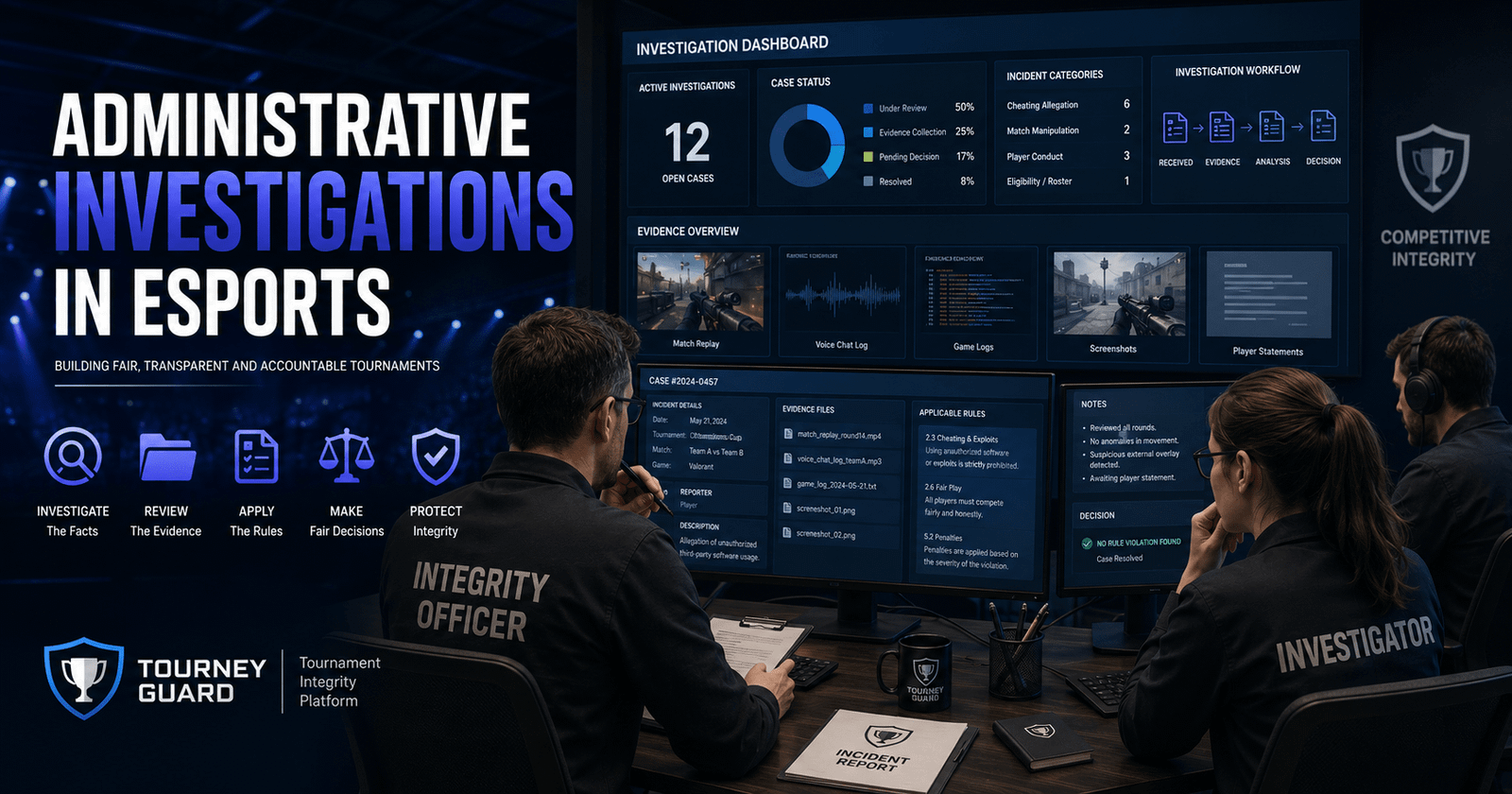
Administrative Investigations in Esports are one of the most critical yet least understood components of professional tournament governance. Every competitive event, regardless of its size, may face situations that require administrators to determine what happened, evaluate evidence, interpret tournament rules, and make decisions that directly affect players, teams, and tournament outcomes.
Contrary to popular belief, an administrative investigation is not about proving someone guilty as quickly as possible. Its purpose is to establish the facts through a structured, objective, and transparent process that protects both competitive integrity and participant rights. A well-executed investigation helps organizers resolve disputes consistently, reduces accusations of favoritism, and reinforces trust in tournament administration.
As esports continues to mature, administrative investigations have become a fundamental element of professional tournament operations. Sponsors, players, publishers, and communities increasingly expect organizers to follow documented procedures rather than relying on subjective judgment or public opinion. Every investigation should therefore be supported by evidence, guided by published tournament rules, and documented in a way that allows future review if necessary.
This guide explains what Administrative Investigations in Esports are, why they matter, the principles that support effective investigations, and how tournament organizers can implement professional investigative processes that strengthen tournament integrity while maintaining fairness, transparency, and accountability.
What Are Administrative Investigations in Esports?
Administrative Investigations in Esports are formal processes used by tournament organizers to determine the facts surrounding a reported incident and decide whether tournament rules have been violated.
Unlike criminal or civil investigations, administrative investigations focus exclusively on tournament governance. Their objective is not to determine legal responsibility but to establish whether participants complied with the published rules, code of conduct, and operational procedures governing the competition.
Administrative investigations commonly address situations such as:
- Alleged cheating.
- Match manipulation.
- Unauthorized assistance.
- Player misconduct.
- Rule violations.
- Identity disputes.
- Roster irregularities.
- Technical incidents affecting competitive fairness.
- Code of Conduct violations.
- Administrative disputes.
A professional investigation follows a documented methodology that includes evidence collection, fact verification, rule interpretation, decision-making, and proper documentation.
Most importantly, investigations should seek the truth rather than simply confirming an initial accusation.
The Purpose of Administrative Investigations
The purpose of an investigation extends far beyond issuing penalties.
Professional investigations exist to answer several critical questions:
- What actually happened?
- Which facts can be verified?
- What evidence supports those facts?
- Which tournament rules apply?
- Was a rule violation committed?
- What administrative response is appropriate?
This structured approach protects tournament integrity while ensuring that administrative decisions are based on objective information rather than speculation.
An investigation that concludes no violation occurred is just as valuable as one that results in disciplinary action because both outcomes strengthen confidence in the governance process.
Why Administrative Investigations Matter
Every stakeholder benefits from professional investigative procedures.
Players
Players expect allegations to be handled fairly.
When investigations follow standardized procedures, competitors gain confidence that accusations will be evaluated objectively rather than influenced by reputation, popularity, or community pressure.
Professional investigations also protect innocent participants by ensuring that administrative action is supported by evidence rather than assumptions.
Tournament Organizers
Administrative investigations reduce operational risk.
Rather than making reactive decisions under pressure, organizers can rely on documented investigative workflows that improve consistency and transparency.
Professional investigations also strengthen organizational credibility by demonstrating that tournament governance follows repeatable standards.
Tournament Officials
Referees and tournament administrators often encounter difficult situations that require objective decision-making.
Well-defined investigative procedures provide officials with clear guidance regarding:
- Evidence collection.
- Incident classification.
- Rule interpretation.
- Documentation.
- Communication.
- Escalation.
This reduces uncertainty and improves administrative consistency across multiple tournaments.
Sponsors and Partners
Commercial partners expect esports competitions to operate professionally.
Structured investigations demonstrate that tournament organizers have mature governance systems capable of protecting competitive fairness while managing disputes responsibly.
Professional governance reduces reputational risk for everyone associated with the event.
The Community
Communities closely observe how organizers respond to controversial situations.
Transparent investigative procedures help reduce speculation by showing that administrative decisions result from documented processes rather than arbitrary judgment.
Even when community members disagree with a decision, confidence increases when the investigative process is clearly explained.
The Core Principles of Administrative Investigations
Every professional investigation should be guided by a set of governance principles that ensure fairness, consistency, and accountability.
Objectivity
Objectivity is the cornerstone of every investigation.
Investigators should evaluate evidence without allowing personal opinions, community reactions, player reputation, or external pressure to influence their conclusions.
Administrative findings must always be based on verified facts rather than assumptions.
Fairness
Every participant deserves equal treatment.
Investigations should follow identical procedures regardless of:
- Team popularity.
- Prize pool.
- Competitive level.
- Sponsorship status.
- Tournament stage.
Applying the same investigative standards to every participant strengthens confidence in tournament governance.
Evidence-Based Decision Making
Administrative decisions should never rely solely on accusations.
Investigators should seek corroborating evidence before reaching conclusions.
Evidence may include:
- Match recordings.
- Screenshots.
- Tournament logs.
- Server data.
- Referee observations.
- Player statements.
- Communication records.
- Platform logs.
Whenever evidence is incomplete, investigators should clearly document the limitations rather than making unsupported assumptions.
Transparency
Professional investigations require transparency throughout the decision-making process.
Participants should understand:
- What incident was investigated.
- Which rules applied.
- What evidence was reviewed.
- How the investigation was conducted.
- What administrative conclusion was reached.
- Whether an appeal is available.
Transparency does not require disclosing confidential evidence. Instead, it focuses on communicating the reasoning behind administrative decisions.
Documentation
Every investigation should produce a complete administrative record.
Documentation should include:
- Incident report.
- Investigation timeline.
- Evidence inventory.
- Applicable tournament rules.
- Investigation findings.
- Administrative reasoning.
- Final decision.
- Appeal status.
Maintaining comprehensive documentation improves accountability while creating valuable historical references for future investigations.
Types of Administrative Investigations
Not every investigation involves cheating.
Tournament organizers routinely investigate a wide variety of administrative situations.
Competitive Integrity Investigations
These investigations focus on incidents that may directly affect competitive fairness.
Examples include:
- Unauthorized assistance.
- Match manipulation.
- Account sharing.
- Identity fraud.
- Exploitation of prohibited game mechanics.
- Circumvention of tournament policies.
Because these incidents may influence tournament outcomes, they typically require the most comprehensive investigative procedures.
Conduct Investigations
Behavioral investigations evaluate alleged violations of the tournament’s Code of Conduct.
Examples include:
- Harassment.
- Discrimination.
- Offensive language.
- Threats toward officials.
- Unsportsmanlike conduct.
- Abusive behavior.
Although these investigations may not directly affect gameplay, they are essential for maintaining a professional and respectful competitive environment.
Administrative Compliance Investigations
Some investigations concern procedural rather than competitive issues.
Examples include:
- Eligibility disputes.
- Roster violations.
- Registration irregularities.
- Unauthorized substitutions.
- Failure to follow tournament procedures.
- Administrative misconduct.
These investigations ensure that tournament policies are applied consistently across all participants.
The Administrative Investigation Process
Professional administrative investigations follow a structured methodology rather than relying on improvised decision-making. Every investigation should move through a series of clearly defined stages that ensure fairness, consistency, and accountability.
Following a standardized workflow helps tournament organizers reach well-supported decisions while maintaining participant confidence throughout the investigative process.
Step 1: Receive and Register the Incident
Every investigation begins with a reported incident.
Reports may originate from several sources, including:
- Players
- Team managers
- Referees
- Tournament administrators
- Tournament integrity staff
- Automated tournament systems
- Anti-cheat platforms
- Community reports (when permitted)
At this stage, organizers should avoid making assumptions about what occurred.
Instead, they should document the initial report using a standardized incident form that captures:
- Date and time
- Tournament stage
- Match identifier
- Reporter
- Participants involved
- Initial description
- Evidence submitted
- Investigation status
Proper registration creates the foundation for every subsequent investigative step.
Step 2: Classify the Incident
Not every report requires the same investigative effort.
Administrators should classify the incident according to its nature before beginning the investigation.
Typical categories include:
Competitive Integrity
Examples:
- Unauthorized assistance
- Match manipulation
- Cheating allegations
- Account sharing
Conduct
Examples:
- Harassment
- Offensive language
- Unsportsmanlike conduct
- Staff misconduct
Administrative Compliance
Examples:
- Roster violations
- Eligibility concerns
- Registration irregularities
- Tournament procedure violations
Technical
Examples:
- Server interruptions
- Connection disputes
- Hardware compliance
- Tournament platform failures
Classification determines the investigation workflow, required evidence, and appropriate decision-makers.
Step 3: Collect Evidence
Evidence is the foundation of every administrative investigation.
Investigators should collect all relevant information before reaching conclusions.
Possible evidence includes:
- Match recordings
- Stream VODs
- Screenshots
- Server logs
- Anti-cheat reports
- Referee notes
- Chat logs
- Voice communications
- Tournament platform logs
- Player statements
- Witness statements
Whenever possible, evidence should be preserved in its original format to maintain authenticity.
Multiple independent evidence sources provide greater reliability than relying on a single screenshot or testimony.
Maintaining the Chain of Custody
One of the most overlooked aspects of tournament investigations is preserving the integrity of evidence after it has been collected.
Every piece of evidence should remain traceable throughout the investigation.
Administrators should record:
- Who collected the evidence.
- When it was collected.
- Where it originated.
- Whether it has been copied.
- Whether additional analysis has been performed.
Maintaining a documented chain of custody prevents questions regarding authenticity during appeals or future reviews.
Although esports investigations differ from criminal investigations, preserving evidence integrity significantly strengthens administrative credibility.
Step 4: Verify the Facts
Evidence collection is only the beginning.
Investigators must determine:
- Which facts are confirmed?
- Which claims remain unverified?
- Which evidence is reliable?
- Are there conflicting accounts?
- Is additional information required?
Professional investigations distinguish carefully between:
Verified Facts
Information supported by reliable evidence.
Witness Statements
Useful information that may require corroboration.
Assumptions
Interpretations that cannot yet be supported by evidence.
Community Speculation
Comments from social media, livestream chats, or forums should never be treated as evidence unless independently verified.
Separating facts from speculation protects investigative objectivity.
Step 5: Interpret Tournament Rules
After establishing the facts, investigators must determine which tournament policies apply.
Questions include:
- Which rule addresses the incident?
- Does the reported behavior violate the published rules?
- Are there documented exceptions?
- Have similar situations occurred previously?
Administrative investigations should rely on the tournament rulebook rather than subjective opinions.
When rules contain ambiguity, administrators should document the reasoning used to interpret the policy.
Step 6: Reach an Administrative Finding
Once evidence and applicable rules have been evaluated, investigators prepare their findings.
Possible conclusions include:
- No rule violation occurred.
- Insufficient evidence.
- Minor administrative violation.
- Major competitive violation.
- Conduct violation.
- Technical issue requiring operational action.
Importantly, an investigation does not always result in disciplinary action.
Finding that no violation occurred demonstrates that the investigative process functions objectively rather than assuming guilt.
Step 7: Document the Investigation
Every investigation should produce a permanent administrative record.
Documentation should include:
- Incident summary.
- Investigation timeline.
- Evidence reviewed.
- Applicable rules.
- Administrative analysis.
- Final decision.
- Penalties, if applicable.
- Appeal eligibility.
- Responsible administrators.
Comprehensive documentation creates institutional knowledge that improves consistency across future tournaments.
Step 8: Communicate the Decision
The final step is communicating the investigation outcome.
Professional communication should explain:
- What was investigated.
- Which rules applied.
- What conclusion was reached.
- What administrative action will be taken.
- Whether an appeal may be submitted.
Participants should understand the reasoning behind the decision even when confidential evidence cannot be disclosed publicly.
Clear communication strengthens trust in tournament governance.
Investigation Decision Framework
Professional investigations benefit from a standardized evaluation framework rather than relying solely on individual judgment.
A practical framework considers the following factors.
Evidence Strength
Questions include:
- Is the evidence authentic?
- Is it complete?
- Has it been independently verified?
- Does it support the reported allegation?
Weak evidence should never produce strong administrative conclusions.
Rule Applicability
Investigators should verify:
- Does the rule clearly apply?
- Are there exceptions?
- Is additional interpretation required?
Applying the wrong rule may lead to inconsistent decisions.
Competitive Impact
Not every violation affects tournament results equally.
Investigators should evaluate:
- Did the incident influence gameplay?
- Did it affect match outcomes?
- Did it compromise competitive fairness?
Competitive impact often influences the appropriate administrative response.
Intent
Intent should be evaluated when tournament policies permit consideration.
Investigators may determine whether behavior was:
- Intentional.
- Negligent.
- Accidental.
- Unavoidable.
Intent does not necessarily determine whether a violation occurred, but it may influence sanctions where the rulebook allows administrative discretion.
Previous Violations
Historical investigations may reveal repeated misconduct.
Organizations often distinguish between:
- First-time violations.
- Repeated misconduct.
- Pattern-based behavior.
Historical documentation supports progressive disciplinary systems while maintaining fairness.
Common Mistakes During Administrative Investigations
Even experienced tournament organizers can unintentionally compromise investigations through avoidable mistakes.
Starting With a Conclusion
Investigators should never begin an investigation assuming guilt or innocence.
Professional investigations seek evidence first and conclusions second.
Confirmation bias is one of the greatest threats to investigative fairness.
Relying on Community Opinion
Social media reactions frequently appear immediately after controversial incidents.
However:
Community opinion is not evidence.
Administrative decisions should never be influenced by:
- Reddit discussions.
- Livestream chat.
- Discord rumors.
- Social media campaigns.
Professional governance depends on verified facts rather than public pressure.
Collecting Incomplete Evidence
Rushing investigations often results in overlooked evidence.
Administrators should verify that all relevant sources have been reviewed before reaching conclusions.
Missing evidence may significantly alter investigative findings.
Poor Documentation
Without documentation:
- Appeals become difficult.
- Future consistency declines.
- Staff training suffers.
- Organizational knowledge disappears.
Documentation is one of the most valuable outputs of every investigation.
Inconsistent Investigations
If two similar incidents are investigated differently, participant confidence declines.
Standardized investigative procedures help ensure that every case follows the same professional methodology regardless of the tournament, participants, or administrators involved.
Best Practices for Administrative Investigations
Organizations seeking professional tournament governance should adopt the following investigative best practices:
- Establish written investigation procedures before the tournament begins.
- Train investigators using previous case studies.
- Use standardized incident report templates.
- Preserve evidence in its original format whenever possible.
- Maintain documented chains of custody.
- Separate verified facts from assumptions.
- Reference published tournament rules in every decision.
- Document every investigative step.
- Communicate decisions professionally and consistently.
- Conduct post-tournament reviews to improve investigative procedures.
Following these practices strengthens tournament integrity while ensuring that investigations remain fair, transparent, and repeatable across every competition.
The Role of Technology in Administrative Investigations
As esports tournaments become larger and more competitive, administrative investigations generate increasing volumes of information. Incident reports, screenshots, match recordings, referee notes, chat logs, player statements, and investigation records must all be managed consistently to support fair decision-making.
Managing these investigations through spreadsheets, messaging platforms, or shared folders often leads to fragmented information, inconsistent documentation, and longer investigation times.
Technology helps tournament organizers standardize investigative processes while improving transparency, accountability, and operational efficiency.
Modern tournament integrity platforms can support administrative investigations by providing:
- Centralized incident reporting.
- Structured evidence repositories.
- Investigation workflow management.
- Administrative decision templates.
- Audit trails.
- Evidence access controls.
- Appeals management.
- Historical case archives.
- Investigation analytics.
- Administrative reporting.
Rather than replacing investigators, these systems ensure that every investigation follows the same structured methodology while preserving complete administrative records that can be reviewed whenever necessary.
Measuring Investigation Performance
Professional investigations should be continuously evaluated to identify opportunities for improvement.
Monitoring operational metrics helps tournament organizers improve investigative quality while reducing administrative delays.
Useful Key Performance Indicators (KPIs) include:
Investigation Metrics
- Average investigation completion time.
- Average response time after incident reporting.
- Percentage of investigations completed within target time.
- Number of investigations per tournament.
- Average evidence review duration.
Evidence Metrics
- Percentage of investigations supported by multiple evidence sources.
- Evidence completeness rate.
- Chain of custody compliance.
- Missing evidence incidents.
Governance Metrics
- Appeals submitted.
- Appeals upheld.
- Investigation documentation rate.
- Decision consistency across similar cases.
- Administrative review completion rate.
Operational Metrics
- Player satisfaction with investigation process.
- Referee reporting accuracy.
- Administrative workload.
- Communication response time.
- Post-event investigation review completion.
Tracking these indicators enables organizations to improve investigations systematically rather than relying on anecdotal experience.
Administrative Investigations Checklist
Before your next tournament begins, verify that your organization is prepared to conduct professional investigations.
Investigation Readiness
- ✓ Incident reporting system established.
- ✓ Investigation procedures documented.
- ✓ Administrative responsibilities assigned.
- ✓ Investigation templates prepared.
- ✓ Appeals policy published.
Evidence Management
- ✓ Evidence collection procedures documented.
- ✓ Evidence storage centralized.
- ✓ Chain of custody maintained.
- ✓ Investigation timelines recorded.
- ✓ Evidence retention policy established.
Decision Making
- ✓ Tournament Rulebook published.
- ✓ Rules enforcement procedures documented.
- ✓ Decision templates standardized.
- ✓ Investigation findings documented.
- ✓ Appeals procedures communicated.
Continuous Improvement
- ✓ Investigation statistics collected.
- ✓ Post-event review scheduled.
- ✓ Staff training completed.
- ✓ Lessons learned documented.
- ✓ Procedures updated after each tournament.
Organizations that consistently complete these tasks create investigations that are fair, transparent, and repeatable across every competition.
Frequently Asked Questions
What is an administrative investigation in esports?
An administrative investigation is a structured process used by tournament organizers to determine the facts surrounding a reported incident, evaluate available evidence, apply tournament rules, and decide whether administrative action is necessary. Its purpose is to protect tournament integrity through objective and documented decision-making.
What types of incidents require an administrative investigation?
Administrative investigations may address allegations of cheating, player misconduct, roster violations, unauthorized assistance, match manipulation, Code of Conduct violations, eligibility disputes, technical incidents affecting competitive fairness, and other situations that require formal review under tournament policies.
Who should conduct administrative investigations?
Investigations should be handled by trained tournament administrators, integrity officers, or designated investigation teams who understand tournament governance, evidence evaluation, and rule interpretation. Whenever possible, investigators should remain independent from the original incident to reduce bias and improve objectivity.
Why is evidence so important during investigations?
Evidence provides the factual foundation for administrative decisions. Reliable investigations rely on multiple sources such as match recordings, referee reports, server logs, screenshots, and player statements rather than assumptions or community opinion. Strong evidence improves fairness while strengthening participant confidence in tournament governance.
How do administrative investigations improve tournament integrity?
Professional investigations ensure that tournament rules are applied consistently, incidents are evaluated objectively, decisions are documented, and participants receive fair treatment. By following standardized investigative procedures, organizers strengthen trust in both tournament administration and competitive outcomes.
Conclusion
Professional Administrative Investigations in Esports are essential for protecting competitive integrity and maintaining confidence in tournament governance. While every competition may encounter disputes or allegations of misconduct, the quality of the investigation often determines how participants perceive the fairness and credibility of the entire event.
Effective investigations are built on structured procedures, objective evidence, consistent rule interpretation, transparent communication, and comprehensive documentation. They are designed not only to identify rule violations but also to protect innocent participants, support fair administrative decisions, and create reliable records that improve governance over time.
As esports continues to grow, tournament organizers who invest in professional investigative processes will be better prepared to manage increasingly complex competitions while earning the trust of players, sponsors, officials, and the wider esports community.
Ultimately, strong administrative investigations are not simply about resolving incidents—they are about demonstrating that every tournament decision is supported by fairness, accountability, and integrity.
Strengthen Administrative Investigations with Tourney Guard
Professional investigations require more than collecting screenshots or reviewing match footage. They depend on structured workflows, organized evidence, documented findings, and transparent administrative processes that remain consistent across every tournament.
As events become more complex, managing investigations through spreadsheets, chat applications, and disconnected files increases the risk of incomplete documentation and inconsistent decision-making. Centralizing investigations allows organizers to improve operational efficiency while preserving a complete history of every case.
Tourney Guard helps tournament organizers professionalize administrative investigations through structured incident management, centralized evidence repositories, investigation tracking, decision documentation, appeals management, and complete administrative audit trails. These capabilities support fair, transparent, and repeatable investigative processes that strengthen tournament integrity at every level of competition.
Discover how Tourney Guard helps esports organizations conduct professional administrative investigations with confidence.
👉 Learn More About Tourney Guard →
Recommended External Resources
These organizations publish guidance that supports professional Tournament Integrity programs:
- Esports Integrity Commission (ESIC) – Standards, codes of conduct, investigations, and integrity initiatives.
- International Olympic Committee (IOC) – Integrity frameworks applicable to competitive sports governance.
- International Betting Integrity Association (IBIA) – Best practices for integrity monitoring.
- NIST Cybersecurity Framework – Guidance for security governance and risk management.
- ISO 37301 Compliance Management Systems – International compliance management principles.
- World Anti-Doping Agency (WADA) – Governance and disciplinary process principles applicable beyond traditional sports.
Suggested Internal Links
Strengthen your internal linking strategy by connecting this article with: