Introduction
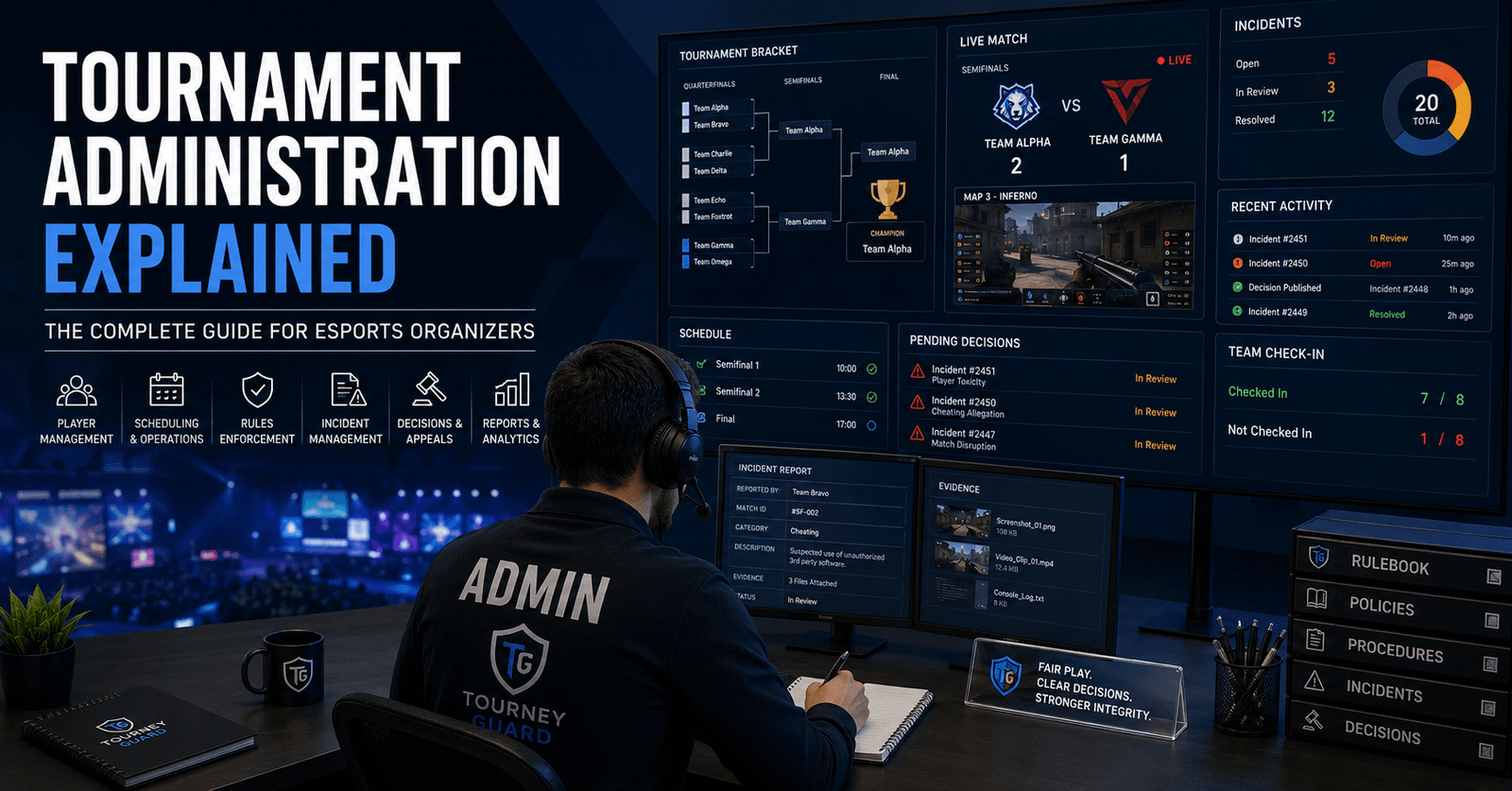
Tournament Administration Explained begins with understanding that successful esports events require far more than competitive matches and skilled players. Every well-organized tournament depends on a structured administrative system responsible for planning operations, enforcing rules, coordinating participants, resolving disputes, and ensuring the competition runs smoothly from registration to the final match.
Behind every professional event is a team that oversees these responsibilities through effective tournament administration.
This responsibility is known as tournament administration.
Although players often associate tournament administration with referees making decisions during matches, the role is far broader. Tournament administrators oversee nearly every operational aspect of an event, ensuring that policies are followed, schedules remain on track, incidents are handled consistently, and every participant competes under the same conditions.
As esports continues to grow into a professional industry, tournament administration has evolved from a volunteer role into a structured operational discipline. Modern tournaments require documented procedures, standardized workflows, transparent governance, and consistent decision-making to protect competitive integrity and maintain player confidence.
Poor administration can quickly undermine even the most technically successful tournament. Missed schedules, inconsistent rulings, unclear communication, and poorly managed investigations create frustration among participants and damage an organizer’s reputation. Conversely, professional administration builds trust, improves operational efficiency, and establishes the credibility necessary to attract players, sponsors, and long-term community support.
This guide provides a comprehensive explanation of Tournament Administration, including its purpose, core responsibilities, operational principles, and the processes that help organizers deliver fair, transparent, and professionally managed esports competitions.
What Is Tournament Administration?
Tournament Administration is the process of planning, organizing, supervising, and governing every operational aspect of an esports competition before, during, and after the event.
It encompasses all administrative activities required to ensure tournaments are conducted fairly, efficiently, and consistently while protecting the integrity of competition.
Tournament administration typically includes responsibilities such as:
- Managing tournament registrations.
- Verifying player eligibility.
- Coordinating match schedules.
- Supervising referees and administrators.
- Enforcing tournament rules.
- Handling incident reports.
- Conducting administrative investigations.
- Communicating official decisions.
- Managing appeals.
- Maintaining tournament records.
- Reviewing operational performance after the event.
Rather than focusing on gameplay itself, tournament administration creates the operational framework that allows competition to occur under predictable and transparent conditions.
Without effective administration, even technically successful tournaments may suffer from confusion, inconsistent rule enforcement, and reduced participant confidence.
Why Tournament Administration Matters
Every esports tournament relies on hundreds of operational decisions.
Players must know when and where to compete.
Referees must understand tournament policies.
Administrators must respond consistently to incidents.
Teams expect rules to be applied fairly.
Sponsors expect professionally managed events.
Tournament administration coordinates all of these activities into a single operational system.
Strong administration provides several important benefits.
Fair Competition
Every participant should compete under the same rules and conditions.
Tournament administrators ensure that policies are applied consistently regardless of player reputation, team popularity, or prize pool size.
Consistent administration protects competitive fairness throughout the event.
Operational Efficiency
Well-organized tournaments experience fewer delays, fewer administrative errors, and faster incident resolution.
Clearly defined procedures allow administrators to respond quickly without sacrificing consistency or transparency.
Operational efficiency improves the experience for players, referees, spectators, and tournament staff alike.
Risk Management
Unexpected situations occur in nearly every competition.
Examples include:
- Technical failures.
- Player disputes.
- Rule violations.
- Scheduling conflicts.
- Eligibility questions.
- Match interruptions.
Professional tournament administration provides structured procedures for managing these situations without disrupting the integrity of the competition.
Organizational Reputation
Reputation is one of the most valuable assets for any tournament organizer.
Players remember events where:
- Rules were enforced fairly.
- Communication was professional.
- Investigations were transparent.
- Administrative decisions were consistent.
Positive experiences encourage repeat participation and strengthen long-term community trust.
The Objectives of Tournament Administration
Although tournaments differ in size and format, effective administration consistently pursues several core objectives.
Ensure Fairness
Every participant deserves equal treatment.
Administrators should apply tournament policies consistently and make decisions based on published rules and verified evidence rather than personal opinion.
Fair administration creates confidence in tournament outcomes.
Maintain Order
Competitive events involve numerous moving parts.
Tournament administrators coordinate schedules, monitor progress, resolve operational issues, and ensure that every stage of the competition proceeds according to plan.
Maintaining order allows players to focus on competition rather than administrative uncertainty.
Protect Tournament Integrity
One of the most important responsibilities of tournament administration is protecting tournament integrity.
This includes:
- Investigating reported incidents.
- Managing evidence.
- Enforcing tournament rules.
- Handling appeals.
- Documenting administrative decisions.
Integrity depends not only on detecting violations but also on managing them through consistent and transparent processes.
Support Participants
Tournament administration is not solely about enforcement.
Administrators also assist participants by:
- Answering procedural questions.
- Explaining tournament policies.
- Providing operational guidance.
- Coordinating communication.
- Resolving logistical issues.
Professional support improves the overall tournament experience.
Key Responsibilities of Tournament Administrators
The responsibilities of tournament administrators extend throughout the entire tournament lifecycle.
Although duties vary depending on the size of the event, most organizations assign administrators to several key operational areas.
Registration Management
Before competition begins, administrators oversee participant registration.
Typical responsibilities include:
- Reviewing registrations.
- Confirming eligibility.
- Verifying player information.
- Managing roster submissions.
- Handling withdrawals.
- Resolving registration issues.
Accurate registration processes prevent many administrative problems later in the tournament.
Tournament Scheduling
Creating a tournament bracket is only the beginning.
Administrators coordinate:
- Match schedules.
- Check-in procedures.
- Time adjustments.
- Delayed matches.
- Broadcast coordination.
- Referee assignments.
Effective scheduling minimizes disruptions while keeping the tournament on track.
Rules Enforcement
Tournament administrators ensure that published rules are followed consistently throughout the competition.
Their responsibilities include:
- Monitoring compliance.
- Reviewing reported violations.
- Applying penalties.
- Documenting decisions.
- Communicating administrative outcomes.
Consistent rules enforcement protects competitive fairness and reduces disputes.
Incident Management
Operational issues inevitably arise during tournaments.
Administrators oversee the complete incident management process, including:
- Receiving reports.
- Classifying incidents.
- Collecting evidence.
- Coordinating investigations.
- Recording findings.
- Communicating outcomes.
Structured incident management improves both efficiency and transparency.
Communication
Professional tournament administration depends on clear communication.
Administrators regularly communicate with:
- Players.
- Team managers.
- Referees.
- Broadcast staff.
- Technical support teams.
- Tournament leadership.
Timely communication helps prevent misunderstandings and keeps the competition running smoothly.
The Difference Between Tournament Administration and Tournament Operations
These two terms are often used interchangeably, but they describe different aspects of tournament management.
Tournament Operations focuses on executing the event.
Examples include:
- Match coordination.
- Broadcast production.
- Technical infrastructure.
- Venue logistics.
- Equipment management.
- Stream scheduling.
Tournament Administration, on the other hand, focuses on governance.
Examples include:
- Rule enforcement.
- Incident investigations.
- Administrative decisions.
- Appeals.
- Documentation.
- Competitive integrity.
- Participant communication.
Operations ensure that the tournament happens.
Administration ensures that the tournament happens fairly.
Organizations that clearly distinguish these responsibilities often achieve greater operational consistency and stronger competitive integrity.
The Evolution of Tournament Administration
As esports has matured, tournament administration has undergone a significant transformation.
Early community tournaments often relied on a small group of volunteers who handled registrations, scheduling, rule enforcement, and player support simultaneously. While this approach was sufficient for local events, it became increasingly difficult as tournaments grew in size, complexity, and competitive significance.
Today, professional esports organizations frequently divide tournament administration into specialized roles, including referees, integrity officers, incident managers, appeals reviewers, and tournament administrators. Standardized procedures, documented workflows, and dedicated technology platforms now support these teams in delivering fair and consistent competitions.
This evolution reflects the growing expectations of players, sponsors, and communities. Modern tournaments are judged not only by the quality of gameplay but also by the professionalism of the administrative systems that govern them.
The Tournament Administration Lifecycle
Professional tournament administration is not limited to supervising matches during competition. Instead, it follows a structured lifecycle that begins long before players enter the server and continues even after champions have been crowned.
Understanding this lifecycle helps organizers build repeatable operational processes that improve efficiency, consistency, and tournament integrity.
Phase 1: Tournament Planning
Every successful tournament begins with careful planning.
During this phase, administrators establish the operational foundation that will guide the event from start to finish.
Typical planning activities include:
- Defining tournament objectives.
- Selecting the competition format.
- Creating the tournament rulebook.
- Establishing codes of conduct.
- Assigning administrative responsibilities.
- Developing investigation procedures.
- Creating appeals policies.
- Preparing communication channels.
- Configuring tournament management systems.
Good planning reduces uncertainty during live competition and enables administrators to respond consistently when unexpected situations occur.
Phase 2: Registration and Player Verification
Once registration opens, tournament administrators begin validating participants.
This phase ensures that every competitor satisfies the tournament’s eligibility requirements before entering the competition.
Administrative responsibilities typically include:
- Reviewing player registrations.
- Verifying player identities when required.
- Confirming roster submissions.
- Checking regional eligibility.
- Managing substitutions.
- Approving late registrations according to tournament policy.
Accurate player verification helps prevent disputes later in the tournament and reduces the risk of administrative disqualifications after matches have already been played.
Phase 3: Tournament Execution
The execution phase represents the most visible aspect of tournament administration.
Administrators oversee the day-to-day operation of the competition while ensuring that every match follows established tournament procedures.
Responsibilities include:
- Coordinating match schedules.
- Supervising referee assignments.
- Managing check-in procedures.
- Monitoring match progress.
- Responding to technical issues.
- Handling operational questions.
- Maintaining communication with participants.
During this phase, administrators must balance efficiency with fairness, ensuring that operational decisions do not compromise tournament integrity.
Phase 4: Incident Management
No tournament is completely free from incidents.
Players may report rule violations, technical failures, scheduling disputes, or behavioral concerns at any stage of the competition.
Professional administrators follow standardized procedures to manage these situations.
The typical workflow includes:
- Receive the incident report.
- Record the incident.
- Collect evidence.
- Review applicable tournament rules.
- Conduct an administrative investigation.
- Determine the appropriate response.
- Communicate the outcome.
- Archive the investigation.
Following a structured workflow reduces inconsistency while improving participant confidence.
Phase 5: Post-Tournament Review
Tournament administration does not end after the championship match.
Professional organizations conduct operational reviews to evaluate what worked well and identify opportunities for improvement.
Post-event reviews often analyze:
- Number of incidents reported.
- Average investigation time.
- Appeals submitted.
- Common rule violations.
- Administrative bottlenecks.
- Participant feedback.
- Communication effectiveness.
- Operational improvements for future tournaments.
Continuous improvement transforms every tournament into valuable organizational experience.
The Tournament Administration Team
Large esports tournaments rarely depend on a single administrator.
Instead, responsibilities are distributed across specialized roles that work together to ensure smooth tournament operations.
Tournament Administrator
The tournament administrator oversees the overall governance of the competition.
Typical responsibilities include:
- Supervising tournament operations.
- Coordinating administrative staff.
- Approving important decisions.
- Managing tournament policies.
- Ensuring procedural consistency.
This role often serves as the central point of coordination between different administrative departments.
Referees
Referees supervise individual matches.
Their responsibilities commonly include:
- Monitoring gameplay.
- Enforcing tournament rules.
- Recording match results.
- Reporting incidents.
- Assisting with player questions.
- Escalating serious violations.
Referees provide the first level of operational oversight during competition.
Integrity Officers
Many professional tournaments now assign dedicated personnel to competitive integrity.
Integrity officers may oversee:
- Incident investigations.
- Evidence review.
- Administrative investigations.
- Integrity reporting.
- Rule interpretation.
- Historical case management.
Separating integrity functions from routine tournament operations often improves investigation quality and consistency.
Appeals Reviewers
Some organizations assign separate administrators to review appeals.
Independent appeals reviewers help ensure that secondary evaluations remain objective and are not influenced by the original investigation.
This separation strengthens participant confidence in tournament governance.
Communication Coordinators
Communication plays a critical role in tournament administration.
Dedicated communication personnel may manage:
- Tournament announcements.
- Match updates.
- Administrative notices.
- Decision publications.
- Player support.
- Operational coordination.
Clear communication prevents misunderstandings and reduces unnecessary disputes.
Common Challenges in Tournament Administration
Even experienced tournament organizers face operational challenges.
Understanding these challenges allows organizations to develop procedures that improve consistency before problems arise.
Managing Large Volumes of Information
Modern esports tournaments generate significant amounts of administrative data.
Examples include:
- Registration records.
- Match schedules.
- Incident reports.
- Evidence files.
- Investigation notes.
- Appeals.
- Administrative decisions.
Without centralized systems, information can quickly become fragmented across spreadsheets, chat applications, shared folders, and emails.
Centralized administration significantly improves operational efficiency.
Maintaining Consistency Across Multiple Administrators
Large tournaments often involve numerous referees and administrators working across different matches.
Without standardized procedures, similar incidents may receive different treatment depending on who handles the investigation.
Organizations reduce this risk by:
- Using standardized workflows.
- Training staff regularly.
- Documenting previous decisions.
- Maintaining operational guidelines.
Consistency remains one of the strongest indicators of professional tournament administration.
Balancing Speed and Accuracy
Live tournaments frequently require administrators to make decisions under significant time pressure.
While maintaining the tournament schedule is important, rushing investigations can produce inconsistent or inaccurate outcomes.
Professional administrators distinguish between:
- Operational urgency.
- Investigative quality.
Whenever possible, decisions should prioritize fairness without creating unnecessary delays.
Adapting to Unexpected Situations
Every tournament presents unique operational challenges.
Examples include:
- Internet outages.
- Platform failures.
- Player disconnects.
- Broadcast interruptions.
- Rule ambiguities.
- Schedule delays.
Professional administration depends on adaptable procedures rather than improvised decision-making.
Organizations with documented contingency plans respond more effectively when unexpected situations occur.
Common Mistakes Tournament Organizers Should Avoid
Even well-intentioned organizers sometimes undermine tournament administration through avoidable mistakes.
Some of the most common include:
Unclear Tournament Rules
If participants cannot understand tournament policies, administrators will struggle to enforce them consistently.
Poor Communication
Late announcements, conflicting information, or unclear instructions create unnecessary confusion throughout the competition.
Inadequate Documentation
Failing to document investigations and administrative decisions reduces accountability and makes future consistency more difficult.
Inconsistent Rule Enforcement
Applying different standards to similar situations quickly damages participant confidence.
Consistency should always take priority over convenience.
Reactive Administration
Waiting until problems occur before defining procedures often leads to rushed and inconsistent decisions.
Professional organizations establish workflows before the tournament begins.
Best Practices for Professional Tournament Administration
Organizations seeking long-term success should adopt operational practices that support fairness, efficiency, and transparency.
These include:
- Develop comprehensive tournament rulebooks.
- Publish operational procedures before registration opens.
- Train administrators and referees consistently.
- Standardize incident management workflows.
- Document every administrative decision.
- Maintain centralized evidence repositories.
- Establish independent appeals procedures.
- Conduct post-event operational reviews.
- Continuously improve administrative processes.
These practices create a repeatable governance framework that can scale from local community tournaments to international esports events.
The Role of Technology in Tournament Administration
Modern esports tournaments generate an enormous amount of operational information. Registrations, match schedules, incident reports, evidence files, administrative decisions, appeals, and communication records all need to be managed efficiently throughout the competition.
For small community tournaments, spreadsheets and messaging platforms may be sufficient. However, as tournaments grow, manual administration becomes increasingly difficult and introduces unnecessary operational risks.
Dedicated tournament administration platforms help organizers centralize these processes while improving consistency, accountability, and transparency.
Technology can support tournament administration by providing:
- Centralized player and tournament management.
- Structured incident reporting.
- Secure evidence repositories.
- Investigation workflows.
- Administrative decision tracking.
- Appeals management.
- Audit trails.
- Historical case archives.
- Operational analytics.
The objective is not to replace tournament administrators but to provide them with tools that reduce repetitive administrative work and support consistent governance.
By standardizing operational workflows, technology allows tournament staff to focus on making informed decisions rather than searching through spreadsheets, Discord conversations, or scattered documentation.
Measuring Tournament Administration Success
Professional tournament administration should be evaluated using measurable indicators rather than assumptions.
Tracking operational metrics allows organizers to identify recurring issues, improve workflows, and demonstrate continuous improvement across multiple events.
Some useful Key Performance Indicators (KPIs) include:
Operational Metrics
- Tournament start-time accuracy.
- Average match delay.
- Average incident response time.
- Average investigation duration.
- Appeal resolution time.
Governance Metrics
- Number of incidents per tournament.
- Percentage of documented investigations.
- Rule enforcement consistency.
- Appeal success rate.
- Administrative errors identified during post-event reviews.
Participant Experience Metrics
- Player satisfaction surveys.
- Administrative communication ratings.
- Number of repeated operational complaints.
- Staff response effectiveness.
- Overall tournament trust score.
These metrics help tournament organizers move from reactive management to continuous operational improvement.
Tournament Administration Checklist
Before launching your next tournament, verify that each of the following elements has been completed.
Planning
- ✓ Tournament objectives defined.
- ✓ Competition format finalized.
- ✓ Rulebook published.
- ✓ Code of Conduct available.
- ✓ Administrative procedures documented.
Operations
- ✓ Player registration verified.
- ✓ Match schedule confirmed.
- ✓ Referees assigned.
- ✓ Communication channels prepared.
- ✓ Tournament staff trained.
Integrity
- ✓ Incident reporting system available.
- ✓ Evidence collection procedures documented.
- ✓ Investigation workflow established.
- ✓ Appeals process defined.
- ✓ Decision documentation standardized.
Post-Tournament
- ✓ Administrative review scheduled.
- ✓ Incident statistics collected.
- ✓ Player feedback gathered.
- ✓ Lessons learned documented.
- ✓ Operational improvements identified.
Organizations that consistently complete these tasks establish a strong foundation for delivering fair, transparent, and professionally managed esports competitions.
Frequently Asked Questions
What is tournament administration?
Tournament administration is the process of planning, organizing, supervising, and governing every operational aspect of an esports competition. It includes player management, scheduling, rules enforcement, incident investigations, communication, appeals, and post-event reviews.
What is the difference between tournament administration and tournament operations?
Tournament operations focus on executing the event, including logistics, broadcasting, technical infrastructure, and match coordination. Tournament administration focuses on governance, including rule enforcement, investigations, administrative decisions, participant communication, and competitive integrity.
Why is tournament administration important?
Professional tournament administration ensures competitions are conducted fairly, consistently, and efficiently. It improves player confidence, strengthens tournament integrity, reduces operational risks, and enhances the organizer’s reputation.
How can organizers improve tournament administration?
Organizers can improve administration by publishing clear rules, training staff, documenting procedures, standardizing investigations, maintaining consistent communication, and reviewing operational performance after every tournament.
Does tournament administration include incident management?
Yes. Incident management is one of the core responsibilities of tournament administration. Administrators oversee the reporting, investigation, documentation, and resolution of incidents while ensuring that tournament rules are applied consistently.
Conclusion
Understanding Tournament Administration is essential for anyone responsible for organizing esports competitions. While spectators often focus on the action inside the game, successful tournaments depend on the operational systems that work behind the scenes to ensure every match is conducted fairly, efficiently, and consistently.
Professional tournament administration extends far beyond scheduling matches or answering player questions. It encompasses governance, rules enforcement, incident management, evidence collection, administrative investigations, appeals, and transparent communication. Together, these responsibilities create the operational framework that protects tournament integrity and strengthens participant trust.
As esports continues to mature, organizers who invest in structured administrative processes will be better equipped to manage larger events, reduce operational risks, and build competitions that players, sponsors, and communities recognize as professional and credible.
Ultimately, excellent tournament administration is not defined by how few problems occur—it is defined by how effectively those problems are managed when they inevitably arise.
Transform Tournament Administration into a Competitive Advantage
Managing a tournament successfully requires more than keeping matches on schedule. Professional tournament administration depends on structured workflows, consistent rule enforcement, organized documentation, and transparent decision-making that can scale as your events grow.
As tournaments become more complex, relying on spreadsheets, chat messages, and disconnected documents makes it increasingly difficult to maintain consistency and accountability. Centralizing administrative operations allows organizers to improve efficiency, reduce human error, and preserve a complete history of every incident, investigation, and decision.
Tourney Guard is built specifically for esports tournament organizers who want to professionalize their administrative processes. From incident reporting and evidence management to investigation tracking, decision documentation, appeals, and audit trails, the platform provides the operational foundation needed to deliver fair, transparent, and professionally governed competitions.
Discover how Tourney Guard helps simplify tournament administration while strengthening competitive integrity at every stage of your events.
👉 Learn More About Tourney Guard →
Recommended External Resources
These organizations publish guidance that supports professional Tournament Integrity programs:
- Esports Integrity Commission (ESIC) – Standards, codes of conduct, investigations, and integrity initiatives.
- International Olympic Committee (IOC) – Integrity frameworks applicable to competitive sports governance.
- International Betting Integrity Association (IBIA) – Best practices for integrity monitoring.
- NIST Cybersecurity Framework – Guidance for security governance and risk management.
- ISO 37301 Compliance Management Systems – International compliance management principles.
- World Anti-Doping Agency (WADA) – Governance and disciplinary process principles applicable beyond traditional sports.
Suggested Internal Links
Strengthen your internal linking strategy by connecting this article with: