
Introduction
Competitive gaming has become a professional industry where prize pools, sponsorships, player reputations, and community trust depend on one essential principle: tournament integrity.
Many tournament organizers invest heavily in rulebooks, referees, and anti-cheat software. While these elements are important, they represent only a portion of what is required to run a trustworthy competition.
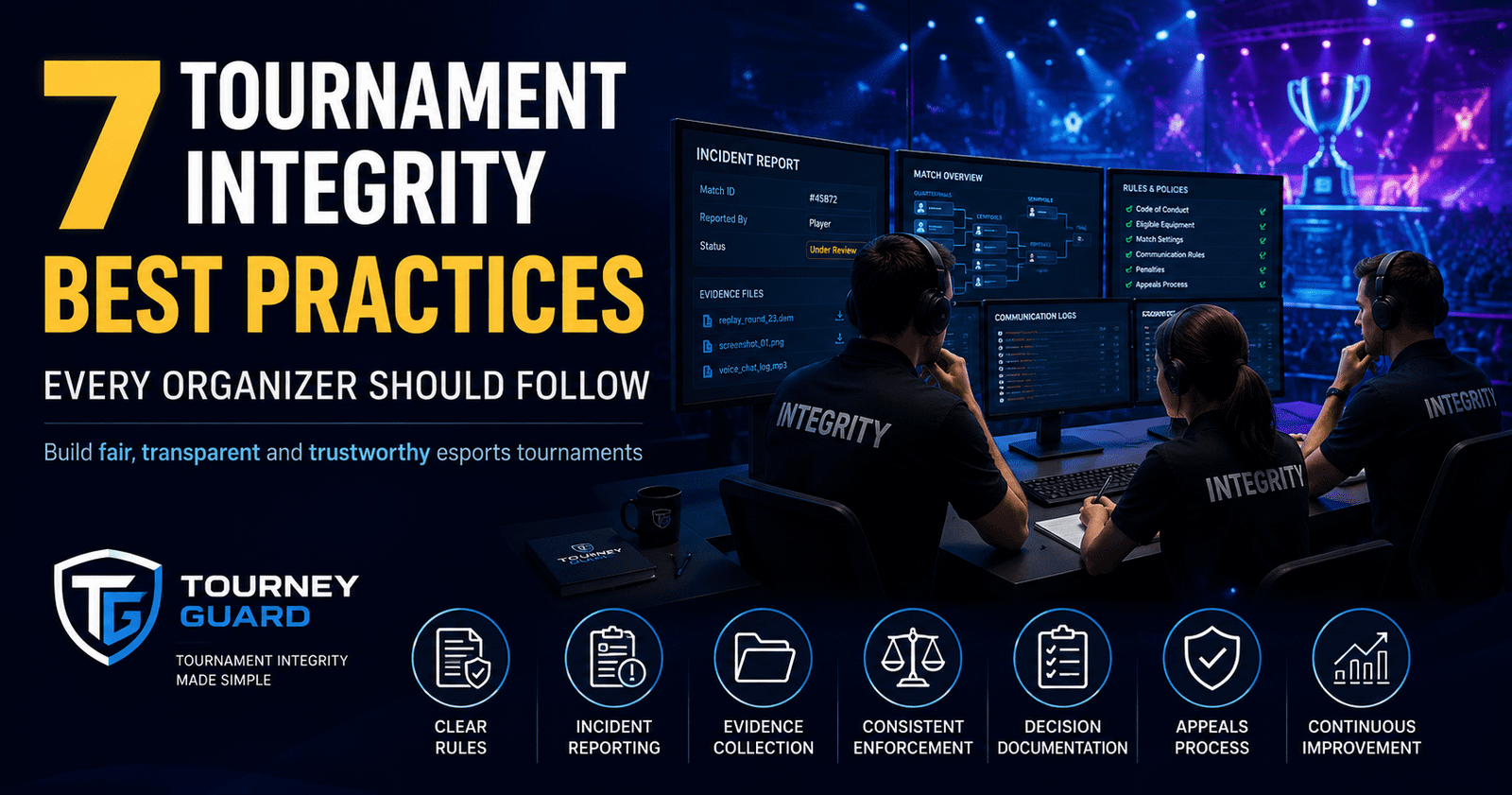
The most successful organizers rely on structured Tournament Integrity Best Practices that standardize how tournaments are administered before, during, and after competition. These practices reduce disputes, improve operational consistency, strengthen participant confidence, and create transparent decision-making processes.
This guide explains the most important best practices every esports organizer should implement regardless of tournament size.
What Are Tournament Integrity Best Practices?
Tournament Integrity Best Practices are standardized operational procedures that help tournament organizers maintain fairness, consistency, accountability, and transparency throughout every stage of a competition.
Rather than focusing solely on cheating detection, these practices cover the complete tournament lifecycle, including:
- Rule creation
- Player communication
- Match administration
- Incident reporting
- Evidence collection
- Administrative investigations
- Decision documentation
- Appeals management
- Post-event reviews
Organizations that adopt structured integrity processes are better prepared to handle unexpected situations while maintaining participant trust.
Why Best Practices Matter
Esports tournaments face a wide variety of operational challenges.
Examples include:
- Rule misunderstandings
- Match disputes
- Player misconduct
- Technical failures
- Identity concerns
- Scheduling conflicts
- Evidence disputes
- Appeal requests
Without documented procedures, similar incidents may receive different outcomes depending on who is making the decision. This inconsistency quickly damages credibility.
Tournament integrity best practices reduce subjectivity by establishing repeatable processes that everyone understands before competition begins.
The Cost of Poor Tournament Integrity
Tournament integrity is often viewed as an operational concern, but its impact extends far beyond individual matches. A single poorly managed incident can damage an organizer’s reputation, discourage future participation, and undermine the credibility of an entire event. Players expect rules to be enforced fairly, sponsors expect competitions to reflect professional standards, and audiences want confidence that results are legitimate.
When integrity processes are weak or inconsistent, organizers may face accusations of favoritism, inconsistent rulings, or inadequate investigations. Even if the final decision is technically correct, a lack of transparency can lead participants to question whether the process was fair.
Strong tournament integrity practices reduce these risks by ensuring that every incident follows the same documented workflow. Consistency, accountability, and clear communication help organizers build long-term trust with their communities. In competitive esports, reputation is one of the most valuable assets an organizer can develop, and maintaining that reputation requires more than good intentions—it requires repeatable operational processes.
1. Create Clear and Comprehensive Tournament Rules
Every integrity program begins with a well-written rulebook.
Rules should clearly define:
- Eligibility requirements
- Tournament format
- Match procedures
- Equipment policies
- Communication rules
- Competitive conduct expectations
- Penalty framework
- Appeal procedures
Avoid vague wording.
Participants should never have to guess how an incident will be handled.
A strong rulebook reduces disputes because expectations are communicated before the tournament starts.
Keep Rules Accessible
Publishing rules is only the first step.
Players should be able to easily access the latest version throughout the tournament.
Best practices include:
- Centralized documentation
- Version history
- Change notifications
- Acknowledgment before participation
Transparency starts with accessibility.
2. Standardize Incident Reporting
One of the most overlooked Tournament Integrity Best Practices is implementing a structured incident reporting process.
Instead of relying on informal Discord messages or private conversations, organizers should use standardized reports.
Every report should capture:
- Date and time
- Match identifier
- Reporter
- Players involved
- Description
- Supporting evidence
- Initial classification
- Status
Standardization improves consistency and prevents important information from being lost.
Encourage Early Reporting
Many integrity issues become difficult to investigate because they are reported too late.
Encourage participants to report incidents immediately after they occur.
Early reporting increases the availability of:
- Match recordings
- Server logs
- Witnesses
- Screenshots
- Chat history
The sooner evidence is collected, the more reliable the investigation becomes.
3. Collect Evidence Systematically
Evidence is the foundation of every administrative investigation.
Tournament organizers should establish clear procedures for collecting, organizing, and preserving evidence.
Evidence may include:
- Match replays
- Video recordings
- Screenshots
- Voice communications
- Tournament logs
- Referee observations
- Platform logs
- Official player statements
Every piece of evidence should remain linked to the corresponding incident.
Preserve Evidence Integrity
Evidence loses value when:
- Files are renamed
- Sources become unclear
- Upload dates disappear
- Multiple versions exist
Maintaining organized evidence repositories improves transparency and allows future reviews if an appeal occurs.
Maintain a Clear Chain of Custody
Collecting evidence is only the first step. Organizers should also maintain a clear chain of custody that documents how evidence was obtained, who handled it, and whether it has been modified or supplemented during the investigation. This practice is especially important when incidents are reviewed by multiple administrators or when a decision is appealed.
For example, screenshots should retain their original timestamps whenever possible, match recordings should be stored in their original format, and communication logs should be archived without editing or selective removal of messages. Each piece of evidence should remain associated with the corresponding incident record so investigators can easily reconstruct the sequence of events.
Maintaining an organized evidence trail not only improves the quality of investigations but also demonstrates professionalism. Players are far more likely to accept difficult decisions when organizers can clearly explain what evidence was reviewed and how conclusions were reached.
4. Apply Rules Consistently
Consistency is one of the strongest indicators of tournament integrity.
If two players commit the same violation under similar circumstances, they should receive comparable outcomes.
Consistency requires:
- Documented procedures
- Penalty guidelines
- Historical case references
- Decision reviews
This reduces accusations of favoritism or bias.
Avoid Improvised Decisions
Pressure during live tournaments often encourages organizers to make immediate decisions.
Whenever possible:
- Review available evidence.
- Consult tournament policies.
- Document the reasoning.
- Apply established procedures.
Structured decisions build confidence among players and spectators alike.
5. Document Every Administrative Decision
Every important integrity decision should be recorded.
Documentation provides accountability and creates valuable institutional knowledge for future events.
Decision records should include:
- Incident summary
- Evidence reviewed
- Applicable rules
- Decision rationale
- Penalties applied
- Decision makers
- Date
Well-documented decisions simplify future investigations because organizers can reference previous cases.
Build an Internal Case History
Over time, organizers accumulate experience.
Maintaining a searchable archive of previous decisions helps ensure similar incidents receive similar treatment.
Historical records improve consistency across multiple tournaments and staff members.
6. Implement a Transparent Appeals Process
Mistakes happen.
Players should have an opportunity to request a review through a structured appeals process.
A transparent system typically defines:
- Appeal eligibility
- Submission deadlines
- Required evidence
- Review procedure
- Final authority
- Response timeline
Appeals should focus on reviewing decisions rather than restarting investigations from scratch.
Separate Investigation From Appeal
Whenever possible, the individuals reviewing an appeal should not be the same people who made the original decision.
Independent reviews strengthen trust and reduce perceptions of bias.
7. Review Tournament Integrity After Every Event
Integrity programs should evolve continuously.
After each tournament, conduct a structured review covering:
- Number of incidents
- Resolution times
- Common violations
- Rule ambiguities
- Appeals submitted
- Operational bottlenecks
These reviews identify opportunities for improving future events.
Measure Integrity Performance
Useful metrics include:
- Incidents per tournament
- Average investigation time
- Appeal rate
- Decision consistency
- Evidence completeness
- Resolution speed
Tracking these indicators helps organizers improve operations over time.
Common Mistakes to Avoid
Even experienced organizers make avoidable mistakes.
The most common include:
- Relying only on anti-cheat software
- Applying inconsistent penalties
- Investigating without evidence
- Using undocumented procedures
- Making verbal decisions only
- Failing to communicate outcomes
- Ignoring appeals
- Updating rules during active tournaments without clear communication
Avoiding these mistakes significantly improves tournament credibility.
How Tournament Integrity Best Practices Improve Player Trust
Players are more likely to participate in tournaments when they believe competitions are administered fairly.
Strong integrity practices provide:
- Predictable rule enforcement
- Consistent investigations
- Transparent communication
- Fair dispute resolution
- Reliable documentation
Trust encourages repeat participation and strengthens community reputation.
The Role of Technology
As tournaments grow, manual processes become increasingly difficult to manage.
Modern tournament operations benefit from platforms that help organize:
- Incident reports
- Evidence repositories
- Administrative investigations
- Decision documentation
- Appeals workflows
- Audit trails
Technology should support operational consistency rather than replace human judgment.
Platforms such as Tourney Guard are designed around these administrative workflows, helping organizers manage tournament integrity through structured processes instead of focusing solely on cheat detection.
Frequently Asked Questions
What are Tournament Integrity Best Practices?
They are standardized operational procedures that help organizers ensure fairness, transparency, consistency, and accountability throughout esports competitions.
Do Tournament Integrity Best Practices replace anti-cheat software?
No. Anti-cheat tools address only part of competitive integrity. Best practices also cover governance, investigations, evidence management, rule enforcement, and appeals.
Why is documentation important?
Documenting incidents and decisions improves consistency, enables audits, supports appeals, and helps organizers learn from previous cases.
Should small tournaments follow these practices?
Yes. Even community tournaments benefit from clear rules, structured investigations, and transparent decision-making. Good operational habits are easier to establish early than after problems arise.
Building a Culture of Integrity
Tournament integrity is not achieved through policies alone. It also depends on fostering a culture in which players, referees, administrators, and organizers share responsibility for maintaining fair competition. Rules and procedures provide the framework, but their effectiveness ultimately relies on consistent application and a commitment to transparency.
Organizations that prioritize integrity often invest in referee training, staff documentation, and continuous improvement after every event. They encourage participants to report concerns without fear of retaliation and communicate decisions in a professional and respectful manner. Over time, these practices create an environment where fairness becomes part of the tournament’s identity rather than simply a compliance requirement.
As esports continues to mature, communities increasingly recognize the value of well-governed competitions. Organizers who establish strong integrity processes today will be better positioned to host larger events, attract reputable partners, and earn the long-term confidence of players and spectators alike.
Conclusion
Implementing Tournament Integrity Best Practices is one of the most effective ways to build trustworthy esports competitions.
While technology and anti-cheat solutions play an important role, long-term integrity depends on structured operational processes, consistent rule enforcement, reliable evidence collection, documented investigations, and transparent decision-making.
Organizers who adopt these best practices create tournaments that participants respect, communities trust, and sponsors are more confident supporting. As esports continues to mature, operational excellence will become just as important as technical infrastructure in delivering fair and credible competitions.
Turn Best Practices into Everyday Tournament Operations
Following Tournament Integrity Best Practices is about more than creating a rulebook or responding to incidents as they happen. Building trustworthy esports competitions requires consistent processes, organized documentation, transparent investigations, and clear administrative workflows that can be repeated across every tournament.
As your events grow, managing integrity through spreadsheets, chat conversations, and disconnected tools becomes increasingly difficult. Centralizing tournament operations helps reduce administrative errors, improve consistency, and create a complete record of every incident, investigation, and decision.
Tourney Guard is designed to help tournament organizers put integrity best practices into action. From incident reporting and evidence management to investigation tracking, appeals, and decision documentation, the platform provides the operational foundation needed to run fair, transparent, and professionally governed esports tournaments.
Discover how Tourney Guard helps organizers build stronger tournament integrity from the first match to the final decision.
👉 Learn More About Tourney Guard →
Recommended External Resources
These organizations publish guidance that supports professional Tournament Integrity programs:
- Esports Integrity Commission (ESIC) – Standards, codes of conduct, investigations, and integrity initiatives.
- International Olympic Committee (IOC) – Integrity frameworks applicable to competitive sports governance.
- International Betting Integrity Association (IBIA) – Best practices for integrity monitoring.
- NIST Cybersecurity Framework – Guidance for security governance and risk management.
- ISO 37301 Compliance Management Systems – International compliance management principles.
- World Anti-Doping Agency (WADA) – Governance and disciplinary process principles applicable beyond traditional sports.
Suggested Internal Links
Strengthen your internal linking strategy by connecting this article with: