
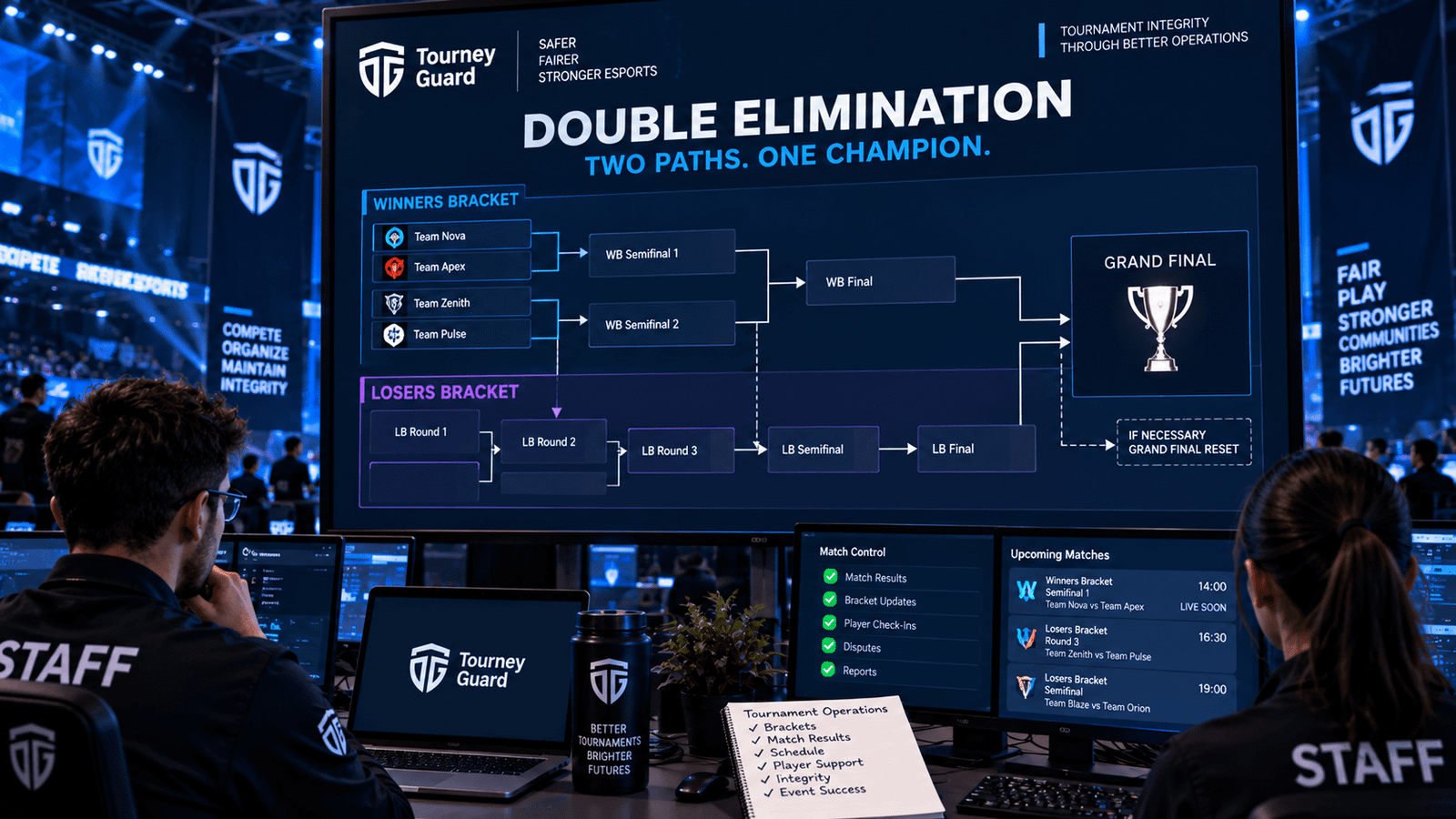
Introduction
Double Elimination Explained begins with a simple difference from single elimination: a competitor normally remains in the tournament after its first loss.
Instead of immediately leaving the competition, the losing team or player moves into a losers bracket, while winners continue through the winners bracket. This creates a second competitive path and allows participants an opportunity to recover from an early defeat.
That structure can provide a very different tournament experience. It gives competitors more matches, creates additional scheduling dependencies, and introduces more administrative complexity.
For tournament organizers, the challenge is not simply creating two brackets. The real challenge is coordinating match results, bracket transitions, scheduling, seeding, eliminations, disputes, roster eligibility, and championship conditions across a connected competition.
A correctly designed double-elimination tournament gives participants a clear understanding of what happens after each result. A poorly administered one can produce confusion about where a losing team goes, when a team is eliminated, how the grand final works, or which result determines the champion.
This guide explains how double elimination works, how winners and losers brackets interact, how the grand final is structured, how to schedule the competition, and how organizers can protect tournament integrity throughout the process.
Key principle: Double elimination provides a second competitive path after a loss, but that flexibility requires stronger bracket management and clearer tournament administration.



Key Takeaways
- Double elimination normally gives a competitor two losses before elimination.
- The format uses a winners bracket and a losers bracket.
- A loss in the winners bracket generally moves a competitor into the losers bracket.
- A second loss normally eliminates the competitor.
- The exact structure varies depending on the tournament rules and bracket design.
- Double elimination requires more matches than single elimination.
- Bracket transitions create dependencies between matches.
- The grand final may require a reset depending on the rules governing the tournament.
- Seeding and bracket placement should be established before competition.
- Match results must be verified before they trigger bracket advancement.
- Tournament organizers should define procedures for forfeits, withdrawals, disputes, and administrative decisions.
- Software can help coordinate connected brackets, schedules, results, and audit records.
What Is Double Elimination?
Double elimination is a tournament format in which a competitor normally remains in competition after one loss and is eliminated after a second loss.
The format generally consists of two interconnected competitive paths:
- Winners bracket
- Losers bracket
A simplified structure looks like this:
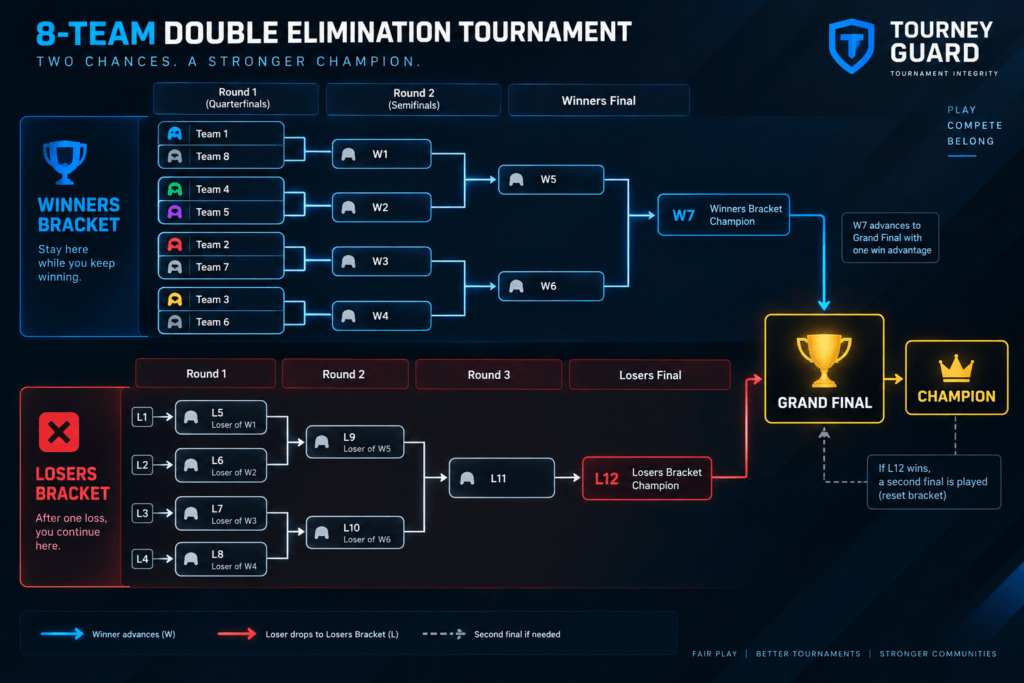
The critical relationship is:
Win → Continue in current path
First loss → Move to losers bracket
Second loss → Elimination
The exact mechanics depend on the tournament’s rulebook.
Some competitions use different bracket structures, match series, seeding systems, or grand-final conditions. Therefore, organizers should define the format explicitly rather than assuming that every double-elimination tournament operates identically.
How Does a Double-Elimination Bracket Work?
A typical double-elimination tournament begins with all competitors in the winners bracket.
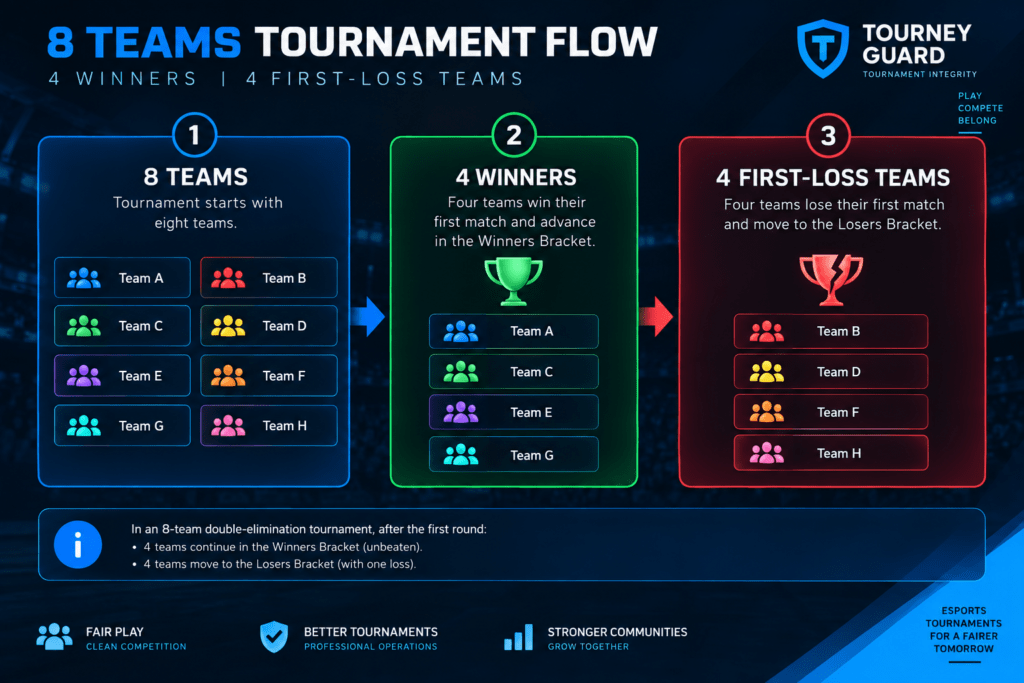
Consider eight teams.
The first stage produces four winners and four losers.
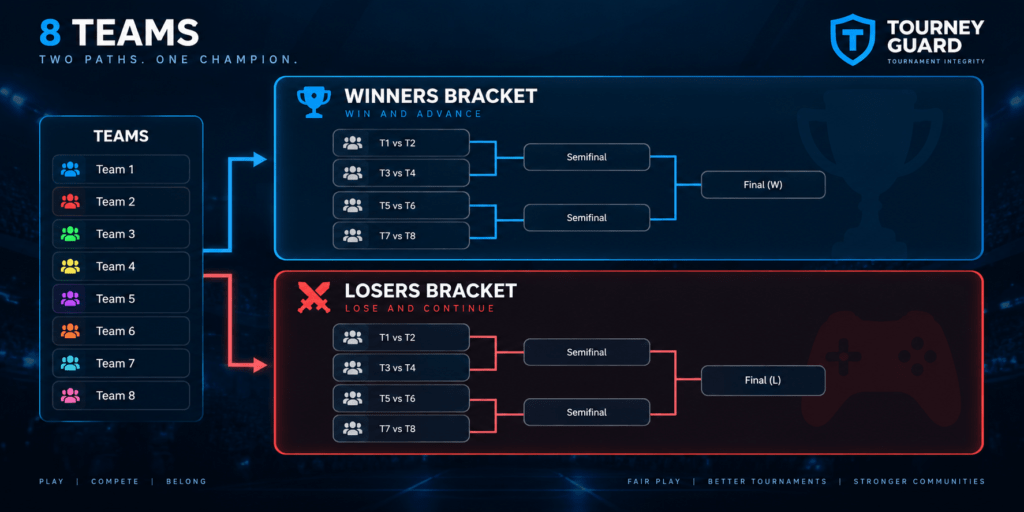
The winners continue competing for the winners-bracket final.
The teams that lose move into the losers bracket, where they receive another opportunity to remain in the tournament.
The losers bracket itself is usually structured so that competitors who lose there are eliminated.
Eventually, the winners-bracket champion and losers-bracket champion meet in the grand final.
Simplified progression
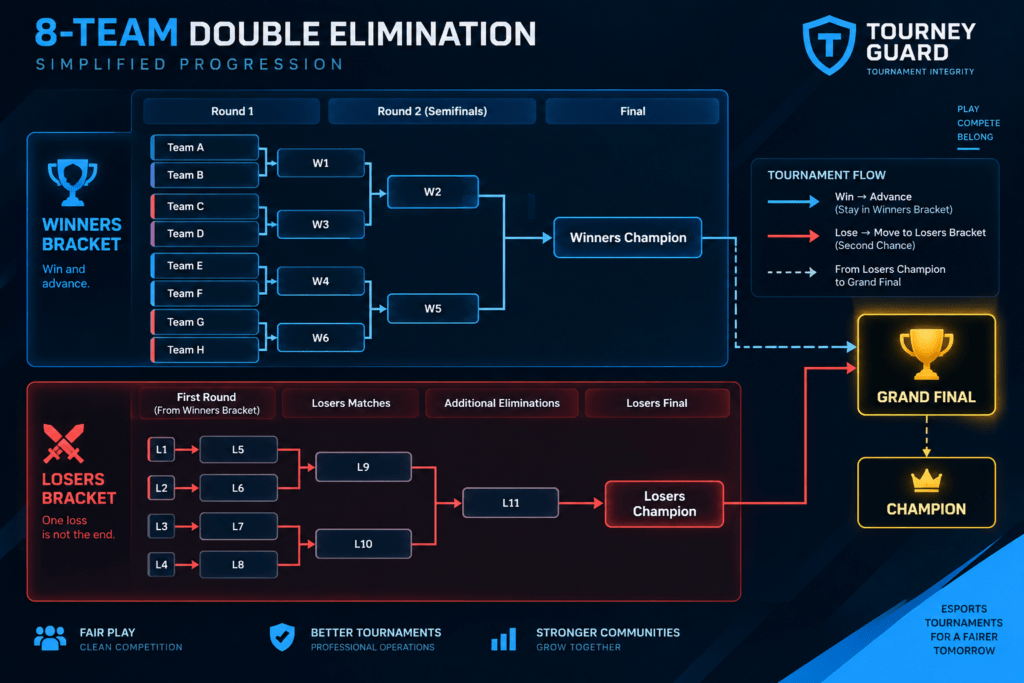
The actual bracket is more interconnected than this simplified representation suggests.
That interconnectedness is what creates much of the administrative complexity.
Tournament operations principle: In double elimination, every verified result can affect not only one participant’s status but also future bracket pairings and schedules.
What Happens After a Team Loses?
A team that loses its first match normally moves from the winners bracket to an appropriate position in the losers bracket.
This is one of the most important concepts to communicate to participants.
First loss
Winner bracket loss → Losers bracket
The team remains alive.
Second loss
Losers bracket loss → Elimination
The team leaves the tournament.
This creates a fundamentally different participant experience from single elimination.
| Single Elimination | Double Elimination |
|---|---|
| First loss normally eliminates | First loss normally moves competitor to losers bracket |
| One competitive path | Two connected competitive paths |
| Fewer matches | More matches |
| Simpler bracket administration | More complex bracket administration |
| Limited recovery | Opportunity to recover after first loss |
| One final path | Winners and losers champions converge |
The tournament rules should explicitly state what a loss means at each stage.
Winners Bracket vs Losers Bracket
The two brackets have different operational roles.
Winners Bracket
The winners bracket contains competitors who have not yet suffered a loss.
A competitor remains there by continuing to win.
Losers Bracket
The losers bracket contains competitors who have already suffered a loss but remain eligible to continue.
A second loss normally ends their tournament.
| Winners Bracket | Losers Bracket |
|---|---|
| Contains undefeated competitors | Contains competitors with one loss |
| Winner continues | Winner continues |
| Loser normally drops to losers bracket | Loser normally exits |
| Leads to winners-bracket final | Leads to losers-bracket final |
| Determines one grand-final participant | Determines the other grand-final participant |
The relationship between these brackets should be explained clearly in the tournament rulebook.
How Many Matches Does Double Elimination Require?
Double elimination requires more matches than single elimination because competitors can remain active after their first loss.
For a standard double-elimination structure without additional championship matches, the theoretical maximum is commonly close to:
2N − 2 matches
where N is the number of competitors.
For example:
| Competitors | Approximate Maximum Matches |
|---|---|
| 4 | 6 |
| 8 | 14 |
| 16 | 30 |
| 32 | 62 |
| 64 | 126 |
The exact number can vary depending on:
- Bracket construction.
- Byes.
- Forfeits.
- Withdrawals.
- Grand-final rules.
- Championship reset rules.
- Tournament-specific format.
This distinction matters operationally.
An organizer planning an eight-team single-elimination tournament expects seven matches.
An eight-team double-elimination tournament may require substantially more match capacity.
Resource implications
More matches can mean:
- More referee assignments.
- More server capacity.
- More broadcast requirements.
- Longer event duration.
- More administrative decisions.
- More result verification.
- More scheduling dependencies.
Planning principle: Do not estimate a double-elimination event using the match requirements of a single-elimination bracket.
What Is a Grand Final Reset?
A grand final reset is an additional championship match or series that may occur under specific double-elimination rules when the losers-bracket finalist defeats the winners-bracket finalist in the first grand-final encounter.
The concept exists because the winners-bracket finalist may enter the grand final without a previous loss, while the losers-bracket finalist has already lost once.
Different tournaments handle this situation differently.
For example, one tournament may define:
Grand Final → One series determines champion
Another may define:
Grand Final → If required, reset series
The tournament rules must explicitly establish which structure applies.
Example
Suppose:
- Team Alpha reaches the grand final through the winners bracket.
- Team Beta reaches it through the losers bracket.
Beta has already suffered one loss.
If Beta wins the first grand-final series, the tournament rules may specify that a reset series is played.
The simplified structure becomes:
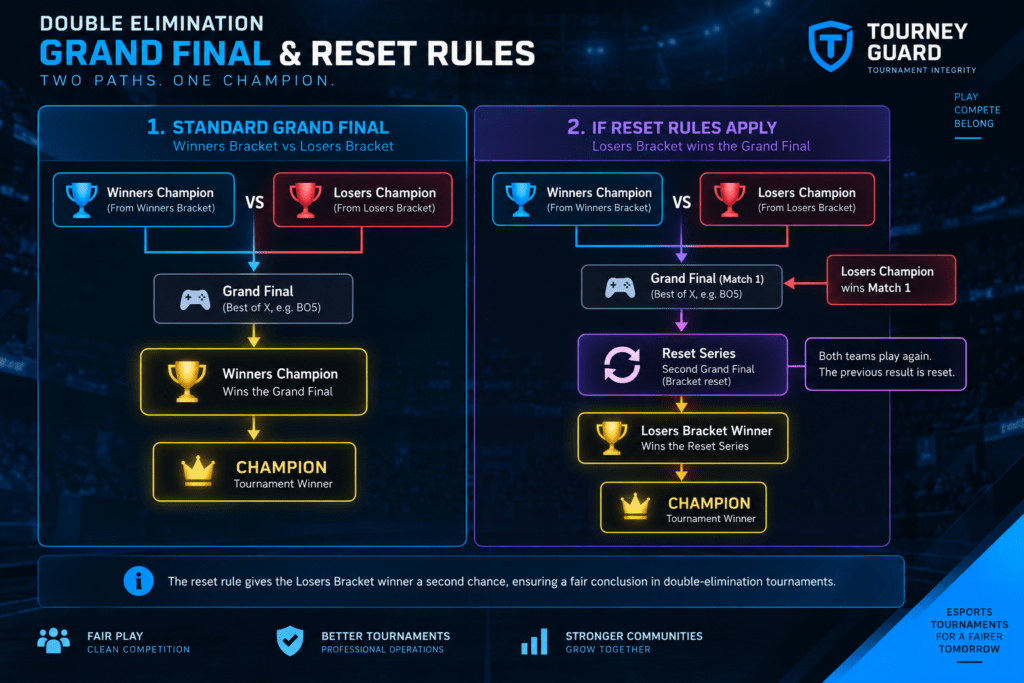
There is no universal grand-final rule.
The organizer must define the condition before the tournament begins.
How Should a Double-Elimination Tournament Be Scheduled?
Scheduling should account for the dependencies between the winners and losers brackets.
This is one of the biggest operational differences from a simple knockout structure.
A match in the losers bracket may depend on the results of multiple previous matches.
For example:
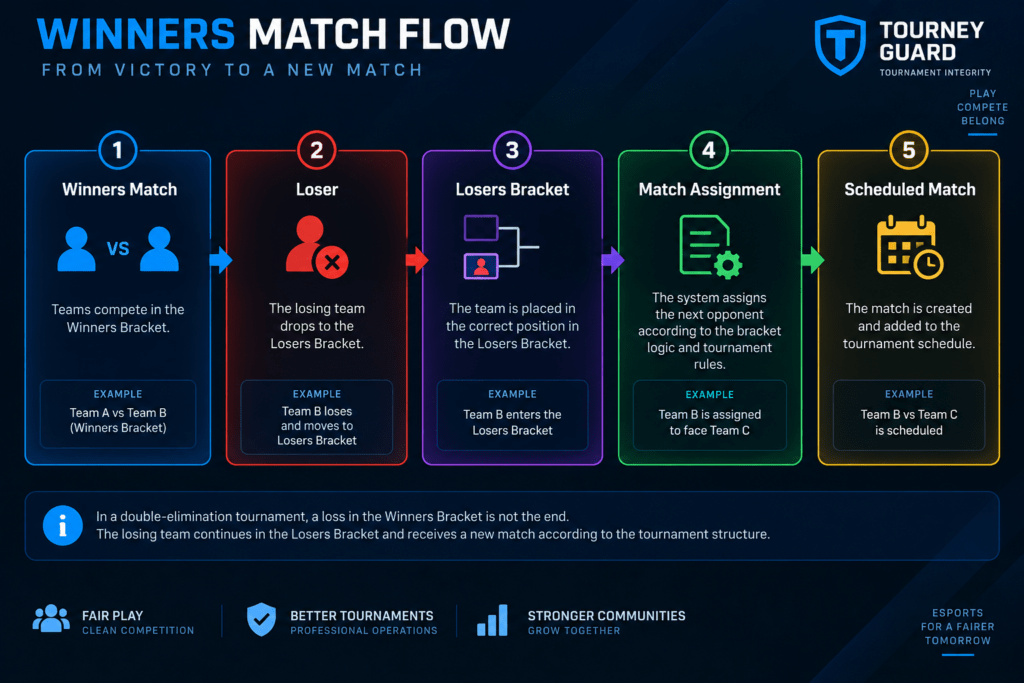
This means that tournament scheduling should allow enough flexibility to absorb:
- Match delays.
- Technical problems.
- Disputes.
- Forfeits.
- Extended match series.
- Unexpected bracket transitions.
Scheduling comparison
| Simple Knockout | Double Elimination |
|---|---|
| Fewer dependencies | Multiple bracket dependencies |
| Easier to predict match sequence | Later matches depend on more results |
| Fewer total matches | More total matches |
| Shorter potential event | Longer potential event |
| Simpler staff coordination | More coordination required |
A good schedule should therefore distinguish between:
Fixed schedule elements
and
Result-dependent schedule elements.
This is particularly important for live events.
How Should Seeding and Bracket Transitions Work?
Seeding should be defined before the bracket is generated, while transitions should be determined by the published bracket rules.
Possible seeding methods include:
- Competitive rankings.
- Qualifier results.
- Previous tournament performance.
- Random draw.
- Tournament-specific criteria.
The method should be documented.
Bracket placement
Once seeding is complete, the tournament system should establish:
- Initial winners-bracket matchups.
- Potential losers-bracket positions.
- Advancement paths.
- Match dependencies.
- Grand-final participants.
The organizer should avoid manually changing bracket positions without a documented reason.
Seeding vs randomization
| Seeding | Randomization |
|---|---|
| Uses defined criteria | Uses chance |
| Can reflect rankings | Does not require ranking |
| Requires methodology | Requires transparent randomization |
| Can be more predictable | Can produce unpredictable pairings |
| Must be documented | Must be reproducible or verifiable |
The appropriate method depends on the tournament’s objectives and published rules.


How Should Forfeits and Disputes Be Handled?
Forfeits, disputes, and administrative incidents should follow predefined procedures because a result can affect multiple future matches.
Consider a disputed winners-bracket match.
The result determines:
- Who remains in the winners bracket.
- Who moves to the losers bracket.
- Which teams meet next.
- Which matches can be scheduled.
- Potential future opponents.
If the result is later reversed, multiple bracket relationships may need to be reconsidered.
A useful workflow is:
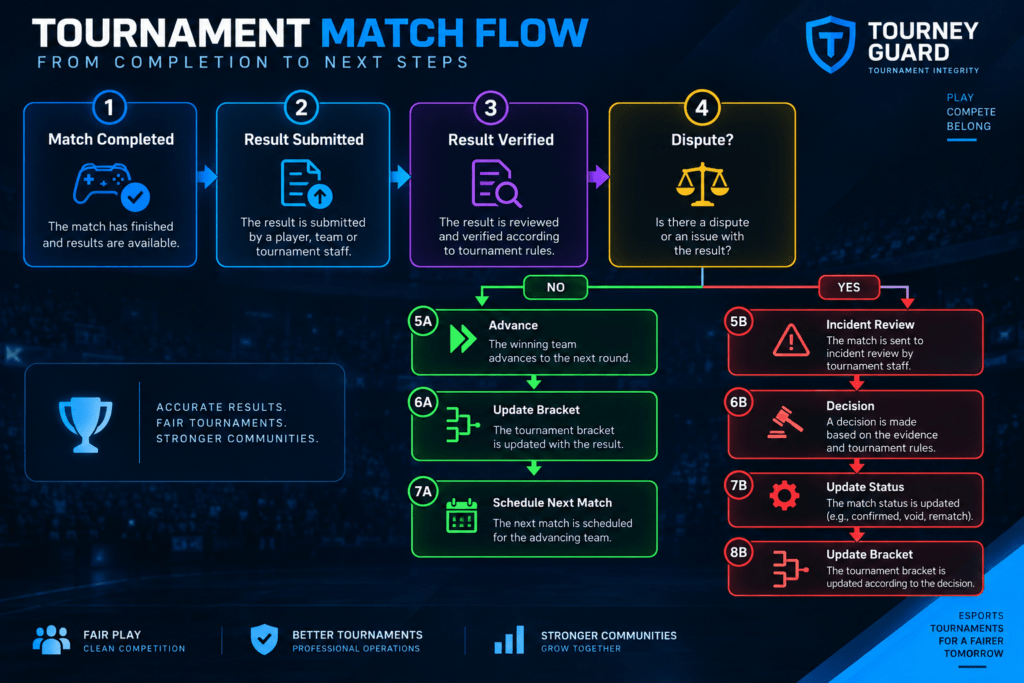
This is why result verification is especially important in connected tournament formats.
Best Practices
1. Explain the two-bracket structure
Participants should understand the relationship between the winners and losers brackets before competition begins.
2. Define what happens after each loss
Explicitly explain:
First loss → Losers bracket
Second loss → Elimination
If the tournament uses different rules, document them.
3. Publish the grand-final format
Teams should know whether a reset is possible and under what conditions.
4. Calculate realistic event capacity
Account for the larger number of matches and longer potential event duration.
5. Protect bracket integrity
Only authorized personnel should modify official results or bracket states.
6. Verify results before advancing competitors
A result should trigger bracket movement only after the applicable verification process.
7. Define dispute procedures
Teams need to know how to challenge results or administrative decisions.
8. Track bracket history
Preserve meaningful changes to results, statuses, and roster information.
9. Separate bracket management from incident investigation
A bracket administrator may need to pause advancement while another process reviews an incident.
10. Communicate changes quickly
A delayed bracket update can create confusion for multiple teams simultaneously.
Operational principle: The more interconnected the tournament format, the more important controlled result management becomes.
Common Mistakes
Mistake 1: Treating double elimination as two independent brackets
The winners and losers brackets are connected.
Consequence: Incorrect transitions and match assignments.
Avoid it: Model the relationships explicitly.
Mistake 2: Failing to explain the second-life concept
Participants may not understand what happens after losing.
Consequence: Confusion about whether they are eliminated.
Avoid it: Explain bracket transitions in the rulebook and participant communications.
Mistake 3: Not defining the grand final
A reset can materially change the end of the tournament.
Consequence: Disputes at the championship stage.
Avoid it: Publish the grand-final conditions before registration.
Mistake 4: Underestimating event duration
More matches mean more potential scheduling requirements.
Consequence: Venue, broadcast, staff, and player schedules become compressed.
Avoid it: Calculate the expected match workload and include operational buffers.
Mistake 5: Advancing teams before results are verified
Consequence: One incorrect result can propagate through several future matches.
Avoid it: Establish a formal result-confirmation checkpoint.
Mistake 6: Manually improvising bracket changes
Consequence: Difficult-to-explain decisions and weak auditability.
Avoid it: Define who can modify the bracket and under which conditions.
Mistake 7: Mixing eligibility and bracket status
A team may be in the losers bracket while still having an unresolved eligibility issue.
Consequence: Administrative and competitive states become confused.
Avoid it: Maintain separate eligibility, incident, and bracket statuses.
Practical Example
Imagine an eight-team double-elimination esports tournament.
The initial winners bracket contains four matches.
After those matches:
- Four teams remain in the winners bracket.
- Four teams move to the losers bracket.
The competition now has two active paths.
Stage 1
Stage 2
The winners continue in the winners bracket.
The teams in the losers bracket compete for survival.
A second loss eliminates a team.
Stage 3
Eventually:
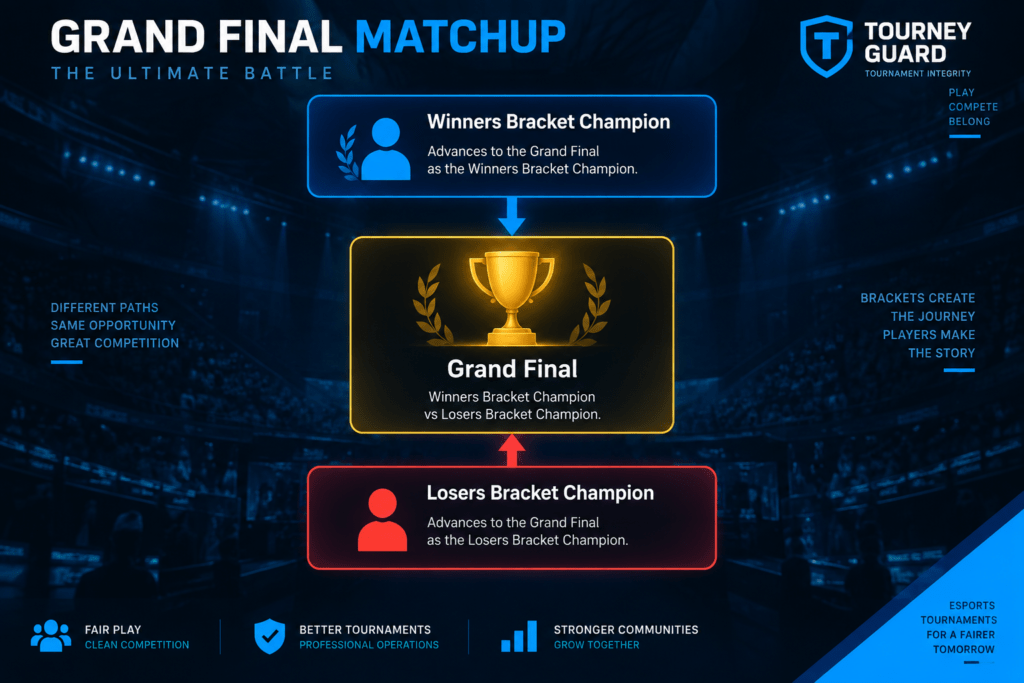
Suppose Team Alpha reaches the grand final without losing.
Team Beta reaches the grand final after losing once earlier in the tournament.
If Beta wins the first grand-final series, the tournament’s rules determine what happens next.
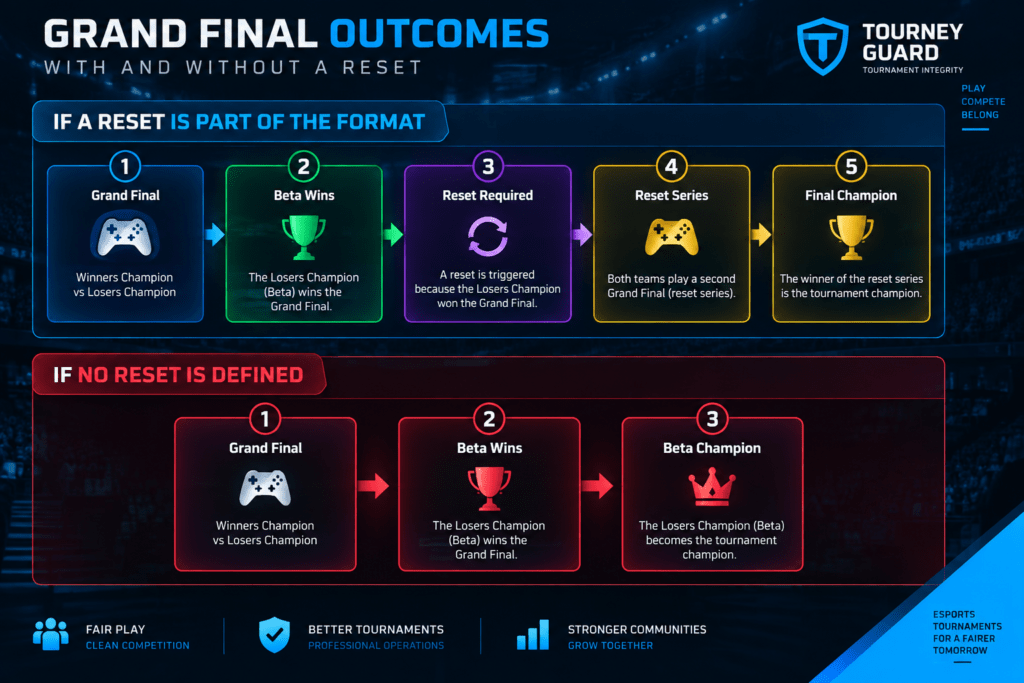
Neither model should be assumed universally.
The rulebook must establish the applicable championship condition.
Why administration matters
Now imagine that a quarterfinal result was entered incorrectly.
The error could affect:
- The winners bracket.
- The losers bracket.
- Match pairings.
- Scheduling.
- Broadcast planning.
- The eventual grand-final participants.
This illustrates an important difference between format design and tournament operations.
The bracket can be mathematically correct while the tournament still suffers from poor administration.
Decision Framework
Before choosing double elimination, organizers should evaluate the following.
1. Do participants need an opportunity to recover after an early loss?
Yes → Double elimination may support that objective.
No → A simpler knockout format may satisfy the competition structure.
2. Can the event accommodate additional matches?
Consider:
- Venue duration.
- Referees.
- Servers.
- Broadcast.
- Staff.
- Player availability.
3. Can the organization manage interconnected brackets?
Staff should understand:
- Winners-bracket transitions.
- Losers-bracket transitions.
- Match dependencies.
- Result verification.
- Grand-final conditions.
4. Can the tournament handle longer scheduling chains?
A delay in one match can affect multiple future matches.
5. Are championship conditions clear?
Before publication, define:
- Grand final.
- Reset conditions.
- Series format.
- Champion determination.
6. Can bracket changes be controlled?
The organizer should have:
- Authorized staff.
- Defined permissions.
- Result verification.
- Change records.
- Incident procedures.
Decision principle: Double elimination is not simply “single elimination with another bracket.” It is a more interconnected tournament system that requires additional operational capacity.
Checklist
Tournament Design Checklist
- ✓ Double-elimination format is explicitly defined.
- ✓ Winners bracket is documented.
- ✓ Losers bracket is documented.
- ✓ First-loss transition is explained.
- ✓ Second-loss elimination is explained.
- ✓ Seeding methodology is defined.
- ✓ Bracket construction rules are documented.
- ✓ Match format is documented.
- ✓ Grand-final structure is defined.
- ✓ Reset conditions are documented if applicable.
- ✓ Forfeit rules are documented.
- ✓ Dispute procedures are documented.
- ✓ Advancement rules are documented.
Tournament Administration Checklist
- ✓ Official bracket is maintained.
- ✓ Results are submitted through an official process.
- ✓ Results are verified before advancement.
- ✓ Winners-bracket transitions are tracked.
- ✓ Losers-bracket transitions are tracked.
- ✓ Bracket changes are controlled.
- ✓ Schedule dependencies are monitored.
- ✓ Delays are communicated.
- ✓ Disputes are documented.
- ✓ Administrative decisions are recorded.
- ✓ Grand-final conditions are confirmed before the championship stage.
- ✓ Final tournament state is preserved.
Tourney Guard
Understanding Double Elimination Explained is only the first step. Applying the format consistently becomes more difficult as tournaments grow, especially when winners and losers brackets generate interconnected schedules, frequent match-result updates, disputes, roster questions, and administrative decisions.
For organizers managing these processes through spreadsheets, chat messages, separate registration systems, or manual notes, it can become difficult to reconstruct why a team moved between brackets or how a particular administrative decision affected the competition.
Tourney Guard helps tournament organizers structure relevant Tournament Administration, Tournament Integrity, Incident Management, Evidence Collection, and administrative decision-making processes. For a double-elimination event, structured records and workflows can help teams and staff maintain clearer operational information as the competition progresses.
If you want to explore how a more structured approach can support your tournament operations, you can start with a free 30-day trial.
👉 Start Your 30-Day Free Trial →
FAQ
What is double elimination?
Double elimination is a tournament format in which a competitor normally receives two opportunities before being eliminated. After a first loss, the competitor moves from the winners bracket into the losers bracket. A subsequent loss in the losers bracket normally eliminates the competitor. The winners-bracket champion and losers-bracket champion eventually meet in the grand final. Exact bracket mechanics, match formats, and championship conditions can vary, so tournament organizers should always define the specific implementation in the official rules.
What happens when you lose in double elimination?
In a typical double-elimination tournament, a competitor that loses in the winners bracket moves into the losers bracket rather than being eliminated immediately. The competitor then continues playing for an opportunity to reach the grand final. A second loss normally results in elimination. The exact transition depends on the tournament’s bracket structure, so participants should review the official tournament rules rather than assuming every double-elimination event uses identical advancement rules.
What is the difference between single and double elimination?
Single elimination normally eliminates a competitor after one loss, while double elimination normally allows a competitor to continue after its first loss through a losers bracket. This gives double elimination a more complex structure and usually requires more matches. Single elimination is generally easier to schedule and administer, while double elimination requires coordination between interconnected winners and losers brackets. The appropriate choice depends on the tournament’s competitive objectives, available resources, expected event duration, and administrative capacity.
How many matches are in a double-elimination tournament?
The theoretical maximum for a standard double-elimination structure is commonly close to 2N − 2, where N is the number of competitors, although the exact total depends on the tournament design. Byes, forfeits, withdrawals, bracket construction, and grand-final rules can change the actual number. For example, an eight-team tournament can require substantially more matches than the seven matches needed in an eight-team single-elimination tournament. Organizers should calculate match capacity before finalizing schedules.
What is the losers bracket?
The losers bracket is the competitive path for participants who have suffered a loss but have not yet been eliminated. In a typical double-elimination structure, competitors enter it after losing in the winners bracket. They continue competing against other participants who have also lost, with another defeat normally resulting in elimination. The losers bracket eventually produces a finalist who meets the winners-bracket champion in the grand final.
What is a grand-final reset?
A grand-final reset is an additional championship match or series that may be played under certain double-elimination rules if the losers-bracket finalist defeats the winners-bracket finalist in the initial grand final. The purpose and exact mechanics depend on the tournament’s published rules. Some competitions include a reset condition while others define the first grand-final series as sufficient to determine the champion. Organizers should state the applicable rule before competition begins so teams understand the championship conditions.
Is double elimination more difficult to organize?
Double elimination generally requires more operational coordination because it has more matches and interconnected bracket paths. A result in the winners bracket can determine a team’s movement into the losers bracket, which can then affect future match assignments and schedules. Organizers also need clear procedures for result verification, bracket updates, disputes, delays, and championship conditions. Tournament-management software can help coordinate these processes, but the underlying rules and responsibilities should still be clearly defined.
Is double elimination fairer than single elimination?
The two formats provide different competitive structures. Double elimination normally gives a participant another opportunity after its first loss, while single elimination normally ends participation after one loss. Whether that structure is appropriate depends on the objectives and constraints of the specific tournament. Organizers should consider event duration, participant expectations, number of matches, competitive format, seeding, resources, and administrative complexity rather than assuming that one format is universally appropriate.
Conclusion
Double Elimination Explained is ultimately about creating a tournament structure where one loss does not normally end a competitor’s run.
The winners bracket rewards continued success, while the losers bracket provides a second competitive path for participants who suffer an initial defeat. Eventually, both paths converge in the grand final.
That structure creates additional opportunities for competitors, but it also creates additional operational responsibilities.
Tournament organizers must manage bracket transitions, match dependencies, scheduling, result verification, disputes, seeding, and championship conditions with precision.
The most important lesson is that double elimination should be treated as an integrated tournament system rather than two independent brackets.
Clear rules define the paths.
Verified results determine movement.
Controlled administration protects the integrity of the bracket.
And well-defined championship conditions eliminate uncertainty at the most important stage of the competition.
For organizers, getting those elements right is what turns a technically correct bracket into a professionally administered tournament.



Recommended External Resources
These organizations publish guidance that supports professional Tournament Integrity programs:
- Esports Integrity Commission (ESIC) – Standards, codes of conduct, investigations, and integrity initiatives.
- International Olympic Committee (IOC) – Integrity frameworks applicable to competitive sports governance.
- International Betting Integrity Association (IBIA) – Best practices for integrity monitoring.
- NIST Cybersecurity Framework – Guidance for security governance and risk management.
- ISO 37301 Compliance Management Systems – International compliance management principles.
- World Anti-Doping Agency (WADA) – Governance and disciplinary process principles applicable beyond traditional sports.
Suggested Internal Links
Strengthen your internal linking strategy by connecting this article with: