Introduction
Your complete Tournament Integrity Guide for protecting fairness, governance, investigations, evidence management, tournament operations, and competitive integrity in modern esports tournaments.
Why This Guide Matters
Whether you organize community tournaments, collegiate leagues, national championships, or international esports events, maintaining Tournament Integrity is one of your greatest responsibilities.
Players expect fair competition.
Teams expect consistent rule enforcement.
Sponsors expect a professional environment.
Publishers expect their competitive ecosystem to be protected.
Communities expect every decision to be transparent and impartial.
Tournament Integrity is the discipline that brings all these expectations together into a structured operational framework.
This guide explains the principles, processes, and best practices that professional tournament organizers use to build trustworthy competitions—from creating clear rules to managing incidents, preserving evidence, conducting investigations, and ensuring every competitive decision is fair, documented, and defensible.
Whether you’re launching your first tournament or managing an established esports circuit, this guide will help you build a governance framework that scales with your events while strengthening player confidence and organizational credibility.
What Is Tournament Integrity?
Tournament Integrity is the collection of governance principles, operational processes, policies, investigations, and administrative controls that ensure every tournament is conducted fairly, consistently, transparently, and according to established rules.
It extends far beyond detecting cheating.
A tournament can experience serious integrity failures even when no cheating software is involved.
Examples include:
- Inconsistent referee decisions
- Missing or incomplete evidence
- Poorly written tournament rules
- Conflicts of interest
- Administrative mistakes
- Unequal rule enforcement
- Inadequate investigation procedures
- Lack of documented disciplinary actions
- Unclear appeals processes
Tournament Integrity exists to ensure that every participant competes under the same standards and that every administrative decision can be justified through documented procedures rather than subjective judgment.
In professional esports, integrity is not defined by the absence of misconduct—it is defined by the presence of reliable governance.
Why Tournament Integrity Matters
As esports has grown into a global industry, tournaments have become increasingly complex.
Modern competitions involve:
- Hundreds or thousands of participants
- Multiple tournament officials
- Remote and on-site competitors
- Sponsors and commercial partners
- Publishers
- Streaming platforms
- International audiences
- Prize pools ranging from hundreds to millions of dollars
In this environment, every administrative decision carries significant consequences.
Without a structured Tournament Integrity program, organizers risk:
- Losing player trust
- Damaging organizational reputation
- Creating inconsistent rulings
- Increasing legal or contractual disputes
- Alienating sponsors
- Encouraging repeated misconduct
- Reducing competitive credibility
Tournament Integrity provides the operational framework that allows tournaments to remain fair regardless of their size or complexity.
It ensures that every investigation follows the same process, every incident is documented consistently, and every disciplinary action is supported by evidence rather than opinion.
Who Benefits from Tournament Integrity?
Tournament Integrity creates value for every stakeholder involved in competitive gaming.
Tournament Organizers
Organizers gain standardized operational procedures that reduce administrative uncertainty and improve decision-making consistency.
Instead of relying on individual judgment, officials can follow predefined governance frameworks that improve transparency and efficiency.
Players
Players participate with greater confidence when they know that:
- Rules are clearly documented.
- Violations are investigated fairly.
- Evidence is reviewed objectively.
- Appeals follow established procedures.
- Similar situations receive similar outcomes.
Consistency builds trust, and trust encourages long-term participation.
Tournament Officials
Referees, administrators, moderators, and integrity teams benefit from clearly defined responsibilities.
Documented procedures reduce uncertainty during stressful situations while improving coordination across tournament staff.
Teams and Organizations
Professional organizations need confidence that tournament decisions are objective and evidence-based.
A mature integrity program reduces concerns about favoritism, inconsistent enforcement, or undocumented disciplinary actions.
Sponsors
Sponsors invest in competitions that demonstrate professionalism.
Transparent governance protects brand reputation and reinforces confidence that sponsored events are managed responsibly.
Publishers
Game publishers benefit when independent tournament organizers operate under consistent governance standards that protect competitive ecosystems and player confidence.
The Evolution of Tournament Integrity
Competitive gaming has changed dramatically over the past two decades.
Early community tournaments often relied on a handful of volunteers, informal rules, and ad hoc decision-making. As esports expanded into a global industry, those informal practices became increasingly difficult to sustain.
Today, tournaments may involve:
- Multiple simultaneous brackets
- Distributed referee teams
- Regional qualifiers
- International participants
- Broadcast production
- Commercial partnerships
- Large prize pools
- Regulatory requirements
With greater scale came greater expectations.
Modern tournament organizers are expected to maintain professional standards comparable to those found in traditional sports and other competitive environments.
As a result, Tournament Integrity has evolved from a simple focus on enforcing rules into a comprehensive operational discipline that includes governance, documentation, investigations, evidence management, appeals, and continuous process improvement.
Tournament Integrity vs. Competitive Integrity
Although these terms are often used interchangeably, they describe different concepts.
Competitive Integrity focuses on the fairness of gameplay itself.
Examples include:
- Equal competitive conditions
- Fair match outcomes
- Sportsmanship
- Balanced competition
- Prevention of unfair competitive advantages
Tournament Integrity encompasses Competitive Integrity but extends beyond gameplay.
It also includes:
- Tournament governance
- Administrative processes
- Rule development
- Incident management
- Evidence collection
- Investigation procedures
- Appeals management
- Policy enforcement
- Operational accountability
In simple terms:
Competitive Integrity protects the match. Tournament Integrity protects the entire tournament.
Tournament Integrity vs. Anti-Cheat
One of the most common misconceptions in esports is assuming that Tournament Integrity is simply another name for anti-cheat systems.
It is not.
Anti-cheat solutions are designed to detect or prevent unauthorized software and technical manipulation during gameplay.
Tournament Integrity addresses a much broader set of organizational responsibilities.
For example, Tournament Integrity includes:
- Tournament governance
- Rulebooks
- Code of Conduct
- Incident reporting
- Evidence preservation
- Administrative investigations
- Appeals management
- Penalty consistency
- Documentation standards
- Operational transparency
Anti-cheat technology is only one possible component within a much larger integrity framework.
Even tournaments with excellent anti-cheat systems can experience integrity failures if investigations are inconsistent, evidence is mishandled, or tournament rules are unclear.
True Tournament Integrity combines people, processes, governance, and technology to create competitions that participants trust.
The Five Pillars of Tournament Integrity
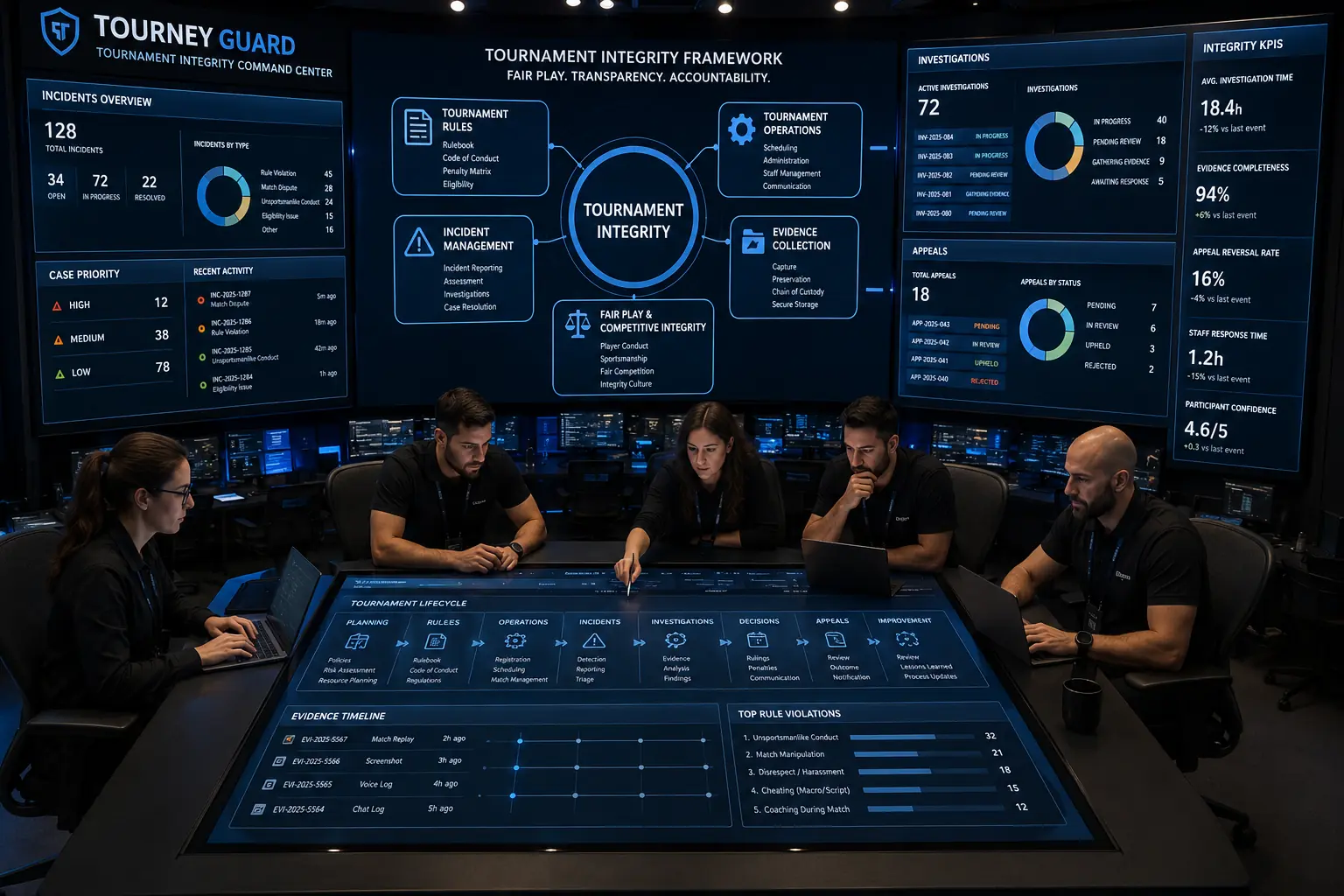
Every successful Tournament Integrity program is built upon five interconnected operational pillars.
Together, these pillars create a governance framework capable of supporting tournaments of every size.
In the following sections of this guide, we will explore each pillar in depth and explain how they work together to build a professional Tournament Integrity program.
1. Tournament Rules
Clear rules establish the foundation for every competitive decision.
A comprehensive rules framework defines eligibility requirements, tournament procedures, player responsibilities, prohibited behavior, penalties, and appeals processes.
Without clear rules, consistent enforcement becomes impossible.
Related Guides
- How to Write Tournament Rules
- Tournament Rulebook Template
- Code of Conduct for Esports Tournaments
2. Tournament Operations
Effective operations ensure tournaments run consistently from registration through final results.
Operational excellence includes scheduling, referee coordination, communication, match administration, participant management, and workflow standardization.
Well-designed operations reduce administrative errors while improving the experience for players and tournament staff alike.
3. Incident Management
No tournament is immune to unexpected situations.
Regardless of the game, tournament size, or level of competition, incidents are inevitable. The difference between amateur and professional tournament operations is not whether incidents occur, but how they are managed.
Incident Management is the operational discipline responsible for identifying, documenting, assessing, investigating, and resolving situations that may affect the fairness, safety, or integrity of a competition.
Without a structured incident management process, organizers often face inconsistent decisions, incomplete documentation, communication breakdowns, and disputes that can damage player trust and tournament credibility.
A mature Incident Management framework ensures that every reported issue follows the same standardized workflow, regardless of who is involved.
Typical incidents include:
- Rule violations
- Unsportsmanlike conduct
- Harassment
- Match disputes
- Administrative errors
- Identity verification issues
- Unauthorized coaching
- Technical pauses
- Streaming violations
- Eligibility disputes
- Evidence disputes
- Appeals resulting from previous decisions
Professional organizers understand that documenting an incident properly is just as important as resolving it.
Every case contributes to organizational learning, helping tournaments improve policies, staff training, and operational procedures over time.
Core Components of Incident Management
An effective incident management process typically includes:
- Incident reporting
- Initial assessment
- Severity classification
- Evidence collection
- Investigation
- Administrative review
- Decision making
- Communication with stakeholders
- Appeals (when applicable)
- Case closure
- Post-incident review
When these stages are consistently followed, tournaments become more transparent, repeatable, and defensible.
Related Guides
- Incident Report Template
- Incident Severity Levels
- Tournament Investigation Process
- Escalation Procedures
- Administrative Investigations in Esports
4. Evidence Collection
Good decisions depend on good evidence.
Evidence Collection is one of the most overlooked aspects of tournament administration, yet it is often the deciding factor in whether an investigation reaches a fair and defensible conclusion.
Without reliable evidence, organizers are forced to rely on assumptions, conflicting testimonies, or subjective opinions.
Professional Tournament Integrity programs instead rely on documented facts.
Evidence may include:
- Match replays
- Screenshots
- Video recordings
- Tournament logs
- Referee observations
- Player statements
- Chat logs
- Voice communications (when permitted)
- System logs
- Streaming footage
- Registration records
- Administrative documentation
However, collecting evidence is only the beginning.
Evidence must also remain:
- Authentic
- Complete
- Accurate
- Secure
- Traceable
- Accessible to authorized investigators
These principles reduce the likelihood of evidence tampering, accidental loss, or disputes regarding authenticity.
Chain of Custody
Professional investigations often rely on a documented Chain of Custody, which records how evidence was collected, stored, transferred, reviewed, and ultimately archived.
Maintaining a clear chain of custody strengthens confidence in administrative decisions and improves transparency during appeals.
Best Practices
Tournament organizers should establish procedures for:
- Evidence submission
- Evidence labeling
- Secure storage
- Retention policies
- Access permissions
- Version control
- Review documentation
- Evidence disposal
Standardized evidence management significantly improves investigation quality while reducing administrative risk.
Related Guides
- Evidence Collection Guide
- Chain of Custody Explained
- Evidence Preservation Best Practices
- Digital Evidence Management
- Tournament Evidence Checklist
5. Fair Play & Competitive Integrity
Fair Play is the ethical foundation upon which every competition is built.
Players expect that victories are earned through skill, preparation, teamwork, and strategic decision-making—not through unfair advantages or inconsistent administration.
Competitive Integrity focuses on preserving those fair competitive conditions throughout every match.
Although Tournament Integrity covers the broader governance of an event, Competitive Integrity ensures that the competition itself remains legitimate.
This includes protecting participants from both intentional misconduct and administrative inconsistencies that could influence competitive outcomes.
Examples include:
- Equal application of tournament rules
- Consistent referee decisions
- Prevention of unfair competitive advantages
- Respectful player behavior
- Sportsmanship
- Equal competitive conditions
- Transparent disciplinary procedures
Competitive Integrity is not solely about detecting cheating.
It also involves creating an environment where every participant believes the competition is being managed objectively and professionally.
When players trust tournament administration, confidence in the event grows alongside its reputation.
Building a Culture of Fair Play
Fair Play should not rely exclusively on enforcement.
Successful tournament organizers actively promote positive competitive behavior through:
- Clear Codes of Conduct
- Staff education
- Player onboarding
- Transparent communication
- Consistent rule enforcement
- Respectful conflict resolution
- Continuous education
A culture of integrity discourages misconduct before it occurs.
Related Guides
- Fair Play Guidelines
- Code of Conduct for Esports Tournaments
- Competitive Integrity Explained
- Sportsmanship Best Practices
- Preventing Unsportsmanlike Conduct
How the Five Pillars Work Together
Although each pillar serves a distinct purpose, none of them operates independently.
Professional Tournament Integrity programs succeed because these disciplines reinforce one another throughout the tournament lifecycle.
Consider the following example:
A player reports suspected unauthorized coaching during a playoff match.
The incident is first evaluated against the Tournament Rules, which define whether the reported behavior constitutes a violation.
The case then enters the Incident Management process, where tournament officials document the report, classify its severity, and initiate an investigation.
Investigators gather screenshots, match recordings, communications, and referee observations through established Evidence Collection procedures, ensuring all materials remain authentic and properly documented.
Throughout the investigation, tournament staff follow standardized Tournament Operations workflows, maintaining communication with the affected teams, recording administrative actions, and coordinating decision-making.
Finally, officials assess the evidence while applying the principles of Fair Play and Competitive Integrity, ensuring that any disciplinary action protects competitive fairness and is applied consistently with previous cases.
This interconnected approach produces decisions that are transparent, evidence-based, and defensible.
Tournament Integrity Is a System, Not a Single Process
One of the most common misconceptions among new tournament organizers is viewing Tournament Integrity as a single department or a collection of isolated procedures.
In reality, Tournament Integrity is a governance system.
Every policy, investigation, operational workflow, evidence record, and administrative decision contributes to the overall credibility of a tournament.
Weakness in any one of the five pillars can undermine the effectiveness of the entire program.
For example:
- Excellent tournament rules lose value if incidents are investigated inconsistently.
- Strong investigations become unreliable when evidence is incomplete or poorly preserved.
- Comprehensive evidence cannot compensate for unclear operational procedures.
- Well-organized tournaments still lose credibility if disciplinary decisions are perceived as unfair or inconsistent.
Conversely, when governance, operations, investigations, evidence management, and fair competition are fully integrated, tournament organizers create an environment where players, officials, sponsors, publishers, and communities can trust that every decision is made with professionalism, transparency, and consistency.
Tournament Integrity Lifecycle
Understanding the individual pillars is only the first step.
The next challenge is learning how Tournament Integrity operates as a continuous process before, during, and after every competition.
In the next section, we will examine the complete Tournament Integrity Lifecycle, exploring how planning, tournament rules, operations, incident response, investigations, evidence management, decision-making, appeals, and continuous improvement connect to create a mature Tournament Integrity program.
Tournament Integrity Lifecycle
Tournament Integrity is not a task performed only when something goes wrong.
It is a continuous operational lifecycle that begins long before the first match is played and continues even after the tournament has concluded.
Organizations that consistently deliver fair and trusted competitions treat Tournament Integrity as an ongoing governance process rather than a reactive incident response function.
The lifecycle can be divided into nine interconnected stages.
Stage 1: Planning & Governance
Every successful tournament begins with proper planning.
During this phase, organizers define the governance structure that will support the competition.
Typical activities include:
- Defining tournament objectives
- Assigning tournament staff roles
- Establishing integrity responsibilities
- Developing tournament policies
- Creating operational procedures
- Identifying potential integrity risks
- Preparing investigation workflows
- Defining communication channels
Strong governance reduces uncertainty later in the tournament.
Stage 2: Tournament Rules
Rules establish the standards that every participant agrees to follow.
During this phase, organizers develop:
- Tournament Rulebook
- Code of Conduct
- Eligibility requirements
- Match procedures
- Penalty matrix
- Appeals policy
- Administrative procedures
Every future decision will rely on these documents.
Well-written rules reduce ambiguity while increasing consistency across officials.
Stage 3: Tournament Operations
Once the tournament begins, operational execution becomes critical.
This stage includes:
- Registration
- Check-ins
- Bracket management
- Match scheduling
- Staff coordination
- Communication
- Live administration
- Technical support
Operational consistency minimizes administrative mistakes that could negatively affect competitive fairness.
Stage 4: Incident Detection
Not every issue immediately becomes an investigation.
The first step is identifying situations that require administrative attention.
Incidents may be reported by:
- Players
- Referees
- Administrators
- Spectators
- Tournament staff
- Automated monitoring systems
Early detection allows organizers to respond before problems escalate.
Stage 5: Evidence Collection
Once an incident is confirmed, investigators begin gathering relevant information.
Typical evidence includes:
- Match replays
- Screenshots
- Tournament logs
- Player statements
- Referee observations
- Video recordings
- Chat logs
- Administrative records
Evidence should always be documented using standardized procedures to maintain credibility throughout the investigation.
Stage 6: Investigation
Investigations seek facts—not assumptions.
Professional investigations should answer questions such as:
- What happened?
- When did it happen?
- Who was involved?
- Which rules apply?
- What evidence supports each conclusion?
- Are additional witnesses required?
Investigations should remain objective, impartial, and fully documented.
Stage 7: Administrative Decision
Once investigators have completed their analysis, tournament officials evaluate the findings.
Possible outcomes include:
- No violation occurred.
- Warning issued.
- Match replay ordered.
- Penalty applied.
- Disqualification.
- Suspension.
- Case dismissed.
- Additional investigation required.
Every decision should clearly reference:
- Applicable rules
- Supporting evidence
- Investigation findings
- Administrative reasoning
Documented decisions improve transparency and consistency.
Stage 8: Appeals
An effective appeals process protects both participants and tournament organizers.
Appeals should focus on:
- Procedural errors
- Newly discovered evidence
- Misinterpretation of tournament rules
- Administrative inconsistencies
Appeals should not simply provide an opportunity to repeat previous arguments.
Instead, they exist to verify that tournament procedures were applied correctly.
Stage 9: Continuous Improvement
Tournament Integrity does not end when the tournament finishes.
Every completed investigation provides valuable information that can improve future events.
Organizations should review:
- Common incident types
- Rule ambiguities
- Operational bottlenecks
- Investigation timelines
- Evidence quality
- Staff performance
- Appeal outcomes
- Player feedback
Continuous improvement transforms individual incidents into organizational knowledge.
Common Tournament Integrity Risks
Every tournament faces risks that have the potential to undermine competitive fairness and organizational credibility.
While no event can eliminate every threat, understanding common integrity risks allows organizers to prepare effective mitigation strategies.
Rule Ambiguity
Poorly written rules often lead to inconsistent enforcement.
If tournament officials interpret the same rule differently, player confidence quickly deteriorates.
Regular rule reviews help eliminate ambiguity before tournaments begin.
Administrative Inconsistency
Different referees should reach similar decisions when presented with similar situations.
Standardized procedures reduce subjective decision-making and improve fairness across the tournament.
Inadequate Evidence
Incomplete evidence frequently results in disputed outcomes.
Missing screenshots, unavailable match recordings, or undocumented witness statements can prevent investigators from reaching reliable conclusions.
Delayed Incident Response
Slow responses often increase tension between participants.
Establishing service-level objectives (SLOs) for incident acknowledgment and investigation helps maintain player confidence.
Poor Communication
Participants deserve clear explanations regarding tournament decisions.
Transparent communication reduces misunderstandings while improving trust in tournament administration.
Conflicts of Interest
Investigators and decision-makers should remain impartial throughout every case.
Organizations should establish policies for identifying and managing potential conflicts of interest.
Inconsistent Penalties
Two identical violations should receive similar disciplinary outcomes.
Maintaining historical case records helps administrators apply penalties consistently over time.
Insufficient Documentation
If an investigation is not documented, future administrators cannot review or learn from previous decisions.
Documentation preserves institutional knowledge and strengthens governance.
Weak Appeals Process
Appeals provide an important safeguard against procedural mistakes.
Without a structured appeals framework, tournaments risk appearing arbitrary or unfair.
Reputation Risk
Tournament Integrity extends beyond operational efficiency.
Every poorly managed incident has the potential to damage relationships with players, sponsors, publishers, and the wider esports community.
Protecting integrity ultimately protects organizational reputation.
Building a Tournament Integrity Program
Developing a mature Tournament Integrity program is an ongoing process rather than a one-time project.
Organizations typically progress through several stages of maturity.
Step 1: Establish Governance
Define organizational responsibilities.
Assign clear ownership for:
- Tournament Directors
- Integrity Officers
- Referees
- Investigators
- Appeals Committee
- Operations Team
Everyone should understand their role before the tournament begins.
Step 2: Develop Policies
Create standardized documentation including:
- Rulebooks
- Code of Conduct
- Investigation Procedures
- Incident Response Plans
- Evidence Handling Policies
- Appeals Procedures
Documentation creates consistency across every tournament.
Step 3: Standardize Operations
Develop repeatable workflows for:
- Registration
- Match administration
- Incident reporting
- Investigations
- Appeals
- Tournament communications
Standardization reduces administrative variability.
Step 4: Train Staff
Policies only become effective when staff understand how to apply them.
Training should include:
- Rule interpretation
- Evidence handling
- Communication skills
- Conflict resolution
- Investigation methodology
- Documentation standards
Well-trained officials improve both efficiency and fairness.
Step 5: Measure Performance
Organizations should regularly evaluate:
- Investigation times
- Incident resolution rates
- Appeals frequency
- Repeat violations
- Evidence quality
- Rule compliance
Measurement enables continuous improvement.
Step 6: Improve Continuously
Tournament Integrity programs evolve alongside the esports ecosystem.
Each tournament should produce insights that strengthen future governance, operational procedures, and participant trust.
Technology Supporting Tournament Integrity
As tournaments grow, manual administration becomes increasingly difficult.
Modern Tournament Integrity programs benefit from technology that improves consistency, documentation, collaboration, and traceability.
Examples include:
- Incident Management platforms
- Case Management systems
- Evidence repositories
- Audit trails
- Workflow automation
- Digital investigation tools
- Document management systems
- Analytics dashboards
- Knowledge bases
- Reporting platforms
Rather than replacing tournament officials, these technologies enable teams to work more efficiently while maintaining comprehensive records of every administrative action.
Organizations that invest in well-designed operational tools are better equipped to manage increasing tournament complexity without sacrificing transparency or fairness.
Measuring Tournament Integrity Success
Implementing policies and procedures is only the beginning.
Professional tournament organizers continuously measure whether their integrity program is achieving its objectives.
The next section explores the Key Performance Indicators (KPIs) that help organizations evaluate investigation efficiency, operational consistency, evidence quality, participant confidence, and the overall health of their Tournament Integrity program.
Tournament Integrity KPIs
An effective Tournament Integrity program should be measured just like any other critical operational function.
Without meaningful metrics, tournament organizers cannot determine whether their governance processes are improving, whether investigations are becoming more efficient, or whether participant confidence is increasing over time.
The following Key Performance Indicators (KPIs) provide a practical framework for evaluating the health and maturity of a Tournament Integrity program.
1. Incident Rate
Definition
The total number of reported incidents during a tournament or competitive season.
Why It Matters
This metric provides visibility into the operational workload and helps identify recurring issues that may require policy updates or staff training.
Examples
- Incidents per tournament
- Incidents per 100 matches
- Incidents by game title
- Incidents by tournament stage
2. Investigation Resolution Time
Definition
The average time required to complete an investigation from initial report to final administrative decision.
Why It Matters
Long investigations delay tournament operations and reduce participant confidence.
Efficient investigations balance speed with thoroughness.
3. Evidence Completeness Rate
Definition
The percentage of investigations that contain all required supporting evidence before reaching a decision.
Examples include:
- Match replay
- Screenshots
- Witness statements
- Referee report
- Administrative notes
Incomplete evidence often leads to appeals or disputed outcomes.
4. Appeals Rate
Definition
The percentage of administrative decisions that are formally appealed.
A high appeals rate may indicate:
- Unclear rules
- Poor communication
- Inconsistent investigations
- Participant dissatisfaction
A low appeals rate combined with high participant confidence often reflects a mature integrity program.
5. Appeal Reversal Rate
Definition
The percentage of appealed decisions that are modified or overturned.
Consistently high reversal rates may reveal:
- Investigation weaknesses
- Rule ambiguity
- Procedural inconsistencies
- Insufficient evidence
6. Repeat Offender Rate
Organizations should monitor how frequently the same participants violate tournament policies.
Tracking repeat offenders enables organizers to:
- Identify behavioral patterns
- Improve educational initiatives
- Apply progressive disciplinary measures
7. Rule Compliance Rate
Measures how consistently tournament participants comply with published tournament rules.
Examples include:
- Registration compliance
- Check-in compliance
- Equipment requirements
- Code of Conduct adherence
Higher compliance generally indicates clearer documentation and effective communication.
8. Staff Response Time
Measures how quickly tournament officials acknowledge newly reported incidents.
Rapid acknowledgment reassures participants that concerns are being addressed while reducing uncertainty during live events.
9. Documentation Quality Score
Every investigation should contain standardized documentation.
Evaluation criteria may include:
- Incident summary
- Timeline
- Evidence references
- Applicable rules
- Investigation findings
- Administrative reasoning
- Final decision
- Appeal information
Consistent documentation strengthens transparency and preserves organizational knowledge.
10. Participant Confidence
Perhaps the most important KPI is participant trust.
This can be measured through post-event surveys covering areas such as:
- Fairness
- Transparency
- Professionalism
- Communication
- Confidence in tournament decisions
Trust is the ultimate indicator of Tournament Integrity.
Tournament Integrity Best Practices
Building an integrity program requires more than policies alone.
The following best practices are widely applicable to tournaments of all sizes and can significantly improve operational consistency and participant confidence.
Standardize Every Process
Avoid relying on individual judgment whenever possible.
Develop standardized procedures for:
- Incident reporting
- Investigations
- Evidence collection
- Rule enforcement
- Appeals
- Documentation
Consistency is the foundation of fairness.
Document Every Administrative Decision
Even seemingly minor decisions should be documented.
Comprehensive records help:
- Support future investigations
- Maintain consistency
- Defend administrative actions
- Improve organizational learning
Train Tournament Staff Regularly
Tournament Integrity depends heavily on people.
Provide recurring training on:
- Rule interpretation
- Conflict resolution
- Evidence handling
- Investigation techniques
- Communication skills
Well-prepared staff make better decisions under pressure.
Communicate Transparently
Participants do not always expect outcomes in their favor.
They do expect to understand how decisions were reached.
Clear communication reduces speculation and strengthens confidence in tournament administration.
Preserve Organizational Knowledge
Every completed tournament generates valuable experience.
Maintain:
- Historical investigations
- Previous rulings
- Lessons learned
- Updated procedures
- Operational playbooks
Knowledge retention enables continuous improvement.
Review Policies Regularly
Esports evolves rapidly.
Tournament rules and operational procedures should evolve alongside:
- New game mechanics
- Publisher updates
- Emerging risks
- Community expectations
- Regulatory requirements
Governance should remain current rather than reactive.
Tournament Integrity Checklist
Before launching any tournament, review the following checklist to ensure your integrity program is prepared.
Governance
- □ Tournament governance structure defined
- □ Staff responsibilities assigned
- □ Investigation authority established
- □ Appeals committee identified
Tournament Rules
- □ Rulebook published
- □ Code of Conduct completed
- □ Penalty matrix documented
- □ Appeals process explained
- □ Eligibility requirements defined
Tournament Operations
- □ Match procedures documented
- □ Staff communication channels established
- □ Check-in process verified
- □ Administrative workflows tested
Incident Management
- □ Incident reporting process available
- □ Severity levels defined
- □ Escalation procedures documented
- □ Investigation workflow prepared
Evidence Collection
- □ Evidence submission process established
- □ Storage procedures documented
- □ Chain of Custody maintained
- □ Access permissions configured
- □ Retention policy defined
Investigations
- □ Investigation templates prepared
- □ Standard interview procedures documented
- □ Decision review process established
Communication
- □ Participant communication templates created
- □ Public announcement procedures defined
- □ Internal reporting workflow documented
Continuous Improvement
- □ KPIs established
- □ Post-event review scheduled
- □ Lessons learned documented
- □ Policies updated after each tournament
Frequently Asked Questions
What is Tournament Integrity?
Tournament Integrity is the governance framework that ensures esports competitions are conducted fairly, transparently, consistently, and according to established rules. It encompasses tournament governance, operations, incident management, evidence collection, investigations, and administrative decision-making.
Is Tournament Integrity the same as Anti-Cheat?
No.
Anti-cheat systems focus on detecting or preventing unauthorized software during gameplay.
Tournament Integrity is much broader and includes governance, rulebooks, investigations, evidence management, operational procedures, appeals, and policy enforcement.
Why is Tournament Integrity important?
A strong integrity program protects player trust, improves operational consistency, strengthens sponsor confidence, and enhances the long-term credibility of tournaments.
Who is responsible for Tournament Integrity?
Responsibility is shared across Tournament Directors, referees, investigators, integrity officers, tournament administrators, and appeals committees.
Each role contributes to maintaining fair and transparent competition.
What types of incidents are handled?
Examples include:
- Rule violations
- Unsportsmanlike conduct
- Administrative disputes
- Harassment
- Identity verification issues
- Technical incidents
- Evidence disputes
- Appeals
What is Chain of Custody?
Chain of Custody is the documented history of how evidence is collected, transferred, reviewed, stored, and archived throughout an investigation.
Maintaining this record helps preserve evidence integrity and strengthens confidence in administrative decisions.
How often should tournament rules be updated?
Tournament organizers should review rules before every competitive season and after significant game updates, publisher policy changes, or major operational lessons learned.
Can small tournaments benefit from Tournament Integrity?
Absolutely.
While large international events may require more formal governance structures, even community tournaments benefit from clear rules, consistent investigations, and transparent decision-making.
The principles of Tournament Integrity scale effectively regardless of tournament size.
Related Guides
Expand your knowledge with these in-depth resources from the Tourney Guard Knowledge Hub.
Tournament Rules
Learn how to create clear, enforceable, and transparent tournament regulations.
Recommended reading:
- What Is Competitive Integrity
- What Is Fair Play in Esports?
- Tournament Integrity Best Practices: The Complete Guide for Esports Organizers
Tournament Operations
Discover best practices for organizing and managing esports competitions efficiently.
Recommended reading:
- Tournament Operations Guide
- Tournament Administration Best Practices
- Tournament Planning Checklist
Incident Management
Explore structured approaches for handling tournament incidents consistently.
Recommended reading:
- Incident Report Template
- Incident Severity Levels
- Tournament Investigation Process
Evidence Collection
Learn how to collect, preserve, and manage digital evidence throughout tournament investigations.
Recommended reading:
- Evidence Collection Guide
- Chain of Custody Explained
- Evidence Preservation Best Practices
Conclusion
Tournament Integrity is far more than a collection of policies or administrative procedures—it is the foundation of every credible esports competition.
While players experience Tournament Integrity through fair matches and transparent decisions, organizers understand that those outcomes depend on a much broader system of governance, operational excellence, investigations, evidence management, and continuous improvement.
Building that system requires commitment, consistency, and a willingness to learn from every tournament.
Organizations that invest in Tournament Integrity strengthen player confidence, improve operational efficiency, reduce administrative risk, and create competitions that sponsors, publishers, officials, and communities can trust.
Whether you manage local community events or international esports championships, the principles outlined in this guide provide a framework for building tournaments that are not only competitive—but also transparent, accountable, and sustainable.
About Tourney Guard
Managing Tournament Integrity becomes increasingly complex as tournaments grow in size and scale.
Tourney Guard helps tournament organizers centralize incident management, evidence collection, administrative investigations, governance workflows, and operational documentation within a single platform designed specifically for esports tournament administration.
Whether you’re managing local competitions, collegiate leagues, or professional circuits, Tourney Guard enables your team to streamline tournament operations while maintaining transparency, consistency, and accountability throughout every stage of the Tournament Integrity lifecycle.
Continue Exploring the Knowledge Hub
Recommended next guides:
- Tournament Operations Guide
- Incident Management Guide
- Evidence Collection Guide
- Tournament Rules Guide
- Code of Conduct for Esports Tournaments
- Tournament Rulebook Template
- Chain of Custody Explained
- Incident Severity Levels
Recommended External Resources
These organizations publish guidance that supports professional Tournament Integrity programs:
- Esports Integrity Commission (ESIC) – Standards, codes of conduct, investigations, and integrity initiatives.
- International Olympic Committee (IOC) – Integrity frameworks applicable to competitive sports governance.
- International Betting Integrity Association (IBIA) – Best practices for integrity monitoring.
- NIST Cybersecurity Framework – Guidance for security governance and risk management.
- ISO 37301 Compliance Management Systems – International compliance management principles.
- World Anti-Doping Agency (WADA) – Governance and disciplinary process principles applicable beyond traditional sports.