
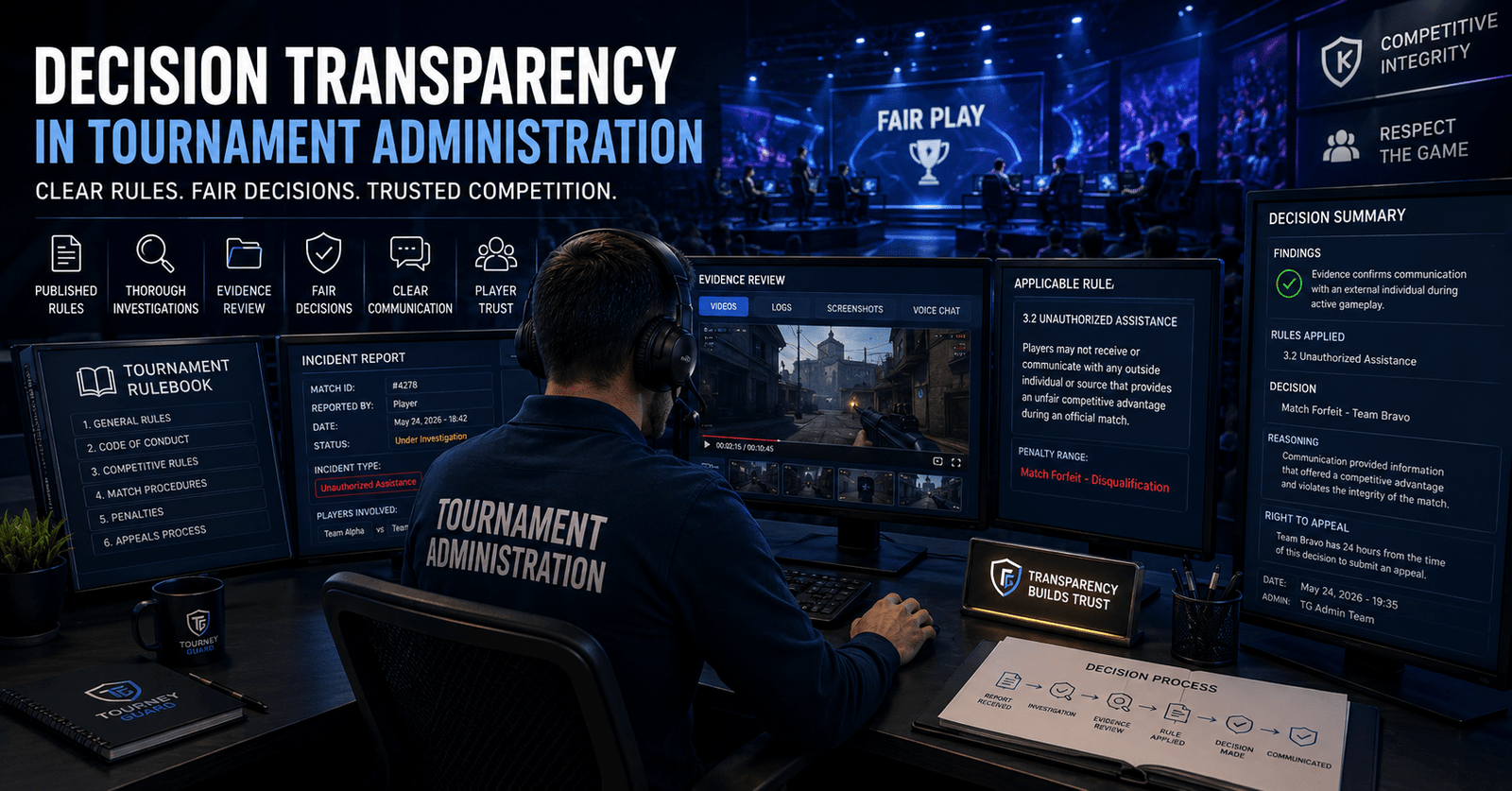
Introduction
Every esports tournament requires administrators to make decisions that can significantly influence the outcome of a competition. Whether resolving disputes, reviewing evidence, applying penalties, or handling appeals, tournament officials are constantly expected to make fair and impartial judgments.
However, making the right decision is only part of the challenge.
Players, teams, sponsors, and spectators also want to understand how and why that decision was reached. When administrative actions appear inconsistent, unexplained, or arbitrary, confidence in the tournament begins to decline—even if the final ruling is technically correct.
This is where Decision Transparency in Tournament Administration becomes essential.
Decision transparency refers to the practice of documenting, explaining, and communicating administrative decisions in a clear, consistent, and professional manner. Rather than expecting participants to simply accept rulings, transparent tournament organizations demonstrate that decisions are based on published rules, verified evidence, and structured investigation procedures.
As esports continues to mature, transparency has become a defining characteristic of professionally managed competitions. Tournament organizers are increasingly expected to show not only that rules are enforced fairly, but also that administrative processes can withstand scrutiny from players, communities, and commercial partners.
This guide explores what Decision Transparency in Tournament Administration means, why it is fundamental to tournament integrity, and how organizers can establish operational practices that strengthen trust throughout every stage of an esports competition.
What Is Decision Transparency in Tournament Administration?
Decision Transparency in Tournament Administration is the practice of ensuring that administrative decisions are supported by documented evidence, published tournament rules, and clearly communicated reasoning.
Transparency does not require organizers to disclose confidential information or sensitive evidence publicly. Instead, it focuses on providing participants with enough information to understand:
- What incident was investigated.
- Which tournament rules were applied.
- What evidence was reviewed.
- How administrators reached their conclusion.
- What administrative action was taken.
- Whether additional review or appeals are available.
Transparent decision-making transforms tournament administration from a process based on authority into one based on accountability.
Participants are far more likely to trust difficult decisions when they understand the reasoning behind them.
Why Decision Transparency Matters
Every administrative decision affects more than the immediate participants involved.
A poorly communicated ruling can quickly spread across social media, Discord communities, livestream chats, and esports news outlets. Even accurate decisions may generate controversy if organizers fail to explain the process that produced them.
Transparent administration provides benefits for every stakeholder.
Players
Players invest significant time preparing for tournaments.
They expect administrators to evaluate incidents objectively and apply tournament rules consistently.
When decisions include clear explanations, players better understand how rules are interpreted and are more likely to view the competition as professionally managed.
Tournament Officials
Transparency also protects referees and tournament administrators.
Instead of relying solely on personal authority, officials can demonstrate that decisions followed documented procedures supported by evidence and tournament policies.
This reduces unnecessary conflict between participants and tournament staff.
Tournament Organizers
Organizations that consistently explain administrative decisions build stronger reputations over time.
Professional governance encourages repeat participation, improves operational credibility, and demonstrates that tournament integrity is a long-term organizational priority rather than a marketing statement.
Sponsors and Partners
Commercial partners seek competitions that operate professionally.
Transparent governance reduces reputational risk by showing that tournament outcomes are supported by objective administrative processes instead of inconsistent judgment.
Sponsors are generally more comfortable investing in events that demonstrate accountability and operational maturity.
The Esports Community
Communities naturally discuss controversial rulings.
When organizers communicate decisions openly and consistently, speculation decreases and discussions become more focused on facts rather than assumptions.
Transparency contributes to healthier relationships between tournament organizers and the communities they serve.
Transparency Does Not Mean Publicly Sharing Everything
One of the most common misconceptions is that transparency requires publishing every investigation, every piece of evidence, or every internal discussion.
In reality, responsible transparency balances openness with confidentiality.
Certain information should remain protected, including:
- Personal player information.
- Private communications unrelated to the investigation.
- Sensitive anti-cheat detection methods.
- Internal security procedures.
- Information protected by contractual agreements.
The objective is not complete disclosure.
Instead, organizers should communicate enough information to explain how a decision was reached without compromising privacy, competitive security, or future investigations.
Professional transparency means explaining the process—not exposing confidential information.
The Core Principles of Transparent Decision-Making
Organizations that consistently demonstrate transparent administration typically follow several foundational principles.
Consistency
Transparency begins with consistency.
Administrative decisions should follow the same documented process regardless of:
- Player popularity.
- Team reputation.
- Prize pool size.
- Community attention.
- Sponsorship interests.
Applying identical procedures to similar situations helps eliminate perceptions of favoritism.
Consistency also allows participants to predict how future incidents are likely to be handled.
Objectivity
Transparent decisions are based on verifiable facts rather than assumptions.
Administrators should distinguish clearly between:
- Verified evidence.
- Witness testimony.
- Administrative observations.
- Speculation.
- Community opinion.
Separating facts from assumptions strengthens both the investigation and the credibility of the final decision.
Documentation
Every significant administrative action should leave a documented record.
Documentation should include:
- Incident summary.
- Timeline of events.
- Evidence reviewed.
- Applicable tournament rules.
- Investigation findings.
- Administrative reasoning.
- Final outcome.
These records provide accountability while creating valuable references for future investigations and staff training.
Clear Communication
Even well-reasoned decisions lose effectiveness if they are communicated poorly.
Tournament administrators should explain decisions using language that is:
- Professional.
- Respectful.
- Concise.
- Accurate.
- Easy to understand.
Avoid unnecessarily technical or legal language whenever possible.
The objective is to help participants understand the reasoning—not to overwhelm them with administrative terminology.
Common Situations That Require Transparent Decisions
Nearly every esports tournament will encounter situations where transparent communication becomes especially important.
Some of the most common include:
Match Disputes
Disagreements over match outcomes frequently require administrative review.
Examples include:
- Incorrect match reporting.
- Technical interruptions.
- Rule interpretation disagreements.
- Scheduling disputes.
- Restart requests.
Clearly explaining the applicable tournament rules helps participants understand why a particular outcome was selected.
Conduct Violations
Behavioral incidents often generate strong emotional reactions.
Examples include:
- Harassment.
- Offensive language.
- Unsportsmanlike conduct.
- Threats toward officials.
- Disruptive behavior.
Because these situations can affect community perception, administrators should clearly explain which code of conduct provisions were violated while protecting confidential information where appropriate.
Competitive Integrity Investigations
Investigations involving allegations of cheating, match manipulation, account sharing, or unauthorized assistance require particularly careful communication.
These cases often involve extensive evidence reviews and significant competitive consequences.
Transparent explanations help demonstrate that administrative decisions resulted from structured investigations rather than assumptions or public pressure.
Appeals
Appeals provide participants with an opportunity to request a secondary review of an administrative decision.
Whether an appeal is accepted or denied, organizers should communicate:
- What aspects of the case were reviewed.
- Whether new evidence was considered.
- Whether the original decision was upheld or modified.
- Why the final conclusion was reached.
Well-documented appeals reinforce confidence in the overall governance process rather than suggesting uncertainty in the original investigation.
The Decision-Making Process
Transparent decisions are rarely the result of a single administrator’s opinion. Instead, they emerge from a structured process that ensures every incident is evaluated using the same methodology.
By following a standardized workflow, tournament organizers reduce subjectivity, improve consistency, and create a clear administrative record that can be reviewed if necessary.
Step 1: Identify the Incident
Every administrative decision begins with identifying the event that requires investigation.
Incidents may be reported by:
- Players
- Team managers
- Referees
- Tournament administrators
- Anti-cheat systems
- Spectators (when permitted by tournament policy)
- Automated tournament platforms
At this stage, administrators should focus on documenting the reported facts rather than drawing immediate conclusions.
Every report should include:
- Date and time
- Match identifier
- Participants involved
- Description of the incident
- Available supporting evidence
- Current investigation status
Creating standardized incident reports ensures that every investigation begins with consistent information.
Step 2: Collect Relevant Evidence
Transparent decisions require objective evidence.
Before reaching any conclusion, administrators should gather every relevant source of information that may clarify what occurred.
Examples include:
- Match replays
- Tournament server logs
- Screenshots
- Video recordings
- Voice communications
- Referee observations
- Player statements
- Anti-cheat reports
- Tournament platform logs
Whenever possible, evidence should be preserved in its original form to maintain authenticity.
Investigators should avoid relying on isolated screenshots or incomplete information when multiple evidence sources are available.
Step 3: Review the Applicable Rules
Evidence alone does not determine the outcome.
Administrators must compare the facts against the published tournament rules.
Important questions include:
- Which rule applies?
- Does the reported behavior violate that rule?
- Are there documented exceptions?
- Has a similar case occurred previously?
Using the official rulebook as the primary reference reduces inconsistent interpretations between different tournament officials.
Step 4: Evaluate the Facts Objectively
At this stage, investigators analyze the available evidence without allowing external influences to affect their judgment.
Decision-making should never be influenced by:
- Community popularity
- Team reputation
- Sponsorship interests
- Social media campaigns
- Public pressure
Instead, administrators should evaluate:
- What facts have been verified?
- What remains uncertain?
- Is additional evidence required?
- Does the available evidence support administrative action?
Objectivity is one of the strongest indicators of professional tournament governance.
Step 5: Document the Decision
One of the most overlooked aspects of tournament administration is documenting why a decision was made.
A professional decision record should include:
- Incident summary.
- Evidence reviewed.
- Applicable rules.
- Administrative analysis.
- Final decision.
- Penalty, if applicable.
- Decision date.
- Responsible administrators.
Good documentation ensures that future investigations remain consistent and provides valuable support if an appeal is submitted.
Step 6: Communicate the Outcome
The final step is communicating the decision.
Effective communication explains:
- What happened.
- Which rules were applied.
- What administrative action was taken.
- Whether additional review is available.
Participants do not necessarily need access to every internal discussion or every piece of evidence.
However, they should clearly understand how the decision was reached.
Transparent communication significantly reduces unnecessary disputes after investigations conclude.
Common Mistakes That Reduce Decision Transparency
Even experienced tournament organizers can unintentionally reduce transparency through poor administrative practices.
Recognizing these mistakes is the first step toward improving tournament governance.
Making Decisions Without Explaining Them
One of the most common mistakes is announcing penalties without providing any explanation.
For example:
“Player X has been disqualified.”
Although technically accurate, this statement provides no context.
Participants immediately begin asking:
- Why?
- Which rule was violated?
- Was evidence reviewed?
- Can the decision be appealed?
Providing a brief explanation greatly improves participant confidence while reducing speculation.
Inconsistent Communication
Some organizers publish detailed explanations for high-profile incidents while providing almost no information for smaller cases.
This inconsistency creates the impression that transparency depends on the popularity of the players involved.
Professional tournament administration should follow standardized communication practices regardless of the visibility of the incident.
Using Ambiguous Language
Statements such as:
- “The administrators felt…”
- “We believed…”
- “It appeared…”
introduce unnecessary subjectivity.
Instead, administrators should reference:
- Published rules.
- Verified evidence.
- Investigation findings.
Objective language improves credibility.
Failing to Document Decisions
Without documentation, consistency becomes increasingly difficult.
New referees may unknowingly handle similar incidents differently because previous investigations were never recorded.
Maintaining administrative records transforms individual experience into organizational knowledge.
Ignoring Participant Questions
Transparency is not limited to publishing decisions.
Players may have legitimate questions regarding:
- Procedures.
- Applicable rules.
- Appeals.
- Administrative timelines.
Providing respectful, professional responses demonstrates accountability without requiring organizers to disclose confidential information.
Writing Professional Administrative Decisions
Clear documentation is only valuable if it is written in a way that participants can easily understand.
A professional administrative decision should generally include five components.
1. Incident Summary
Briefly describe the reported situation.
Example:
During Match 12 of the semifinal bracket, tournament officials received a report alleging unauthorized communication between a player and an external individual during live gameplay.
2. Investigation Summary
Describe what was reviewed.
Example:
Tournament administrators reviewed match recordings, Discord communication logs, referee observations, and player statements submitted after the match.
3. Applicable Rules
Reference the specific tournament policies.
Example:
The investigation was conducted under Section 5.3 of the Tournament Rulebook regarding unauthorized external assistance during official matches.
4. Administrative Findings
Explain the reasoning.
Example:
Based on the available evidence, administrators determined that unauthorized communication occurred during active gameplay and materially violated tournament competition rules.
5. Final Decision
Clearly state the outcome.
Example:
The player receives a match forfeit in accordance with Section 5.3 of the Tournament Rulebook. The participant may submit an appeal within 24 hours following publication of this decision.
This structure creates consistency across every investigation regardless of its complexity.
Building a Transparency Framework
Organizations seeking long-term operational excellence should establish a standardized framework for every administrative decision.
An effective transparency framework answers five essential questions.
What happened?
Provide an objective description of the incident.
Which rules apply?
Reference the exact tournament policies.
What evidence supports the findings?
Summarize the evidence reviewed without exposing confidential information.
How was the conclusion reached?
Explain the reasoning behind the administrative analysis.
What happens next?
Communicate:
- Final decision.
- Penalties.
- Appeal options.
- Effective dates.
- Additional administrative actions if required.
Answering these five questions consistently creates predictable communication that participants quickly learn to trust.
Why Transparent Decisions Strengthen Tournament Integrity
Decision transparency extends far beyond individual investigations.
Over time, consistently documented and well-communicated decisions contribute to a stronger competitive environment by:
- Increasing player confidence in tournament administration.
- Reducing accusations of favoritism.
- Improving referee consistency.
- Supporting fair appeal processes.
- Strengthening sponsor confidence.
- Creating valuable historical records for future events.
- Demonstrating organizational professionalism.
- Reinforcing the credibility of tournament results.
Transparency is therefore not simply a communication strategy—it is a governance practice that directly supports long-term tournament integrity.
Best Practices for Decision Transparency
Transparent decision-making is not achieved simply by publishing rulings. It requires consistent operational practices that allow every participant to understand how administrative decisions are made and why they can trust the process.
The following best practices can help tournament organizers establish a professional and repeatable approach to decision transparency.
Publish Clear Tournament Policies
Transparency begins long before the first incident occurs.
Tournament organizers should publish comprehensive documentation covering:
- Tournament rules.
- Code of conduct.
- Penalty guidelines.
- Investigation procedures.
- Appeals process.
- Administrative responsibilities.
When participants know what to expect before the tournament begins, administrative decisions become far easier to understand and accept.
Explain Decisions Without Revealing Sensitive Information
Transparency does not require organizers to disclose confidential evidence or internal security procedures.
Instead, every decision should communicate:
- The nature of the incident.
- The applicable tournament rules.
- The administrative reasoning.
- The final outcome.
- Available appeal options.
This approach balances openness with the need to protect player privacy, security measures, and the integrity of future investigations.
Use Standardized Decision Templates
One of the simplest ways to improve consistency is by documenting every ruling using the same structure.
Each administrative decision should include:
- Incident summary.
- Evidence reviewed.
- Applicable rules.
- Administrative findings.
- Final decision.
- Appeal information.
Using standardized templates reduces omissions and ensures that every investigation is documented to the same professional standard.
Train Administrators in Communication
Technical expertise alone is not enough.
Tournament administrators should also learn how to communicate decisions professionally.
Effective communication should be:
- Respectful.
- Objective.
- Concise.
- Easy to understand.
- Free from emotional language.
Professional communication helps de-escalate disputes and reinforces confidence in tournament governance.
Review Transparency Practices After Every Tournament
Decision transparency should improve over time.
After each tournament, organizers should evaluate questions such as:
- Were decisions communicated consistently?
- Did players understand the reasoning?
- Were appeals handled effectively?
- Which types of incidents generated the most confusion?
- Which administrative documents require improvement?
Continuous review allows organizations to strengthen governance as their tournaments evolve.
Decision Transparency Checklist
Before launching your next tournament, verify that your organization can confidently answer “yes” to each of the following questions.
- ✓ Has a complete tournament rulebook been published?
- ✓ Are investigation procedures documented?
- ✓ Do administrators use standardized incident reports?
- ✓ Is evidence collected consistently?
- ✓ Are administrative decisions documented?
- ✓ Are players informed of the reasoning behind important rulings?
- ✓ Does every decision reference the applicable tournament rules?
- ✓ Is there a clearly defined appeals process?
- ✓ Are completed investigations archived?
- ✓ Does the tournament conduct post-event administrative reviews?
Organizations that consistently follow these practices create competitions that participants perceive as fair, accountable, and professionally managed.
How Technology Improves Decision Transparency
As tournaments become larger and more complex, maintaining transparency through manual processes becomes increasingly difficult.
Incident reports, screenshots, referee notes, video evidence, chat logs, and administrative decisions can quickly become scattered across spreadsheets, messaging platforms, and shared folders. This fragmentation makes investigations harder to manage and increases the likelihood of inconsistent communication.
Dedicated tournament integrity platforms help organizers centralize the entire administrative process by providing structured workflows for investigations and decision management.
Technology can support transparency by enabling:
- Centralized incident reporting.
- Organized evidence repositories.
- Investigation tracking.
- Standardized decision templates.
- Administrative audit trails.
- Historical case management.
- Appeal tracking.
- Consistent documentation across every tournament.
Rather than replacing administrators, these systems help ensure that every decision follows the same professional process from beginning to end.
Platforms such as Tourney Guard are designed to support transparent tournament governance by helping organizers manage investigations, document administrative decisions, preserve evidence, and maintain complete operational records that strengthen trust across the esports community.
Frequently Asked Questions
What is decision transparency in tournament administration?
Decision transparency is the practice of clearly documenting and communicating how administrative decisions are made. It ensures that participants understand which rules were applied, what evidence was reviewed, and how organizers reached their conclusions.
Why is transparency important for esports tournaments?
Transparency increases confidence in tournament administration by demonstrating that decisions are based on objective evidence and published rules rather than personal opinions or external pressure. It also helps reduce disputes and strengthens the credibility of tournament results.
Does transparency require publishing all investigation details?
No. Responsible transparency balances openness with confidentiality. Organizers should explain the reasoning behind decisions while protecting sensitive information such as private player data, security procedures, or confidential evidence.
How can organizers make administrative decisions more consistent?
Using standardized workflows, documenting every investigation, training tournament staff, maintaining historical case records, and applying published rules consistently all contribute to more transparent and reliable decision-making.
How does decision transparency support tournament integrity?
Transparent decisions reinforce tournament integrity by ensuring that participants can trust both the outcome of investigations and the administrative process used to reach those outcomes. Fair governance depends not only on making the right decision but also on demonstrating how that decision was made.
Conclusion
Effective Decision Transparency in Tournament Administration is essential for building trust in modern esports competitions. While tournament organizers are responsible for enforcing rules and resolving disputes, their credibility ultimately depends on how those decisions are documented, communicated, and understood by participants.
Organizations that prioritize transparency create a governance framework built on accountability, consistency, and professionalism. By documenting investigations, referencing published rules, communicating decisions clearly, and maintaining structured administrative records, tournament officials demonstrate that competitive outcomes are protected by fair and repeatable processes.
As esports continues to evolve, transparency will remain one of the defining characteristics of professionally managed tournaments. Organizers who invest in transparent governance today will be better positioned to earn the confidence of players, attract long-term partners, and establish competitions that communities trust year after year.
Strengthen Transparency Across Every Tournament Decision
Transparent tournament administration requires more than simply announcing rulings. It depends on consistent investigation workflows, organized evidence, documented reasoning, and professional communication that participants can trust.
As tournaments grow, managing decisions through spreadsheets, chat messages, and disconnected documents becomes increasingly difficult. Centralizing administrative operations helps ensure that every investigation follows the same process, every decision is properly documented, and every appeal can be reviewed with confidence.
Tourney Guard is designed to help tournament organizers strengthen decision transparency through structured incident management, evidence organization, investigation tracking, decision documentation, and complete administrative audit trails. By standardizing these processes, organizers can build fairer competitions while improving operational efficiency and long-term credibility.
Discover how Tourney Guard helps create transparent, accountable, and professionally governed esports tournaments.
👉 Learn More About Tourney Guard →
Recommended External Resources
These organizations publish guidance that supports professional Tournament Integrity programs:
- Esports Integrity Commission (ESIC) – Standards, codes of conduct, investigations, and integrity initiatives.
- International Olympic Committee (IOC) – Integrity frameworks applicable to competitive sports governance.
- International Betting Integrity Association (IBIA) – Best practices for integrity monitoring.
- NIST Cybersecurity Framework – Guidance for security governance and risk management.
- ISO 37301 Compliance Management Systems – International compliance management principles.
- World Anti-Doping Agency (WADA) – Governance and disciplinary process principles applicable beyond traditional sports.
Suggested Internal Links
Strengthen your internal linking strategy by connecting this article with: