
Introduction
Competitive Integrity vs Fair Play is a topic that often creates confusion among tournament organizers, players, and even esports professionals. Although these terms are closely related, they do not mean the same thing.
Many people use them interchangeably when discussing esports competitions. However, understanding the distinction between Competitive Integrity and Fair Play is essential for building professional tournaments that players trust and sponsors confidently support.
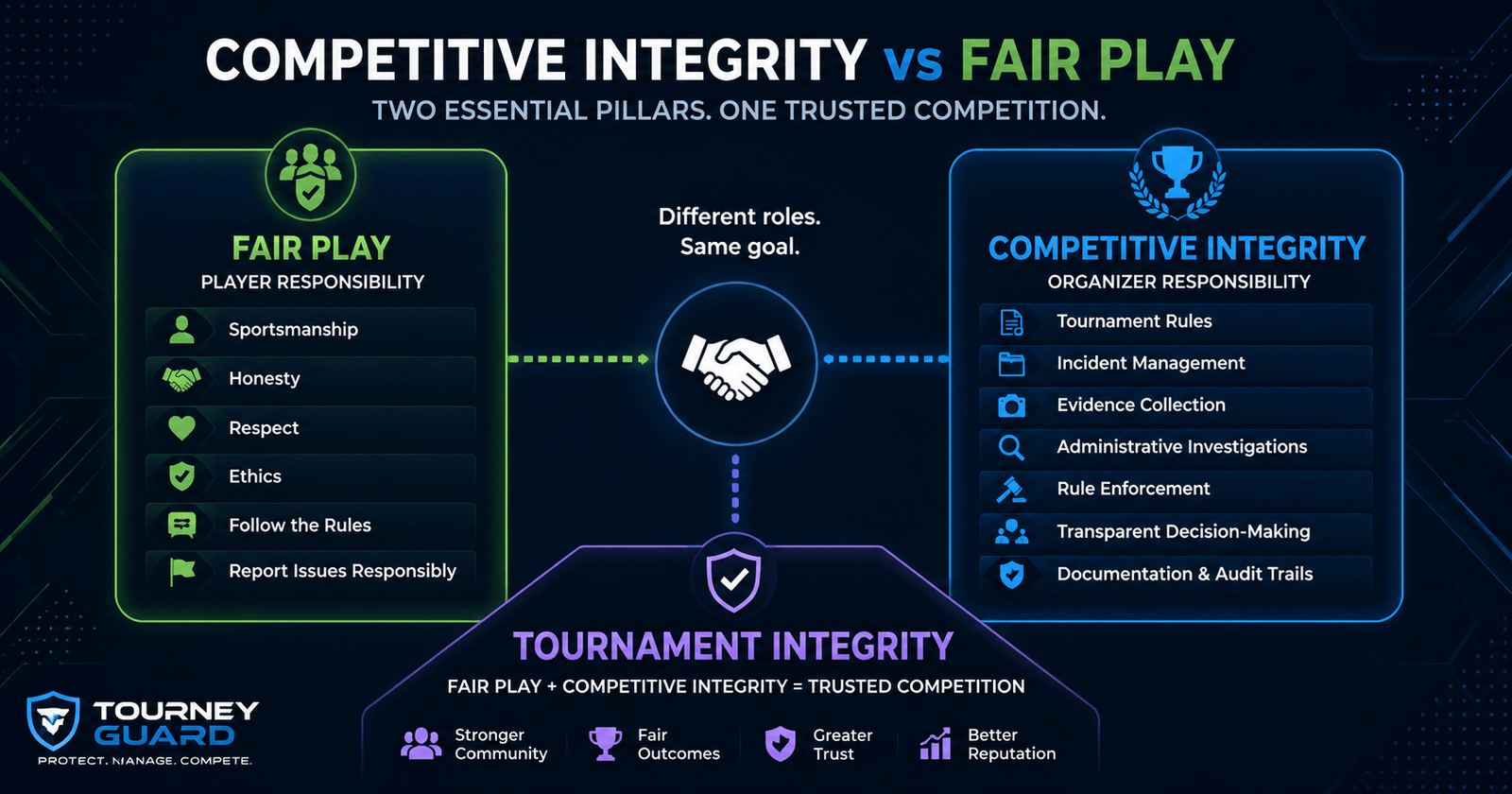
Fair Play primarily focuses on how participants behave during competition. It promotes honesty, respect, sportsmanship, and adherence to the rules by every player and team.
Competitive Integrity, on the other hand, extends far beyond individual behavior. It encompasses the policies, operational processes, investigations, evidence management, rule enforcement, and transparent decision-making that ensure every match is administered fairly from beginning to end.
Professional esports organizations recognize that Fair Play and Competitive Integrity work together.
One represents the values competitors should demonstrate.
The other represents the systems organizers must build.
In this guide, we’ll explore the differences between Competitive Integrity vs Fair Play, explain why both concepts matter, and show how structured tournament operations create trustworthy esports competitions.



What Is Fair Play?
Fair Play refers to the ethical behavior expected from every participant in a competition.
Players demonstrate Fair Play when they:
- Respect tournament rules.
- Compete honestly.
- Treat opponents respectfully.
- Accept referee decisions.
- Avoid unsportsmanlike conduct.
- Report problems responsibly.
Fair Play represents the human side of competition.
It is built on values rather than technology.
Tournament organizers encourage Fair Play through education, codes of conduct, and consistent rule enforcement.
What Is Competitive Integrity?
Competitive Integrity is the framework that ensures every participant competes under equal conditions.
Rather than focusing only on player behavior, Competitive Integrity encompasses the operational systems used to administer tournaments professionally.
These include:
- Tournament rules.
- Player verification.
- Match administration.
- Incident management.
- Evidence collection.
- Administrative investigations.
- Transparent decision-making.
- Appeals.
- Documentation.
- Audit trails.
Competitive Integrity exists to ensure tournament outcomes are determined by skill rather than inconsistent administration or unfair advantages.
Competitive Integrity vs Fair Play
Although closely related, these concepts address different responsibilities.
| Fair Play | Competitive Integrity |
|---|---|
| Focuses on player behavior | Focuses on tournament operations |
| Encourages honesty | Ensures consistent administration |
| Promotes sportsmanship | Protects competitive fairness |
| Driven by ethics | Driven by structured processes |
| Responsibility of players | Responsibility of organizers |
Professional tournaments require both.
Strong Competitive Integrity cannot compensate for poor Fair Play.
Likewise, excellent sportsmanship cannot overcome weak tournament administration.
Why Both Concepts Matter
Successful esports competitions depend on the combination of ethical participant behavior and professional tournament operations.
Players create Fair Play.
Organizers create Competitive Integrity.
When both exist together:
- Players trust tournament results.
- Referees make consistent decisions.
- Sponsors gain confidence.
- Communities remain engaged.
- Disputes decrease.
- Tournament reputation improves.
The following sections explore common misconceptions, practical examples, and the operational best practices that help organizers strengthen both Fair Play and Competitive Integrity.
Common Misconceptions About Competitive Integrity and Fair Play
One of the biggest challenges in esports tournament administration is the misunderstanding of these two concepts.
Many organizers believe that encouraging Fair Play alone is enough to create trustworthy competitions.
Unfortunately, that is not the case.
Even tournaments with honest players can experience administrative failures if organizers lack structured operational processes.
Likewise, excellent tournament systems cannot completely eliminate problems caused by poor sportsmanship.
Professional competitions require both.
Misconception 1: Fair Play Prevents Every Integrity Issue
Fair Play encourages ethical behavior.
It does not guarantee it.
Players may still:
- Break tournament rules.
- Share accounts.
- Stream snipe opponents.
- Exploit technical issues.
- Submit false reports.
Tournament organizers must be prepared to investigate these situations objectively.
Misconception 2: Competitive Integrity Is Just Anti-Cheat
Another common misunderstanding is assuming Competitive Integrity is limited to detecting cheating software.
In reality, Competitive Integrity includes:
- Tournament governance.
- Rule enforcement.
- Administrative investigations.
- Evidence collection.
- Match administration.
- Appeals.
- Documentation.
- Transparency.
Anti-cheat software may support one part of the process, but it cannot replace professional tournament operations.
Misconception 3: Rules Alone Create Fair Competitions
Publishing a tournament rulebook is important.
However, rules have little value if organizers cannot apply them consistently.
Professional tournaments require:
- Qualified referees.
- Documented investigation procedures.
- Standardized decision-making.
- Complete evidence records.
- Transparent communication.
Rules establish expectations.
Operations build trust.
Best Practices for Tournament Organizers
Understanding Competitive Integrity vs Fair Play becomes much easier when organizers implement practical operational standards.
The following recommendations are widely applicable to online esports competitions of any size.
Create a Clear Code of Conduct
Every tournament should publish a Code of Conduct that defines expected player behavior.
Topics should include:
- Respectful communication.
- Unsportsmanlike conduct.
- Harassment.
- Match manipulation.
- Intentional disruption.
- Reporting misconduct.
A clear Code of Conduct promotes Fair Play before competition even begins.
Standardize Tournament Operations
Consistency is one of the strongest indicators of Competitive Integrity.
Every tournament should define standard procedures for:
- Registration.
- Player verification.
- Match administration.
- Incident reporting.
- Evidence collection.
- Referee reviews.
- Appeals.
- Final decisions.
Standardized operations reduce administrative errors while increasing player confidence.
Collect Evidence Before Making Decisions
Tournament officials should avoid making decisions based on assumptions.
Every investigation should include objective evidence whenever possible.
Examples include:
- Match recordings.
- Screenshots.
- Replay files.
- Chat logs.
- Server logs.
- Referee observations.
- Player statements.
Evidence-based investigations improve transparency and reduce disputes.
Apply Rules Consistently
Players quickly recognize inconsistent rule enforcement.
If two similar incidents produce different outcomes, confidence in tournament administration declines.
Before issuing a ruling, organizers should verify:
- Which rule applies?
- Was the rule violated?
- What evidence supports the finding?
- Which penalty is appropriate?
Consistency strengthens Competitive Integrity.


Maintain Complete Documentation
Every administrative action should be documented.
Documentation typically includes:
- Incident summary.
- Evidence reviewed.
- Investigation timeline.
- Applicable rules.
- Final decision.
- Responsible official.
- Communication history.
Good documentation simplifies future appeals and demonstrates professionalism.
Competitive Integrity vs Fair Play in Different Tournament Stages
The relationship between these concepts changes throughout the tournament lifecycle.
| Tournament Stage | Fair Play | Competitive Integrity |
|---|---|---|
| Registration | Honest player information | Identity verification |
| Match Preparation | Respect tournament rules | Match administration |
| Live Competition | Ethical player behavior | Referee oversight |
| Incident Review | Honest statements | Evidence-based investigation |
| Appeals | Respect review process | Transparent decision-making |
| Tournament Closure | Sportsmanship | Documentation and audit trail |
This comparison demonstrates that both concepts remain active throughout the entire competition.
Neither replaces the other.
Technology Supports Competitive Integrity
Modern tournament administration has become increasingly complex.
As competitions grow, organizers must manage:
- Hundreds of players.
- Multiple referees.
- Numerous incident reports.
- Large volumes of evidence.
- Administrative decisions.
- Appeals.
Technology helps centralize these activities.
However, technology does not replace human judgment.
Instead, it improves consistency by organizing information and supporting standardized workflows.
Examples include:
- Centralized incident management.
- Evidence repositories.
- Investigation tracking.
- Decision documentation.
- Audit trails.
- Administrative collaboration.
Technology strengthens Competitive Integrity by making professional tournament operations more efficient.
Practical Example
Imagine two identical tournaments.
Both publish the same rules.
Both use the same game.
Both have qualified referees.
During a semifinal match, a player is accused of stream sniping.
Tournament A
- Referee reviews the situation informally.
- Evidence is incomplete.
- Decision is communicated verbally.
- No documentation exists.
Players question the outcome.
Community trust declines.
Tournament B
- Incident report submitted.
- Evidence collected.
- Investigation follows documented procedures.
- Decision references tournament rules.
- Players receive a written explanation.
- Records remain available for future appeals.
Even if the final ruling is identical, Tournament B demonstrates significantly stronger Competitive Integrity because the process itself is transparent, consistent, and evidence-based.
How Tourney Guard Helps Tournament Organizers
Building Competitive Integrity requires much more than good intentions.
Tournament organizers must coordinate player verification, enforce tournament rules, investigate incidents, collect evidence, document decisions, communicate with participants, and maintain consistent administrative processes throughout the competition.
Managing these responsibilities manually quickly becomes difficult as tournaments grow.
Tourney Guard helps organizers strengthen Competitive Integrity by providing structured workflows that support professional tournament operations.
Rather than replacing referees or tournament administrators, Tourney Guard centralizes the information they need to investigate incidents consistently and make transparent decisions.
With Tourney Guard, organizers can:
- Centralize incident reports.
- Organize supporting evidence.
- Track investigations.
- Record administrative decisions.
- Maintain audit trails.
- Standardize operational workflows.
- Improve collaboration among tournament staff.
- Increase transparency for players, teams, and sponsors.
Technology supports Competitive Integrity by making professional tournament administration more consistent, organized, and efficient.
Final Thoughts
Understanding Competitive Integrity vs Fair Play is essential for anyone responsible for organizing esports competitions.
Although the two concepts are closely connected, they represent different responsibilities.
Fair Play depends on the integrity and sportsmanship of players.
Competitive Integrity depends on the systems, policies, and operational processes implemented by tournament organizers.
Professional tournaments require both.
By combining ethical participant behavior with transparent investigations, structured incident management, evidence-based decision-making, and consistent tournament administration, organizers create competitions that players trust and communities respect.
Ultimately, Tournament Integrity is achieved when Fair Play and Competitive Integrity work together to create an environment where every participant competes under equal conditions.
Ready to Protect Your Tournament?
Strengthen tournament integrity with better incident management, evidence collection, and transparent decision-making.
Frequently Asked Questions (FAQ)
What is the difference between Competitive Integrity and Fair Play?
Fair Play focuses on ethical player behavior, sportsmanship, and respect for tournament rules. Competitive Integrity focuses on the systems, operational processes, investigations, and administrative decisions that ensure competitions remain fair and trustworthy.
Can a tournament have Fair Play without Competitive Integrity?
Yes.
Players may behave ethically while tournament administration remains inconsistent or poorly organized.
Without structured tournament operations, competitions may still lose credibility.
Can Competitive Integrity exist without Fair Play?
Not completely.
Strong tournament administration reduces risks, but organizers still depend on players behaving honestly and respecting tournament rules.
Both concepts complement each other.
Why is Competitive Integrity important in esports?
Competitive Integrity ensures every participant competes under equal conditions through consistent rule enforcement, transparent investigations, evidence-based decisions, and professional tournament operations.
What responsibilities belong to tournament organizers?
Organizers are responsible for:
- Tournament rules.
- Player verification.
- Match administration.
- Incident management.
- Evidence collection.
- Administrative investigations.
- Appeals.
- Documentation.
- Transparent communication.
These responsibilities collectively strengthen Tournament Integrity.
How does technology improve Competitive Integrity?
Technology helps organizers centralize information, standardize workflows, maintain documentation, organize evidence, and improve collaboration between tournament officials.
Technology supports—not replaces—human decision-making.
Why do players trust tournaments with strong Competitive Integrity?
Players gain confidence when rules are applied consistently, investigations follow documented procedures, evidence supports every decision, and organizers communicate transparently throughout the tournament.
Learn More About Esports Integrity
To better understand professional tournament governance and integrity standards, explore resources from:
These organizations publish guidance on tournament governance, disciplinary procedures, fair competition, and integrity standards across the esports industry.
Suggested Internal Links
Connect this article with the following resources in the Tourney Guard Knowledge Hub:
- What Is Tournament Integrity? A Complete Guide for Esports Organizers
- Tournament Incident Management: Best Practices for Esports Organizers
- How to Run a Fair Online Esports Tournament
- Why Anti-Cheat Software Alone Isn’t Enough for Esports Tournaments
- 10 Common Types of Cheating in Esports Tournaments