Introduction
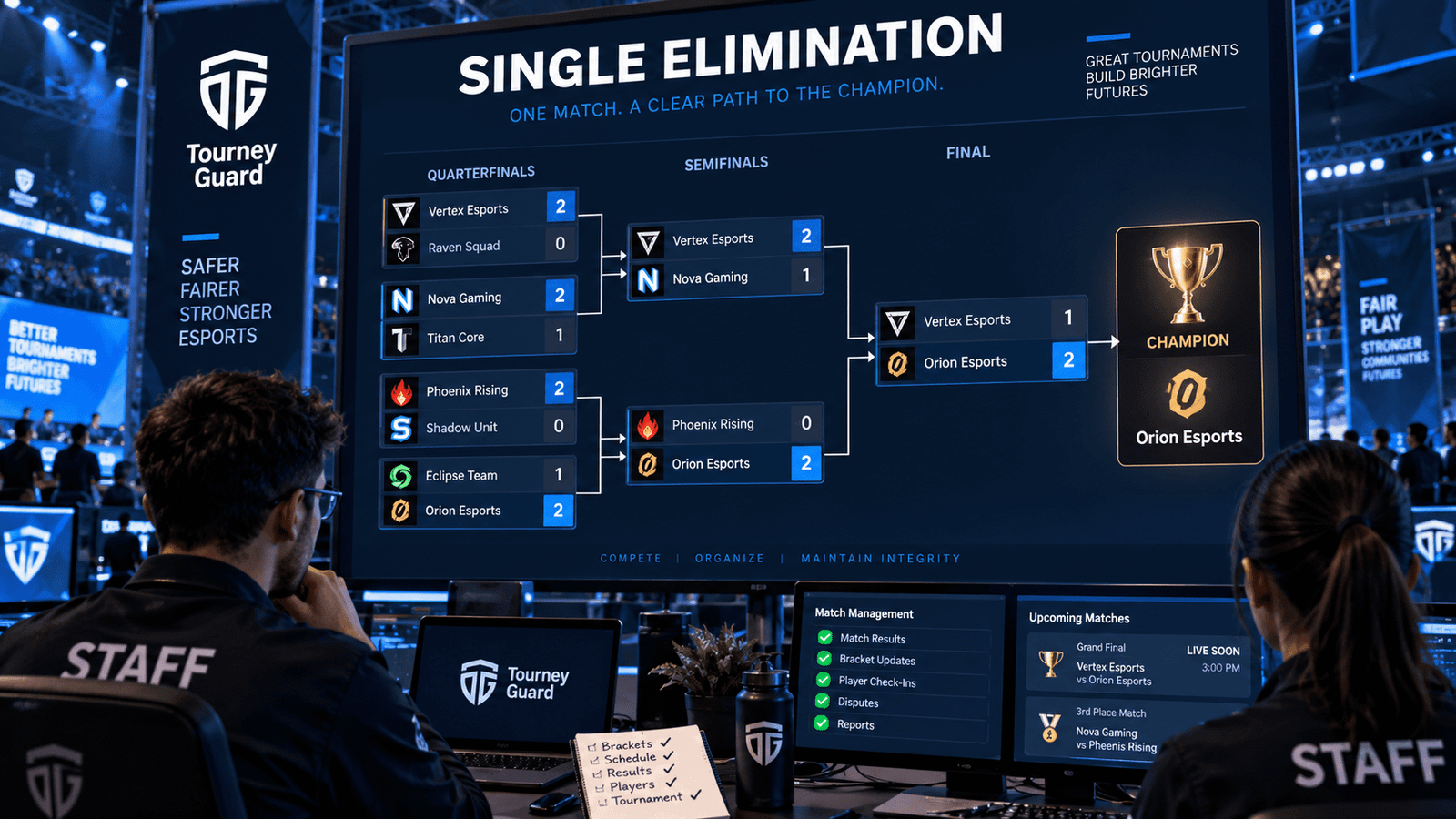
Single Elimination Explained starts with one simple principle: a team or player is eliminated after losing a match, while the winner advances to the next round.
This format is one of the easiest tournament structures for participants to understand. A bracket progresses through successive rounds until only one competitor remains. Because each match can determine whether a participant continues or leaves the competition, however, tournament organizers need more than a visually simple bracket.
The format affects scheduling, match volume, competitive pressure, byes, seeding, venue operations, player communication, and tournament administration.
A well-designed single-elimination tournament can provide a clear competitive pathway with relatively few matches. A poorly administered one can create confusion around bracket placement, scheduling, late arrivals, match results, or advancement decisions.
For tournament organizers, understanding the format means understanding both how the bracket works and how to operate it consistently.
This guide explains the structure, mathematics, operational workflow, advantages and limitations, common mistakes, and administrative considerations of single-elimination tournaments.
Key principle: In single elimination, every match has direct consequences for tournament progression, so bracket accuracy and match administration are critical.



Key Takeaways
- Single elimination is a knockout tournament format in which a competitor is eliminated after losing.
- Each completed match normally produces one advancing competitor and one eliminated competitor.
- The tournament continues through rounds until a final determines the champion.
- A single-elimination tournament with N competitors requires N − 1 completed matches to determine a winner.
- Brackets work most cleanly when the number of competitors is a power of two, such as 8, 16, 32, or 64.
- When the number of competitors is not a power of two, organizers can use byes to create an appropriate bracket structure.
- Seeding determines initial bracket placement when the tournament uses a seeding system.
- Scheduling becomes particularly important because losing a match ends a participant’s tournament run.
- Match results should be recorded accurately and reflected in the bracket immediately.
- Organizers should define rules for forfeits, withdrawals, ties, disputes, and administrative decisions before competition begins.
What Is Single Elimination?
Single elimination is a tournament format in which a competitor is eliminated from the competition after one loss.
The basic structure is straightforward:
Match → Winner advances → Loser is eliminated
The winner continues through the bracket until reaching the final. The winner of the final becomes the tournament champion.
A simplified eight-player bracket looks like this:
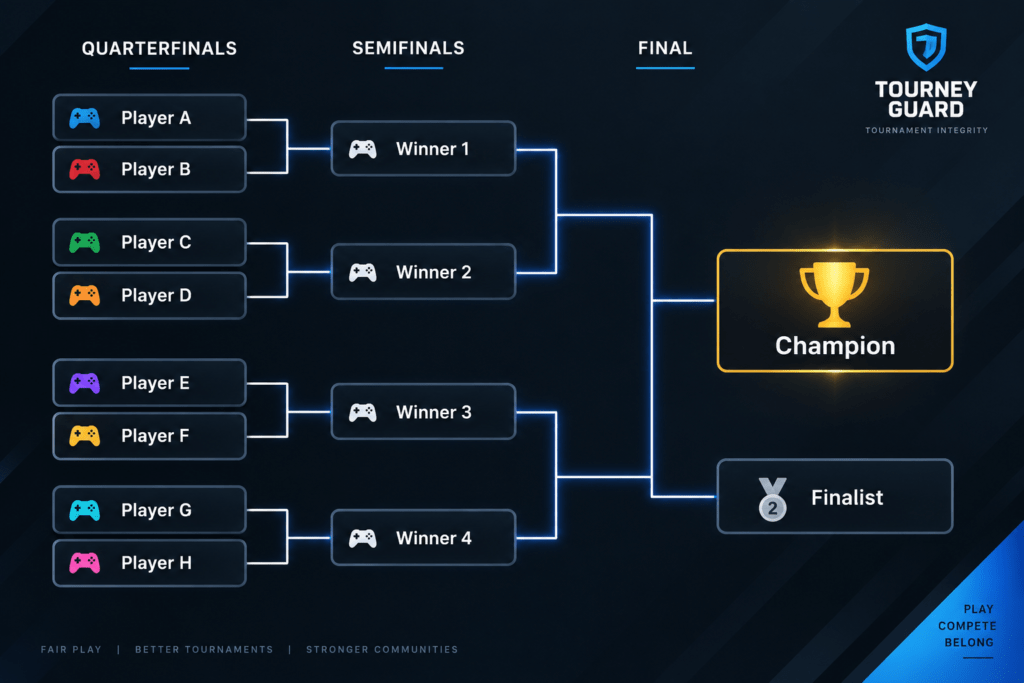
The exact bracket presentation varies depending on the tournament system, but the fundamental principle remains the same.
How many matches are required?
If there are N competitors, a single-elimination tournament requires:
N − 1 matches
For example:
| Competitors | Total Matches |
|---|---|
| 4 | 3 |
| 8 | 7 |
| 16 | 15 |
| 32 | 31 |
| 64 | 63 |
| 128 | 127 |
Why?
Every match eliminates exactly one competitor.
To reduce N competitors to one champion, the tournament must eliminate N − 1 competitors.
This simple relationship is extremely useful for tournament scheduling and operational planning.
Operational insight: Match count can be calculated before the tournament begins, making single elimination relatively predictable from a scheduling perspective.
How Does a Single-Elimination Bracket Work?
A standard single-elimination bracket consists of successive rounds.
For an eight-competitor tournament, the structure is:
- Quarterfinals
- Semifinals
- Final
For 16 competitors:
- Round of 16
- Quarterfinals
- Semifinals
- Final
The number of rounds generally follows the logarithm base 2 of the number of competitors when the bracket is a perfect power of two.
| Competitors | Rounds |
|---|---|
| 4 | 2 |
| 8 | 3 |
| 16 | 4 |
| 32 | 5 |
| 64 | 6 |
| 128 | 7 |
This creates a very clear progression.
However, tournament organizers should distinguish between theoretical bracket structure and actual event scheduling.
A five-round bracket does not necessarily mean the event will have only five scheduled time blocks. Multiple matches can occur simultaneously when sufficient facilities, referees, servers, or administrative capacity exist.
What Happens When the Number of Competitors Is Not a Power of Two?
A single-elimination bracket is easiest to structure when the number of competitors is 2, 4, 8, 16, 32, and so on.
But real tournaments do not always receive those exact numbers.
Suppose 12 teams register.
The next power of two is 16.
The organizer can construct a 16-position bracket and assign four byes.
A bye means a competitor advances through that bracket position without playing a first-round match.
The number of first-round byes required can be calculated as:
Next power of two − number of competitors
For 12 teams:
16 − 12 = 4 byes
For 20 teams:
32 − 20 = 12 byes
Byes should be handled carefully because their allocation can affect perceptions of fairness, particularly when the tournament uses seeding.
What Is Seeding in Single Elimination?
Seeding determines how competitors are positioned in the initial bracket.
A tournament can use different approaches depending on its objectives and rules.
Examples include:
- Ranking-based seeding.
- Qualification results.
- Previous performance.
- Random draw.
- Regional considerations.
- Organizer-defined placement rules.
The important point is that the seeding method should be defined before competitors are placed into the bracket.
Seeding comparison
| Structured Seeding | Random Placement |
|---|---|
| Uses predefined criteria | Uses chance |
| Can reflect rankings | Does not require rankings |
| Requires reliable ranking information | Easier to administer |
| May reduce early meetings between high seeds | Can produce any matchup |
| Requires clear methodology | Requires transparent randomization |
Neither approach is universally appropriate.
The correct choice depends on the tournament’s objectives and published rules.
Single Elimination Explained Through a Match Progression
Consider a tournament with eight teams.
Round 1
Eight teams compete in four matches.
8 → 4
Round 2
Four remaining teams compete in two matches.
4 → 2
Final
Two teams compete for the championship.
2 → 1
The complete progression is:
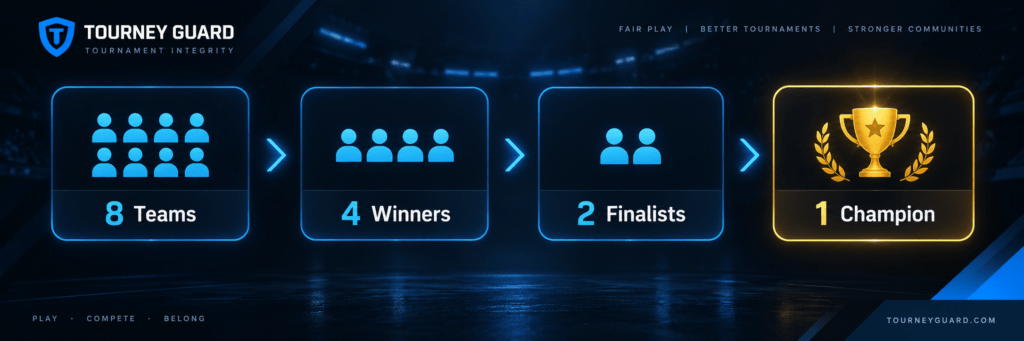
This predictable structure is one of the format’s operational strengths.
Single Elimination vs Double Elimination
The most important structural difference is what happens after the first loss.
| Single Elimination | Double Elimination |
|---|---|
| One loss eliminates competitor | Competitor normally receives a second path |
| One main bracket | Winners and losers brackets |
| Fewer matches | More matches |
| Simpler administration | More complex administration |
| Shorter event potential | Longer event potential |
| Every match is highly consequential | A first loss does not necessarily end participation |
Single elimination is therefore particularly attractive when event duration, simplicity, or facility capacity are important considerations.
Double elimination provides a different competitive structure and should be evaluated separately rather than treated as simply a larger version of single elimination.
What Are the Operational Implications of Single Elimination?
The format may be simple from a bracket perspective, but its operational characteristics deserve careful planning.
Match Scheduling
Because competitors are eliminated after a loss, the schedule must keep advancing participants through the bracket without creating unnecessary delays.
Organizers should account for:
- Match duration.
- Breaks.
- Technical issues.
- Player check-in.
- Server preparation.
- Referee availability.
- Result confirmation.
- Dispute handling.
Match Dependencies
Later-round matches depend on earlier results.
For example:
Quarterfinal Match 1 winner → Semifinal Match 1
The semifinal cannot be finalized until the corresponding quarterfinal has produced a winner.
This means tournament staff need reliable result reporting and bracket updates.
Administrative Decisions
A disputed result can affect the entire downstream bracket.
If an incorrect result is entered, the wrong competitor may advance and subsequent matches may be scheduled incorrectly.
Governance principle: In a knockout format, an administrative error in one match can propagate through the remainder of the bracket.
How Should Forfeits Be Handled?
Tournament rules should define what happens when a competitor does not appear or cannot play.
Possible situations include:
- Failure to check in.
- Failure to appear.
- Technical inability to compete.
- Disqualification.
- Withdrawal.
- Administrative ruling.
The tournament rulebook should define the applicable procedure.
For example:
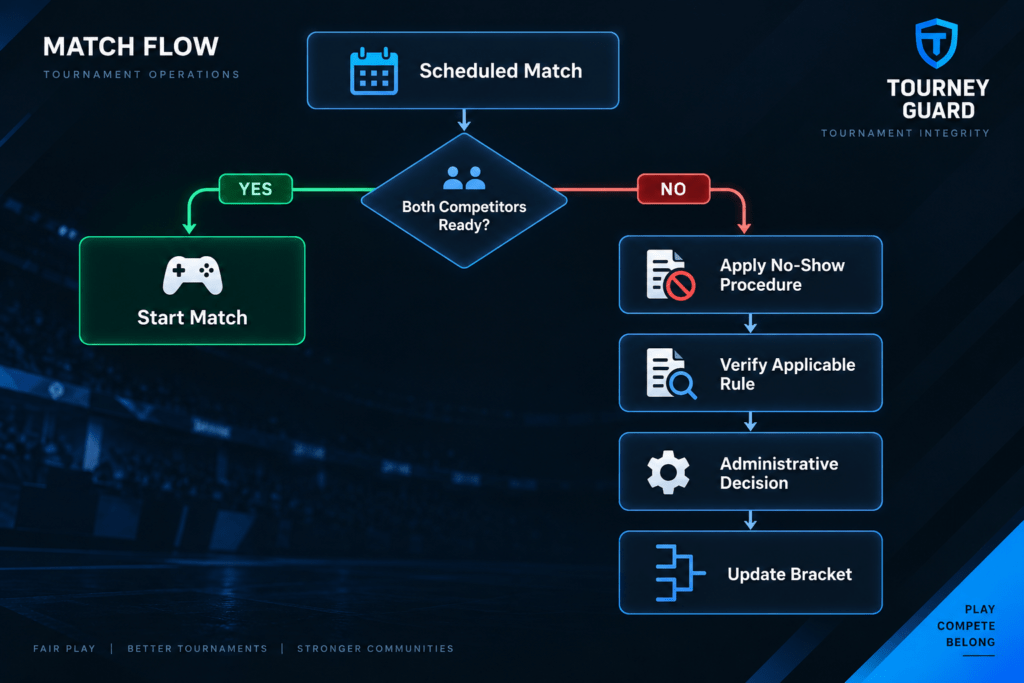
The important point is that tournament staff should not invent a different procedure for each incident.
How Do You Manage Byes?
Byes should be assigned according to a predefined methodology.
If a tournament has 12 competitors, four first-round byes are required for a 16-position bracket.
Organizers should determine:
- How byes are allocated.
- Whether seeds receive priority.
- Whether bye distribution is balanced.
- How the bracket is published.
- When participants learn their first match status.
Bye allocation comparison
| Method | Characteristics |
|---|---|
| Seed-based | Byes can be assigned according to predefined seeds |
| Randomized | Bye placement is determined through a random process |
| Rule-defined | Placement follows explicitly published criteria |
| Manual | Staff directly determine placement |
The selected method should be communicated clearly.
What Are the Advantages and Limitations of Single Elimination?
Advantages
Simple participant experience
Players can easily understand the fundamental rule:
Win and advance. Lose and exit.
Predictable match count
The total number of matches can be calculated as N − 1.
Shorter event structure
Compared with formats that give competitors multiple opportunities after losing, single elimination can require fewer matches.
Straightforward bracket
The progression from early rounds to the final is easy to visualize.
Efficient use of resources
When venue, staffing, server capacity, or broadcast resources are constrained, fewer total matches can simplify planning.
Limitations
One loss ends participation
A competitor can exit the tournament after a single poor result.
Less room for recovery
There is no lower bracket or second competitive path after a loss.
Early matchup sensitivity
The initial bracket can have a substantial effect on the path competitors take through the tournament.
High administrative stakes
Because every match can eliminate a participant, incorrect results or poorly handled disputes can have significant consequences.



Best Practices
1. Publish the format before registration
Participants should know that the tournament uses single elimination before committing to the event.
2. Explain the elimination rule clearly
Do not assume participants understand every consequence of the format.
State that a loss results in elimination unless the tournament rules provide a specific exception.
3. Define seeding rules
Explain how initial bracket positions are determined.
4. Define bye allocation
If byes are possible, document how they are assigned.
5. Define match-result procedures
Establish who confirms results and who updates the bracket.
6. Plan for delays
A single-elimination bracket contains dependencies between matches. Delays in early rounds can affect later rounds.
7. Establish dispute procedures
Participants should know how to report and challenge match-related administrative issues.
8. Protect bracket integrity
Only authorized staff should modify official bracket results.
9. Preserve decision records
Significant administrative decisions should be documented.
10. Communicate bracket changes immediately
When a result or schedule changes, affected teams should receive the updated information promptly.
Best-practice principle: A simple tournament format still requires disciplined tournament administration.
Common Mistakes
Mistake 1: Assuming the bracket is self-explanatory
A bracket may show who plays whom but not explain rules for byes, forfeits, disputes, or scheduling.
Avoid it: Publish the operational rules alongside the bracket.
Mistake 2: Incorrectly calculating match requirements
An organizer may underestimate the total event workload.
Avoid it: Use N − 1 to calculate the total number of matches required to determine a champion.
Mistake 3: Poor bye allocation
Unclear bye placement can generate complaints.
Avoid it: Define the bye methodology before generating the bracket.
Mistake 4: Updating results informally
A result entered incorrectly can affect multiple future matches.
Avoid it: Establish an official result-confirmation process.
Mistake 5: Failing to define no-show procedures
Last-minute absences can delay competition if staff do not know what action to take.
Avoid it: Define check-in, grace periods, forfeits, and escalation procedures in the tournament rules.
Mistake 6: Treating every dispute as a bracket problem
Some disputes concern player eligibility, evidence, conduct, or rules interpretation rather than the bracket itself.
Avoid it: Route incidents through the appropriate tournament administration or investigation process.
Practical Example
Imagine an esports tournament with 12 teams using single elimination.
The organizer needs a bracket with 16 positions.
Therefore:
16 − 12 = 4 byes
The first round contains four matches and four byes.
The first stage therefore produces:
12 teams → 8 teams
The remaining structure becomes:
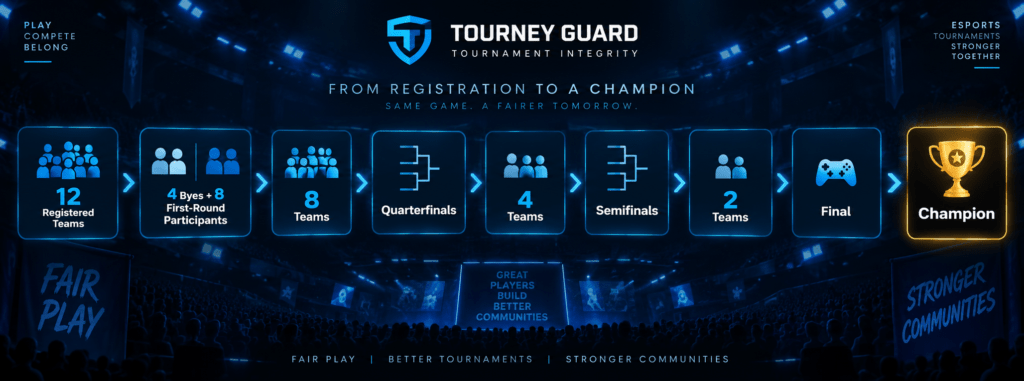
The total number of completed matches remains:
12 − 1 = 11 matches
This is an important operational property of single elimination.
The four teams receiving byes do not create additional matches. They simply enter the competition at a later bracket stage.
Now consider an administrative dispute.
Suppose the result of a quarterfinal is incorrectly entered and the wrong team advances.
The error can affect:
- The semifinal pairing.
- Player scheduling.
- Broadcast planning.
- Referee assignments.
- Venue resources.
- Subsequent results.
This demonstrates why tournament administration matters even when the underlying format is simple.
A good tournament system therefore needs both a clear bracket structure and a controlled process for recording and validating match outcomes.
Decision Framework
Before selecting single elimination, tournament organizers can evaluate five questions.
Question 1: Is a short, straightforward competitive structure desirable?
Yes → Single elimination may fit the event objectives.
No → Consider formats that provide additional competitive opportunities.
Question 2: Can competitors accept elimination after one loss?
Yes → Continue.
No → Consider a format with additional paths after a loss.
Question 3: Is the available event capacity limited?
Consider:
- Venue time.
- Server capacity.
- Staff.
- Referees.
- Broadcast resources.
If resource efficiency is important, the relatively low match count may be relevant.
Question 4: Can the tournament administer high-consequence matches reliably?
If result confirmation, dispute handling, and bracket management are not sufficiently controlled, the organizer should strengthen those processes before relying on a knockout structure.
Question 5: Are the rules clear?
Before publishing the bracket, define:
- Seeding.
- Byes.
- Match format.
- Forfeits.
- Scheduling.
- Result confirmation.
- Disputes.
- Appeals.
- Advancement.
Decision principle: Choose the format based on the tournament’s objectives and operational constraints—not simply because the bracket is easy to draw.
Checklist
Tournament Design Checklist
- ✓ Tournament format is explicitly identified as single elimination.
- ✓ Elimination after a loss is clearly explained.
- ✓ Expected number of competitors is established.
- ✓ Required bracket size is determined.
- ✓ Byes are calculated where necessary.
- ✓ Seeding methodology is defined.
- ✓ Match format is documented.
- ✓ Match scheduling rules are documented.
- ✓ Forfeit procedures are documented.
- ✓ Dispute procedures are documented.
- ✓ Advancement rules are documented.
- ✓ Final championship conditions are documented.
Tournament Administration Checklist
- ✓ Official bracket is maintained.
- ✓ Authorized staff can update results.
- ✓ Match results are confirmed before advancement.
- ✓ Bracket changes are recorded.
- ✓ Participants receive schedule updates.
- ✓ Delays are communicated.
- ✓ No-show decisions follow published rules.
- ✓ Eligibility issues are handled separately from bracket mechanics.
- ✓ Significant administrative decisions are documented.
- ✓ Disputed results can be reviewed.
- ✓ Final results are preserved as part of the tournament record.
Tourney Guard
Understanding Single Elimination Explained is only the first step. Applying the format consistently becomes more difficult as tournaments grow, particularly when organizers are managing multiple matches, staff members, scheduling dependencies, bracket changes, disputes, and administrative decisions simultaneously.
A tournament may begin with a simple bracket, but the operational information behind that bracket can quickly become distributed across spreadsheets, chat conversations, registration systems, match records, and staff notes. When a result is disputed or a decision needs to be reviewed, reconstructing what happened can become difficult without a structured process.
Tourney Guard helps tournament organizers standardize relevant Tournament Administration, Tournament Integrity, Incident Management, Evidence Management, and governance workflows. The objective is to provide structure around the operational processes that support tournament decisions while keeping the competition’s published rules at the center.
If you want to explore how structured tournament administration can support your events, you can start with a free 30-day trial.
👉 Start Your 30-Day Free Trial →
FAQ
What is single elimination in a tournament?
Single elimination is a tournament format where a competitor is eliminated after losing a match. Winners advance through successive rounds until two remaining competitors meet in the final. The winner of the final becomes the tournament champion. The format is straightforward because every match has a direct progression: one competitor advances and the other leaves the competition. This makes the bracket easy to understand, although tournament organizers still need clear rules for seeding, byes, scheduling, forfeits, disputes, and result verification.
How many matches are required in a single-elimination tournament?
A single-elimination tournament with N competitors requires N − 1 completed matches to determine a champion. The reason is that every match eliminates exactly one competitor, and the tournament must eliminate all but one competitor. For example, eight competitors require seven matches, while 32 competitors require 31 matches. This formula is useful for planning event duration, staffing, venue capacity, referee requirements, broadcast resources, and other operational needs.
What happens when there is an odd number of teams?
When the number of teams does not fit neatly into a power-of-two bracket, organizers can use byes. For example, a 12-team tournament can use a 16-position bracket with four byes. The bye allows a team to advance through the initial bracket position without playing a first-round match. Tournament rules should define how byes are allocated, particularly when the competition uses seeding. Transparent bye allocation helps participants understand why certain teams begin at different stages.
What is a bye in single elimination?
A bye is a bracket position that allows a competitor to advance to the next round without playing a match in that round. Byes are commonly used when the number of competitors is not a power of two. Their allocation should follow a predefined method. Depending on the tournament rules, byes may be distributed according to seeding, randomization, or another published criterion. A bye does not represent a match victory; it represents advancement without a first-round match.
What is seeding in single elimination?
Seeding is the process of determining where competitors are placed in the initial tournament bracket. An organizer may use rankings, qualification results, previous performance, randomization, or another defined methodology. The important administrative requirement is transparency: participants should understand how the bracket positions were determined. When seeding is used, the tournament rules should establish the criteria before competition begins rather than changing placement informally after the bracket has been published.
Is single elimination fair?
Fairness depends on the tournament’s objectives, rules, seeding methodology, and administration. Single elimination gives every competitor the same fundamental condition: one loss ends the tournament run. However, a single loss also provides no opportunity to recover through another bracket path. Initial seeding and matchups can influence the route a competitor takes through the tournament. Organizers should therefore evaluate whether the format matches the competitive objectives of their event and clearly document the rules governing bracket construction.
What should tournament organizers do if a match result is disputed?
A disputed result should be handled according to the tournament’s published rules and review process. Administrators should preserve the relevant match information, identify the applicable rule, verify the reported result, and determine who has authority to make the decision. If the tournament provides an appeals process, participants should use that mechanism. Because a single-elimination result can determine immediate advancement or elimination, organizers should avoid making informal bracket changes without documenting the underlying decision.
What are the advantages of single elimination?
Single elimination offers a simple bracket structure, a predictable match count, and a relatively direct path to determining a champion. It can also reduce the number of matches compared with formats that provide competitors with additional opportunities after losing. These characteristics may make it useful when event duration, venue capacity, staffing, or broadcast resources are constrained. At the same time, organizers must recognize that every loss eliminates a competitor and that administrative errors can have significant downstream effects.
Conclusion
Single Elimination Explained ultimately comes down to a simple competitive structure: win and advance, lose and exit.
Its simplicity is one of its greatest operational advantages. A tournament organizer can calculate the required number of matches, create a straightforward bracket, schedule successive rounds, and determine a champion through a clearly defined progression.
But simplicity should not be confused with the absence of administration.
Seeding, byes, scheduling, forfeits, result confirmation, disputes, and bracket changes all require clear rules and consistent procedures. Because every match can eliminate a competitor, an administrative mistake can have consequences beyond a single match.
The strongest single-elimination tournaments therefore combine a simple competitive format with disciplined tournament administration.
The bracket determines the path.
The rules define the conditions.
And the administrative process ensures that the competition follows both.


Recommended External Resources
These organizations publish guidance that supports professional Tournament Integrity programs:
- Esports Integrity Commission (ESIC) – Standards, codes of conduct, investigations, and integrity initiatives.
- International Olympic Committee (IOC) – Integrity frameworks applicable to competitive sports governance.
- International Betting Integrity Association (IBIA) – Best practices for integrity monitoring.
- NIST Cybersecurity Framework – Guidance for security governance and risk management.
- ISO 37301 Compliance Management Systems – International compliance management principles.
- World Anti-Doping Agency (WADA) – Governance and disciplinary process principles applicable beyond traditional sports.
Suggested Internal Links
Strengthen your internal linking strategy by connecting this article with: