
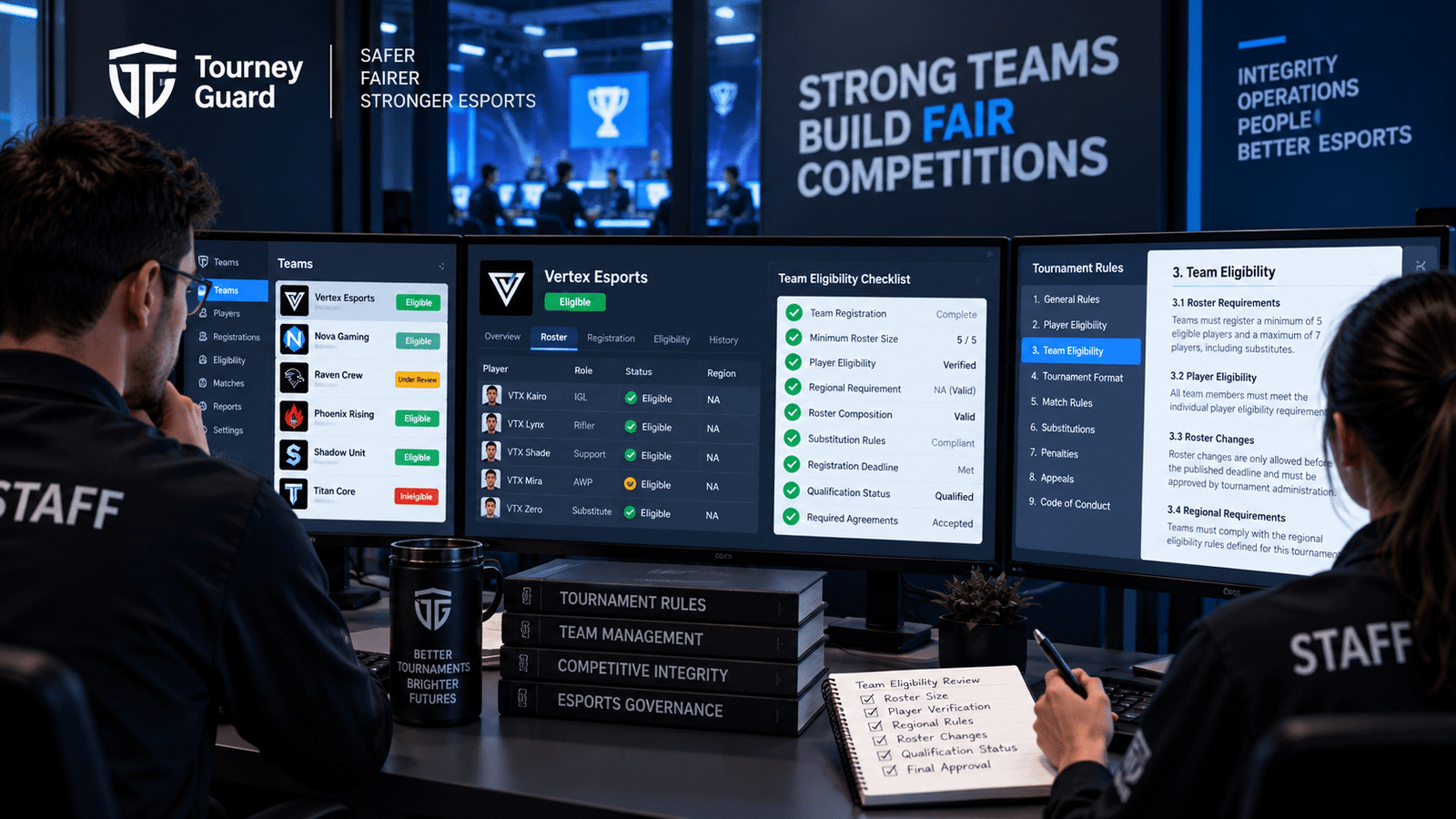
Introduction
Team Eligibility Requirements determine whether a roster is permitted to participate in a tournament. While individual player eligibility establishes whether a person can compete, team eligibility answers a different question: does this specific group of players satisfy the tournament’s requirements as a competitive unit?
That distinction becomes increasingly important as tournaments grow.
A team may have eligible individual players but still fail to meet requirements concerning roster size, registration deadlines, required player roles, regional composition, qualification pathways, substitutions, or roster changes.
When these requirements are unclear, tournament administrators can face difficult decisions at exactly the wrong moment—during check-in, immediately before a match, during playoffs, or after another participant files a complaint.
Well-designed Team Eligibility Requirements reduce that uncertainty by defining the conditions a roster must satisfy, explaining how those conditions are verified, and establishing what happens when a team does not meet them.
This guide explains how tournament organizers can design, verify, document, and enforce team eligibility requirements while maintaining consistency, transparency, and competitive integrity.
Key principle: A team should know what makes its roster eligible before competition begins, and tournament staff should know exactly how that eligibility will be verified.



Key Takeaways
- Team Eligibility Requirements determine whether a roster can participate in a tournament.
- Team eligibility is different from individual player eligibility.
- A team can contain eligible players and still be an ineligible roster.
- Requirements should be published before registration begins.
- Roster size, registration status, qualification, regional requirements, and roster-change rules should be clearly defined when applicable.
- Every important eligibility requirement should have a corresponding verification method.
- Roster changes should follow documented procedures rather than ad hoc decisions.
- Exceptions should be handled consistently and documented.
- Eligibility decisions should identify the applicable rule and supporting information.
- Appeals or review mechanisms can help resolve legitimate disputes.
- Technology can centralize roster information, verification, decisions, and audit records.
Operational principle: Team eligibility is not simply a registration checkbox. It is an administrative control that determines whether a roster is authorized to compete.
What Are Team Eligibility Requirements?
Team Eligibility Requirements are the rules and conditions that a team or roster must satisfy to participate in a tournament.
They establish the conditions under which a group of players is recognized as an eligible competitive unit.
Depending on the tournament, requirements may address:
- Minimum or maximum roster size.
- Required registered players.
- Player eligibility.
- Team registration.
- Qualification.
- Regional requirements.
- Roster composition.
- Substitution rules.
- Roster-change deadlines.
- Required documentation.
- Team ownership or representation.
- Participation restrictions.
- Competition-specific requirements.
The exact requirements should always be defined according to the tournament’s governing rules.
The important point is that team eligibility must be evaluated at the roster level, not simply by checking each player independently.
For example:
Player A is eligible.
Player B is eligible.
Player C is eligible.
That does not automatically mean:
Team ABC is eligible.
The team may still fail another requirement, such as an invalid roster size, an expired registration, a qualification condition, or a prohibited roster configuration.
Why Do Team Eligibility Requirements Matter?
Team eligibility rules matter because they establish the competitive conditions under which teams are allowed to participate.
Poorly designed requirements create uncertainty for almost everyone involved.
For players
Players need to know whether their team can actually compete before investing significant time preparing for an event.
For teams
Team managers need predictable rules for registration, roster management, substitutions, and changes.
For tournament staff
Administrators need objective criteria for determining whether a roster is eligible.
For organizers
Organizers need a defensible process for handling disputes and exceptions.
For the competitive ecosystem
Consistent eligibility administration supports confidence that participating teams are being treated according to the same published standards.
| Weak Team Eligibility Framework | Strong Team Eligibility Framework |
|---|---|
| Ambiguous roster rules | Defined roster requirements |
| Informal verification | Documented verification |
| Last-minute decisions | Predefined checkpoints |
| Unclear substitutions | Explicit substitution rules |
| Manual exceptions | Structured exception process |
| Poor decision records | Documented decisions |
| Frequent disputes | Predictable administration |
What Should Team Eligibility Requirements Include?
There is no universal team eligibility rulebook. Requirements should reflect the tournament’s format, game, governing body, competitive level, and operational model.
However, organizers should consider several common categories.
1. Roster Size Requirements
The rules should establish whether teams must have:
- A minimum number of players.
- A maximum number of players.
- Starting players.
- Reserve or substitute players.
- Registered staff or coaches, where applicable.
The important part is to distinguish between the registered roster and the players actually participating in a particular match.
2. Player Eligibility
Every player included on a team should satisfy the tournament’s applicable player eligibility rules.
This creates a direct relationship between the two articles in this cluster:
Player Eligibility Rules → Team Eligibility Requirements
Team eligibility should therefore reference the applicable individual requirements rather than duplicate the entire player eligibility framework.
3. Registration Requirements
A team may need to complete registration before a specified deadline.
Rules should establish:
- Who can register the team.
- What information must be submitted.
- When registration closes.
- Whether incomplete registrations are eligible.
- How corrections are handled.
- Whether registration can be reopened.
Clear registration rules reduce last-minute administrative problems.
4. Qualification Requirements
Some tournaments require teams to earn participation through a defined competitive pathway.
Examples may include:
- Qualifier results.
- League standings.
- Invitations.
- Previous tournament results.
- Ranking.
- Regional qualification.
- Open qualification stages.
Qualification and eligibility should remain conceptually separate.
A team may be eligible to participate in a qualifier without being qualified for the main event.
5. Regional Requirements
A tournament may define geographic requirements for participating teams.
Depending on the competition, this could concern:
- Team location.
- Player residency.
- Competition region.
- Regional qualification.
- Geographic representation.
The rule should explicitly define what criterion applies.
Terms such as residency, citizenship, location, and regional representation should not automatically be treated as equivalent.
6. Roster Composition
Some competitions impose requirements on how a roster can be constructed.
For example, a rule may establish restrictions concerning:
- Number of players from a particular region.
- Required qualified players.
- Registered substitutes.
- Minimum number of returning players.
- Required team composition.
If composition rules exist, administrators need a reliable method for checking them.
7. Roster Change Rules
Roster changes can significantly affect eligibility.
The rulebook should address:
- When changes are allowed.
- Which players can be added.
- Which players can be removed.
- Deadlines.
- Approval requirements.
- Substitution conditions.
- Whether changes affect qualification.
- Whether changes are allowed after competition begins.
This is one of the areas where unclear rules can produce significant disputes.
Team Eligibility vs Player Eligibility
What is the difference between team eligibility and player eligibility?
Player eligibility evaluates an individual. Team eligibility evaluates the roster as a competitive unit.
| Player Eligibility | Team Eligibility |
|---|---|
| Individual participant | Entire roster |
| Individual registration | Team registration |
| Age requirements | Roster size |
| Individual qualification | Team qualification |
| Individual restrictions | Team restrictions |
| Individual verification | Roster verification |
| Individual account | Team composition |
| Individual disciplinary status | Team participation status |
Consider this example:
Three players individually satisfy all applicable requirements.
However, the tournament requires four registered players.
The players may all be individually eligible, but the team is not eligible because the roster does not satisfy the team-level requirement.
Comparison: Individual vs Team Decision
| Question | Player Eligibility | Team Eligibility |
|---|---|---|
| Who is being evaluated? | Individual | Team/roster |
| What is being verified? | Personal requirements | Roster requirements |
| Can eligibility exist independently? | Yes | Depends on roster conditions |
| Typical decision | Player eligible/ineligible | Team eligible/ineligible |
| Primary administrative object | Player | Team/Roster |
Important: Do not assume that verifying every player automatically verifies the team.
Team Eligibility vs Team Qualification
What is the difference between eligibility and qualification?
Eligibility determines whether a team is permitted to participate; qualification determines whether it has earned a place through the competition’s defined pathway.
These concepts often become confused.
Imagine a tournament with an open qualifier.
A team may:
- Meet all eligibility requirements.
- Register correctly.
- Participate in the qualifier.
- Fail to finish within the qualifying positions.
The team was eligible, but it did not qualify.
Conversely, a team may achieve a qualifying result but later be found unable to satisfy another mandatory participation requirement.
| Eligibility | Qualification |
|---|---|
| Permission to participate | Earned competitive position |
| Rule-based | Performance/pathway-based |
| Often verified administratively | Usually determined competitively |
| Can exist before competition | Often established through results |
| Does not guarantee participation | Usually leads to participation if other requirements remain satisfied |
This distinction should be explicit in the tournament rulebook.
How to Build a Team Eligibility Framework
A reliable framework can be created using six steps.
Step 1: Define the team
Establish what constitutes a team for the tournament.
Specify:
- Official team identity.
- Registered roster.
- Starting lineup.
- Substitutes.
- Team representative.
- Relevant staff roles.
Step 2: Define the requirements
List every condition that can affect team eligibility.
A useful matrix is:
| Requirement | Mandatory? | Verification Method | Verification Stage |
|---|---|---|---|
| Team registration | Yes | Registration record | Registration |
| Minimum roster size | Yes | Roster review | Registration |
| Player eligibility | Yes | Player records | Registration |
| Qualification | If applicable | Competition results | Qualification |
| Regional requirement | If applicable | Required information | Registration/review |
| Roster deadline | Yes | Timestamp/history | Roster review |
This forces organizers to connect rules with operational verification.
Step 3: Define verification ownership
Someone should be responsible for determining whether the requirements are satisfied.
Depending on the tournament, this may be:
- Registration staff.
- Tournament administrators.
- Competition officials.
- Tournament directors.
- An eligibility review authority.
The important principle is accountability.
Step 4: Define timing
Eligibility should not be checked only when a dispute occurs.
Possible checkpoints include:
Registration → Qualification → Check-in → Competition → Critical-stage verification
Not every tournament needs all of these.
The correct checkpoints depend on the rules and risk profile.
Step 5: Define exceptions
Document what happens when:
- Information is missing.
- A roster changes.
- A deadline is missed.
- A player becomes unavailable.
- Eligibility information conflicts.
- A team challenges a decision.
Step 6: Define the decision record
For significant eligibility decisions, record:
- Team.
- Applicable requirement.
- Information reviewed.
- Decision.
- Decision-maker.
- Date/time.
- Reason.
- Follow-up action.
- Appeal or review status, when applicable.
This transforms eligibility administration from an informal judgment into a traceable process.
Team Eligibility Verification Workflow
A standardized workflow can reduce inconsistent decisions.
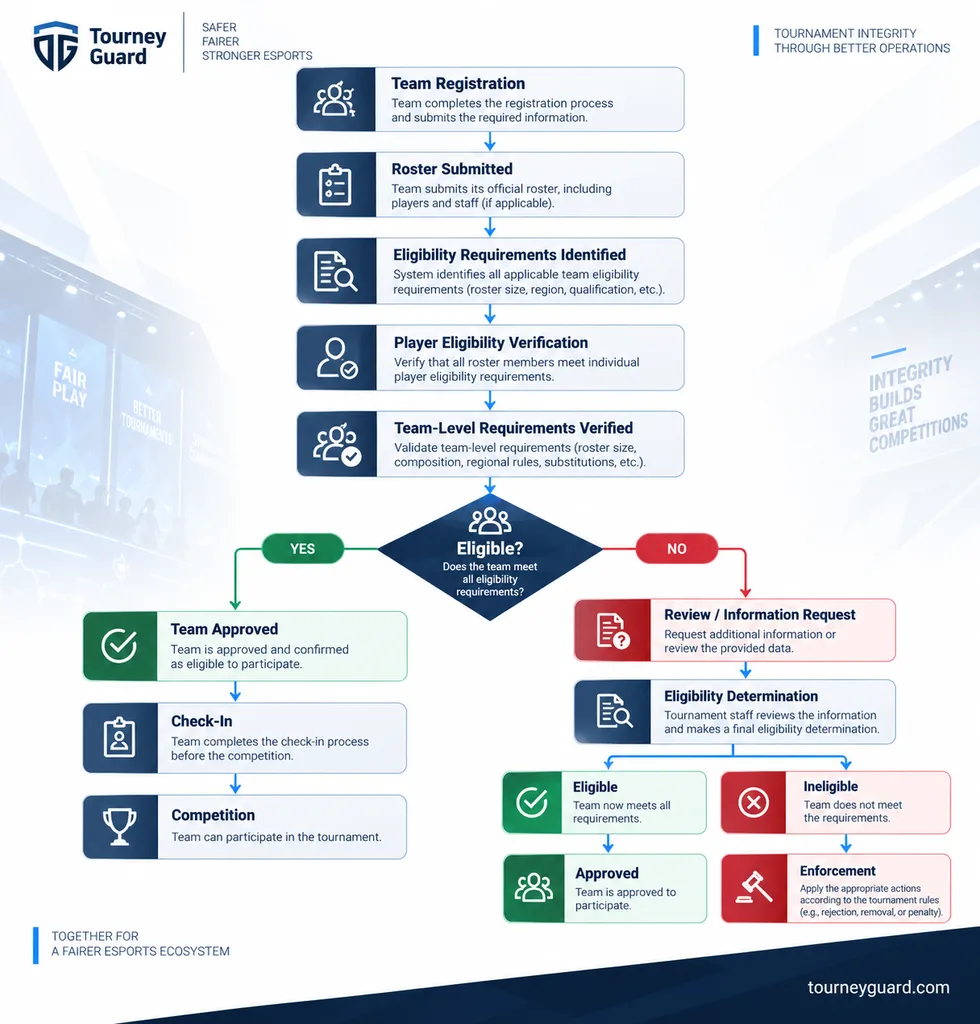
The workflow deliberately separates player verification from team verification.
That distinction is important because a team can fail a team-level requirement even when every player passes individual eligibility checks.
Governance principle: Verification should establish facts; decision-making should apply the published rules to those facts.
How Should Roster Changes and Substitutions Be Handled?
Roster changes should follow explicit rules because they can alter the eligibility status of a team.
A strong roster-change policy should answer:
- When can a roster change?
- Who can request the change?
- Which players can be added?
- Which players can be removed?
- Is there a deadline?
- Does the replacement player need verification?
- Does the change affect qualification?
- Who approves the change?
- Is the change recorded?
- Can the decision be reviewed?
Before competition
Roster changes are generally easier to administer because the organizer has more time to verify the new configuration.
During competition
Changes become more sensitive because they can affect competitive fairness and previously established conditions.
After a deadline
A request should not automatically be accepted simply because the team has a legitimate operational problem.
The tournament’s published rules should determine what options are available.



How Should Exceptions and Disputed Eligibility Be Handled?
What should happen when a team claims that an eligibility decision is incorrect?
Use a controlled process rather than informal negotiation.
Recommended process
1. Identify the rule
Determine exactly which requirement is in question.
2. Preserve the relevant information
Record the roster, registration information, timestamps, submitted documentation, and other relevant material.
3. Determine whether information is missing
Some apparent eligibility failures may simply result from incomplete information.
4. Evaluate the requirement
Apply the published rule to the available information.
5. Escalate interpretation
If the rule is ambiguous, the designated authority should interpret it according to the tournament’s governance process.
6. Document the decision
Record what was decided and why.
7. Communicate the outcome
Tell the affected team what the decision means.
8. Apply the review or appeal process
If an appeal mechanism exists, follow it consistently.
Common Team Eligibility Mistakes
Mistake 1: Assuming eligible players equal an eligible team
Why it happens: Administrators focus on individual verification.
Consequence: Team-level requirements can be overlooked.
Better approach: Perform a separate roster-level eligibility review.
Mistake 2: Not defining roster deadlines
Why it happens: Organizers assume teams understand when changes stop being permitted.
Consequence: Disputes arise when a team attempts a late change.
Better approach: Publish deadlines clearly and define the consequences.
Mistake 3: Handling substitutions informally
Why it happens: A team experiences an urgent problem close to competition.
Consequence: Different teams may receive different treatment.
Better approach: Establish substitution criteria before the event.
Mistake 4: Mixing qualification and eligibility
Why it happens: Both concepts affect participation.
Consequence: Teams may misunderstand whether they are eligible, qualified, or both.
Better approach: Define the two concepts separately.
Mistake 5: Changing eligibility rules during competition
Why it happens: An unexpected case exposes a weakness in the rulebook.
Consequence: Existing teams may perceive the change as unfair.
Better approach: Use an established exception or interpretation process and document any necessary rule changes.
Mistake 6: Failing to maintain roster history
Why it happens: Staff overwrite the current roster without preserving previous states.
Consequence: It becomes difficult to reconstruct what the team looked like at a particular point in the tournament.
Better approach: Maintain a history of meaningful roster changes.
Best Practices for Team Eligibility Administration
1. Publish requirements early
Teams should know the rules before they register.
2. Separate individual and team requirements
Maintain two distinct levels of eligibility.
3. Make every requirement verifiable
A requirement should have a practical method for determining compliance.
4. Establish deadlines
Clearly define when registration and roster changes close.
5. Standardize roster-change procedures
Avoid case-by-case improvisation.
6. Document decisions
Create an administrative record for significant eligibility decisions.
7. Assign decision authority
Staff should know who has authority to approve, reject, or interpret eligibility.
8. Preserve roster history
Maintain enough historical information to understand eligibility at relevant moments.
9. Separate facts from interpretation
First establish what happened. Then determine what the rules mean.
10. Review recurring disputes
Repeated questions often indicate that a rule is unclear or operationally difficult to enforce.
Technology and Team Eligibility Management
How can software support team eligibility?
Software can centralize information that is often fragmented across registration forms, spreadsheets, email conversations, and staff notes.
A structured tournament administration platform can potentially maintain:
- Team profiles.
- Player rosters.
- Registration status.
- Eligibility status.
- Qualification information.
- Roster changes.
- Verification records.
- Administrative notes.
- Decision history.
- Staff permissions.
- Audit trails.
- Appeals information.
The purpose is not to automate every eligibility decision.
Human judgment may still be required when rules are ambiguous or circumstances fall outside normal procedures.
Instead, technology should make the administrative process more structured, visible, and traceable.
Manual vs Structured Administration
| Manual Administration | Structured Administration |
|---|---|
| Spreadsheets | Centralized records |
| Email approvals | Defined workflows |
| Informal roster changes | Recorded changes |
| Scattered information | Unified team profile |
| Difficult history reconstruction | Roster history |
| Manual status tracking | Eligibility status |
| Limited auditability | Audit trail |
Technology principle: Software should operationalize the tournament’s rules—not become a substitute for having clear rules.
Practical Example: A Team Changes Its Roster
Consider a tournament requiring each team to register a defined roster before a published deadline.
Team Alpha registers successfully.
Two days before the competition, one player becomes unavailable. The team asks to replace that player with someone who was not originally registered.
A weak process might simply approve or reject the request based on the administrator’s judgment.
A stronger process asks:
- Is the roster-change window still open?
- Is the replacement player individually eligible?
- Does the new roster satisfy the required size?
- Does the replacement affect any qualification requirement?
- Does the roster still satisfy regional or composition rules?
- Does the tournament permit this type of substitution?
- Who has authority to approve the change?
- How should the change be recorded?
Suppose all requirements are satisfied and the rules permit the substitution.
The administrator approves the change and records the new roster state.
Now suppose the request arrives after the published deadline and the rules do not provide an exception.
The administrator should not create an informal exception simply because the request appears reasonable.
The correct response is to apply the established rules and any applicable review mechanism.
This distinction protects both the team requesting the change and every other team competing under the same rules.
Team Eligibility Decision Framework
Tournament administrators can use this framework when determining whether a roster is eligible.
Question 1: Is the team properly registered?
No → Registration issue or review.
Yes → Continue.
Question 2: Are all required players individually eligible?
No → Team cannot satisfy the applicable roster requirements.
Yes → Continue.
Question 3: Does the roster satisfy team-level requirements?
Check:
- Roster size.
- Composition.
- Regional requirements.
- Required roles.
- Other tournament-specific conditions.
No → Team-level eligibility issue.
Yes → Continue.
Question 4: Has the team satisfied applicable qualification requirements?
No → Team may be eligible but not qualified.
Yes → Continue.
Question 5: Are there unresolved roster changes or exceptions?
Yes → Review according to the applicable process.
No → Continue.
Question 6: Is the team eligible to compete?
Yes → Approve participation.
No → Apply the applicable administrative consequence.
This framework is deliberately simple: verify → evaluate → decide → document.
Team Eligibility Checklist
Rulebook Checklist
- ✓ Team eligibility is explicitly defined.
- ✓ Minimum roster requirements are documented.
- ✓ Maximum roster requirements are documented where applicable.
- ✓ Player eligibility requirements are referenced.
- ✓ Registration requirements are clear.
- ✓ Qualification requirements are separated from eligibility.
- ✓ Regional requirements are defined where applicable.
- ✓ Roster-change rules are documented.
- ✓ Substitution rules are documented.
- ✓ Deadlines are clearly stated.
- ✓ Exceptions are addressed.
- ✓ Review or appeal procedures are defined.
Administration Checklist
- ✓ Team registration has been verified.
- ✓ Current roster has been reviewed.
- ✓ Individual player eligibility has been checked.
- ✓ Team-level requirements have been checked.
- ✓ Qualification status has been confirmed where applicable.
- ✓ Roster changes have been recorded.
- ✓ Exceptions have been documented.
- ✓ Eligibility decisions have an accountable decision-maker.
- ✓ Relevant records can be retrieved later.
- ✓ Teams receive clear eligibility decisions.
Tourney Guargd
Understanding Team Eligibility Requirements is only the first step. Applying those requirements consistently becomes significantly harder when tournaments have dozens or hundreds of teams, frequent roster changes, multiple qualification stages, and staff working across different administrative responsibilities.
Teams may submit information through registration forms while roster changes arrive through email, eligibility decisions are recorded in spreadsheets, and staff maintain separate notes about exceptions or approvals. Over time, reconstructing why a team was considered eligible—or when its roster changed—can become unnecessarily difficult.
Tourney Guard helps tournament organizers structure the operational processes surrounding Tournament Administration, Tournament Integrity, Evidence Management, and administrative decision-making. By centralizing relevant tournament records and workflows, organizers can build a more consistent process for managing the information behind eligibility decisions.
If you’re looking to bring greater structure and accountability to tournament administration, you can explore the platform with a free 30-day trial.
👉 Start Your 30-Day Free Trial →
FAQ
What are Team Eligibility Requirements?
Team Eligibility Requirements define the conditions a roster must satisfy to participate in a tournament. They can include registration status, roster size, player eligibility, qualification, regional conditions, composition rules, and roster-change requirements. The exact requirements depend on the tournament and its governing rules. Strong requirements also explain how eligibility will be verified, when verification occurs, who makes eligibility decisions, and what happens when a team does not satisfy a requirement. This makes the rules more predictable for both teams and tournament administrators.
What is the difference between team eligibility and player eligibility?
Player eligibility determines whether an individual can participate, while team eligibility determines whether a particular roster satisfies the tournament’s requirements as a team. A roster can therefore contain individually eligible players and still be ineligible because of a team-level condition such as roster size, composition, registration, or qualification. Keeping these concepts separate helps tournament administrators perform the appropriate checks at each level and prevents teams from assuming that individual eligibility automatically guarantees roster eligibility.
What should a tournament rulebook include about team eligibility?
A tournament rulebook should define the conditions that determine whether a team can participate. Depending on the competition, this can include roster size, registration deadlines, player eligibility, qualification, regional requirements, roster composition, substitutions, and roster-change procedures. It should also explain how requirements are verified and what happens when they are not satisfied. Clear deadlines and decision authority are particularly important because they reduce ambiguity when teams request changes shortly before or during competition.
Can a team be eligible but not qualified?
Yes. Eligibility and qualification are different concepts. A team can satisfy all requirements necessary to participate in a qualifier but fail to achieve the competitive result required to reach the main event. In that situation, the team was eligible to compete but did not qualify. Conversely, a team that earns a qualifying position may still need to satisfy other applicable participation requirements. Keeping these concepts separate makes tournament administration clearer and reduces confusion about what a team’s status actually means.
How should tournament organizers handle roster changes?
Roster changes should be governed by published rules that establish when changes are permitted, who can request them, which players can be added or removed, and whether deadlines apply. Replacement players should be checked against applicable individual and team requirements. The organizer should also determine whether the change affects qualification or roster composition. Significant changes should be recorded so there is a reliable history of the team’s roster at relevant stages of the tournament.
Should team eligibility be checked more than once?
In many tournaments, multiple eligibility checkpoints can be useful. Initial verification may occur during registration, with additional checks before qualification stages, check-in, playoffs, or other critical points. The appropriate approach depends on the tournament’s rules and operational risk. Re-verification becomes particularly important after roster changes or when new information raises a legitimate eligibility concern. The key is to define the checkpoints in advance rather than applying them inconsistently to individual teams.
What happens when a team disputes an eligibility decision?
A disputed decision should follow the tournament’s established review or appeals process when one exists. Administrators should identify the specific rule involved, preserve relevant information, determine whether additional information is needed, and assign the case to the appropriate decision-maker. The outcome should be documented and communicated clearly. A structured process helps distinguish between genuine eligibility questions and disagreements with a properly applied rule, while also providing a consistent experience for different teams.
How can technology help manage team eligibility?
Technology can centralize team registrations, rosters, player records, verification status, roster changes, administrative decisions, and related documentation. This reduces dependence on disconnected spreadsheets, email threads, and informal notes. It can also provide workflows, permissions, notifications, and audit trails. Technology should support the tournament’s established rules rather than replace human judgment. The strongest approach combines clear eligibility policies with structured tools that make those policies easier to administer consistently.
Conclusion
Team Eligibility Requirements provide the foundation for determining whether a roster can participate in a tournament.
The strongest frameworks do more than define a minimum roster size. They establish a complete relationship between registration, player eligibility, roster composition, qualification, roster changes, verification, decision-making, and appeals.
The most important distinction is between the individual and the team.
A player can be eligible without making the entire roster eligible. Similarly, a team can be eligible without being qualified for a later stage of competition.
For organizers, the objective should therefore be to create rules that are clear before registration, practical to verify, consistently applied, and properly documented.
As tournaments grow, these requirements become increasingly difficult to manage through disconnected spreadsheets and informal communication. Structured tournament administration can help transform eligibility from a recurring source of uncertainty into a predictable operational process.
That is ultimately what good tournament governance should achieve: clear rules, consistent decisions, and confidence that every team is competing under the same conditions.


Recommended External Resources
These organizations publish guidance that supports professional Tournament Integrity programs:
- Esports Integrity Commission (ESIC) – Standards, codes of conduct, investigations, and integrity initiatives.
- International Olympic Committee (IOC) – Integrity frameworks applicable to competitive sports governance.
- International Betting Integrity Association (IBIA) – Best practices for integrity monitoring.
- NIST Cybersecurity Framework – Guidance for security governance and risk management.
- ISO 37301 Compliance Management Systems – International compliance management principles.
- World Anti-Doping Agency (WADA) – Governance and disciplinary process principles applicable beyond traditional sports.
Suggested Internal Links
Strengthen your internal linking strategy by connecting this article with: