
Introduction
Tournament Incident Management is one of the most critical responsibilities of any esports organizer. No matter how well a tournament is planned, situations such as player disputes, suspected cheating, rule violations, technical issues, or appeals are inevitable.
The difference between a trusted tournament and a controversial one is rarely determined by the incident itself—it is determined by how the incident is handled.
Professional organizers understand that every report deserves a structured investigation supported by evidence, clear procedures, and transparent decision-making. Without consistent incident management, even a technically fair competition can lose credibility among players, teams, sponsors, and the community.
Many organizers still rely on spreadsheets, messaging applications, and manual documentation to track incidents. While these methods may work for small events, they quickly become difficult to manage as tournaments grow in size and complexity.
A structured Tournament Incident Management process helps organizers investigate incidents consistently, document every decision, maintain complete audit trails, and strengthen Tournament Integrity throughout the entire competition.
In this guide, you’ll learn the best practices for managing tournament incidents, building reliable investigation workflows, and creating transparent processes that increase confidence in your esports events.
What Is Tournament Incident Management?
Tournament Incident Management is the structured process used to receive, investigate, document, resolve, and archive incidents that occur during an esports competition.
Rather than reacting differently to every situation, professional organizers establish standardized workflows that ensure similar incidents receive consistent treatment.
Typical tournament incidents include:
- Suspected cheating
- Rule violations
- Player disputes
- Match interruptions
- Technical issues
- Unsportsmanlike conduct
- Account sharing
- Stream sniping reports
- Appeals
Each incident requires objective evaluation supported by evidence and tournament rules.
Without a defined management process, organizers risk inconsistent decisions that may undermine player confidence and tournament credibility.
Why Incident Management Matters
Competitive integrity depends not only on preventing problems but also on responding to them professionally.
Poor incident management can result in:
- Conflicting referee decisions.
- Missing evidence.
- Delayed resolutions.
- Player frustration.
- Sponsor concerns.
- Community criticism.
- Appeals based on inconsistent rulings.
By contrast, tournaments with well-defined incident management procedures demonstrate fairness, accountability, and operational maturity.
Players are more likely to trust organizers who can clearly explain:
- What happened.
- What evidence was reviewed.
- Which rules applied.
- Why a decision was made.
Transparency transforms difficult situations into opportunities to reinforce confidence in the tournament.
The Tournament Incident Lifecycle
Every tournament incident should follow a repeatable lifecycle.
A typical workflow includes:
- Incident Report
- Evidence Collection
- Initial Review
- Administrative Investigation
- Decision
- Communication
- Appeals (if applicable)
- Archive
Using the same workflow for every case improves consistency, reduces administrative errors, and creates complete historical records for future reference.
The following sections explain each stage in detail and describe the best practices professional esports organizers use to maintain fair and transparent tournament operations.
Best Practices for Managing Tournament Incidents
Professional esports tournaments rarely avoid incidents altogether.
What separates successful organizers from inexperienced ones is their ability to respond quickly, consistently, and transparently.
The following best practices help establish a structured Tournament Incident Management process that protects both competitive integrity and player confidence.
1. Standardize Incident Reporting
Every incident should begin with a structured report.
Allowing players to submit reports through chat messages or informal conversations often leads to missing information and inconsistent investigations.
A standardized incident report should include:
- Match ID
- Tournament stage
- Player or team involved
- Date and time
- Description of the incident
- Tournament rule allegedly violated
- Evidence attached
- Person submitting the report
Using the same reporting format for every incident significantly improves investigation quality.
2. Collect Evidence Before Drawing Conclusions
One of the most common mistakes organizers make is reaching conclusions too quickly.
Every decision should be supported by objective evidence rather than assumptions or community opinions.
Examples of useful evidence include:
- Match recordings
- Screenshots
- Video clips
- Replay files
- Chat logs
- Server logs
- Referee observations
- Player statements
The stronger the evidence, the more transparent and defensible the final decision becomes.
3. Assign Incidents to Qualified Reviewers
Not every administrator should investigate every type of incident.
Large tournaments often assign specialized reviewers based on the nature of the report.
For example:
| Incident Type | Recommended Reviewer |
|---|---|
| Suspected cheating | Integrity referee |
| Rule violation | Tournament administrator |
| Technical issue | Technical operations team |
| Player misconduct | Competition referee |
| Appeals | Senior tournament committee |
Assigning responsibility improves consistency while reducing conflicts of interest.
4. Follow a Consistent Investigation Workflow
Every report should follow the same sequence of steps.
Example workflow:
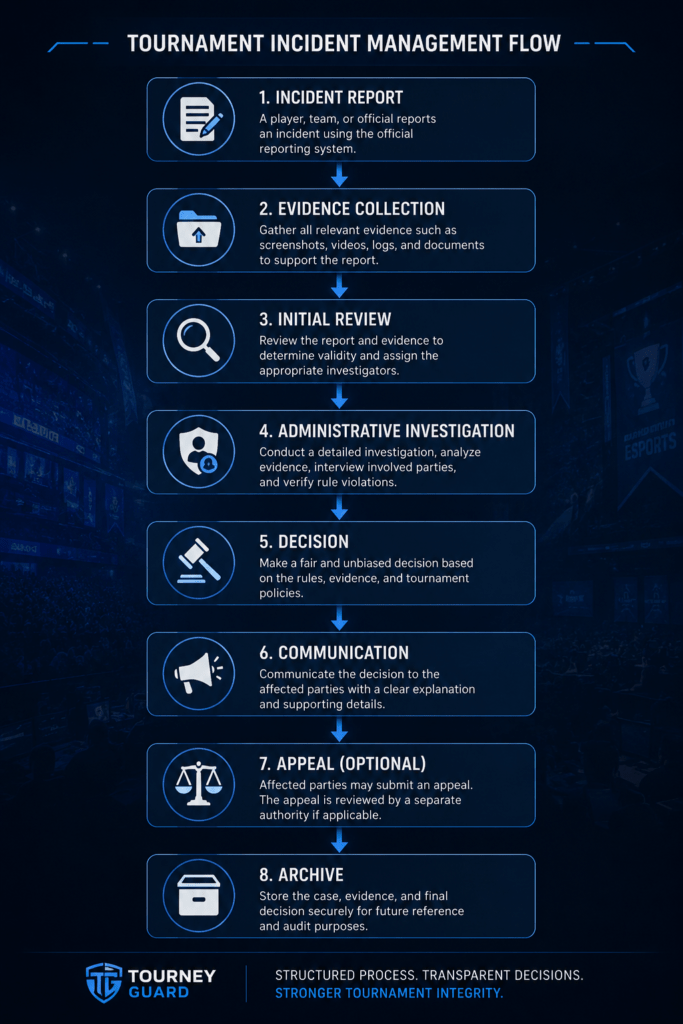
Consistency ensures that similar incidents receive similar treatment regardless of who investigates them.
5. Base Decisions on Tournament Rules
Tournament rules should always be the foundation of every administrative decision.
Avoid making exceptions based on:
- Player popularity
- Community pressure
- Sponsor influence
- Social media reactions
Instead, ask four questions:
- Which rule applies?
- Was the rule violated?
- What evidence supports the finding?
- What penalty does the rulebook specify?
Rule-based decisions strengthen trust and reduce controversy.
6. Document Every Decision
Documentation is often overlooked, yet it becomes invaluable when questions arise later.
Every resolved incident should record:
- Summary of the incident
- Evidence reviewed
- Investigation timeline
- Tournament rule applied
- Final decision
- Reviewer responsible
- Decision date
Complete documentation creates accountability and simplifies future audits or appeals.
7. Communicate Decisions Clearly
Players are more likely to accept unfavorable decisions when organizers explain them transparently.
A good decision notice should include:
- Incident summary
- Evidence considered
- Applicable tournament rule
- Final ruling
- Appeal instructions (if available)
Transparency reduces misunderstandings and demonstrates professionalism.
Common Mistakes Organizers Should Avoid
Even experienced tournament administrators occasionally introduce avoidable risks into their incident management process.
Recognizing these mistakes helps build stronger tournament operations.
Inconsistent Rule Enforcement
Applying different standards to similar situations damages competitive integrity.
Every participant should be treated according to the same tournament rules.
Missing Evidence
Investigating incidents without sufficient evidence often leads to subjective decisions.
Always verify that supporting material has been collected before closing a case.
Poor Documentation
Failing to record investigations creates problems during future disputes or appeals.
If a decision cannot be explained months later, the documentation was insufficient.
Delayed Responses
Long investigation times frustrate players and may delay tournament progression.
Define response targets for different types of incidents.
Example:
| Priority | Recommended Response |
| Critical | Within 30 minutes |
| High | Within 2 hours |
| Medium | Within 24 hours |
| Low | Before tournament closure |
Lack of Transparency
Players rarely expect every decision to favor them.
However, they do expect decisions to be understandable and consistent.
Providing clear explanations strengthens confidence in tournament administration.
Building Transparent Investigation Processes
Transparency should be embedded into every stage of Tournament Incident Management.
Professional organizers establish procedures that can be consistently repeated regardless of tournament size.
A transparent investigation process typically includes:
Clear reporting channels
Players know exactly where and how to report incidents.
Defined investigation responsibilities
Every administrator understands their role during the review process.
Standard evidence requirements
Investigators evaluate similar evidence using the same standards.
Consistent decision templates
Every ruling follows a common structure.
Complete audit trails
Administrative actions remain available for future reviews and appeals.
Investigation Checklist
Before closing any incident, organizers should verify the following:
✅ Incident reported correctly
✅ Evidence collected
✅ Tournament rule identified
✅ Investigation completed
✅ Decision documented
✅ Player notified
✅ Appeal information provided
✅ Case archived
Following a checklist reduces administrative mistakes while improving operational consistency.
How Technology Improves Incident Management
As tournaments grow, manual incident management becomes increasingly difficult.
Technology helps organizers centralize information and standardize workflows without replacing human judgment.
Modern Tournament Incident Management platforms can assist by:
- Centralizing reports
- Organizing evidence
- Tracking investigation progress
- Recording referee decisions
- Maintaining audit trails
- Improving collaboration between tournament staff
- Standardizing administrative workflows
Technology enables organizers to spend less time searching for information and more time making fair, evidence-based decisions.
The final section of this guide explores how structured incident management strengthens Tournament Integrity, how Tourney Guard supports professional tournament operations, and answers the most common questions organizers have about incident management.
How Tourney Guard Supports Tournament Incident Management
Managing tournament incidents effectively requires more than good intentions.
As tournaments grow, organizers face increasing volumes of reports, evidence, referee decisions, and appeals. Without structured processes, information becomes scattered across spreadsheets, messaging applications, cloud folders, and emails, making investigations slower and less consistent.
Tourney Guard was built to simplify this operational challenge.
Instead of replacing tournament officials, Tourney Guard provides a centralized platform that supports every stage of Tournament Incident Management, helping organizers standardize investigations and improve transparency across competitive events.
With Tourney Guard, organizers can:
- Centralize incident reports in one place.
- Attach screenshots, videos, and supporting evidence.
- Track investigation progress.
- Record referee decisions.
- Maintain complete audit trails.
- Standardize investigation workflows.
- Improve communication between tournament staff.
- Increase transparency for players and sponsors.
Technology cannot replace human judgment, but it can make tournament administration significantly more efficient, consistent, and trustworthy.
Final Thoughts
Tournament Incident Management is one of the strongest foundations of competitive integrity.
Every tournament will eventually face disputes, technical issues, player reports, or allegations of rule violations. The difference between an amateur event and a professional competition lies in how those situations are managed.
By implementing standardized workflows, collecting objective evidence, documenting every administrative decision, and communicating transparently with participants, organizers strengthen confidence in their tournaments and reduce unnecessary disputes.
Effective incident management is not about reacting faster.
It is about responding consistently.
Professional tournament operations depend on structured processes that protect fairness while ensuring every participant receives equal treatment under the tournament rules.
Ultimately, Tournament Integrity is built one decision at a time.
Ready to Protect Your Tournament?
Strengthen tournament integrity with better incident management, evidence collection, and transparent decision-making.
Frequently Asked Questions (FAQ)
What is Tournament Incident Management?
Tournament Incident Management is the structured process of receiving, investigating, documenting, resolving, and archiving incidents that occur during an esports competition. It ensures every report is handled consistently, transparently, and according to tournament rules.
Why is Tournament Incident Management important?
A structured incident management process protects Tournament Integrity by ensuring investigations are based on evidence rather than assumptions. It also improves consistency, transparency, and player confidence throughout the competition.
What types of incidents should be investigated?
Common tournament incidents include:
- Suspected cheating
- Rule violations
- Player disputes
- Technical failures
- Match interruptions
- Unsportsmanlike conduct
- Account sharing
- Stream sniping reports
- Appeals
Every incident should follow the same investigation workflow.
What evidence should organizers collect?
Evidence may include:
- Match recordings
- Screenshots
- Replay files
- Chat logs
- Server logs
- Referee observations
- Player statements
Collecting objective evidence improves decision quality while reducing disputes.
How can organizers improve investigation consistency?
Using standardized workflows, predefined decision templates, documented procedures, and evidence-based reviews helps ensure similar incidents receive similar outcomes regardless of who conducts the investigation.
Can technology replace tournament administrators?
No.
Technology supports Tournament Incident Management by organizing information, tracking investigations, and maintaining documentation.
Final decisions should always remain the responsibility of qualified tournament officials.
How does Tournament Incident Management improve Tournament Integrity?
Consistent incident management builds trust by ensuring every participant is treated fairly, every investigation follows the same procedures, and every decision is supported by evidence and tournament rules.
Learn More About Esports Integrity
To learn more about professional integrity standards, organizers should explore resources from:
- Esports Integrity Commission (ESIC)
- International Esports Federation (IESF)
These organizations provide guidance on fair competition, governance, disciplinary procedures, and integrity standards across the global esports ecosystem.
Connect this guide with the following articles inside the Tourney Guard Knowledge Hub:
- What Is Tournament Integrity? A Complete Guide for Esports Organizers
- Why Anti-Cheat Software Alone Isn’t Enough for Esports Tournaments
- 10 Common Types of Cheating in Esports Tournaments