
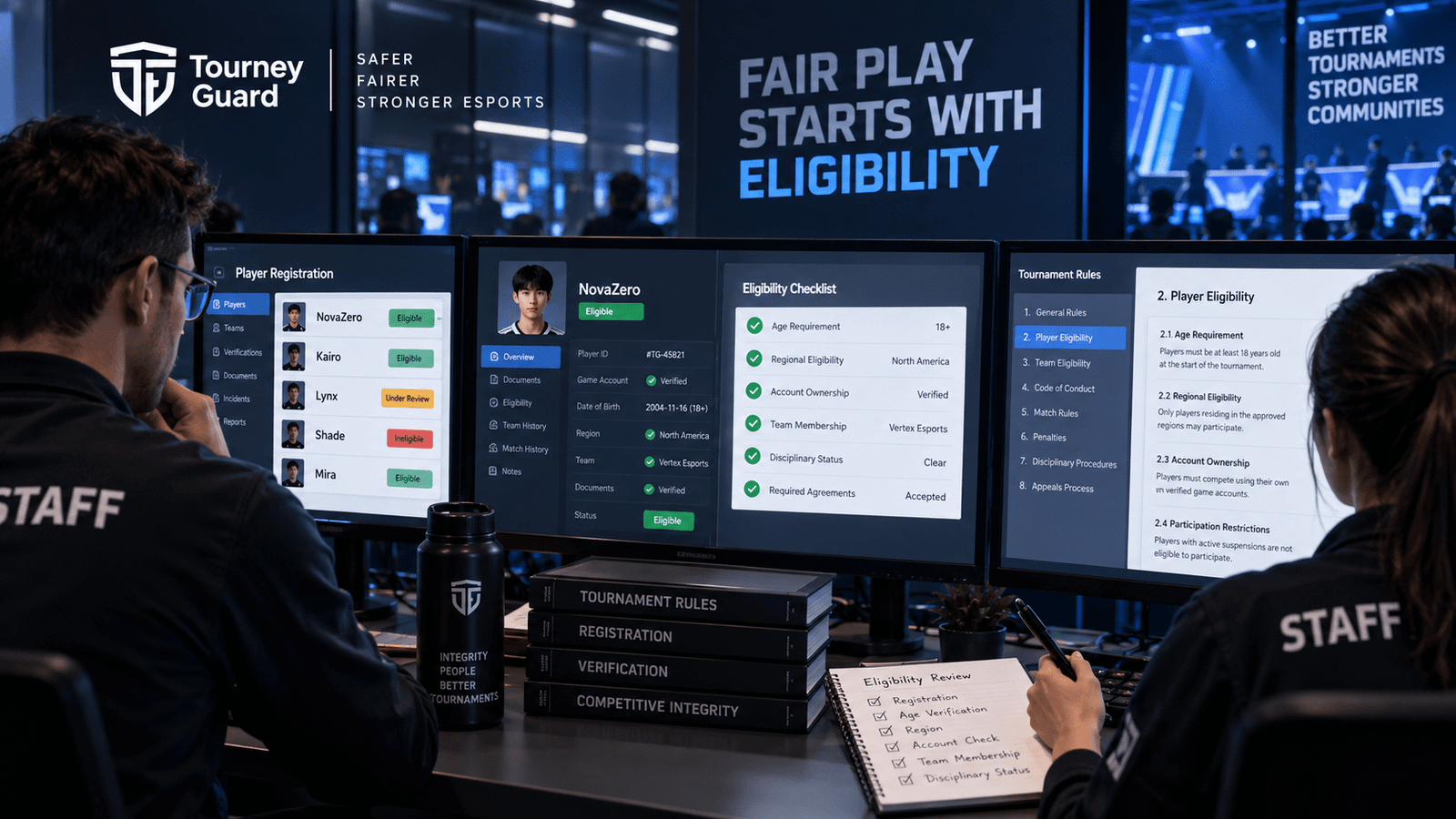
Introduction
Player Eligibility Rules define who is allowed to participate in a tournament and under what conditions. They are one of the most important components of a tournament rulebook because they establish a consistent standard before competition begins.
Eligibility is more than checking whether a player completed a registration form. Depending on the tournament, organizers may need to establish requirements related to age, registration status, roster membership, residency, competitive level, account ownership, participation restrictions, or other tournament-specific conditions.
Poorly defined eligibility requirements create operational problems. Players may discover restrictions after registering, teams may challenge roster decisions, and tournament staff may be forced to make inconsistent decisions under time pressure.
Well-designed rules solve this problem by making eligibility clear, verifiable, consistently enforced, and subject to an appropriate review or appeals process.
This guide explains how tournament organizers can design and administer Player Eligibility Rules as part of a broader tournament governance and rules-enforcement framework.
Key principle: Eligibility rules should be understandable before registration, verifiable during administration, and enforceable through a documented process.



Key Takeaways
- Player Eligibility Rules establish who may participate in a tournament.
- Eligibility requirements should be defined before registration opens.
- Rules should distinguish between player-level and team-level requirements.
- Every eligibility requirement should have a practical verification method.
- Organizers should document eligibility decisions rather than relying on informal judgments.
- Exceptions should follow predefined procedures whenever possible.
- Eligibility enforcement should be consistent across players and teams.
- Players should understand eligibility requirements before committing to participation.
- Appeals should be available when an eligibility decision can materially affect competitive participation.
- Tournament administration software can help centralize registration, verification, documentation, and decision records.
Operational principle: A rule that cannot be consistently verified and enforced is not a strong eligibility rule.
What Are Player Eligibility Rules?
Player Eligibility Rules are the requirements a participant must satisfy to enter, remain in, or compete in a tournament.
They answer a fundamental administrative question:
Who is permitted to compete?
These requirements can vary considerably depending on the tournament’s purpose, competitive structure, jurisdiction, game, organizer, or governing framework.
For example, an organizer may establish requirements concerning:
- Minimum or maximum age.
- Registration completion.
- Required identification or account information.
- Team or roster membership.
- Residency or regional eligibility.
- Competitive ranking or qualification.
- Previous participation.
- Participation in qualifying events.
- Existing disciplinary restrictions.
- Required agreements or acknowledgements.
- Publisher or competition-specific requirements.
The important distinction is that eligibility is not simply a registration concept.
Registration tells the organizer that a player wants to participate. Eligibility determines whether that player is actually permitted to participate.
Why Do Player Eligibility Rules Matter?
Player eligibility directly affects competitive integrity, tournament administration, and player trust.
If two players receive different treatment for the same eligibility issue, participants may perceive the competition as unfair even if the original rule was legitimate.
For players
Clear eligibility requirements help players understand whether they can compete before investing time, money, and preparation into the tournament.
For teams
Teams can build rosters with greater confidence when eligibility requirements are clearly documented.
For tournament staff
Defined rules reduce the amount of subjective interpretation required during registration and live events.
For organizers
Consistent eligibility administration reduces disputes and provides a defensible foundation for tournament decisions.
For competitive integrity
Eligibility rules help ensure that participants compete under the same established conditions.
| Without clear eligibility rules | With clear eligibility rules |
|---|---|
| Ambiguous requirements | Defined requirements |
| Manual interpretation | Standardized evaluation |
| Last-minute disputes | Earlier verification |
| Inconsistent decisions | Consistent enforcement |
| Poor documentation | Decision records |
| Higher administrative risk | Controlled workflow |
The Core Components of Player Eligibility
A strong eligibility framework should separate requirements into clearly understandable categories.
1. Registration Eligibility
The player must complete the required registration process within the established timeframe.
This may include:
- Required registration fields.
- Acceptance of tournament rules.
- Required declarations.
- Account information.
- Contact information.
- Team association.
- Required documentation.
The rule should make clear what constitutes a complete registration.
2. Age Requirements
Some competitions may establish age requirements.
Rather than simply stating:
Players must meet the tournament’s age requirement.
A rule should clearly communicate:
- The minimum age.
- How age is determined.
- When the requirement must be satisfied.
- Whether verification can be requested.
- What happens when eligibility cannot be established.
The exact requirement will depend on the tournament and applicable rules.
3. Regional or Residency Requirements
Certain competitions may restrict participation according to geographic criteria.
Possible requirements could concern:
- Country.
- Region.
- Competition territory.
- Residency.
- Citizenship.
- Location during competition.
These concepts should not be treated as interchangeable.
A rule should explicitly define the criterion being used.
4. Competitive Qualification
Some tournaments require players to satisfy competitive conditions before participating.
Examples may include:
- Qualification through an earlier stage.
- Ranking requirements.
- Invitations.
- Previous tournament results.
- Qualifier participation.
- League membership.
The eligibility rule should explain how qualification is established and recorded.
5. Account or Identity Requirements
A competition may require a player to participate using an identified account or other defined competitive identity.
The important administrative principle is consistency.
If an account or identity requirement exists, organizers should define:
- What must be registered.
- When it must be provided.
- How changes are handled.
- Who can verify it.
- What happens when information conflicts.
6. Participation Restrictions
Eligibility may also depend on whether the player is subject to an existing tournament restriction.
Depending on the governing rules, this could involve:
- Active disciplinary restrictions.
- Suspension from a competition.
- Restrictions established by an organizer.
- Other explicitly defined participation limitations.
These conditions should be documented rather than handled through informal staff knowledge.
Player Eligibility Rules vs Team Eligibility Rules
One of the most common sources of confusion is treating player and team eligibility as the same thing.
They are related, but they answer different questions.
Player eligibility
Can this individual participate?
Team eligibility
Can this roster participate as a team?
A team may satisfy its roster requirements while containing an individual who does not meet player eligibility requirements.
Conversely, several individually eligible players may form a roster that does not satisfy the tournament’s team requirements.
| Player Eligibility | Team Eligibility |
|---|---|
| Individual participant | Entire roster |
| Age | Roster size |
| Individual registration | Required team composition |
| Individual qualification | Team qualification |
| Individual restrictions | Team restrictions |
| Identity/account requirements | Roster registration |
| Individual verification | Team verification |
This distinction should be reflected in the tournament rulebook and administrative workflows.
How to Build a Player Eligibility Framework
A practical framework can be built using five steps.
Step 1: Define the eligibility requirement
Start with the actual requirement.
For example:
Players must satisfy the tournament’s published age requirement before participating.
Avoid creating requirements that are vague enough to require subjective interpretation.
Step 2: Define the verification method
Every important eligibility requirement should have a corresponding verification mechanism.
Ask:
How will tournament staff determine whether this requirement has been satisfied?
If there is no practical answer, the rule probably needs refinement.
Step 3: Define the verification timing
Determine when eligibility will be checked.
Possible points include:
- Registration.
- Registration review.
- Before a qualifier.
- Before a match.
- Before playoffs.
- During an investigation.
- After a reported eligibility concern.
Not every requirement needs to be checked at every stage.
Step 4: Define the consequence
The rule should explain what happens when a requirement is not satisfied.
Possible administrative outcomes may include:
- Registration rejection.
- Request for additional information.
- Temporary review.
- Removal from a roster.
- Match-related administrative action.
- Escalation for investigation.
The appropriate consequence depends on the tournament’s rules.
Step 5: Define the review or appeal process
Eligibility decisions can sometimes be disputed.
A strong rulebook therefore explains:
- Who reviews eligibility decisions.
- How a player or team can challenge a decision.
- What evidence can be submitted.
- Applicable deadlines.
- Who makes the final determination.
This creates a more transparent administrative process.
Player Eligibility Verification Workflow
A standardized workflow reduces inconsistent decisions.
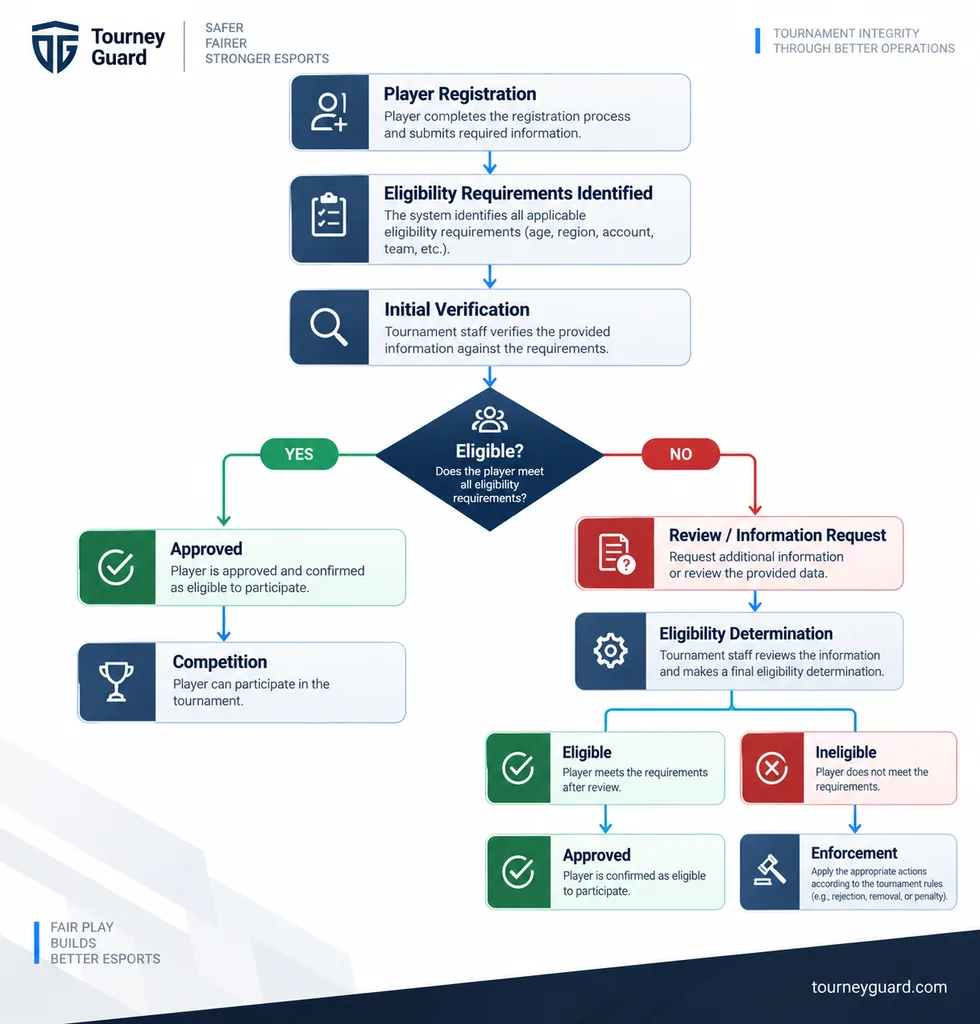
The exact workflow should be adapted to the tournament’s rules and operational requirements.
The important principle is that staff should follow the same decision path for comparable cases.



When Should Eligibility Be Verified?
There is no universal answer.
The appropriate timing depends on the type of tournament and the eligibility requirement.
| Verification Stage | Advantages | Risk |
|---|---|---|
| During registration | Early detection | More administrative work upfront |
| Before competition | Reduces live-event surprises | Less time to resolve issues |
| Before playoffs | Protects high-stakes stages | Problems may surface late |
| During an incident | Useful for disputed cases | Reactive rather than preventive |
| Multiple checkpoints | Stronger control | Higher operational complexity |
For most tournaments, early verification combined with targeted re-verification provides a practical balance.
The key is to avoid discovering fundamental eligibility problems immediately before an important match whenever they could reasonably have been detected earlier.
Handling Exceptions and Special Cases
Real tournaments rarely operate entirely within simple yes-or-no conditions.
Organizers may encounter:
- Missing information.
- Conflicting information.
- Registration errors.
- Roster changes.
- Late submissions.
- Technical registration problems.
- Disputed eligibility.
- Exceptional circumstances.
The dangerous approach is to improvise a new rule for every case.
Instead, define an exception-handling process.
A practical exception process
- Record the issue.
- Identify the applicable rule.
- Collect relevant information.
- Determine whether the requirement is satisfied.
- Escalate when the case requires interpretation.
- Document the decision.
- Communicate the outcome.
- Provide the applicable review or appeal mechanism.
This transforms an ambiguous situation into a controlled administrative process.
Important: Exceptions should not quietly become unofficial rules. If the same exception occurs repeatedly, the underlying tournament rule may need clarification.
Common Player Eligibility Mistakes
Mistake 1: Writing vague requirements
A rule such as “players must meet all eligibility requirements” provides little practical value if the requirements are not defined elsewhere.
Why it happens: Organizers assume participants already understand the criteria.
Better approach: Define the requirement explicitly and explain how it is verified.
Mistake 2: Checking eligibility too late
Discovering an eligibility problem after a tournament stage has already started can create significant administrative complications.
Better approach: Establish verification checkpoints before critical competition stages.
Mistake 3: Treating every case differently
Staff may make reasonable decisions individually but create inconsistency across the tournament.
Better approach: Use documented procedures and decision criteria.
Mistake 4: Failing to document decisions
A verbal decision may resolve an immediate problem but provides little institutional memory.
Better approach: Record the issue, applicable rule, evidence considered, decision, and responsible authority.
Mistake 5: Confusing eligibility with qualification
Being eligible does not necessarily mean that a player has qualified for the competition.
Eligibility answers whether participation is permitted.
Qualification answers whether the player earned a place through the tournament’s competitive pathway.
Best Practices for Tournament Organizers
1. Publish eligibility requirements before registration
Players should be able to determine whether they are eligible before entering the competition.
2. Use precise language
Avoid terms that can be interpreted differently by different staff members.
3. Separate player and team requirements
Maintain clear distinctions between individual eligibility and roster eligibility.
4. Define verification procedures
Every significant eligibility requirement should have a corresponding administrative process.
5. Establish ownership
Determine which tournament staff member or role is responsible for eligibility decisions.
6. Document exceptions
Exceptions should be recorded with enough information to explain why the decision was made.
7. Apply rules consistently
Comparable cases should receive comparable treatment.
8. Define appeals
Participants should know how an eligibility decision can be challenged when an appeals mechanism applies.
9. Review rules after each tournament
Recurring eligibility disputes are signals that the rulebook or workflow may need improvement.
10. Connect eligibility to tournament governance
Eligibility should not exist as an isolated registration function. It should connect to rules enforcement, incident management, appeals, and administrative decision-making.
Technology: How Software Supports Player Eligibility
Technology can make eligibility administration more reliable by centralizing information and reducing dependence on disconnected spreadsheets, emails, and manual notes.
A tournament administration platform can potentially support:
- Centralized player records.
- Registration workflows.
- Eligibility status.
- Roster information.
- Verification records.
- Administrative notes.
- Incident records.
- Decision history.
- Audit trails.
- Staff permissions.
- Appeals workflows.
The goal is not to automate every eligibility decision.
Some decisions require human interpretation.
Instead, technology should help tournament staff apply established rules consistently and preserve the information needed to explain administrative decisions.
This becomes increasingly important as tournaments grow in participant count, staff size, competition stages, and administrative complexity.
Practical Example: A Player Eligibility Dispute
Imagine a tournament with a published eligibility requirement that players must satisfy a defined regional participation condition.
A player registers successfully, but tournament staff later receive information suggesting the player may not satisfy the requirement.
A weak process might be:
An administrator checks the information, makes a decision, and communicates it verbally.
A stronger process would be:
- Create an eligibility review record.
- Identify the specific rule involved.
- Record the information that triggered the review.
- Request supporting information if necessary.
- Assign the case to the appropriate tournament official.
- Determine eligibility according to the published rule.
- Record the decision and reasoning.
- Notify the player or team.
- Apply the relevant review or appeals procedure.
The second approach creates a much stronger administrative record.
It also makes the decision easier to explain if it is later challenged.
The objective is not simply to make the correct decision. It is to make the decision through a process that is consistent, transparent, and defensible.
Player Eligibility Checklist
Tournament organizers can use the following checklist when designing or reviewing eligibility requirements.
Rule Design
- ✓ Eligibility requirements are explicitly defined.
- ✓ Player requirements are separated from team requirements.
- ✓ Eligibility terminology is clearly explained.
- ✓ Requirements are published before registration.
- ✓ Exceptions are addressed.
- ✓ Consequences for ineligibility are defined.
- ✓ Review or appeals procedures are documented.
Administration
- ✓ Registration captures required eligibility information.
- ✓ Verification responsibilities are assigned.
- ✓ Verification timing is defined.
- ✓ Eligibility decisions are documented.
- ✓ Exceptions are recorded.
- ✓ Staff have access to the current rulebook.
- ✓ Comparable cases are handled consistently.
Governance
- ✓ Eligibility decisions have an accountable decision-maker.
- ✓ Evidence supporting disputed decisions can be preserved.
- ✓ Administrative records can be reviewed later.
- ✓ Appeals are handled through a defined process.
- ✓ Repeated eligibility disputes trigger rule review.
Decision Framework: Should a Player Be Considered Eligible?
When evaluating a player, tournament staff can use a simple framework:
Question 1: Is there an applicable eligibility requirement?
No: Continue according to the tournament’s general rules.
Yes: Continue to Question 2.
Question 2: Is the requirement satisfied?
Yes: Mark the requirement as satisfied.
No or unclear: Continue to Question 3.
Question 3: Is additional information required?
Yes: Request or review the required information.
No: Continue to Question 4.
Question 4: Does the case require interpretation?
Yes: Escalate to the designated tournament authority.
No: Apply the published rule.
Question 5: Is the decision disputed?
Yes: Follow the applicable review or appeals process.
No: Record and communicate the decision.
This framework helps staff distinguish between verification, interpretation, and enforcement rather than treating every eligibility issue as the same type of problem.
FAQ
What are Player Eligibility Rules?
Player Eligibility Rules define the conditions an individual must satisfy to participate in a tournament. They can cover areas such as registration, age, regional requirements, qualification, account information, roster membership, or participation restrictions. The exact requirements depend on the tournament’s rules. A well-designed eligibility framework also explains how requirements are verified, when verification occurs, what happens when information is missing or conflicting, and how disputed decisions can be reviewed.
Why are Player Eligibility Rules important?
Player Eligibility Rules create a common standard for determining who may participate. Without clearly defined requirements, tournament staff may make inconsistent decisions, players may misunderstand participation conditions, and eligibility disputes may arise during important stages of competition. Clear rules allow organizers to identify requirements before registration, establish verification procedures, document decisions, and provide appropriate review mechanisms. This supports competitive integrity while also making tournament administration more predictable and transparent.
What is the difference between player eligibility and team eligibility?
Player eligibility applies to an individual participant, while team eligibility applies to the roster or team as a whole. An individual may satisfy all personal eligibility requirements while the team does not satisfy its roster requirements. Similarly, a team structure may appear valid while one individual is ineligible. Keeping the two concepts separate makes tournament rules easier to understand and allows administrators to evaluate individual and roster conditions independently.
When should tournament organizers verify player eligibility?
Eligibility should generally be verified early enough to identify significant problems before they affect important competitive stages. Registration is often an appropriate point for initial verification, while additional checks may be appropriate before qualifiers, playoffs, or other critical stages. The correct approach depends on the tournament’s requirements. The important principle is to define verification checkpoints in advance rather than discovering eligibility issues only after a dispute or match has occurred.
What should happen when a player’s eligibility is disputed?
A disputed eligibility case should follow a documented administrative process. The organizer should identify the relevant rule, preserve the information supporting the review, determine whether additional information is required, and assign the case to the appropriate decision-maker. The final decision should be recorded and communicated clearly. When the tournament provides an appeals or review process, participants should have access to that process according to the published rules.
Can eligibility requirements be changed after registration opens?
Changes to eligibility requirements can create significant fairness and administrative concerns because participants may have registered based on the original rules. If a change is necessary, organizers should carefully assess its impact, communicate it clearly, document the decision, and determine whether transitional provisions are required. The specific approach should follow the tournament’s governing rules. Avoiding unnecessary mid-competition changes generally makes administration more predictable.
Should eligibility decisions be documented?
Yes. Documenting eligibility decisions creates an administrative record that can help explain how a rule was applied. A useful record can include the relevant rule, the issue being evaluated, information reviewed, the decision, the decision-maker, and any applicable review or appeal information. Documentation becomes especially valuable when a decision is challenged or when similar cases occur later in the same tournament or future competitions.
How can technology improve eligibility administration?
Technology can centralize registration data, player records, roster information, verification status, administrative decisions, and related records. This can reduce reliance on disconnected spreadsheets, email conversations, and informal notes. Software can also support permissions, workflows, notifications, audit trails, and case management. Technology should support the tournament’s rules and administrative processes rather than replace human judgment where interpretation is required.
Conclusion
Player Eligibility Rules are more than registration requirements. They form part of the governance structure that determines who can participate and how tournament administrators make eligibility decisions.
The strongest eligibility frameworks share several characteristics: they are clear before registration, practical to verify, consistently enforced, properly documented, and connected to appropriate review procedures.
For tournament organizers, the goal should not be to create the longest possible eligibility section. The goal is to create rules that participants can understand and administrators can apply consistently.
As tournaments become larger and more operationally complex, eligibility administration also becomes part of a broader system involving tournament rules, governance, incident management, evidence, decision-making, and appeals.
That is where structured tournament administration becomes valuable.
Tourney Guard
Understanding Player Eligibility Rules is only the first step. Applying those rules consistently becomes more difficult as tournaments grow, registration volumes increase, teams change, and eligibility questions require documented administrative decisions.
When eligibility information is distributed across registration forms, spreadsheets, emails, and staff conversations, it becomes harder to maintain a clear record of what was verified, who made a decision, and why.
Tourney Guard helps tournament organizers standardize the operational processes surrounding Tournament Administration, Tournament Integrity, Incident Management, Evidence Management, and Administrative Investigations. Instead of treating eligibility-related issues as isolated administrative tasks, organizers can build more structured and accountable workflows around their tournament operations.
If you want to explore how a structured platform can support the processes behind professional tournament administration, you can start with a free 30-day trial.
👉 Start Your 30-Day Free Trial →


Recommended External Resources
These organizations publish guidance that supports professional Tournament Integrity programs:
- Esports Integrity Commission (ESIC) – Standards, codes of conduct, investigations, and integrity initiatives.
- International Olympic Committee (IOC) – Integrity frameworks applicable to competitive sports governance.
- International Betting Integrity Association (IBIA) – Best practices for integrity monitoring.
- NIST Cybersecurity Framework – Guidance for security governance and risk management.
- ISO 37301 Compliance Management Systems – International compliance management principles.
- World Anti-Doping Agency (WADA) – Governance and disciplinary process principles applicable beyond traditional sports.
Suggested Internal Links
Strengthen your internal linking strategy by connecting this article with: