Introduction
A Code of Conduct for Esports Tournaments is one of the most important governance documents any tournament organizer can implement to protect competitive integrity, participant safety, and professional tournament administration.
While tournament rules define how a competition operates, a Code of Conduct defines how participants are expected to behave. It establishes standards for sportsmanship, communication, respect, fair play, and professional conduct while providing tournament administrators with a framework for addressing misconduct consistently.
As esports continues to mature, organizers face increasing challenges related to harassment, toxicity, discrimination, match manipulation, unsportsmanlike behavior, and community management. Without a clearly defined Code of Conduct, tournament officials often struggle to enforce expectations consistently, leading to disputes, reputational damage, and reduced participant trust.
A well-designed Code of Conduct helps create a competitive environment where players, coaches, staff members, sponsors, spectators, and community members understand their responsibilities and can participate confidently.
This guide provides a comprehensive framework for creating and enforcing a professional Code of Conduct for Esports Tournaments, including governance principles, behavioral standards, enforcement mechanisms, investigation procedures, and operational best practices.


What Is a Code of Conduct for Esports Tournaments?
A Code of Conduct is a governance document that establishes behavioral expectations for all individuals participating in a tournament ecosystem.
Unlike tournament rules, which focus primarily on competition procedures, a Code of Conduct focuses on participant behavior.
It defines:
- Expected conduct
- Prohibited conduct
- Community standards
- Professional expectations
- Reporting procedures
- Enforcement mechanisms
- Appeals processes
A Code of Conduct applies to:
- Players
- Teams
- Coaches
- Managers
- Tournament Staff
- Referees
- Casters
- Analysts
- Content Creators
- Spectators (when applicable)
The objective is not simply to punish misconduct.
The objective is to create an environment that promotes:
- Fair Play
- Respect
- Safety
- Accountability
- Professionalism
- Competitive Integrity
Why a Tournament Code of Conduct Matters
For Players
Players need confidence that they can compete in a respectful and fair environment.
A Code of Conduct helps protect participants from:
- Harassment
- Discrimination
- Abuse
- Intimidation
- Unsportsmanlike conduct
This creates a healthier competitive experience.
For Tournament Organizers
Tournament organizers benefit from having a documented framework for handling behavioral incidents.
Benefits include:
- Consistent enforcement
- Reduced disputes
- Improved participant trust
- Stronger governance
- Better risk management
Without documented standards, misconduct cases often become subjective.
For Sponsors
Sponsors increasingly evaluate tournament governance practices before investing.
A strong Code of Conduct demonstrates:
- Professional administration
- Community responsibility
- Brand safety
- Operational maturity
Poor conduct management can create significant reputational risks.
For Communities
Healthy communities require clear expectations.
A Code of Conduct promotes:
- Respectful communication
- Positive competition
- Inclusive participation
- Fair treatment
Communities are more likely to grow when participants feel protected and respected.
Core Principles of an Effective Esports Code of Conduct
Before writing specific policies, organizers should understand the principles that support effective conduct management.
Respect
Every participant should be treated with dignity and professionalism.
Respect applies regardless of:
- Skill level
- Team affiliation
- Nationality
- Gender
- Race
- Religion
- Background
Respect forms the foundation of every healthy competitive environment.
Fair Play
Participants must compete honestly and ethically.
Fair Play extends beyond gameplay.
It includes:
- Honest communication
- Respect for officials
- Good sportsmanship
- Compliance with tournament policies
Fair Play strengthens Competitive Integrity.
Accountability
Participants are responsible for their actions.
Accountability requires:
- Ownership of behavior
- Compliance with tournament policies
- Cooperation during investigations
Clear accountability improves enforcement consistency.
Professionalism
Professional conduct should be expected throughout tournament participation.
This includes:
- Communications
- Public statements
- Social media activity
- Interactions with officials
- Interactions with opponents
Professionalism helps protect the reputation of the tournament ecosystem.
Safety
Organizers should foster environments that minimize harassment, abuse, and harmful behavior.
Safety applies to:
- Online interactions
- Tournament platforms
- Community spaces
- Official communications
A safe environment encourages long-term participation.
Code of Conduct Template for Esports Tournaments
The following framework can be adapted to tournaments of any size.
Section 1 — Expected Conduct
All participants are expected to:
- Act with integrity
- Demonstrate sportsmanship
- Treat others respectfully
- Follow tournament policies
- Cooperate with tournament staff
- Support fair competition
Participants should contribute to a positive competitive environment.


Section 2 — Respectful Communication
Participants must communicate respectfully.
Examples of acceptable behavior:
- Constructive feedback
- Professional communication
- Respectful disagreement
Examples of unacceptable behavior:
- Personal attacks
- Harassment
- Threats
- Intimidation
- Abusive language
Tournament officials should be empowered to address violations promptly.
Section 3 — Anti-Harassment Policy
Harassment is prohibited.
Examples include:
- Repeated unwanted contact
- Targeted abuse
- Personal attacks
- Bullying
- Intimidation campaigns
Harassment may occur through:
- Voice communications
- Text chat
- Social media
- Community platforms
- Tournament systems
Organizers should investigate all credible reports.
Section 4 — Anti-Discrimination Policy
Discrimination based on protected characteristics is prohibited.
Examples include:
- Racist remarks
- Sexist remarks
- Religious discrimination
- Nationality-based discrimination
- Disability-based discrimination
Inclusive participation strengthens tournament communities and professional standards.
Section 5 — Sportsmanship Requirements
Participants should demonstrate good sportsmanship before, during, and after competition.
Examples include:
- Respecting opponents
- Respecting officials
- Accepting outcomes professionally
- Avoiding disruptive conduct
Sportsmanship contributes directly to tournament integrity.
Section 6 — Fair Play and Competitive Integrity
Participants may not engage in conduct that compromises competition.
Examples include:
- Match fixing
- Collusion
- Unauthorized assistance
- Deliberate disruption
- Competitive sabotage
These violations should typically be addressed under both the Tournament Rules and the Code of Conduct.
Section 7 — Toxicity and Community Conduct
Esports communities are often highly competitive, but competitiveness should never be used to justify toxic behavior.
Tournament participants must avoid conduct that creates a hostile environment for others.
Prohibited Toxic Behavior
Examples include:
- Persistent verbal abuse
- Excessive trash talk
- Personal attacks
- Provocation intended to create conflict
- Public humiliation of participants
- Hostile or disruptive behavior
The determining factor is not whether someone was offended, but whether the behavior violates established conduct standards.
Public Conduct Expectations
Participants represent both themselves and the tournament.
Expected behavior includes:
- Professional interactions
- Respectful communication
- Constructive criticism
- Responsible public engagement
Repeated toxic conduct may result in escalating penalties.
Section 8 — Social Media Conduct
Modern esports governance extends beyond the game server.
Conduct on public platforms may impact tournament participation when it directly affects tournament operations, participants, or community safety.
Covered Platforms
Examples include:
- X (Twitter)
- Discord
- YouTube
- Twitch
- TikTok
- Community forums
Prohibited Social Media Conduct
Examples include:
- Harassment campaigns
- Targeted abuse
- Threats
- Doxxing
- Impersonation
- Hate speech
- Publication of confidential tournament information
Tournament organizers should clearly define the circumstances under which off-platform conduct may become a tournament matter.
Professional Representation
Participants should avoid actions that could:
- Damage tournament reputation
- Create community safety concerns
- Undermine tournament integrity
This is particularly important for:
- Professional players
- Team representatives
- Casters
- Influencers
- Tournament partners
Section 9 — Staff Code of Conduct
Tournament governance is only effective if staff members are held to standards equal to or greater than participants.
Professional Responsibilities
Tournament staff should:
- Act impartially
- Maintain confidentiality
- Apply rules consistently
- Avoid conflicts of interest
- Document decisions appropriately
Prohibited Staff Conduct
Examples include:
- Favoritism
- Abuse of authority
- Selective enforcement
- Retaliation
- Disclosure of confidential investigations
Trust in tournament administration depends heavily on staff conduct.
Conflict of Interest Policy
Staff members should disclose relationships that may influence decision-making.
Examples:
- Personal friendships
- Team affiliations
- Financial interests
Independent review may be required in such situations.
Section 10 — Reporting Conduct Violations
A Code of Conduct is only effective if participants know how to report violations.
Who Can Submit Reports?
Reports may be submitted by:
- Players
- Coaches
- Managers
- Referees
- Tournament staff
- Community members
Reporting Channels
Examples:
- Official reporting form
- Tournament platform
- Discord ticket system
Organizers should provide accessible reporting mechanisms.
Required Information
Reports should include:
- Incident description
- Individuals involved
- Date and time
- Supporting evidence
- Relevant screenshots or recordings
Confidentiality
Tournament organizers should protect reporter identities whenever possible.
This encourages reporting and reduces fear of retaliation.
Section 11 — Conduct Investigation Framework
Every conduct report should follow a documented investigation process.
Stage 1 — Initial Assessment
Determine:
- Whether the report falls within tournament jurisdiction
- Whether sufficient information exists
- Whether immediate action is necessary
Stage 2 — Evidence Collection
Gather:
- Screenshots
- Videos
- Chat logs
- Statements
- Platform records
Evidence should be preserved before conclusions are reached.
Stage 3 — Fact Verification
Investigators determine:
- What occurred
- Who was involved
- Which policies apply
This stage should focus on facts rather than assumptions.
Stage 4 — Conduct Review
Evaluate:
- Severity
- Intent
- Impact
- Prior history
- Pattern of behavior
Not all violations warrant identical penalties.
Stage 5 — Decision
Possible outcomes:
- No violation found
- Educational warning
- Formal warning
- Competitive penalty
- Suspension
- Disqualification
Stage 6 — Documentation
Every investigation should produce a record containing:
- Incident summary
- Evidence reviewed
- Findings
- Policies applied
- Final decision
Documentation supports transparency and future consistency.
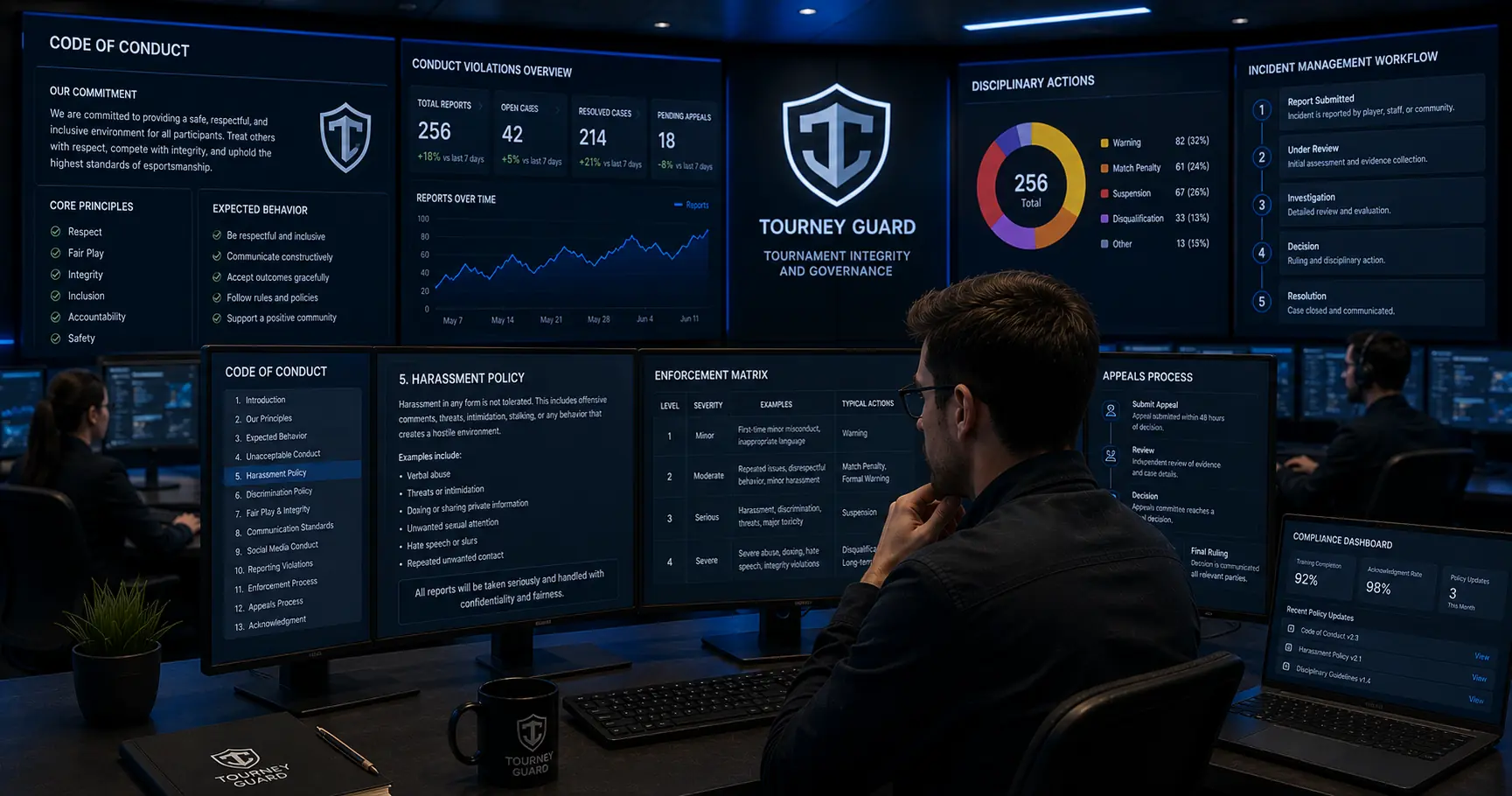
Section 12 — Enforcement Matrix
A structured enforcement framework improves consistency.
Level 1 — Minor Conduct Violations
Examples:
- Minor inappropriate language
- Low-level unsportsmanlike behavior
- First-time procedural misconduct
Typical penalties:
- Verbal warning
- Written warning
Level 2 — Moderate Conduct Violations
Examples:
- Repeated misconduct
- Hostile communication
- Disruptive behavior
Typical penalties:
- Match penalties
- Temporary restrictions
- Formal disciplinary action
Level 3 — Serious Conduct Violations
Examples:
- Harassment
- Discrimination
- Severe abuse
- Repeated violations
Typical penalties:
- Suspension
- Tournament disqualification
Level 4 — Severe Community Safety Violations
Examples:
- Threats
- Doxxing
- Targeted harassment campaigns
- Fraudulent conduct
Typical penalties:
- Immediate disqualification
- Long-term suspension
- Permanent ban
Section 13 — Appeals Process
Participants should have the ability to challenge significant disciplinary actions.
Appealable Decisions
Examples:
- Suspensions
- Disqualifications
- Major sanctions
Minor warnings may not be eligible.
Appeal Requirements
Appeals should include:
- Original decision
- Reason for appeal
- Supporting evidence
- Requested review
Appeal Timeline
Example:
Appeals must be submitted within 48 hours of notification.
Organizers should define timelines clearly.
Independent Review
Appeals should be reviewed by individuals not directly involved in the original decision whenever possible.
This improves fairness and confidence.
Common Code of Conduct Scenarios
Scenario 1 — In-Game Harassment
A player repeatedly insults an opponent during a match.
Response:
- Collect evidence
- Review communications
- Apply conduct policy
- Issue appropriate penalty
Scenario 2 — Social Media Abuse
A participant launches a harassment campaign against another player after a tournament.
Response:
- Determine tournament relevance
- Review evidence
- Evaluate impact
- Apply conduct policies
Scenario 3 — Referee Abuse
A participant verbally attacks tournament officials after a ruling.
Response:
- Document behavior
- Review conduct standards
- Apply enforcement procedures
Scenario 4 — Discriminatory Remarks
A player uses discriminatory language in tournament communications.
Response:
- Immediate investigation
- Evidence review
- Severity assessment
- Escalated disciplinary action
Most professional tournaments treat such violations as serious offenses.
Best Practices for Code of Conduct Enforcement
Educate Before Enforcement
Participants should understand expectations before competition begins.
Consider:
- Pre-tournament briefings
- Rule acknowledgments
- Published conduct standards
Be Consistent
Consistency is critical.
Similar conduct should receive similar responses.
Inconsistent enforcement damages trust.
Document Everything
Maintain records of:
- Reports
- Investigations
- Decisions
- Appeals
Documentation strengthens governance and improves future decision-making.
Focus on Behavior, Not Individuals
Investigations should evaluate:
- Actions
- Evidence
- Policy violations
Avoid decisions based on popularity, reputation, or personal opinions.
Protect Community Trust
The ultimate goal of a Code of Conduct is not punishment.
The goal is maintaining a competitive environment that is:
- Fair
- Safe
- Respectful
- Professional
These principles directly support Tournament Integrity and long-term community growth.
Code of Conduct Governance KPIs
A Code of Conduct should not simply exist as a document. Tournament organizers should measure whether it is effectively improving participant behavior, community health, and tournament governance.
Conduct Incident Rate
Measures:
(Number of Conduct Reports ÷ Number of Participants) × 100
This KPI helps identify:
- Community health issues
- Tournament culture concerns
- Areas requiring additional participant education
Harassment Incident Rate
Measures the frequency of:
- Harassment reports
- Abuse reports
- Targeted misconduct cases
Tracking this metric helps organizers identify emerging community risks.
Repeat Offender Rate
Measures:
Percentage of participants involved in multiple conduct violations.
A high rate may indicate:
- Weak enforcement
- Insufficient participant education
- Ineffective penalties
Appeal Rate
Measures:
Percentage of disciplinary decisions that are appealed.
High appeal rates may indicate:
- Unclear conduct standards
- Inconsistent enforcement
- Poor communication of decisions
Appeal Reversal Rate
Measures:
Percentage of appealed decisions that are overturned.
This KPI helps evaluate investigation quality and enforcement consistency.
Resolution Time
Measures:
Average time between report submission and final decision.
Faster resolutions improve trust and operational efficiency.
Community Safety Indicators
Track incidents involving:
- Harassment
- Discrimination
- Threats
- Doxxing
- Community abuse
These indicators provide valuable insight into the overall health of the tournament environment.
Code of Conduct Checklist
Before publishing a Code of Conduct, verify the following:
✓ Expected behavior is clearly defined
✓ Prohibited behavior is documented
✓ Anti-harassment policy exists
✓ Anti-discrimination policy exists
✓ Sportsmanship expectations are defined
✓ Competitive integrity expectations are included
✓ Social media conduct is addressed
✓ Staff conduct standards are documented
✓ Reporting procedures are available
✓ Investigation procedures are documented
✓ Evidence requirements are defined
✓ Penalty framework exists
✓ Appeals process is documented
✓ Confidentiality standards are defined
✓ Conflict of interest policy exists
✓ Conduct standards use plain language
✓ Participants can easily access the document
✓ Staff members are trained on enforcement procedures
✓ Governance procedures support consistent decision-making
✓ Tournament integrity principles are reflected throughout the policy
Frequently Asked Questions
1. What is the purpose of a Code of Conduct in esports tournaments?
A Code of Conduct establishes behavioral expectations for participants, staff, and community members. It promotes respectful interactions, protects participant safety, supports fair competition, and provides tournament organizers with a framework for investigating and addressing misconduct consistently.
2. How is a Code of Conduct different from tournament rules?
Tournament rules primarily govern competition procedures, match operations, and competitive requirements. A Code of Conduct focuses on participant behavior, community standards, sportsmanship, harassment prevention, professional conduct, and respectful interactions.
3. Should social media behavior be covered by a tournament Code of Conduct?
In many cases, yes. When social media activity directly impacts tournament participants, tournament operations, community safety, or tournament reputation, organizers may need authority to investigate and address misconduct occurring outside the game environment.
4. Who should be covered by a tournament Code of Conduct?
A comprehensive Code of Conduct should apply to players, coaches, managers, tournament officials, referees, casters, analysts, staff members, contractors, and any other individuals participating in official tournament activities.
5. How should Code of Conduct violations be investigated?
Investigations should follow a documented process involving report intake, evidence collection, fact verification, policy review, decision-making, documentation, and appeals when applicable. Consistent procedures help improve fairness and transparency.
Conclusion
A Code of Conduct for Esports Tournaments is one of the most important tools available to tournament organizers seeking to build professional, respectful, and trustworthy competitive environments.
Strong conduct policies help establish clear expectations, protect participants, support community health, and strengthen tournament governance. They also provide administrators with the structure necessary to investigate misconduct consistently and apply disciplinary actions fairly.
The most successful esports tournaments recognize that competitive integrity extends beyond gameplay. It includes how participants interact with opponents, staff, sponsors, and the broader community. By implementing a comprehensive Code of Conduct, organizers create environments where competition remains fair, professional, and welcoming to all participants.
As esports continues to grow, effective conduct management will remain a fundamental component of tournament integrity and long-term community success.
Strengthen Conduct Enforcement Beyond Written Policies
Creating a Code of Conduct is an essential step, but consistently enforcing behavioral standards becomes increasingly challenging as tournaments scale. Reports may arrive through multiple channels, evidence can become scattered across platforms, investigations require coordination between staff members, and disciplinary decisions must remain consistent over time.
Many organizers initially manage conduct cases through spreadsheets, chat logs, email threads, and manual documentation. As tournament operations grow, these fragmented processes can create inconsistencies, incomplete records, and limited auditability.
Tourney Guard helps tournament organizers operationalize conduct governance through structured incident management, evidence management, administrative investigations, disciplinary tracking, and tournament integrity workflows. By centralizing conduct-related processes, organizers can improve consistency, documentation quality, and transparency across their tournaments.
If you want to apply the governance practices discussed in this guide more effectively, explore how Tourney Guard can support your tournament administration and integrity operations.
👉 Start Your 30-Day Free Trial →
Related Articles (Internal Link Strategy)
Pillar Pages
- Tournament Integrity Guide
- Tournament Governance Framework
- Tournament Administration Guide
- Tournament Rules and Regulations Guide
- Competitive Integrity in Esports
Supporting Articles
- How to Write Tournament Rules
- Tournament Rulebook Template
- Fair Play Policy Template
- Harassment Policy for Esports Events
- Incident Management for Tournament Organizers
- Tournament Appeals Process Guide
- Rules Enforcement Best Practices
- Evidence Collection Checklist
- How to Investigate Tournament Incidents
- Competitive Integrity Violations Explained
Recommended External Resources
These organizations publish guidance that supports professional Tournament Integrity programs:
- Esports Integrity Commission (ESIC) – Standards, codes of conduct, investigations, and integrity initiatives.
- International Olympic Committee (IOC) – Integrity frameworks applicable to competitive sports governance.
- International Betting Integrity Association (IBIA) – Best practices for integrity monitoring.
- NIST Cybersecurity Framework – Guidance for security governance and risk management.
- ISO 37301 Compliance Management Systems – International compliance management principles.
- World Anti-Doping Agency (WADA) – Governance and disciplinary process principles applicable beyond traditional sports.
Suggested Internal Links
Strengthen your internal linking strategy by connecting this article with: