Introduction
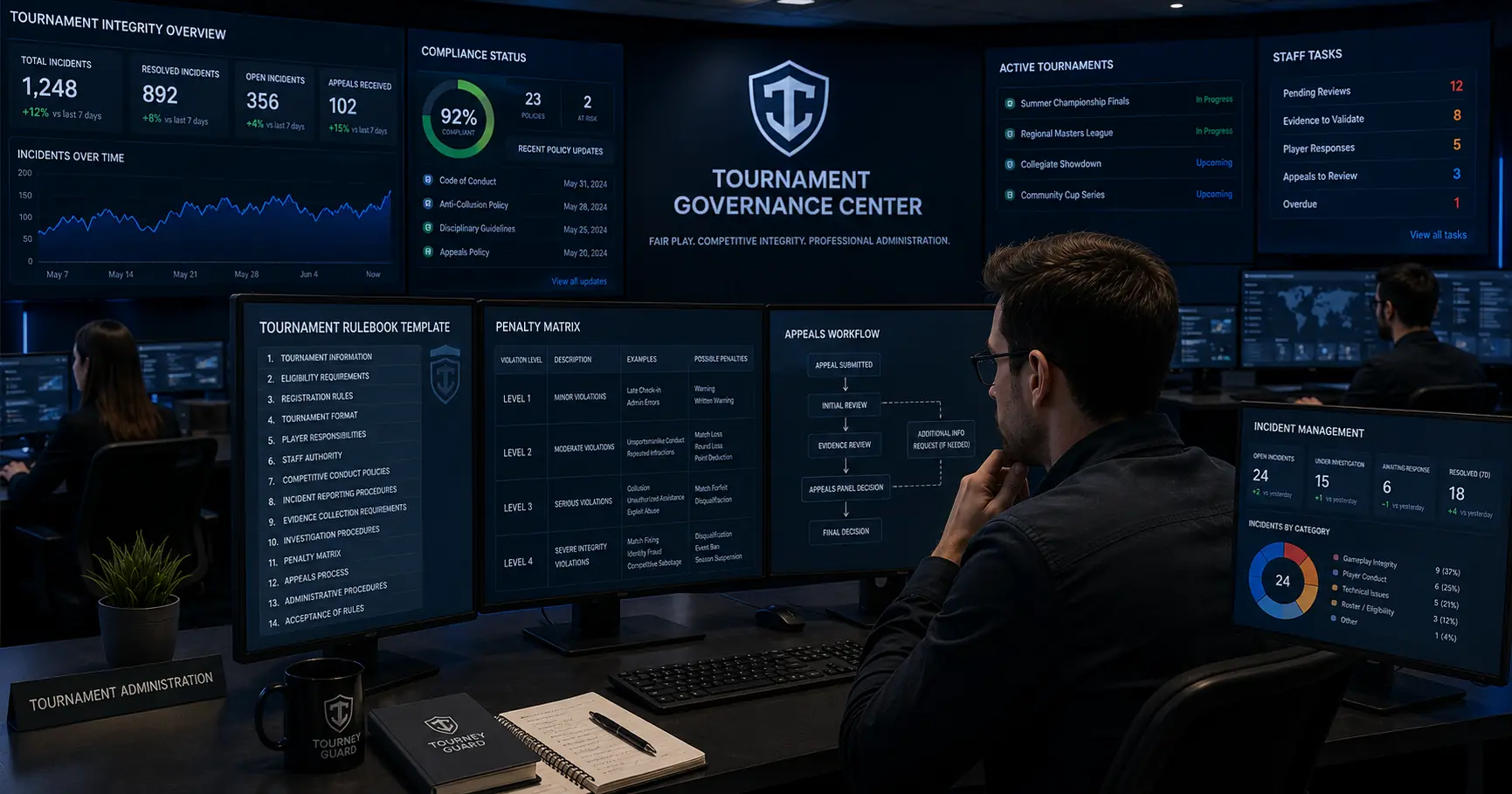
A Tournament Rulebook Template is one of the most valuable resources a tournament organizer can have when building competitions that are fair, transparent, and professionally managed.
Many tournament disputes, player complaints, appeals, and administrative challenges occur not because participants intentionally break rules, but because the rules themselves are incomplete, unclear, or inconsistently applied. A well-designed rulebook establishes expectations before competition begins and provides tournament officials with a framework for making consistent decisions when incidents occur.
Whether you are organizing a community tournament, collegiate competition, esports league, amateur championship, or professional event, a structured tournament rulebook helps protect competitive integrity, improve tournament administration, reduce disputes, and create trust among players, staff, sponsors, and spectators.
This guide provides a complete Tournament Rulebook Template that organizers can adapt to their own competitions. In addition to the template itself, we will explain why each section exists, how it supports tournament governance, and how it contributes to stronger rules enforcement, incident management, and appeals processes.
What Is a Tournament Rulebook Template?
A Tournament Rulebook Template is a structured framework used to create tournament-specific rules and governance policies.
Instead of writing rules from scratch every time a competition is organized, tournament administrators can use a standardized template containing the core sections required for professional tournament governance.
A complete rulebook typically includes:
- Tournament information
- Eligibility requirements
- Registration rules
- Competition format
- Player responsibilities
- Staff authority
- Conduct policies
- Incident reporting procedures
- Investigation procedures
- Penalty systems
- Appeals processes
The template serves as the foundation upon which organizers build tournament-specific requirements.
Why Tournament Rulebooks Matter
For Players
Players need confidence that competitions are administered fairly.
A clear rulebook provides:
- Transparency
- Predictability
- Equal treatment
- Consistent enforcement
Participants are more likely to trust tournament officials when decisions can be traced back to documented rules.
For Tournament Organizers
Tournament organizers rely on rulebooks to:
- Reduce disputes
- Standardize decisions
- Improve staff consistency
- Protect tournament reputation
- Scale operations
As tournaments grow, informal rules become increasingly difficult to manage.
For Tournament Officials
Referees, administrators, and tournament integrity personnel need documented procedures for:
- Investigations
- Evidence review
- Penalty decisions
- Appeals
Without documented procedures, rulings become inconsistent.
For Sponsors and Partners
Sponsors prefer tournaments that demonstrate professional governance.
Strong rulebooks signal:
- Operational maturity
- Risk management
- Competitive fairness
- Professional administration
Core Principles of an Effective Tournament Rulebook
Before reviewing the template, organizers should understand the principles behind effective tournament governance.
Clarity
Rules should be easily understood.
Avoid:
- Legal jargon
- Ambiguous wording
- Complex sentences
Participants should immediately understand their responsibilities.
Consistency
Rules should produce predictable outcomes.
Similar incidents should result in similar decisions.
Consistency strengthens trust.
Enforceability
Every rule should be enforceable.
Before adding a rule, ask:
- Can violations be detected?
- Can evidence be collected?
- Can investigations be conducted?
- Can penalties be applied fairly?
If not, the rule may create more problems than solutions.
Transparency
Players should understand:
- How incidents are reported
- How investigations occur
- How penalties are determined
- How appeals are reviewed
Transparency reduces disputes and improves confidence in tournament administration.
Tournament Rulebook Template
1. Tournament Information
Tournament Name
[Insert Tournament Name]
Organizer
[Insert Organization Name]
Tournament Version
Version: [Number]
Publication Date: [Date]
Effective Date: [Date]
Official Communication Channels
- Website
- Discord
- Tournament Platform
Governing Authority
The Tournament Administration Team has authority to interpret and enforce tournament rules.
2. Eligibility Requirements
Player Eligibility
Participants must:
- Meet minimum age requirements
- Comply with regional restrictions
- Use personal accounts
- Complete registration requirements
Team Eligibility
Teams must:
- Maintain eligible rosters
- Meet roster deadlines
- Comply with tournament requirements
Organizer Rights
Tournament organizers reserve the right to deny participation to individuals who violate tournament policies.
3. Registration Rules
Registration Process
Participants must:
- Complete registration forms
- Submit required information
- Accept tournament rules
Registration Deadlines
Registration closes on:
[Insert Date]
Check-In Requirements
Participants must complete check-in procedures before competition begins.
Failure to check in may result in removal from the tournament.
4. Tournament Format
Competition Structure
Example:
- Single Elimination
- Double Elimination
- Swiss Format
- Round Robin
Match Format
Example:
- Best of 1
- Best of 3
- Best of 5
Seeding Process
Explain:
- Random seeding
- Ranking-based seeding
- Qualification-based seeding
Tiebreakers
Document all tiebreaking procedures.
5. Player Responsibilities
Participants are responsible for:
- Arriving on time
- Maintaining communication
- Following tournament instructions
- Competing fairly
- Reporting incidents when necessary
Players must comply with all tournament policies throughout the event.
6. Tournament Staff Authority
Tournament staff may:
- Investigate incidents
- Request evidence
- Apply penalties
- Interpret tournament rules
- Resolve disputes
All decisions should follow documented procedures whenever possible.
7. Competitive Conduct Policies
This section protects Competitive Integrity and Fair Play by defining prohibited behaviors and participant expectations.
7.1 Fair Play Requirement
All participants must compete honestly and fairly.
Any action that intentionally compromises competitive fairness may result in penalties.
7.2 Prohibited Conduct
Match Fixing
Participants may not intentionally manipulate match outcomes.
Examples:
- Intentionally losing
- Arranging outcomes
- Coordinating results with opponents
Recommended Penalty: Disqualification and potential suspension.
Collusion
Participants may not cooperate with opponents to gain an unfair advantage.
Examples:
- Coordinated gameplay
- Shared strategies during restricted periods
- Manipulation of standings
Recommended Penalty: Match loss, disqualification, or suspension depending on severity.
Unauthorized Assistance
Participants may not receive outside assistance during competition.
Examples:
- Coaching during live matches
- Real-time strategic advice
- External communication regarding active matches
Recommended Penalty: Warning, match loss, or disqualification.
Exploitation
Participants may not intentionally abuse bugs, glitches, or unintended game mechanics.
Examples:
- Known game-breaking exploits
- Map exploits
- Score manipulation exploits
Recommended Penalty: Match loss or disqualification.
Harassment and Abuse
Participants must treat all individuals respectfully.
Prohibited behavior includes:
- Personal attacks
- Threats
- Discriminatory remarks
- Targeted harassment
Recommended Penalty: Warning, suspension, or disqualification.
Impersonation
Participants may not impersonate:
- Other players
- Tournament staff
- Organizers
Recommended Penalty: Immediate disqualification.
8. Incident Reporting Procedures
A formal incident reporting process improves consistency and supports administrative investigations.
Who May Submit Reports
Reports may be submitted by:
- Players
- Team managers
- Coaches
- Referees
- Tournament administrators
Reporting Deadline
Incident reports must be submitted within:
[Insert Time Limit]
Example:
Within 30 minutes after match completion.
Required Information
Reports should include:
- Reporter name
- Match identifier
- Description of incident
- Supporting evidence
- Relevant timestamps
Incomplete reports may be rejected.
Report Review Process
Every report should receive:
- Initial review
- Evidence assessment
- Investigation decision
- Final ruling
9. Evidence Collection Requirements
Tournament investigations should be evidence-based.
Acceptable Evidence
Examples include:
- Screenshots
- Match recordings
- Broadcast footage
- Referee observations
- Platform logs
- Communication records
- Tournament system records
Evidence Standards
Evidence should be:
- Relevant
- Authentic
- Verifiable
- Complete
Evidence Retention
Tournament organizers should retain evidence for:
[Insert Duration]
Recommended:
- 30 days for small tournaments
- 90–180 days for leagues
- Longer periods for major events
Evidence Ownership
Tournament organizers reserve the right to store and review evidence submitted during investigations.
10. Investigation Procedures
This section establishes the administrative investigation framework.
Investigation Initiation
Investigations may begin through:
- Incident reports
- Referee observations
- Administrative review
- Tournament monitoring
Investigation Workflow
Step 1 — Case Creation
Create an incident record containing:
- Incident ID
- Date
- Reporter
- Summary
Step 2 — Evidence Collection
Gather:
- Screenshots
- Match footage
- Statements
- Logs
Step 3 — Fact Review
Investigators determine:
- What occurred
- Timeline of events
- Applicable rules
Step 4 — Rule Assessment
Identify:
- Applicable policies
- Severity level
- Relevant precedents
Step 5 — Decision
Possible outcomes:
- No violation found
- Warning
- Match penalty
- Disqualification
- Suspension
Step 6 — Documentation
Document:
- Findings
- Evidence reviewed
- Rules applied
- Final decision
11. Penalty Matrix
A documented penalty system improves consistency.
Level 1 — Minor Violations
Examples:
- Late check-in
- Administrative errors
- Minor procedural violations
Possible penalties:
- Verbal warning
- Written warning
Level 2 — Moderate Violations
Examples:
- Repeated misconduct
- Failure to follow tournament instructions
- Unsportsmanlike conduct
Possible penalties:
- Match penalty
- Round loss
- Point deduction
Level 3 — Serious Violations
Examples:
- Collusion
- Unauthorized assistance
- Significant disruption
Possible penalties:
- Match forfeit
- Tournament disqualification
Level 4 — Severe Integrity Violations
Examples:
- Match fixing
- Fraud
- Identity falsification
- Deliberate competitive sabotage
Possible penalties:
- Immediate disqualification
- Event ban
- Seasonal suspension
12. Appeals Process
A structured appeals process improves transparency and trust.
Appeal Eligibility
Participants may appeal:
- Disqualifications
- Suspensions
- Major penalties
Minor administrative decisions may not be appealable.
Appeal Submission Deadline
Appeals must be submitted within:
[Insert Time Limit]
Example:
24 hours after the decision.
Appeal Requirements
Appeals should include:
- Participant information
- Original ruling
- Reason for appeal
- Supporting evidence
Appeal Review Process
Stage 1
Administrative review.
Stage 2
Independent review of evidence.
Stage 3
Final determination.
Final Decision Authority
The final decision rests with:
[Insert Authority]
Examples:
- Head Tournament Administrator
- Appeals Committee
- Tournament Integrity Panel
13. Administrative Procedures
Rule Interpretation
Tournament organizers retain authority to interpret tournament rules.
Interpretations should remain consistent with:
- Tournament objectives
- Competitive integrity principles
- Fair play standards
Emergency Decisions
Organizers may issue temporary rulings when unforeseen situations occur.
Such decisions should be documented and communicated to participants.
Rule Updates
Tournament rules may only be modified by authorized personnel.
Updates should include:
- Version number
- Change summary
- Effective date
Communication of Decisions
Tournament decisions should be communicated through official channels.
Examples:
- Tournament platform
- Discord
- Official website
14. Acceptance of Rules
By participating in the tournament, participants acknowledge that they:
- Have read the rulebook
- Understand tournament policies
- Agree to comply with tournament procedures
- Accept tournament authority and enforcement mechanisms
Tournament Rulebook Governance Note
A rulebook should not be viewed as a static document.
It should evolve after every tournament based on:
- Incident trends
- Appeals data
- Investigation outcomes
- Staff feedback
- Participant feedback
- Competitive integrity reviews
The most effective tournament organizers treat their rulebook as a living governance framework rather than a one-time document.
Tournament Rulebook Best Practices
A tournament rulebook is not simply a compliance document. It is the operational foundation of tournament governance, competitive integrity, incident management, and administrative decision-making.
The following best practices help organizers create rulebooks that remain effective as tournaments scale.
Write for Players First
Many organizers write rulebooks as if they are internal administrative documents.
The primary audience should always be participants.
Good rulebooks answer:
- What am I allowed to do?
- What am I not allowed to do?
- What happens if I violate a rule?
- How do I report an issue?
- How can I appeal a decision?
If participants cannot easily answer these questions, the rulebook requires improvement.
Define Every Critical Term
Commonly misunderstood terms should be explicitly defined.
Examples:
- Competitive Integrity
- Match Fixing
- Collusion
- Harassment
- Exploitation
- Unauthorized Assistance
- Tournament Official
- Appeals Committee
Definitions reduce ambiguity and improve enforcement consistency.
Use a Standardized Penalty Framework
Penalties should not be created on the spot.
A documented framework helps ensure:
- Fairness
- Predictability
- Consistency
- Transparency
This becomes increasingly important in recurring leagues and large tournaments.
Document Investigation Procedures
Many rulebooks explain violations but fail to explain how incidents are investigated.
Investigation procedures should define:
- Evidence requirements
- Investigation authority
- Review standards
- Decision-making process
This strengthens tournament legitimacy.
Review the Rulebook After Every Event
Every tournament creates new operational lessons.
Review:
- Appeals
- Incident reports
- Staff feedback
- Participant feedback
- Enforcement decisions
Continuous improvement strengthens governance over time.
Common Tournament Rulebook Mistakes
Mistake #1 — Using Generic Templates Without Customization
Templates are starting points.
Every tournament has unique:
- Risks
- Participants
- Formats
- Operational challenges
Templates should always be adapted.
Mistake #2 — Missing Incident Procedures
Many rulebooks describe prohibited behavior but fail to explain:
- How incidents are reported
- Who investigates
- What evidence is required
This creates administrative confusion.
Mistake #3 — No Appeals Process
A rulebook without appeals often creates distrust.
Even when decisions are correct, an appeals process strengthens confidence in tournament governance.
Mistake #4 — Excessive Complexity
Longer does not mean better.
Some organizers attempt to anticipate every possible situation.
The result is often:
- Confusing language
- Contradictory rules
- Low participant engagement
Clarity should always take priority.
Mistake #5 — No Version Control
Tournament rulebooks should always include:
- Version number
- Publication date
- Effective date
- Revision history
Without version control, disputes may arise regarding which rules apply.
Rulebook Maintenance Framework
Professional tournament organizers should treat their rulebook like a living governance document.
A recommended review cycle includes:
Before Tournament
- Review rules
- Validate procedures
- Update references
During Tournament
Track:
- Incident frequency
- Appeals
- Administrative challenges
After Tournament
Conduct a governance review.
Questions to ask:
- Which rules caused confusion?
- Which incidents occurred repeatedly?
- Which appeals revealed weaknesses?
- Which procedures slowed investigations?
The answers should guide future revisions.
Tournament Rulebook KPIs
Organizations that want to improve tournament governance should monitor measurable indicators.
Incident Frequency
Measures:
Number of reported incidents per tournament.
Helps identify:
- Policy weaknesses
- Operational risks
- Competitive integrity concerns
Appeal Rate
Measures:
Percentage of decisions that are appealed.
High appeal rates may indicate:
- Poor communication
- Ambiguous rules
- Inconsistent enforcement
Appeal Success Rate
Measures:
Percentage of appealed decisions that are overturned.
This KPI can reveal weaknesses in investigations or enforcement procedures.
Average Investigation Time
Measures:
Time between incident submission and final decision.
Faster investigations improve tournament operations and participant confidence.
Repeat Violation Rate
Measures:
Percentage of participants who commit multiple violations.
High rates may indicate ineffective penalties or poor participant education.
Rules Acknowledgment Rate
Measures:
Percentage of participants who confirm they have read tournament rules.
This KPI helps evaluate rulebook visibility and accessibility.
Tournament Rulebook Checklist
Before publishing your rulebook, verify the following:
✓ Tournament information is complete
✓ Eligibility requirements are documented
✓ Registration procedures are defined
✓ Tournament format is explained
✓ Player responsibilities are documented
✓ Staff authority is defined
✓ Competitive conduct rules are included
✓ Incident reporting procedures exist
✓ Evidence requirements are documented
✓ Investigation procedures are defined
✓ Penalty matrix is included
✓ Appeals process is documented
✓ Critical terms are defined
✓ Rulebook version number exists
✓ Revision history exists
✓ Rules are written in plain language
✓ Staff reviewed the document
✓ Participants can access the latest version
✓ Governance procedures are enforceable
✓ Tournament integrity principles are reflected throughout the rulebook
Frequently Asked Questions
1. What should every tournament rulebook include?
Every tournament rulebook should include eligibility requirements, registration procedures, tournament format, player responsibilities, staff authority, conduct policies, incident reporting procedures, investigation processes, penalties, and appeals mechanisms. These sections provide the governance framework required for consistent tournament administration.
2. Can I use the same rulebook for every tournament?
A standard template can be reused, but each tournament should customize the document to reflect its specific format, game, audience, operational risks, and competition structure. Templates provide consistency, but customization ensures relevance.
3. How often should a tournament rulebook be updated?
Rulebooks should be reviewed after every major tournament. Incident trends, appeals, enforcement challenges, and participant feedback often reveal areas where rules can be improved or clarified.
4. Why are investigation procedures important?
Investigation procedures ensure that tournament decisions are based on evidence rather than assumptions. They help create consistent outcomes, improve transparency, and strengthen confidence in tournament governance.
5. Should tournament rulebooks include an appeals process?
Yes. Appeals provide participants with a structured mechanism for requesting review of major decisions. Appeals strengthen accountability, improve trust, and contribute to more transparent tournament administration.
Conclusion
A Tournament Rulebook Template provides far more than a convenient document structure. It establishes the governance framework that supports fair competition, tournament administration, competitive integrity, incident management, and rules enforcement.
The most successful tournaments are rarely those with the most complicated rules. They are the tournaments with the clearest expectations, the most consistent enforcement, and the strongest administrative processes.
By implementing a structured rulebook template, organizers can improve participant trust, reduce disputes, streamline investigations, and create scalable governance systems capable of supporting tournaments of any size.
Whether managing a local competition or a professional esports league, a well-designed tournament rulebook remains one of the most important tools available to tournament organizers.
Build Consistent Governance Beyond the Rulebook
Creating a Tournament Rulebook Template is an important first step, but maintaining consistent governance throughout a tournament presents additional operational challenges. Incident reports, evidence collection, investigations, enforcement actions, and appeals can quickly become difficult to manage as participation grows.
Many organizers initially rely on spreadsheets, chat messages, shared drives, and manual documentation. Over time, these disconnected processes can create inconsistencies, missing records, limited audit trails, and administrative inefficiencies.
Tourney Guard helps tournament organizers operationalize the governance framework defined in their rulebooks through tournament administration workflows, incident management, evidence management, administrative investigations, and competitive integrity processes. Instead of relying on fragmented tools, organizers can manage governance activities through structured and documented workflows designed specifically for tournament operations.
If you are looking to apply the best practices outlined in this guide consistently across your events, explore how Tourney Guard can help support your tournament governance processes.
👉 Start Your 30-Day Free Trial →
Recommended External Resources
These organizations publish guidance that supports professional Tournament Integrity programs:
- Esports Integrity Commission (ESIC) – Standards, codes of conduct, investigations, and integrity initiatives.
- International Olympic Committee (IOC) – Integrity frameworks applicable to competitive sports governance.
- International Betting Integrity Association (IBIA) – Best practices for integrity monitoring.
- NIST Cybersecurity Framework – Guidance for security governance and risk management.
- ISO 37301 Compliance Management Systems – International compliance management principles.
- World Anti-Doping Agency (WADA) – Governance and disciplinary process principles applicable beyond traditional sports.
Suggested Internal Links
Strengthen your internal linking strategy by connecting this article with: