Introduction
Incident Severity Levels provide tournament organizers with a structured framework for evaluating how serious an incident is before determining an appropriate response. Instead of relying on subjective opinions or inconsistent judgments, severity levels help ensure that every investigation follows transparent, repeatable, and fair administrative procedures.
Whether an incident involves unsportsmanlike conduct, rule violations, match disruptions, eligibility issues, or evidence tampering, correctly classifying its severity is essential for maintaining Tournament Integrity. Poor classification can lead to disproportionate penalties, inconsistent rulings, player dissatisfaction, appeals, and even reputational damage for tournament organizers.
As esports continues to professionalize, tournaments of every size—from community competitions to international championships—are expected to demonstrate consistent governance practices. One of the most important building blocks of that governance is a clearly defined incident severity model.
This guide explains how severity levels work, why they matter, how they should be applied, common mistakes to avoid, and how tournament administration platforms can standardize the entire process.
What Are Incident Severity Levels?
Incident Severity Levels are predefined categories that measure the operational and competitive impact of an incident.
Rather than describing what happened, severity levels describe how serious the consequences are and how urgently organizers should respond.
This distinction is important.
Two incidents may involve the same rule violation but require different responses depending on factors such as:
- Competitive impact
- Intentional versus accidental behavior
- Match outcome influence
- Scope of affected participants
- Evidence quality
- Risk to tournament integrity
- Previous disciplinary history
Severity levels help tournament officials evaluate incidents consistently regardless of who performs the investigation.
Instead of subjective decisions such as:
“This feels serious.”
Officials can rely on standardized criteria such as:
- Competitive damage
- Operational disruption
- Integrity risk
- Reputational impact
- Required response time
This creates a much more predictable governance process.
Why Incident Severity Levels Matter
Severity classification influences nearly every administrative decision made during a tournament.
Without standardized classifications, similar incidents may receive entirely different penalties depending on who investigates them.
That inconsistency quickly undermines confidence in tournament governance.
For Players
Players expect equal treatment.
A transparent severity framework ensures that similar violations receive similar administrative responses regardless of team popularity, tournament stage, or individual reputation.
Consistency strengthens trust.
For Tournament Organizers
Organizers benefit from:
- Faster investigations
- Consistent rulings
- Better documentation
- Reduced administrative uncertainty
- Easier policy enforcement
Instead of debating every incident from scratch, officials can reference predefined severity criteria.
For Tournament Staff
Referees, moderators, investigators, and administrators often work across multiple matches simultaneously.
Severity levels provide a shared language that allows staff members to communicate efficiently.
For example:
“This appears to be a Level 3 incident requiring immediate investigation.”
Everyone immediately understands the expected response.
For Sponsors
Sponsors invest in competitions that demonstrate professionalism.
Transparent governance frameworks reduce reputational risks associated with controversial decisions.
Well-documented severity classifications also provide evidence that organizers follow objective procedures rather than arbitrary judgment.
For the Community
Communities are more likely to trust tournament decisions when organizers explain not only what penalty was applied, but also why the incident reached a particular severity level.
Transparency reduces speculation.
Core Principles of Incident Severity Classification
A good severity model is not based solely on rule violations.
Instead, it evaluates incidents through multiple governance principles.
Principle 1: Impact Over Appearance
Some incidents appear dramatic but have little competitive impact.
Others seem minor but fundamentally alter tournament outcomes.
Severity should measure consequences—not emotions.
For example:
- A heated argument in chat may generate attention but have limited competitive consequences.
- A hidden roster substitution may quietly invalidate an entire tournament bracket.
The second incident is generally more severe.
Principle 2: Consistency
The same incident should receive the same classification regardless of:
- Tournament size
- Prize pool
- Player popularity
- Staff member investigating
- Public attention
Consistency is one of the strongest indicators of mature tournament governance.
Principle 3: Evidence-Based Decisions
Severity should never be determined by assumptions.
Officials should evaluate:
- Match recordings
- Screenshots
- Tournament logs
- Official reports
- Referee observations
- Communication records
- Witness statements
Higher-quality evidence leads to more reliable classifications.
Principle 4: Proportionality
Administrative responses should match incident severity.
Minor operational mistakes should not receive severe disciplinary penalties.
Likewise, incidents threatening competitive integrity should not receive symbolic warnings.
Balanced governance requires proportional responses.
Principle 5: Transparency
Players should understand:
- Why an incident received its classification
- Which rules were applied
- Which evidence supported the decision
- Which appeal options remain available
Transparent reasoning significantly reduces unnecessary disputes.
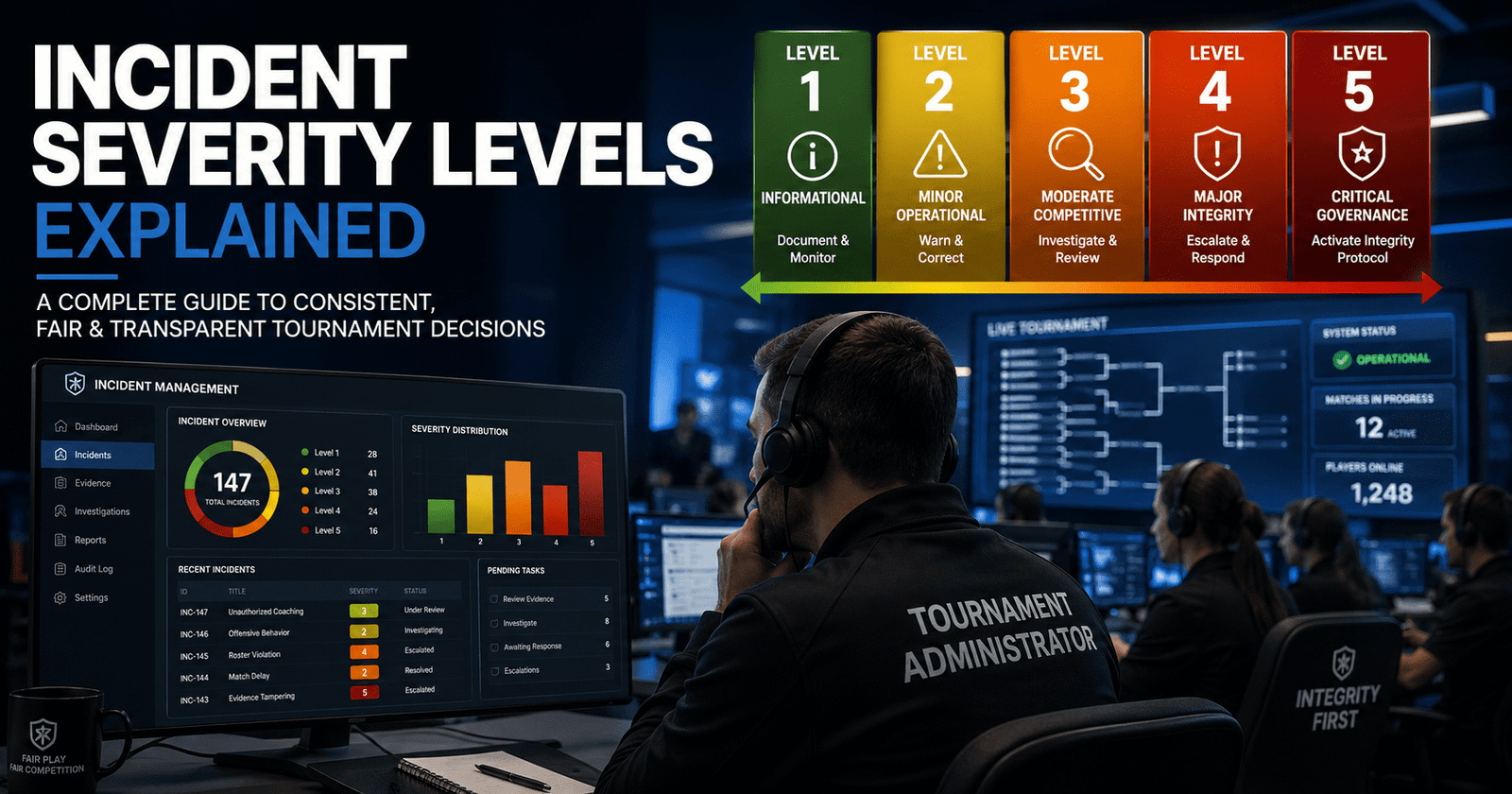
A Five-Level Incident Severity Framework
Although every tournament may customize its governance policies, many organizers adopt a five-level severity model because it balances simplicity with sufficient administrative detail.
Level 1 — Informational Incidents
These incidents require documentation but typically do not affect tournament integrity.
Examples include:
- Minor procedural misunderstandings
- Administrative reminders
- Incorrect registration details corrected before play
- Low-impact communication issues
Typical response:
- Documentation
- No disciplinary action
- Internal monitoring
Level 2 — Minor Operational Violations
These incidents involve rule violations with limited competitive impact.
Examples include:
- Late check-in
- Minor lobby delays
- Equipment setup violations
- Small procedural infractions
Possible responses:
- Official warning
- Time adjustment
- Administrative correction
- Educational feedback
Level 3 — Moderate Competitive Incidents
These incidents begin affecting competitive fairness and require formal investigation.
Examples include:
- Unsportsmanlike conduct
- Repeated rule violations
- Unauthorized coaching
- Moderate evidence disputes
- Failure to follow tournament procedures
Typical administrative actions include:
- Formal investigation
- Evidence review
- Temporary competitive restrictions
- Escalation to tournament administrators
Level 4 — Major Integrity Incidents
These incidents threaten competitive integrity and require immediate administrative attention.
Examples include:
- Match manipulation attempts
- Identity fraud
- Intentional roster deception
- Serious evidence tampering
- Coordinated rule violations
These cases often involve multiple investigators and comprehensive documentation.
Level 5 — Critical Governance Incidents
The highest severity level represents incidents capable of compromising the tournament itself.
Examples include:
- Organized cheating conspiracies
- Widespread match-fixing
- Systematic evidence destruction
- Large-scale tournament fraud
- Major governance failures
These incidents frequently require:
- Immediate escalation
- Senior administrator involvement
- Full evidence preservation
- Public communication planning
- Appeals preparation
- Post-incident governance review
Building an Effective Incident Severity Classification Framework
A severity framework is only valuable if tournament staff can apply it consistently under real tournament conditions. The objective is not simply to assign a number to an incident, but to guide investigators through a repeatable decision-making process that minimizes subjectivity.
An effective framework evaluates multiple dimensions before assigning a severity level.
Step 1: Determine the Type of Incident
Before measuring severity, identify the category of the incident.
Examples include:
- Player misconduct
- Rule violations
- Match administration issues
- Technical disputes
- Eligibility violations
- Roster violations
- Evidence-related issues
- Tournament operations failures
- Appeals
- Communication misconduct
Classifying the incident type first prevents unrelated factors from influencing the severity assessment.
Step 2: Evaluate Competitive Impact
The next question should always be:
Did this incident affect competitive fairness?
Ask investigators to consider:
- Did the incident change the outcome of a match?
- Did it create an unfair advantage?
- Were multiple players affected?
- Could tournament standings change?
- Was the integrity of the competition compromised?
Greater competitive impact generally results in higher severity.
Step 3: Evaluate Operational Impact
Some incidents may not directly affect gameplay but can significantly disrupt tournament operations.
Examples include:
- Tournament delays
- Server administration failures
- Broadcast interruptions
- Scheduling conflicts
- Incorrect bracket updates
- Missing official communications
Operational impact should be assessed independently from competitive impact.
Step 4: Evaluate Intent
Intent is one of the most important factors in incident classification.
Consider whether the behavior was:
Accidental
Examples:
- Misunderstanding tournament rules
- Honest administrative mistakes
- Technical errors outside player control
These usually receive lower severity.
Negligent
Examples:
- Ignoring published procedures
- Repeated carelessness
- Failure to follow mandatory tournament requirements
Negligence often justifies a higher classification than accidental mistakes.
Intentional
Examples:
- Deliberate rule violations
- False reporting
- Identity deception
- Match manipulation
- Evidence concealment
Intentional behavior substantially increases incident severity because it directly threatens Tournament Integrity.
Step 5: Evaluate Evidence Confidence
Severity should never exceed the confidence supported by available evidence.
Investigators should classify evidence quality.
For example:
| Evidence Confidence | Description |
|---|---|
| Very High | Multiple independent sources confirm the incident |
| High | Strong direct evidence with minimal uncertainty |
| Medium | Credible evidence requiring additional verification |
| Low | Limited supporting information |
| Very Low | Unverified reports or assumptions |
A critical allegation supported only by weak evidence should remain under investigation until additional information is collected.
Step 6: Consider Previous History
Repeated violations often indicate a pattern of behavior.
Questions include:
- Has the participant received previous warnings?
- Has similar misconduct occurred before?
- Are repeated procedural failures documented?
- Is this a first offense?
Escalation policies should be clearly documented in tournament regulations.
Decision Tree for Severity Classification
Tournament officials can simplify incident classification by following a structured decision tree.
Incident Report Received
           │
           ▼
Does it violate tournament rules?
           │
     ┌─────┴─────┐
     │           │
    No          Yes
     │           │
Document      Assess Impact
                  │
                  ▼
      Competitive Impact?
                  │
          Low / Medium / High
                  │
                  ▼
         Evaluate Intent
                  │
                  ▼
        Review Evidence
                  │
                  ▼
      Assign Severity Level
                  │
                  ▼
 Begin Investigation Workflow
This structured approach helps different officials reach similar conclusions even when working independently.
Practical Classification Scenarios
The following examples illustrate how severity levels can be applied consistently.
Scenario 1: Late Match Check-In
A team arrives three minutes after the scheduled check-in deadline.
Assessment
Competitive Impact:
Low
Intent:
Accidental
Operational Impact:
Minor delay
Evidence:
Confirmed by tournament logs.
Recommended Severity:
Level 2
Reason:
Although tournament procedures were violated, the incident had minimal impact on competitive fairness.
Scenario 2: Unauthorized Player Substitution
A substitute player competes without organizer approval.
Assessment
Competitive Impact:
High
Intent:
Intentional
Evidence:
Roster records and match logs.
Operational Impact:
Significant.
Recommended Severity:
Level 4
Reason:
Roster integrity directly affects competitive legitimacy.
Scenario 3: Offensive Chat During a Match
A player repeatedly insults opponents using prohibited language.
Assessment
Competitive Impact:
Moderate
Operational Impact:
Low
Intent:
Intentional
Evidence:
Chat logs.
Recommended Severity:
Level 3
Reason:
Although gameplay remains unaffected, player conduct impacts tournament professionalism and community standards.
Scenario 4: Evidence Manipulation
A participant edits screenshots before submitting them during an investigation.
Assessment
Competitive Impact:
Potentially High
Operational Impact:
Major
Intent:
Clearly intentional
Evidence:
Metadata comparison confirms alteration.
Recommended Severity:
Level 5
Reason:
Manipulating evidence undermines the integrity of the investigative process itself and threatens trust in tournament governance.
Scenario 5: Temporary Server Outage
A tournament server disconnects for five minutes.
Assessment
Competitive Impact:
Low
Operational Impact:
Moderate
Intent:
None
Evidence:
Infrastructure monitoring.
Recommended Severity:
Level 2
Reason:
The disruption affects operations but does not indicate misconduct.
Operational Workflow After Assigning Severity
Severity classification should immediately trigger predefined administrative workflows.
Level 1 Workflow
- Document incident
- Notify appropriate staff if necessary
- Close report
- Archive records
Level 2 Workflow
- Notify tournament administrator
- Record findings
- Issue warning if applicable
- Monitor for recurrence
Level 3 Workflow
- Assign investigator
- Collect supporting evidence
- Interview involved participants
- Produce investigation report
- Apply administrative decision
Level 4 Workflow
- Escalate to senior tournament officials
- Preserve all available evidence
- Restrict participant actions if necessary
- Conduct formal investigation
- Prepare appeal documentation
Level 5 Workflow
- Activate tournament integrity procedures
- Notify governance leadership
- Secure all digital evidence
- Coordinate investigation team
- Prepare public communication strategy if appropriate
- Complete post-incident review
Common Factors That Increase Severity
Certain conditions justify raising an incident’s severity even when the original violation appears moderate.
Examples include:
- Multiple participants involved
- Repeated misconduct
- Evidence tampering
- False statements during investigations
- Refusal to cooperate
- Attempts to intimidate witnesses
- Significant financial implications
- Match outcome manipulation
- Damage to tournament reputation
These aggravating factors should be explicitly documented in tournament governance policies.
Common Mistakes in Severity Classification
Mistake 1: Equating Rule Violations with Severity
Not every rule violation deserves severe sanctions.
Investigators should evaluate impact rather than assuming all infractions carry equal weight.
Mistake 2: Letting Public Pressure Influence Decisions
Community reactions, social media discussions, or player popularity should never determine incident severity.
Governance decisions must rely on documented evidence and established procedures.
Mistake 3: Skipping Documentation
Assigning a severity level without recording the supporting rationale makes future reviews, audits, and appeals significantly more difficult.
Every classification should include:
- Applicable rule references
- Supporting evidence
- Investigator observations
- Justification for the selected severity level
Mistake 4: Ignoring Context
Two similar incidents may deserve different classifications because of:
- Different competitive consequences
- Different intent
- Different evidence quality
- Different operational impact
Context is essential for fair governance.
Mistake 5: Never Reviewing the Framework
Tournament ecosystems evolve.
New game mechanics, tournament formats, technologies, and emerging misconduct patterns may require updates to severity definitions.
Regular reviews help maintain consistency over time.
Best Practices for Tournament Organizers
Organizations with mature governance programs typically follow these practices:
- Define objective criteria for every severity level.
- Train referees and administrators using realistic case studies.
- Maintain written investigation procedures.
- Document every severity assessment.
- Separate evidence collection from disciplinary decisions whenever possible.
- Conduct periodic reviews to ensure consistent classifications.
- Maintain complete audit trails for future appeals.
- Publish disciplinary guidelines before tournaments begin.
- Analyze historical incidents to improve governance policies.
- Review severity decisions after each major event to identify opportunities for continuous improvement.
How Technology Supports Severity Classification
As tournaments scale, manual incident management becomes increasingly difficult.
Modern Tournament Integrity platforms help organizers standardize severity classification by providing structured workflows instead of relying on spreadsheets or isolated communication channels.
Technology can support the process by enabling:
- Standardized incident intake forms.
- Configurable severity matrices aligned with tournament rules.
- Centralized evidence management.
- Automated investigation workflows.
- Role-based review and approval processes.
- Complete audit trails for every administrative action.
- Historical incident analysis to identify recurring patterns.
- Integrated reporting dashboards for governance performance.
Rather than replacing human judgment, these systems ensure that every investigator follows the same governance framework, improving consistency, transparency, and accountability across tournaments of any size.
KPIs for Measuring Incident Severity Management
A well-designed severity classification framework should be evaluated continuously. Tracking governance metrics allows tournament organizers to identify operational bottlenecks, improve investigation quality, and demonstrate accountability over time.
Below are several Key Performance Indicators (KPIs) that can help measure the effectiveness of incident management processes.
| KPI | Why It Matters |
|---|---|
| Average Incident Classification Time | Measures how quickly incidents are assessed after being reported. |
| Investigation Completion Time | Evaluates the efficiency of the investigation workflow. |
| Percentage of High-Severity Incidents | Helps identify trends and potential integrity risks. |
| Severity Distribution | Reveals whether classifications are balanced or overly concentrated in specific levels. |
| Appeal Rate | Indicates whether participants frequently challenge administrative decisions. |
| Appeal Reversal Rate | Measures the consistency and accuracy of original severity assessments. |
| Repeat Offender Rate | Identifies recurring misconduct requiring policy adjustments. |
| Evidence Completeness Rate | Tracks whether investigations include sufficient supporting documentation. |
| Investigation Documentation Quality | Ensures audit readiness and transparency. |
| Incident Resolution SLA Compliance | Verifies that investigations are completed within defined response times. |
Monitoring these KPIs allows organizers to continuously improve governance practices rather than simply reacting to incidents.
Incident Severity Classification Checklist
Before finalizing a severity level, verify the following:
✓ The applicable tournament rule has been identified.
✓ The incident category has been determined.
✓ Competitive impact has been assessed.
✓ Operational impact has been evaluated.
✓ Player intent has been considered.
✓ Evidence has been reviewed for quality and completeness.
✓ Previous disciplinary history has been checked.
✓ Aggravating or mitigating factors have been documented.
✓ The selected severity level matches published tournament policies.
✓ The rationale for the decision has been recorded.
✓ Supporting evidence has been securely stored.
✓ Participants have been informed according to tournament procedures.
✓ Appeal rights have been communicated where applicable.
Using a consistent checklist helps reduce subjective decision-making and improves fairness across every investigation.
Frequently Asked Questions
What is the difference between incident severity and rule violations?
Rule violations describe what happened, while severity levels describe how serious the consequences are. Two participants may violate the same rule, yet receive different severity classifications depending on factors such as competitive impact, intent, previous history, and evidence quality. Separating these concepts allows organizers to apply proportionate and consistent administrative responses.
Should every tournament use five severity levels?
Not necessarily. Smaller community tournaments may choose a simplified three-level model, while larger professional events often benefit from five or more categories. The most important objective is consistency. Every level should have clearly documented criteria so tournament officials classify incidents using the same standards.
Can severity change during an investigation?
Yes. Initial classifications are often provisional because investigators may have limited information when an incident is first reported. As additional evidence, interviews, or technical analysis become available, the severity level may be adjusted. Maintaining an audit trail of these changes improves transparency and supports future reviews or appeals.
Should penalties always match the severity level?
Severity levels guide administrative decision-making but should not automatically dictate penalties. Tournament regulations may include additional considerations such as mitigating circumstances, prior disciplinary history, participant cooperation, or corrective actions. A structured governance framework combines severity assessment with documented disciplinary policies to ensure fair outcomes.
How often should severity definitions be reviewed?
Tournament organizers should review their severity framework after major events or at least once per competitive season. Reviewing historical incidents, appeal outcomes, and governance metrics helps ensure that classifications remain relevant as tournament formats, game mechanics, and operational procedures evolve.
Conclusion
Understanding Incident Severity Levels is essential for building a fair, transparent, and consistent tournament governance process. A structured severity framework helps tournament officials evaluate incidents objectively, communicate decisions more clearly, and apply proportionate administrative responses that strengthen trust among players, staff, sponsors, and the wider community.
Rather than relying on subjective judgment, organizers who define clear severity criteria, document investigative decisions, and regularly review their governance policies create competitions that are easier to administer and more resilient to disputes. As esports continues to mature, standardized incident classification is becoming a fundamental component of professional Tournament Integrity programs.
Apply Consistent Incident Management Across Every Tournament
Learning how to classify incidents is only the first step. As tournaments grow in size and complexity, maintaining consistent severity assessments becomes increasingly difficult. Manual workflows, scattered evidence, inconsistent documentation, and spreadsheet-based investigations can lead to delays, conflicting decisions, and unnecessary appeals.
Tourney Guard helps tournament organizers operationalize these best practices through a platform designed specifically for Tournament Integrity, Incident Management, Tournament Administration, Evidence Management, and Administrative Investigations. By standardizing incident reporting, evidence collection, investigation workflows, and severity classification, organizers can improve consistency while maintaining complete audit trails throughout the entire governance process.
Whether you’re running a local community event or managing large-scale esports competitions, adopting structured operational processes can significantly improve transparency and administrative efficiency.
👉 Start Your 30-Day Free Trial →
Recommended External Resources
These organizations publish guidance that supports professional Tournament Integrity programs:
- Esports Integrity Commission (ESIC) – Standards, codes of conduct, investigations, and integrity initiatives.
- International Olympic Committee (IOC) – Integrity frameworks applicable to competitive sports governance.
- International Betting Integrity Association (IBIA) – Best practices for integrity monitoring.
- NIST Cybersecurity Framework – Guidance for security governance and risk management.
- ISO 37301 Compliance Management Systems – International compliance management principles.
- World Anti-Doping Agency (WADA) – Governance and disciplinary process principles applicable beyond traditional sports.
Suggested Internal Links
Strengthen your internal linking strategy by connecting this article with: