Introduction
Tournament Compliance Explained begins with understanding that successful esports tournaments require much more than exciting matches and well-written rules. Every professional competition depends on participants, officials, and administrators consistently following established policies, operational procedures, and governance standards. This collective adherence is known as tournament compliance, and it is one of the foundational pillars of tournament integrity.
Compliance is often misunderstood as simply enforcing rules after violations occur. In reality, it is a proactive governance function designed to prevent problems before they affect competitive fairness. Strong compliance programs establish clear expectations, educate participants, monitor adherence to tournament policies, and create structured processes for identifying and addressing non-compliance.
As esports continues to attract larger prize pools, international teams, sponsors, and publishers, compliance has become an operational necessity rather than an administrative afterthought. Tournament organizers who invest in professional compliance frameworks reduce operational risks, improve consistency, and strengthen confidence among players and commercial partners alike.
This guide explains Tournament Compliance, why it matters, the principles behind effective compliance programs, and how organizers can build governance systems that support fair, transparent, and accountable esports competitions.


What Is Tournament Compliance?
Tournament Compliance is the process of ensuring that every participant, official, administrator, and operational activity complies with the policies, rules, procedures, and governance standards established for an esports tournament.
Compliance extends far beyond detecting violations.
It encompasses the entire lifecycle of tournament operations, including:
- Rule adherence.
- Eligibility verification.
- Player registration.
- Roster validation.
- Tournament procedures.
- Code of Conduct compliance.
- Administrative responsibilities.
- Reporting obligations.
- Appeals procedures.
- Documentation requirements.
Rather than focusing solely on penalties, compliance aims to create an environment where tournament rules are consistently understood, followed, and enforced.
Professional compliance transforms tournament governance from reactive problem-solving into proactive operational management.
The Purpose of Tournament Compliance
The primary purpose of tournament compliance is to ensure that competitions are conducted according to established governance standards.
A mature compliance program seeks to answer questions such as:
- Are tournament policies being followed?
- Have participants met all eligibility requirements?
- Are administrative procedures consistently applied?
- Are officials performing their responsibilities correctly?
- Are investigations and appeals following documented processes?
- Are governance records complete and auditable?
Compliance therefore becomes the operational mechanism that supports tournament integrity throughout every phase of the competition.
Instead of waiting for incidents to occur, compliance identifies risks early and encourages corrective action before competitive fairness is compromised.
Why Tournament Compliance Matters
Professional compliance benefits every stakeholder involved in tournament operations.
Players
Players expect every competitor to compete under the same conditions.
Strong compliance programs ensure that:
- Eligibility requirements are applied consistently.
- Tournament rules are enforced fairly.
- Administrative decisions follow published procedures.
- Competitive advantages gained through procedural violations are minimized.
This creates confidence that tournament outcomes are determined by skill rather than inconsistent administration.
Tournament Organizers
For organizers, compliance reduces operational uncertainty.
Rather than relying on informal processes, compliance establishes standardized procedures that improve consistency across multiple tournaments, staff members, and competitive divisions.
Effective compliance also reduces the likelihood of disputes, appeals, and governance failures.
Tournament Officials
Referees and administrators rely on compliance frameworks to guide their daily responsibilities.
Compliance provides clear expectations regarding:
- Rule enforcement.
- Incident reporting.
- Evidence collection.
- Administrative documentation.
- Investigation procedures.
- Appeals management.
This improves operational consistency while reducing ambiguity during high-pressure situations.
Sponsors and Publishers
Commercial partners invest in competitions that demonstrate professionalism.
A structured compliance program shows that tournament organizers have established governance mechanisms capable of protecting competitive integrity while minimizing operational and reputational risks.
This increases confidence among sponsors, publishers, and strategic partners.
The Esports Community
Communities are more likely to trust tournaments when governance standards are consistently applied.
Compliance demonstrates that organizers value transparency, accountability, and fairness—not only when problems occur but throughout the entire tournament lifecycle.
Core Principles of Tournament Compliance
Professional compliance programs are built upon several governance principles.
Consistency
Compliance requires tournament rules and procedures to be applied consistently across all participants.
Standards should never vary because of:
- Team popularity.
- Prize pool size.
- Competitive level.
- Community influence.
- Sponsorship relationships.
Consistency is essential for maintaining competitive fairness.
Accountability
Every participant and administrator should understand their responsibilities.
Compliance clearly defines:
- Required actions.
- Expected behavior.
- Reporting obligations.
- Administrative authority.
- Governance responsibilities.
Clearly assigning accountability reduces uncertainty while improving operational efficiency.
Transparency
Participants should understand:
- Tournament requirements.
- Compliance expectations.
- Reporting procedures.
- Investigation processes.
- Appeals mechanisms.
Transparency encourages voluntary compliance by eliminating uncertainty.
Documentation
Professional compliance depends upon comprehensive documentation.
Organizations should maintain records including:
- Tournament Rulebooks.
- Codes of Conduct.
- Eligibility verification.
- Registration records.
- Incident reports.
- Investigation documentation.
- Administrative decisions.
- Appeals records.
- Compliance reviews.
Documentation creates an auditable governance history while supporting future decision-making.
Continuous Improvement
Compliance is not static.
After every tournament, organizers should evaluate:
- Which procedures worked well?
- Which governance gaps were identified?
- Which policies require clarification?
- Which recurring compliance issues appeared?
Continuous improvement transforms tournament experience into stronger governance for future events.
Areas of Tournament Compliance
Tournament compliance extends across nearly every administrative activity within an esports competition.
Player Compliance
Players must comply with tournament requirements such as:
- Registration deadlines.
- Eligibility requirements.
- Identity verification.
- Roster rules.
- Tournament Rulebook.
- Code of Conduct.
- Match procedures.
Player compliance establishes the foundation for fair competition.
Team Compliance
Organizations participating in tournaments must often comply with additional requirements.
Examples include:
- Roster submissions.
- Substitute player policies.
- Coaching restrictions.
- Contractual obligations.
- Communication procedures.
- Administrative deadlines.
Maintaining team compliance reduces operational disputes during tournament execution.
Administrative Compliance
Tournament staff must also comply with governance standards.
This includes:
- Consistent rule enforcement.
- Proper incident documentation.
- Investigation procedures.
- Evidence management.
- Appeals handling.
- Decision transparency.
Administrative compliance is essential because tournament governance depends on organizers following the same standards expected of participants.
Operational Compliance
Operational procedures also require compliance.
Examples include:
- Match scheduling.
- Check-in procedures.
- Broadcast coordination.
- Tournament communications.
- Technical readiness.
- Record retention.
Operational compliance ensures tournaments function smoothly while minimizing avoidable disruptions.
Tournament Compliance Framework
Professional tournament compliance is most effective when it follows a structured governance framework rather than relying on individual administrators to enforce rules independently.
A compliance framework establishes standardized processes that help tournament organizers prevent violations, identify risks early, and respond consistently whenever non-compliance occurs.
Instead of viewing compliance as a final verification step, organizations should integrate it throughout the entire tournament lifecycle.
Phase 1: Define Compliance Requirements
Every compliance program begins by clearly documenting the standards participants and administrators are expected to follow.
These requirements should include:
- Tournament Rulebook.
- Code of Conduct.
- Eligibility requirements.
- Registration procedures.
- Roster policies.
- Match procedures.
- Technical requirements.
- Investigation procedures.
- Appeals process.
- Administrative responsibilities.
Publishing these requirements before registration opens helps eliminate misunderstandings while establishing clear expectations for every stakeholder.
Phase 2: Communicate Expectations
Compliance depends on participants understanding their responsibilities.
Tournament organizers should communicate compliance requirements through multiple channels, including:
- Tournament websites.
- Registration portals.
- Player handbooks.
- Administrative briefings.
- Team manager meetings.
- Pre-tournament announcements.
Clear communication significantly reduces accidental violations caused by misunderstanding tournament policies.
Phase 3: Monitor Compliance
Once the tournament begins, organizers should actively monitor compliance rather than waiting for violations to be reported.
Monitoring activities may include:
- Player identity verification.
- Roster validation.
- Match check-ins.
- Referee observations.
- Administrative audits.
- Technical compliance checks.
- Tournament procedure reviews.
- Evidence monitoring.
Continuous monitoring allows administrators to identify issues before they escalate into competitive integrity incidents.
Phase 4: Address Non-Compliance
When violations occur, organizers should respond using documented administrative procedures.
The response should include:
- Incident reporting.
- Initial assessment.
- Evidence collection.
- Administrative investigation.
- Rules evaluation.
- Decision making.
- Appeals opportunity.
- Documentation.
Following a standardized workflow ensures similar situations receive similar treatment.



Phase 5: Improve the Compliance Program
Compliance should evolve after every tournament.
Post-event reviews should identify:
- Frequently violated rules.
- Ambiguous policies.
- Operational bottlenecks.
- Administrative inconsistencies.
- Communication gaps.
- Training opportunities.
Continuous improvement strengthens governance while reducing future compliance risks.
Monitoring Tournament Compliance
Monitoring is one of the most proactive aspects of tournament governance.
Rather than reacting only after incidents occur, organizers should continuously verify that tournament operations remain aligned with established policies.
Effective monitoring includes both manual oversight and structured administrative reviews.
Player Monitoring
Administrators should regularly verify that participants continue meeting tournament requirements.
Examples include:
- Identity verification.
- Account ownership verification.
- Eligibility confirmation.
- Team roster validation.
- Match attendance.
- Code of Conduct compliance.
Routine monitoring reduces opportunities for procedural violations.
Administrative Monitoring
Tournament officials should also be monitored to ensure governance procedures are followed consistently.
Areas include:
- Investigation documentation.
- Incident response.
- Rule enforcement.
- Decision consistency.
- Appeals handling.
- Communication quality.
Governance improves when administrators are evaluated using the same standards applied to participants.
Operational Monitoring
Tournament operations should also be reviewed continuously.
Examples include:
- Schedule adherence.
- Match administration.
- Technical readiness.
- Broadcast operations.
- Communication timelines.
- Record management.
Operational compliance supports a stable competitive environment.
Internal Compliance Audits
Professional tournament organizers should periodically conduct internal compliance audits.
Unlike incident investigations, audits evaluate whether governance systems themselves are functioning correctly.
Typical audit objectives include:
- Reviewing documentation quality.
- Evaluating administrative consistency.
- Measuring policy compliance.
- Identifying governance risks.
- Verifying operational procedures.
Audits encourage continuous improvement while helping organizations prepare for increasingly complex tournaments.
Documentation Audits
Administrators should verify that required records have been maintained.
Examples include:
- Registration records.
- Investigation reports.
- Appeals documentation.
- Administrative decisions.
- Tournament communications.
- Evidence inventories.
Incomplete documentation weakens governance and reduces organizational accountability.
Policy Audits
Tournament policies should be reviewed regularly to ensure they remain effective.
Questions include:
- Are rules still relevant?
- Are policies clearly written?
- Are recurring questions appearing?
- Have previous incidents revealed policy gaps?
Updating policies after each tournament improves future compliance.
Managing Non-Compliance
Not every compliance issue requires disciplinary action.
Professional governance distinguishes between:
- Administrative mistakes.
- Procedural oversights.
- Minor violations.
- Serious competitive integrity violations.
This distinction allows organizers to apply proportionate responses rather than treating every issue equally.
Minor Non-Compliance
Examples include:
- Late documentation.
- Registration corrections.
- Administrative omissions.
- Minor procedural deviations.
These situations may only require corrective action rather than formal sanctions.
Major Non-Compliance
Examples include:
- Intentional rule violations.
- Eligibility fraud.
- Identity misrepresentation.
- Repeated procedural misconduct.
- Failure to cooperate during investigations.
Major violations often require formal investigations followed by documented administrative decisions.
Common Compliance Risks
Tournament organizers frequently encounter recurring compliance risks.
Understanding these risks allows organizations to implement preventive controls.
Unclear Tournament Rules
Ambiguous language creates inconsistent interpretation.
Every rule should clearly explain:
- Requirements.
- Responsibilities.
- Exceptions.
- Administrative consequences.
Well-written policies reduce unnecessary investigations.
Inconsistent Rule Enforcement
Even excellent rules lose credibility if administrators apply them inconsistently.
Organizations should standardize:
- Investigation procedures.
- Decision criteria.
- Appeals handling.
- Documentation.
Consistency is essential for tournament integrity.
Poor Record Management
Missing documentation creates long-term governance problems.
Without complete records:
- Appeals become more difficult.
- Previous cases cannot be referenced.
- Administrative consistency declines.
- Organizational learning is reduced.
Professional compliance depends upon complete administrative documentation.
Limited Staff Training
Compliance programs are only as effective as the administrators responsible for implementing them.
Regular training should include:
- Tournament policies.
- Investigation procedures.
- Evidence handling.
- Decision documentation.
- Appeals management.
- Communication standards.
Training ensures governance procedures remain consistent across every tournament.
Best Practices for Tournament Compliance
Organizations seeking mature governance should implement these best practices:
- Publish comprehensive tournament policies before registration opens.
- Use standardized operational procedures.
- Clearly define administrative responsibilities.
- Verify eligibility before competition begins.
- Monitor compliance throughout the tournament.
- Document every administrative action.
- Conduct investigations using structured workflows.
- Maintain complete governance records.
- Review compliance performance after every event.
- Update policies based on operational experience.
These practices create a compliance program that prevents problems rather than simply reacting to them.
Technology and Tournament Compliance
As esports organizations grow, manual compliance management becomes increasingly difficult.
Tournament organizers must coordinate:
- Players.
- Teams.
- Officials.
- Rules.
- Investigations.
- Appeals.
- Documentation.
- Governance reporting.
Technology enables organizers to centralize these activities within structured operational workflows.
Modern tournament governance platforms may support compliance through:
- Policy management.
- Registration verification.
- Compliance tracking.
- Incident reporting.
- Evidence management.
- Investigation workflows.
- Appeals management.
- Administrative audit trails.
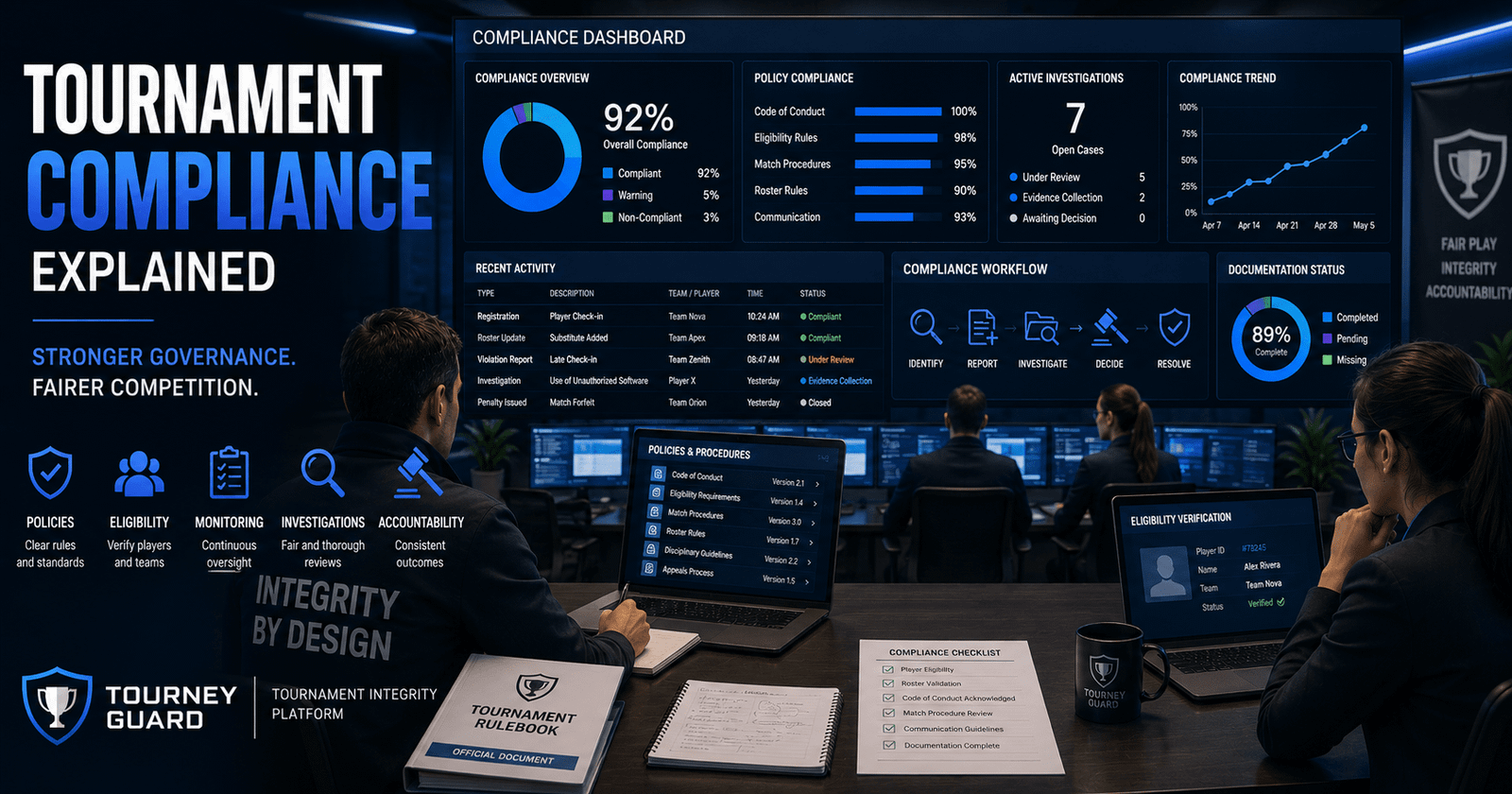
- Compliance dashboards.
- Historical reporting.
Rather than replacing administrators, technology helps ensure that compliance procedures are applied consistently across every tournament while preserving complete governance records for future review.
The Role of Technology in Tournament Compliance
As esports tournaments become larger and more complex, maintaining compliance through spreadsheets, emails, and chat applications becomes increasingly difficult. Tournament organizers must monitor dozens of operational activities simultaneously while ensuring that policies are applied consistently across players, teams, referees, and administrative staff.
Technology helps organizations transform compliance from a reactive administrative task into a proactive governance function.
Modern tournament governance platforms can support compliance by providing:
- Tournament policy management.
- Eligibility verification.
- Registration compliance tracking.
- Incident reporting.
- Evidence repositories.
- Administrative investigation workflows.
- Appeals management.
- Decision documentation.
- Administrative audit trails.
- Compliance dashboards.
- Historical reporting.
Rather than replacing tournament administrators, technology standardizes operational workflows, reduces administrative errors, and preserves complete governance records that support accountability and continuous improvement.
Organizations that centralize compliance processes are better equipped to scale tournaments while maintaining consistent governance standards across every event.
Measuring Tournament Compliance Performance
Professional compliance programs should be evaluated through measurable indicators rather than assumptions.
Monitoring compliance metrics allows organizers to identify recurring issues, improve governance processes, and demonstrate operational maturity over time.
Compliance Metrics
- Overall compliance rate.
- Number of compliance violations.
- Percentage of participants meeting eligibility requirements.
- Code of Conduct violation rate.
- Administrative policy compliance rate.
Investigation Metrics
- Number of compliance-related investigations.
- Average investigation completion time.
- Documentation completion rate.
- Percentage of investigations completed within policy deadlines.
Governance Metrics
- Appeals resulting from compliance decisions.
- Administrative consistency rate.
- Rule clarification requests.
- Policy revision frequency.
- Governance audit findings.
Operational Metrics
- Registration accuracy.
- Administrative workload.
- Tournament delay rate caused by compliance issues.
- Staff training completion rate.
- Post-event compliance review completion.
Tracking these KPIs enables organizations to continuously improve compliance rather than simply responding to isolated incidents.
Tournament Compliance Checklist
Before launching your next tournament, verify that your compliance framework includes the following elements.
Governance
- ✓ Tournament Rulebook published.
- ✓ Code of Conduct available.
- ✓ Compliance responsibilities assigned.
- ✓ Administrative authority documented.
- ✓ Appeals procedures established.
Participant Compliance
- ✓ Player eligibility verified.
- ✓ Team rosters validated.
- ✓ Registration completed.
- ✓ Required documentation received.
- ✓ Participant responsibilities communicated.
Operational Compliance
- ✓ Match procedures documented.
- ✓ Incident reporting process available.
- ✓ Evidence management procedures established.
- ✓ Investigation workflows standardized.
- ✓ Administrative records maintained.
Continuous Improvement
- ✓ Compliance audit scheduled.
- ✓ Governance metrics collected.
- ✓ Staff training completed.
- ✓ Lessons learned documented.
- ✓ Policies updated after each tournament.
Organizations that consistently complete this checklist create compliance programs that support fairness, transparency, and long-term operational excellence.
Frequently Asked Questions
What is tournament compliance?
Tournament compliance is the process of ensuring that players, teams, officials, administrators, and tournament operations follow the rules, procedures, and governance standards established for a competition. It supports tournament integrity by promoting consistency, accountability, and fair administration.
Why is tournament compliance important?
Compliance reduces operational risk, prevents procedural violations, improves consistency, and strengthens participant confidence. It helps tournament organizers maintain fair competitions while ensuring that governance processes are applied equally to everyone involved.
Who is responsible for tournament compliance?
Compliance is a shared responsibility.
Tournament organizers establish governance policies, administrators monitor and enforce procedures, referees apply tournament rules, and participants are responsible for complying with published requirements throughout the competition.
What happens when tournament compliance is violated?
The response depends on the nature of the violation.
Minor administrative issues may require corrective actions, while significant compliance failures can trigger formal administrative investigations, disciplinary measures, or appeals procedures according to the tournament’s published policies.
How can technology improve tournament compliance?
Technology centralizes governance processes such as policy management, eligibility verification, incident reporting, investigations, evidence management, appeals, and audit trails. This helps tournament organizers apply compliance procedures consistently while reducing administrative workload and improving documentation quality.
Conclusion
Professional Tournament Compliance is one of the fundamental building blocks of successful esports governance. While tournament rules establish expectations, compliance ensures that those expectations are consistently followed by participants, officials, and administrators throughout every stage of a competition.
Effective compliance extends beyond identifying rule violations. It includes proactive monitoring, standardized procedures, clear communication, comprehensive documentation, structured investigations, and continuous improvement. Together, these elements create governance systems that strengthen tournament integrity while reducing operational risk.
As esports continues to mature, organizations that invest in professional compliance programs will be better positioned to manage larger tournaments, attract sponsors, improve participant confidence, and maintain fair, transparent competitions.
Ultimately, tournament compliance is not about creating more bureaucracy—it is about ensuring that every competition operates according to consistent standards that protect competitive integrity and build long-term trust within the esports community.
Build Stronger Tournament Compliance with Tourney Guard
Maintaining tournament compliance requires more than publishing a rulebook. It depends on structured governance processes, consistent administrative workflows, centralized documentation, and the ability to monitor compliance throughout every stage of a competition.
As tournaments become larger and more complex, managing compliance through spreadsheets, emails, and disconnected documents increases operational risk. Centralizing compliance activities helps organizers improve consistency, reduce administrative errors, and maintain complete records of every investigation, decision, and governance process.
Tourney Guard helps tournament organizers professionalize compliance through centralized policy management, incident reporting, evidence management, administrative investigations, appeals tracking, governance workflows, and complete audit trails. These capabilities help organizations build scalable compliance programs that strengthen tournament integrity while improving operational efficiency.
Discover how Tourney Guard helps esports organizations implement professional tournament compliance with confidence.
👉 Learn More About Tourney Guard →
Recommended External Resources
These organizations publish guidance that supports professional Tournament Integrity programs:
- Esports Integrity Commission (ESIC) – Standards, codes of conduct, investigations, and integrity initiatives.
- International Olympic Committee (IOC) – Integrity frameworks applicable to competitive sports governance.
- International Betting Integrity Association (IBIA) – Best practices for integrity monitoring.
- NIST Cybersecurity Framework – Guidance for security governance and risk management.
- ISO 37301 Compliance Management Systems – International compliance management principles.
- World Anti-Doping Agency (WADA) – Governance and disciplinary process principles applicable beyond traditional sports.
Suggested Internal Links
Strengthen your internal linking strategy by connecting this article with:
- What Is Tournament Integrity? A Complete Guide for Esports Organizers
- Why Anti-Cheat Software Alone Isn’t Enough for Esports Tournaments
- 10 Common Types of Cheating in Esports Tournaments