
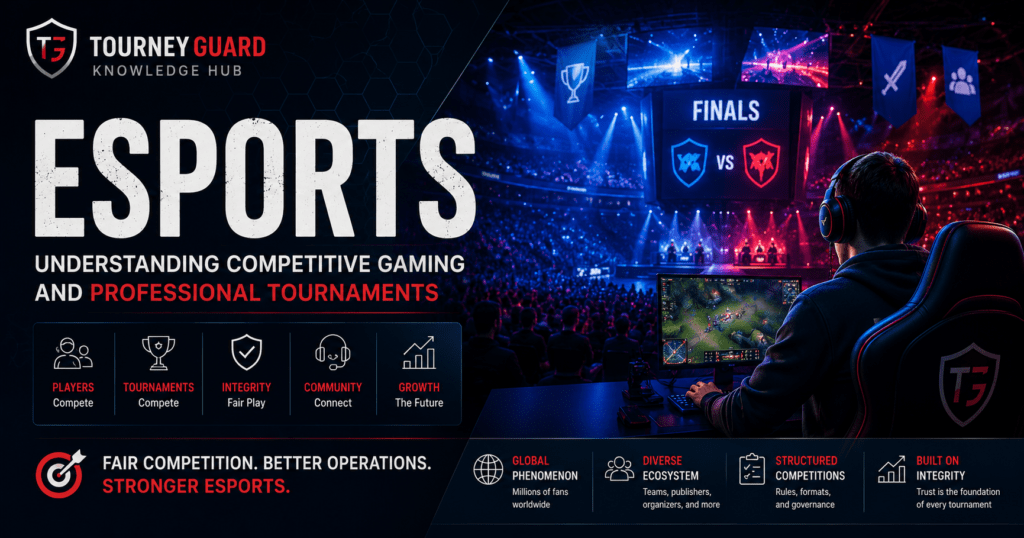
Understanding Competitive Gaming and Professional Tournaments
Esports has evolved from small community competitions into a global ecosystem of professional leagues, international championships, collegiate tournaments, and grassroots events that attract millions of players and spectators worldwide.
Today, esports is much more than simply playing video games competitively. It is a structured industry involving tournament organizers, publishers, teams, referees, administrators, broadcasters, sponsors, technology providers, and competitive communities working together to create fair and engaging competitions.
As tournaments continue to grow in scale and complexity, successful esports events rely on more than skilled players. They require effective Tournament Operations, transparent governance, consistent rule enforcement, and strong Tournament Integrity practices to maintain competitive fairness and participant trust.
This guide introduces the fundamentals of esports, explains how tournaments are organized, and provides a roadmap to the operational concepts explored throughout the Tourney Guard Knowledge Hub.



What Is Esports?
Esports, short for electronic sports, refers to organized competitive video gaming where individuals or teams compete under established rules in structured tournaments or leagues.
Unlike casual gaming, esports emphasizes:
- Organized competition
- Defined tournament rules
- Player eligibility
- Match administration
- Competitive rankings
- Professional officiating
- Tournament governance
- Fair competition
Competitions range from local community tournaments to international championships featuring significant prize pools and global audiences.
The Esports Ecosystem
Modern esports involves many different participants working together.
Players
Individuals who compete according to tournament rules and eligibility requirements.
Teams
Organizations that manage professional or amateur players and participate in organized competitions.
Tournament Organizers
Organizations responsible for planning, administering, and operating esports tournaments.
Their responsibilities include:
- Registration
- Scheduling
- Tournament Operations
- Rule enforcement
- Incident Management
- Communication
- Administrative investigations
Game Publishers
Companies that develop and maintain competitive games while often supporting official tournament circuits.
Referees and Administrators
Officials responsible for monitoring matches, enforcing tournament rules, documenting incidents, and supporting competitive fairness.
Spectators and Communities
Fans contribute to the growth of esports through viewership, community engagement, and event participation.



How Esports Tournaments Work
Every successful tournament follows a structured operational lifecycle.
Although formats vary, most competitions include:
- Tournament Planning
- Registration
- Eligibility Verification
- Scheduling
- Competition
- Incident Management
- Appeals
- Tournament Completion
- Post-Event Review
Each stage requires documented operational procedures that support fairness and consistency throughout the competition.
Why Tournament Operations Matter
As tournaments become larger and more competitive, operational excellence becomes increasingly important.
Tournament Operations provide the framework that helps organizers:
- Coordinate tournament staff
- Schedule matches
- Manage participants
- Resolve operational issues
- Document administrative decisions
- Improve communication
- Conduct post-event reviews
Strong Tournament Operations reduce operational risk while improving participant confidence.
Why Tournament Integrity Matters
Competitive success depends on trust.
Players, teams, publishers, and spectators expect tournaments to be conducted fairly and consistently.
Tournament Integrity supports these expectations through:
- Rules Enforcement
- Incident Management
- Evidence Collection
- Administrative Investigations
- Appeals Management
- Decision Transparency
- Tournament Governance
These operational disciplines work together to ensure competitions remain fair even when unexpected situations occur.
Learn More
Continue exploring the Tourney Guard Knowledge Hub.
Tournament Integrity
Understand the principles that protect fair competition.
Recommended articles:
- What Is Tournament Integrity?
- Tournament Integrity vs Competitive Integrity
- Types of Cheating
- Anti-Cheat Isn’t Enough
Tournament Operations
Discover how tournaments are organized and managed.
Recommended articles:
- How to Run a Tournament
- Incident Management
- Evidence Collection
Practical Resources
Visit the Resources section to explore operational guides, checklists, templates, and best practices designed specifically for tournament organizers.
Why Tourney Guard?
Tourney Guard is dedicated to helping tournament organizers strengthen Tournament Integrity through better Tournament Operations.
Rather than focusing solely on gameplay or technical detection, Tourney Guard emphasizes structured operational processes including Incident Management, Evidence Collection, Administrative Investigations, Appeals Management, and transparent decision-making.
Our goal is to provide tournament organizers with practical knowledge and operational frameworks that help build competitions players can trust.
Frequently Asked Questions
What is esports?
Esports is organized competitive video gaming where individuals or teams compete under established rules in structured tournaments or leagues.
Is esports only for professional players?
No.
Esports includes community tournaments, amateur leagues, collegiate competitions, regional championships, and professional circuits.
Why are Tournament Operations important?
Tournament Operations ensure competitions are organized efficiently while supporting consistent administration and participant experience.
What is Tournament Integrity?
Tournament Integrity refers to the policies, operational processes, and governance practices that help maintain fair competition and transparent tournament administration.
Where can I learn more about tournament organization?
The Tourney Guard Knowledge Hub provides educational resources covering Tournament Operations, Tournament Integrity, Incident Management, Evidence Collection, and many other topics relevant to esports organizers.
Conclusion
Esports continues to grow as one of the world’s most dynamic competitive industries, bringing together players, organizers, teams, publishers, and communities through structured competition.
Behind every successful tournament are well-defined operational processes that support fairness, transparency, and consistency. By understanding the principles of Tournament Operations and Tournament Integrity, organizers can create competitions that participants trust and communities respect.
Whether you’re new to esports or already managing competitive events, the Tourney Guard Knowledge Hub provides practical knowledge to help you build stronger, better-organized tournaments.
Recommended External Resources
The following organizations provide valuable guidance for tournament organizers and operational professionals:
- Esports Integrity Commission (ESIC) – Standards, codes of conduct, investigations, and integrity initiatives.
- International Olympic Committee (IOC) – Integrity frameworks applicable to competitive sports governance.
- International Betting Integrity Association (IBIA) – Best practices for integrity monitoring.
- NIST Cybersecurity Framework – Guidance for security governance and risk management.
- ISO 37301 Compliance Management Systems – International compliance management principles.
- World Anti-Doping Agency (WADA) – Governance and disciplinary process principles applicable beyond traditional sports.


