
Introduction
Every esports tournament, regardless of its size, will eventually encounter unexpected situations. A player may report suspected cheating, a team may dispute a match result, technical issues may interrupt competition, or an administrator may receive allegations of misconduct. The difference between a well-managed tournament and a controversial one is rarely the incident itself—it is how that incident is managed.
Incident Management is the operational discipline responsible for identifying, documenting, investigating, resolving, and reviewing situations that may affect the fairness, safety, or integrity of a competition. It provides tournament organizers with a structured methodology for handling issues consistently while minimizing operational disruption and maintaining participant trust.
Within Tournament Operations, Incident Management serves as the bridge between tournament rules and administrative decision-making. Instead of reacting differently to every situation, organizers follow predefined workflows that standardize reporting, evidence collection, case evaluation, communication, and final resolution.
As esports events continue to increase in scale, prize pools, and public visibility, tournament organizers face greater expectations for transparency and accountability. Players, teams, publishers, sponsors, and spectators all expect incidents to be handled fairly and consistently. Informal conversations in Discord, ad hoc decisions, or undocumented penalties are no longer sufficient for professional competitions.
A mature Incident Management process transforms isolated problems into repeatable operational workflows. Every reported issue becomes a documented case that follows established procedures, ensuring that similar incidents receive similar treatment while preserving evidence and maintaining an auditable history of administrative actions.
This guide explains how Incident Management fits within Tournament Operations, why it is essential for maintaining Tournament Integrity, and how organizers can implement repeatable workflows that improve fairness, efficiency, and confidence in every competition.
Key Takeaways
- Incident Management provides a structured process for responding to tournament issues.
- Every incident should follow standardized workflows rather than improvised decisions.
- Proper documentation improves consistency, transparency, and accountability.
- Evidence collection is fundamental before administrative decisions are made.
- Incident prioritization helps organizers allocate resources effectively.
- Clear communication reduces confusion during investigations.
- Historical case records improve future decision-making.
- Incident Management strengthens Tournament Integrity and Tournament Operations.
- Repeatable processes scale more effectively than informal administration.
- Continuous review helps organizations improve future tournaments.
Executive Summary
Incident Management is a structured operational process that enables tournament organizers to identify, assess, investigate, resolve, document, and review events that may affect the integrity or successful operation of a competition.
Within Tournament Operations, incidents range from player misconduct and eligibility disputes to technical failures, rule violations, scheduling conflicts, and administrative errors. Without standardized procedures, organizers risk inconsistent decisions, delayed responses, incomplete evidence, and reduced confidence among participants.
An effective Incident Management framework defines clear reporting channels, assigns responsibilities, establishes severity classifications, preserves evidence, documents investigative actions, communicates decisions transparently, and archives every case for future reference. These operational practices help ensure fairness while reducing organizational risk.
Incident Management is not limited to responding to cheating allegations. It encompasses every operational event that could disrupt tournament fairness, participant safety, or administrative consistency. By integrating Incident Management with governance, evidence collection, administrative investigations, and appeals management, tournament organizers create resilient operational processes capable of supporting competitions of any size.
Main Guide
What Is Incident Management?
Incident Management is the structured process of identifying, documenting, investigating, resolving, and reviewing operational events that may affect a tournament’s fairness, compliance, or successful execution.
Unlike informal problem-solving, Incident Management follows predefined workflows designed to produce consistent outcomes regardless of who receives the report or when it occurs.
An incident may involve:
- Alleged rule violations
- Player misconduct
- Team disputes
- Technical interruptions
- Administrative errors
- Identity verification concerns
- Match result disputes
- Eligibility issues
- Scheduling conflicts
- Broadcast disruptions
Every incident should progress through the same operational lifecycle, ensuring that organizers collect sufficient information before making administrative decisions.
Definition
Incident Management combines operational procedures, documentation standards, and communication protocols to manage tournament issues from initial report through final closure.
Why It Matters
Without structured Incident Management, tournament staff often rely on personal judgment, fragmented communications, or inconsistent procedures. This increases the likelihood of unfair decisions and weakens participant confidence.
Benefits
- Faster incident response
- Consistent investigations
- Improved documentation
- Better communication
- Reduced operational risk
- Greater transparency
- Stronger Tournament Integrity
Challenges
- Handling multiple incidents simultaneously
- Preserving evidence under time pressure
- Coordinating multiple administrators
- Maintaining procedural consistency
- Communicating effectively with stakeholders
Best Practice
Create documented Incident Management procedures before the tournament begins and train administrators to follow them consistently.
Common Mistake
Attempting to resolve incidents privately without recording actions or preserving supporting evidence.
Practical Example
A player reports suspected impersonation shortly before a playoff match. Rather than making an immediate decision, tournament staff initiate the Incident Management workflow, verify player identity, collect registration records, review communications, and document every step before determining eligibility.
Recommended Internal Link
Evidence Collection
Related Topic
Tournament Integrity
Why Is Incident Management Essential for Tournament Operations?
Incident Management protects Tournament Operations by ensuring every operational issue is handled consistently, efficiently, and transparently.
Tournament Operations encompass every administrative activity required to organize and deliver a successful competition. While planning focuses on preparation, Incident Management focuses on responding when unexpected events occur.
Modern tournaments involve numerous operational risks:
| Operational Area | Example Incident |
|---|---|
| Player Registration | Identity discrepancy |
| Match Administration | Incorrect result submission |
| Rule Enforcement | Unsportsmanlike conduct |
| Technical Operations | Server outage |
| Broadcast Operations | Stream interruption |
| Scheduling | Team no-show |
| Compliance | Eligibility violation |
| Integrity | Match manipulation allegation |
Without Incident Management, each department may respond differently to similar situations, creating confusion and inconsistency.
Incident Management provides a shared operational language that enables administrators to coordinate effectively while documenting every significant action.
Which Types of Incidents Should Tournament Organizers Prepare For?
Tournament organizers should prepare for operational, technical, administrative, and integrity-related incidents throughout the entire competition lifecycle.
Not every incident involves cheating. Many issues arise from routine tournament operations and still require structured handling.
Common categories include:
Integrity Incidents
These affect competitive fairness directly.
Examples:
- Suspected collusion
- Match manipulation
- Account sharing
- Identity fraud
- Rule violations
Operational Incidents
These affect tournament execution.
Examples:
- Schedule conflicts
- Missing participants
- Bracket errors
- Incorrect seeding
- Administrative mistakes
Technical Incidents
Technology failures may interrupt competition without involving misconduct.
Examples:
- Server outages
- Platform instability
- Network interruptions
- Replay failures
- Communication system failures
Compliance Incidents
Some situations involve policies rather than gameplay.
Examples:
- Missing eligibility documents
- Age verification issues
- Residency disputes
- Roster violations
- Registration inconsistencies
Preparing for these categories before competition begins allows organizers to respond quickly while maintaining fairness and consistency.
Recommended Internal Link
Tournament Compliance
Related Topic
Tournament Governance
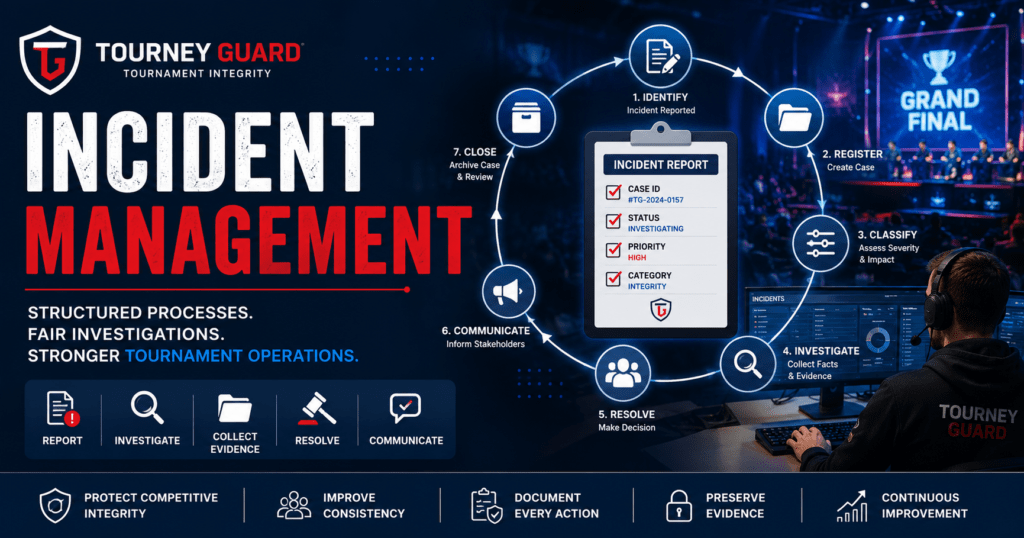
What Does the Incident Management Lifecycle Look Like?
Every incident should move through a repeatable lifecycle that ensures consistency from reporting to closure.
A standardized lifecycle reduces uncertainty and improves operational efficiency.
The typical Incident Management lifecycle consists of:
| Stage | Objective | Primary Output |
| Identification | Detect or receive the incident | Incident report |
| Registration | Create official case | Case record |
| Classification | Determine severity and category | Priority level |
| Investigation | Collect facts and evidence | Investigation file |
| Resolution | Apply corrective actions | Administrative decision |
| Communication | Inform stakeholders | Official notification |
| Closure | Archive documentation | Closed case |
| Review | Identify lessons learned | Process improvements |
Following the same lifecycle for every incident helps tournament staff respond consistently regardless of the tournament’s size or complexity.
How Should Tournament Organizers Classify Incidents?
Incident classification helps organizers prioritize resources, assign responsibilities, and determine the appropriate response based on impact and urgency.
Not every incident requires the same level of attention. A temporary broadcast delay and an allegation of match manipulation should not follow identical escalation paths. By classifying incidents consistently, tournament staff can respond proportionally while maintaining fairness.
A practical classification model considers two dimensions:
- Impact: How much does the incident affect competitive integrity or tournament operations?
- Urgency: How quickly must the issue be resolved to avoid further disruption?
Suggested Severity Levels
| Severity | Description | Example |
|---|---|---|
| Critical | Threatens tournament integrity or prevents competition | Match manipulation allegation before finals |
| High | Significantly affects players or tournament schedule | Identity fraud or server outage |
| Medium | Requires investigation but does not immediately stop play | Rule interpretation dispute |
| Low | Administrative issue with limited operational impact | Minor registration correction |
Why It Matters
Classification prevents overreaction to minor issues while ensuring high-risk incidents receive immediate attention.
Common Mistake
Treating every report as equally urgent, which overloads administrators and delays critical investigations.
Recommended Internal Link
Tournament Governance
Related Topic
Administrative Investigations
Who Is Responsible During an Incident?
Clearly defined responsibilities ensure incidents are managed efficiently without confusion or duplicated effort.
Incident Management depends on people as much as processes. Every tournament should define operational roles before competition begins.
Typical responsibilities include:
| Role | Primary Responsibility |
|---|---|
| Tournament Administrator | Oversees operational response |
| Integrity Officer | Coordinates investigations |
| Referee | Documents match-related events |
| Technical Administrator | Resolves infrastructure issues |
| Communications Lead | Updates players and stakeholders |
| Appeals Reviewer | Reviews disputed decisions |
In smaller tournaments, one person may perform several of these functions. Larger events often separate responsibilities to reduce bias and improve accountability.
Best Practice
Document role ownership for every stage of the Incident Management lifecycle before registration opens.
Common Mistake
Allowing multiple administrators to investigate independently without coordination.
Practical Example
A technical outage occurs during a playoff match. While the Technical Administrator restores services, the Tournament Administrator documents the interruption, communicates with teams, and records operational decisions for future review.
Recommended Internal Link
Tournament Administration
Related Topic
Decision Transparency
Why Is Evidence Collection Essential During Incident Management?
Evidence transforms allegations into objective investigations by providing verifiable information that supports administrative decisions.
Incident Management is only as reliable as the evidence supporting each case.
Evidence may include:
- Match recordings
- Replay files
- Tournament logs
- Registration records
- Screenshots
- Video clips
- Chat transcripts
- Voice communications
- Witness statements
- Administrative notes
Collecting evidence early reduces the risk of losing critical information and strengthens the credibility of final decisions.
Evidence Collection Principles
| Principle | Purpose |
|---|---|
| Accuracy | Preserve original information |
| Completeness | Gather all relevant evidence |
| Traceability | Record when and how evidence was collected |
| Security | Prevent unauthorized modifications |
| Confidentiality | Protect sensitive participant information |
Why It Matters
Reliable evidence enables organizers to explain decisions confidently, defend them during appeals, and improve future investigations.
Common Mistake
Making disciplinary decisions before sufficient evidence has been collected.
Practical Example
After a disputed match result, administrators preserve server logs, player communications, replay files, and referee notes before discussing penalties. This prevents decisions from relying solely on memory or community speculation.
Recommended Internal Link
Evidence Collection
Related Topic
Case Management
How Should Tournament Organizers Communicate During an Incident?
Clear, timely, and consistent communication reduces confusion while protecting the integrity of ongoing investigations.
Poor communication often creates more controversy than the incident itself.
Stakeholders expect updates that explain:
- What happened
- What actions are being taken
- Whether competition is affected
- When additional information will be available
Communication should remain factual and avoid speculation while investigations are in progress.
Internal Communication
Administrators should document:
- Timeline of events
- Assigned responsibilities
- Evidence status
- Investigation progress
- Pending actions
External Communication
Players and teams should receive:
- Confirmation that the incident has been acknowledged
- Information about any immediate operational impact
- Expected timelines
- Final decisions once investigations conclude
Communication Best Practices
| Recommended Practice | Risk if Ignored |
|---|---|
| Acknowledge reports quickly | Loss of participant confidence |
| Share verified information only | Spread of misinformation |
| Maintain consistent messaging | Conflicting public statements |
| Document all communications | Missing historical records |
Recommended Internal Link
Decision Transparency
Related Topic
Appeals Management
Why Should Every Incident Be Reviewed After Closure?
Post-incident reviews help organizers improve processes, reduce recurring problems, and strengthen future Tournament Operations.
Closing an incident should not mark the end of organizational learning.
A structured review examines:
- Was the incident identified quickly?
- Were procedures followed correctly?
- Was evidence collected effectively?
- Were communications timely?
- Were decisions consistent with tournament policies?
- What improvements should be implemented before the next event?
Benefits of Post-Incident Reviews
- Better administrator training
- Improved workflows
- Stronger documentation
- Faster response times
- Fewer repeated operational mistakes
Common Mistake
Archiving incidents without analyzing their operational lessons.
Practical Example
Following several registration disputes across multiple tournaments, organizers discover inconsistent identity verification procedures. The review leads to updated registration requirements, reducing future incidents significantly.
Recommended Internal Link
Tournament Operations
Related Topic
Continuous Improvement
Best Practices
Establish Incident Procedures Before Registration Opens
Incident Management begins long before the first match.
Prepare:
- Reporting channels
- Classification criteria
- Investigation procedures
- Evidence standards
- Communication templates
- Escalation paths
Standardize Every Investigation
Every reported incident should follow the same documented workflow regardless of:
- Tournament size
- Prize pool
- Team reputation
- Community pressure
Consistency strengthens organizational credibility.
Record Every Administrative Action
Maintain complete documentation including:
- Incident summary
- Timeline
- Evidence reviewed
- Individuals involved
- Findings
- Decisions
- Follow-up actions
Comprehensive records simplify future reviews and appeals.
Train Tournament Staff
Even well-designed procedures fail if administrators do not understand how to apply them.
Regular training improves response quality and reduces operational errors.
Review Incident Metrics
Measure operational performance through indicators such as:
- Average response time
- Investigation duration
- Number of reopened cases
- Appeal success rate
- Incident categories
- Repeat incident frequency
These metrics support continuous operational improvement.
Common Mistakes
Mistake 1: Managing Incidents Through Informal Chats
Using private messages or voice calls without documentation creates incomplete case histories.
Mistake 2: Skipping Incident Classification
Without prioritization, administrators may spend valuable time on low-impact issues while critical incidents escalate.
Mistake 3: Delaying Evidence Collection
Evidence becomes harder to preserve as time passes.
Capture relevant information immediately.
Mistake 4: Inconsistent Rule Enforcement
Different penalties for similar incidents reduce participant trust and create unnecessary appeals.
Mistake 5: Closing Cases Without Lessons Learned
Every incident provides an opportunity to improve Tournament Operations.
Ignoring those lessons increases the likelihood of recurring problems.
Decision Framework
The maturity of your Incident Management process should match the complexity of your Tournament Operations.
| Tournament Maturity | Operational Characteristics | Recommended Incident Management Capability |
|---|---|---|
| Community Event | Volunteer administration | Basic reporting and documentation |
| Amateur League | Recurring tournaments | Standardized workflows and evidence collection |
| Regional Organizer | Multiple concurrent events | Case management and severity classification |
| National Competition | High participation | Structured investigations and communication plans |
| Professional Circuit | Large prize pools and public visibility | Comprehensive Incident Management integrated with Tournament Integrity |
Ask these questions when evaluating your organization:
- Can every participant report an incident easily?
- Are incidents categorized consistently?
- Do administrators follow documented procedures?
- Is evidence preserved before decisions are made?
- Are stakeholders informed appropriately?
- Can previous cases be reviewed for consistency?
- Are post-incident reviews conducted regularly?
If several answers are “no,” strengthening Incident Management should become a priority within your Tournament Operations strategy.
Practical Examples
Scenario 1: Identity Verification Before Playoffs
Minutes before a playoff match, administrators discover discrepancies between a player’s registration details and tournament account.
The Incident Management process includes:
- Registering the incident
- Verifying identification documents
- Reviewing registration records
- Consulting tournament rules
- Documenting findings
- Communicating the final decision
Lesson
A standardized workflow prevents rushed decisions under competitive pressure.
Scenario 2: Server Failure During a Championship Match
A hosting platform experiences an unexpected outage midway through the grand final.
Tournament staff:
- Classify the incident as High Severity
- Suspend play
- Preserve match state
- Notify participants
- Coordinate technical recovery
- Resume competition according to documented procedures
Lesson
Technical incidents require operational coordination, not only technical expertise.
Scenario 3: Unsportsmanlike Conduct Complaint
A team submits evidence alleging repeated abusive behavior from an opposing player.
Administrators:
- Open an official incident record
- Collect chat logs and witness statements
- Review tournament rules
- Conduct an administrative investigation
- Apply proportional disciplinary measures
- Archive the completed case
Lesson
Incident Management ensures behavioral issues are handled consistently and transparently rather than emotionally.
Visual Checklist
Tournament Incident Management Readiness Checklist
Use this checklist before every tournament to verify that your Incident Management process is prepared to handle operational issues consistently.
✅ Governance
- ☐ Incident Management policy is documented.
- ☐ Incident severity levels are defined.
- ☐ Administrator responsibilities are assigned.
- ☐ Escalation procedures are documented.
- ☐ Tournament rules are published before registration.
✅ Incident Reporting
- ☐ Players know how to report incidents.
- ☐ Multiple reporting channels are available.
- ☐ Every report receives a unique case number.
- ☐ Incident timestamps are recorded automatically.
- ☐ Reports are acknowledged promptly.
✅ Investigation
- ☐ Evidence collection procedures are documented.
- ☐ Investigation workflow is standardized.
- ☐ Evidence is preserved before decisions.
- ☐ Investigation activities are logged.
- ☐ Similar historical cases can be reviewed.
✅ Communication
- ☐ Stakeholders receive timely updates.
- ☐ Investigation status is documented.
- ☐ Final decisions are communicated consistently.
- ☐ Appeals instructions are provided when applicable.
- ☐ Internal communications are archived.
✅ Continuous Improvement
- ☐ Closed cases are reviewed.
- ☐ Incident metrics are analyzed.
- ☐ Administrator training is updated.
- ☐ Operational procedures are improved regularly.
- ☐ Lessons learned are documented.
Visual Checklist
Signs Your Tournament Needs Better Incident Management
If your tournament regularly experiences these problems, your Incident Management process likely requires improvement.
- ☐ Players do not know how to report incidents.
- ☐ Administrators handle similar cases differently.
- ☐ Evidence is collected after decisions are made.
- ☐ Incident records are incomplete.
- ☐ Communication is inconsistent.
- ☐ Appeals frequently overturn decisions.
- ☐ Historical cases cannot be located.
- ☐ Rules are interpreted differently by administrators.
- ☐ Incident response is slow.
- ☐ Decisions rely on personal opinions instead of documented evidence.
Checking several of these items indicates an opportunity to strengthen Tournament Operations through standardized Incident Management procedures.
Strengthen Tournament Operations with Structured Incident Management
Effective Incident Management is more than responding to unexpected events—it is a core capability of professional Tournament Operations.
By implementing standardized reporting, investigation workflows, evidence collection, communication, and post-incident reviews, tournament organizers create fairer competitions and build long-term trust among players, teams, publishers, and sponsors.
Tourney Guard helps organizations strengthen Tournament Integrity by supporting structured Incident Management processes, administrative investigations, evidence collection, case management, appeals management, and decision transparency. It complements your Tournament Operations by providing repeatable operational workflows rather than relying on improvised responses.
Frequently Asked Questions
What is Incident Management in Tournament Operations?
Incident Management is the structured process of identifying, documenting, investigating, resolving, and reviewing events that may affect tournament fairness, compliance, or successful operation.
What types of incidents should be managed?
Incident Management should address:
- Rule violations
- Technical failures
- Player misconduct
- Identity verification issues
- Eligibility disputes
- Administrative errors
- Scheduling conflicts
- Match disputes
- Integrity concerns
Why is Incident Management important?
It enables organizers to respond consistently, preserve evidence, improve communication, reduce operational risk, and strengthen Tournament Integrity.
Is Incident Management only about cheating?
No.
While cheating allegations may trigger Incident Management, the process also covers operational, technical, administrative, and compliance-related issues that affect tournament execution.
How does Incident Management support Tournament Integrity?
Incident Management provides the operational framework required to investigate incidents fairly, document findings, communicate decisions transparently, and maintain historical case records that improve consistency across tournaments.
Can small tournaments benefit from Incident Management?
Absolutely.
Even community tournaments benefit from documented reporting procedures, evidence preservation, standardized investigations, and consistent administrative decisions. These practices become increasingly valuable as events grow in size and complexity.
Conclusion
Incident Management is one of the foundational disciplines of successful Tournament Operations.
Every tournament will encounter unexpected situations, but the quality of the response determines whether those incidents become isolated operational challenges or long-term threats to competitive credibility.
A structured Incident Management process enables organizers to respond consistently, collect reliable evidence, conduct objective investigations, communicate transparently, and learn from every completed case.
By integrating Incident Management with governance, evidence collection, administrative investigations, appeals management, and Tournament Integrity principles, organizers create competitions that are more resilient, transparent, and trusted by participants and stakeholders alike.
Professional Tournament Operations are not defined by the absence of incidents—they are defined by the ability to manage them fairly, efficiently, and consistently.
Learn More
Expand your knowledge with these related topics:
- Tournament Operations
- Tournament Integrity
- Administrative Investigations
- Evidence Collection
- Tournament Governance
- Appeals Management
- Decision Transparency
- Tournament Compliance
- Rules Enforcement
- Competitive Integrity
- Anti-Cheat Isn’t Enough
- Types of Cheating
Recommended External Resources
The following organizations publish guidance that complements professional Incident Management practices:
- Esports Integrity Commission (ESIC) – Standards, codes of conduct, investigations, and integrity initiatives.
- International Olympic Committee (IOC) – Integrity frameworks applicable to competitive sports governance.
- International Betting Integrity Association (IBIA) – Best practices for integrity monitoring.
- NIST Cybersecurity Framework – Guidance for security governance and risk management.
- ISO 37301 Compliance Management Systems – International compliance management principles.
- World Anti-Doping Agency (WADA) – Governance and disciplinary process principles applicable beyond traditional sports.
Suggested Internal Links
Strengthen your internal linking strategy by connecting this article with: