
Introduction
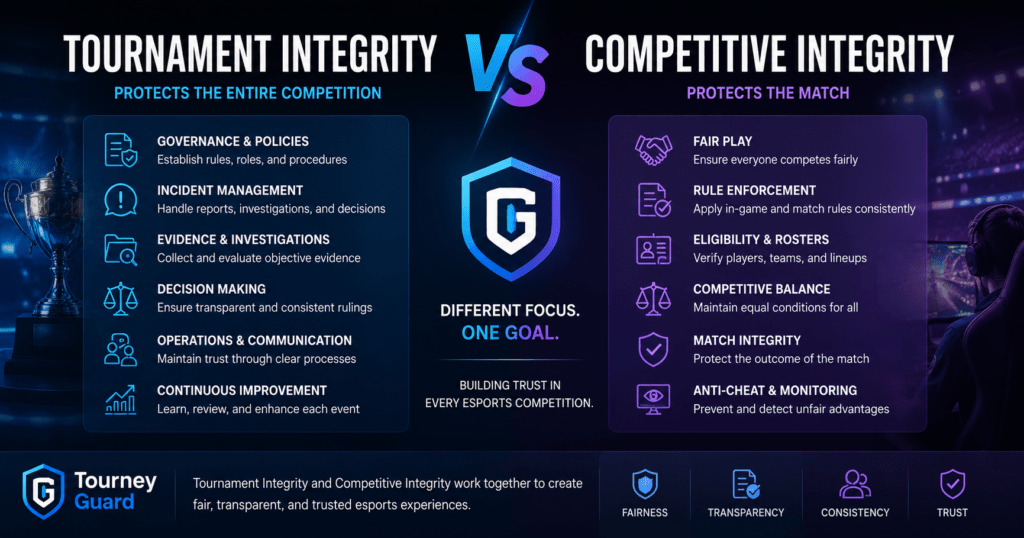
One of the most common misconceptions in esports is that Tournament Integrity vs Competitive Integrity are interchangeable terms. Although they are closely related, they address different aspects of a professional competition.
Understanding this distinction helps tournament organizers build more comprehensive governance frameworks and avoid gaps in their operational processes.
Understanding the differences between Tournament Integrity vs Competitive Integrity is essential for tournament organizers who want to build fair, transparent, and professionally managed esports competitions. While both concepts contribute to competitive trust, they address different responsibilities throughout the tournament lifecycle.
What Is Competitive Integrity?
Competitive Integrity focuses on ensuring that every match is played under equal and fair competitive conditions.
Its objective is to protect the legitimacy of the competition itself by minimizing unfair advantages and ensuring that every participant competes according to the same rules.
Competitive Integrity typically includes:
- Fair competition
- Equal playing conditions
- Match rule enforcement
- Player eligibility
- Roster validation
- Competitive fairness
- Match scheduling consistency
The emphasis is on the competition itself.
Examples of Competitive Integrity in Esports
Competitive Integrity can be seen in many aspects of a tournament beyond the matches themselves. Every decision that ensures players compete under equal conditions contributes to maintaining a fair competitive environment.
For example, tournament organizers verify player eligibility before the event begins to ensure that all participants meet age requirements, regional restrictions, and roster deadlines. During the competition, referees apply the same rules consistently to every team, regardless of their reputation or ranking.
Competitive Integrity also involves maintaining standardized match settings, preventing unauthorized substitutions, enforcing time schedules, and ensuring that all participants use the approved tournament configuration. Even seemingly minor administrative inconsistencies can create unfair advantages and negatively affect player confidence.
By establishing clear competitive standards and applying them consistently, organizers help ensure that every match is decided by player skill rather than administrative inconsistencies.
What Is Tournament Integrity?
Tournament Integrity has a broader scope.
Instead of focusing solely on the competition, it encompasses the governance, operational, administrative, and investigative processes that support the tournament before, during, and after every match.
Tournament Integrity includes:
- Tournament governance
- Incident management
- Evidence collection
- Administrative investigations
- Documentation
- Appeals procedures
- Decision transparency
- Operational consistency
- Stakeholder communication
- Continuous improvement
In other words:
Competitive Integrity protects the match.
Tournament Integrity protects the entire competition ecosystem.
Why Tournament Integrity Is Essential for Modern Esports
As esports continues to grow, tournaments involve more stakeholders than ever before. Players, teams, sponsors, publishers, streaming platforms, and spectators all expect competitions to be managed professionally.
Tournament Integrity provides the governance framework that supports these expectations. Rather than reacting to incidents as they occur, organizers establish structured processes that define how reports are received, how evidence is evaluated, who is responsible for investigations, and how final decisions are documented.
Professional Tournament Integrity practices also reduce operational risk. Clear procedures help minimize disputes, improve communication, and ensure similar situations are handled consistently across different events. This consistency strengthens the credibility of tournament organizers and builds long-term trust within the esports community.
Tournament Integrity vs Competitive Integrity
| Tournament Integrity | Competitive Integrity |
|---|---|
| Covers the entire tournament lifecycle | Focuses on individual matches |
| Includes governance and administration | Focuses on fair gameplay |
| Manages incidents and investigations | Ensures equal competitive conditions |
| Documents administrative decisions | Enforces match rules |
| Includes appeals procedures | Ensures competitive fairness |
| Improves operational transparency | Protects competitive balance |
Both disciplines complement each other and are essential for delivering trustworthy esports events.
Why Both Disciplines Work Together
Although Tournament Integrity and Competitive Integrity have different responsibilities, they are most effective when implemented together.
Competitive Integrity focuses on protecting fair gameplay by ensuring equal competitive conditions, consistent rule enforcement, and balanced competition. Tournament Integrity expands beyond individual matches by providing the governance, administrative procedures, documentation, investigations, and operational consistency required to manage an entire competition.
For example, if a roster violation is reported during a tournament, Competitive Integrity determines whether the violation affects the fairness of the match, while Tournament Integrity defines how the incident is reported, investigated, documented, communicated, and resolved according to established procedures.
Organizations that invest in both disciplines create competitions that are not only fair but also transparent, accountable, and trusted by players, teams, sponsors, and the broader esports community.
Ultimately, understanding Tournament Integrity vs Competitive Integrity enables organizers to develop governance frameworks that protect both the fairness of individual matches and the credibility of the tournament as a whole. Organizations that implement both disciplines are better prepared to manage incidents consistently and strengthen long-term trust.
The Core Principles of Tournament Integrity
Strong Tournament Integrity programs are built upon several foundational principles that guide every administrative decision throughout a competition.
These principles should be reflected in tournament policies, staff training, operational workflows, and incident management procedures.
Fairness
Every participant should be treated consistently regardless of their popularity, ranking, organization, or previous history.
Fairness requires:
- Consistent rule application
- Equal opportunities
- Impartial investigations
- Objective evidence evaluation
When participants believe that everyone is treated equally, confidence in the tournament naturally increases.
Transparency
Transparency means participants understand:
- Which rules apply
- How incidents are reviewed
- Who makes decisions
- How appeals work
- Why disciplinary actions were taken
Transparent processes reduce speculation and improve trust.
Transparency does not necessarily require publishing every internal discussion.
Instead, it requires clearly documenting how decisions are reached.
Consistency
Similar situations should receive similar treatment.
Without consistency, organizers unintentionally create uncertainty.
Standard Operating Procedures (SOPs), investigation templates, and documented workflows help staff maintain consistency across different tournaments.
Accountability
Tournament officials should be accountable for their decisions.
Accountability includes:
- Decision records
- Investigation reports
- Evidence references
- Approval workflows
- Audit history
Proper documentation protects both organizers and participants.
Due Process
Administrative decisions should follow defined procedures rather than subjective opinions.
Due process generally includes:
- Incident report received
- Evidence collected
- Investigation performed
- Relevant parties interviewed
- Rules reviewed
- Decision documented
- Participants informed
- Appeal opportunity provided when appropriate
This structured approach strengthens credibility.
Continuous Improvement
Every tournament provides valuable lessons.
Professional organizers review completed events to identify:
- recurring incidents
- operational bottlenecks
- communication gaps
- unclear rules
- staffing issues
Continuous improvement transforms experience into better future tournaments.
The Tournament Integrity Lifecycle
Tournament Integrity is not a single action performed during a dispute.
It is an ongoing process that spans the entire lifecycle of a tournament.
A mature integrity program follows a structured operational workflow.
Phase 1 — Tournament Planning
Preparation begins long before registration opens.
Key activities include:
- Defining tournament governance
- Creating the rulebook
- Establishing disciplinary policies
- Preparing incident workflows
- Defining investigation procedures
- Assigning staff responsibilities
Good preparation prevents many operational issues.
Phase 2 — Registration and Verification
Before competition begins, organizers should verify participant eligibility.
Examples include:
- Registration validation
- Identity verification
- Team roster approval
- Age requirements
- Regional eligibility
- Rule acceptance
Proper verification reduces administrative disputes later.
Phase 3 — Tournament Operations
During the competition, tournament staff oversee daily operations.
Responsibilities include:
- Match administration
- Rule enforcement
- Schedule management
- Incident intake
- Player communication
- Administrative coordination
Operational consistency becomes critical at this stage.
Phase 4 — Incident Management
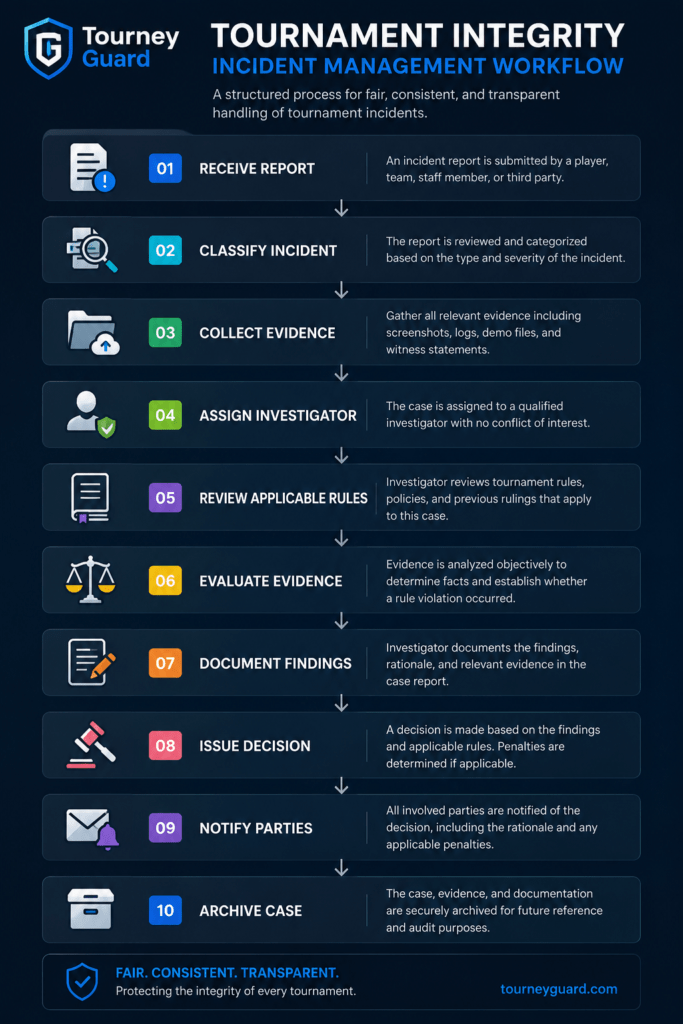
When incidents occur, organizers should follow predefined procedures rather than improvising.
Typical workflow:
Ready to Protect Your Tournament?
Strengthen tournament integrity with better incident management, evidence collection, and transparent decision-making.
Why a Structured Incident Workflow Matters
A documented incident management workflow allows tournament organizers to respond consistently regardless of the type or complexity of the situation.
Instead of relying on subjective judgment, tournament staff follow predefined procedures that ensure every incident receives the appropriate level of review. This structured approach reduces response times, improves documentation quality, and helps maintain consistency across multiple tournaments.
It also protects organizers by creating a complete administrative record of every decision. If an appeal is submitted or questions arise after the tournament concludes, investigators can review the original evidence, findings, and decision history without relying on memory or informal communication.
Ultimately, a standardized workflow strengthens Tournament Integrity by promoting transparency, accountability, and procedural fairness throughout the entire competition.
Phase 5 — Appeals
Not every disciplinary decision should be final without review.
Appeals help strengthen procedural fairness by allowing additional evidence or clarification to be considered under defined policies.
A structured appeals process improves confidence even when the original decision is upheld.
Phase 6 — Post Tournament Review
After the tournament ends, organizers should conduct operational reviews.
Questions include:
- Which incidents occurred most frequently?
- Which rules generated confusion?
- Were investigations completed efficiently?
- Were communications effective?
- What operational improvements are needed?
This review closes the integrity lifecycle and prepares organizers for future competitions.
Practical Example of Tournament Integrity in Action
Imagine that during an online esports tournament, Team Alpha reports that Team Bravo used a substitute player after the official roster lock deadline.
Rather than issuing an immediate penalty, the Tournament Administrator follows the organization’s established Tournament Integrity process.
First, the incident report is reviewed and classified as a potential eligibility violation. Relevant evidence is then collected, including registration records, match logs, roster submissions, screenshots, and any communication between tournament officials and the participating teams.
An Integrity Officer reviews the tournament rulebook to determine whether a violation has occurred and evaluates the available evidence objectively. Once the investigation is complete, the findings are documented in a formal case report that explains the facts, the applicable rules, the reasoning behind the decision, and any disciplinary action that may be required.
Finally, both teams receive a clear explanation of the outcome, and the case is archived to ensure future consistency if similar situations occur.
This structured approach demonstrates how Tournament Integrity protects not only the fairness of the competition but also the credibility of the tournament organizer by ensuring every administrative decision is transparent, evidence-based, and consistently applied.
Roles and Responsibilities
Tournament Integrity depends on clearly defined responsibilities.
When roles overlap or remain undefined, confusion increases during incidents.
Tournament Director
Responsible for overall tournament governance.
Typical responsibilities include:
- Tournament policies
- Operational oversight
- Final administrative authority
- Staff coordination
Tournament Administrator
Responsible for day-to-day tournament operations.
Typical duties:
- Match scheduling
- Registration management
- Rule enforcement
- Player communication
Integrity Officer
The Integrity Officer focuses specifically on administrative integrity processes.
Responsibilities include:
- Incident review
- Investigation coordination
- Evidence management
- Documentation
- Decision recommendations
This role becomes increasingly valuable as tournaments grow in size.
Investigators
Investigators evaluate reported incidents objectively.
Responsibilities include:
- Gathering evidence
- Reviewing submissions
- Interviewing participants when necessary
- Producing investigation reports
Their objective is not to punish players.
Their objective is to establish facts.
Appeals Committee
High-level tournaments often benefit from separating appeals from the original investigation team.
Independent review reduces perceived bias and strengthens confidence in administrative fairness.
Tournament Policies and Rulebooks
A tournament’s rulebook is one of its most important integrity documents.
It establishes expectations before competition begins and serves as the primary reference during investigations.
Well-written rulebooks reduce ambiguity, improve consistency, and minimize disputes.
Every Rulebook Should Include
- Tournament format
- Player eligibility
- Team eligibility
- Match procedures
- Communication rules
- Behavioral expectations
- Incident reporting procedures
- Penalty guidelines
- Appeals process
- Administrative authority
The more clearly these policies are defined, the easier they are to apply consistently.
Characteristics of a Strong Rulebook
A professional rulebook should be:
- Clear
- Easy to understand
- Consistent
- Up to date
- Publicly accessible
- Reviewed before every tournament
Avoid vague language that leaves excessive room for interpretation.
Instead of saying:
“Players may receive penalties.”
Prefer:
“Players who intentionally disconnect during an official match without administrative approval may receive penalties ranging from a warning to match forfeiture depending on the circumstances.”
Specific language promotes consistent enforcement.
Internal Knowledge Hub Articles
Each topic above deserves its own in-depth resource. Throughout this pillar page, naturally link readers to specialized guides such as:
- How to Build an Effective Tournament Rulebook
- Tournament Integrity vs Competitive Integrity
- Incident Management Best Practices for Esports
- Evidence Collection in Esports Competitions
- Administrative Investigations Explained
- Transparent Decision Making in Tournament Administration
- Creating an Appeals Process for Esports Tournaments
- Tournament Operations Best Practices
- Fair Play Principles in Esports
- Tournament Governance Frameworks
Frequently Asked Question: Tournament Integrity vs Competitive Integrity
Many tournament organizers ask whether Tournament Integrity vs Competitive Integrity represents two different approaches to managing esports competitions. In reality, Tournament Integrity vs Competitive Integrity is not a matter of choosing one over the other. Instead, both disciplines complement each other throughout the tournament lifecycle.
Understanding Tournament Integrity vs Competitive Integrity helps organizers recognize that Competitive Integrity focuses on fair gameplay and equal competitive conditions, while Tournament Integrity provides the administrative framework that governs investigations, evidence collection, incident management, and transparent decision-making.
Organizations that clearly understand Tournament Integrity vs Competitive Integrity are better prepared to create trusted competitions, improve operational consistency, and increase confidence among players, teams, sponsors, and tournament staff.
When evaluating Tournament Integrity vs Competitive Integrity, the most successful esports organizations implement both disciplines together. Combining Tournament Integrity with Competitive Integrity creates tournaments that are not only fair to compete in but also professionally administered from registration through post-event review.
Conclusion
The comparison between Tournament Integrity vs Competitive Integrity demonstrates that successful esports events require more than fair gameplay alone. Professional tournaments depend on structured governance, consistent rule enforcement, transparent investigations, and documented decision-making to create competitions that players, teams, sponsors, and fans can trust.
While Competitive Integrity focuses on ensuring equal playing conditions during matches, Tournament Integrity provides the governance, operational processes, and administrative framework that support every stage of a tournament. From incident management and evidence collection to investigations and transparent decision-making, these structured practices help organizers build trust among players, teams, sponsors, and the wider esports community.
By implementing documented procedures and consistently applying tournament policies, organizers can strengthen the credibility of their events and create competitions where every participant understands that decisions are made fairly, objectively, and with accountability.
Learn More
Suggested Internal Links
Strengthen your internal linking strategy by connecting this article with: