
Introduction
Types of Cheating in Esports Tournaments have evolved far beyond traditional hacks and cheat software. As esports continues to grow into a global industry, tournament organizers face an increasing number of integrity threats that can undermine fair competition, damage player trust, and harm the reputation of competitive events.
When people think about cheating in esports, they often imagine a player using an aimbot or wallhack. While these forms of cheating are certainly serious, they represent only a small portion of the risks organizers encounter today.
Modern competitions can also be compromised by account sharing, stream sniping, ghosting, match manipulation, smurfing, administrative abuse, and many other behaviors that traditional anti-cheat software cannot fully prevent.
Understanding these risks is essential for anyone responsible for organizing competitive events and protecting Tournament Integrity.
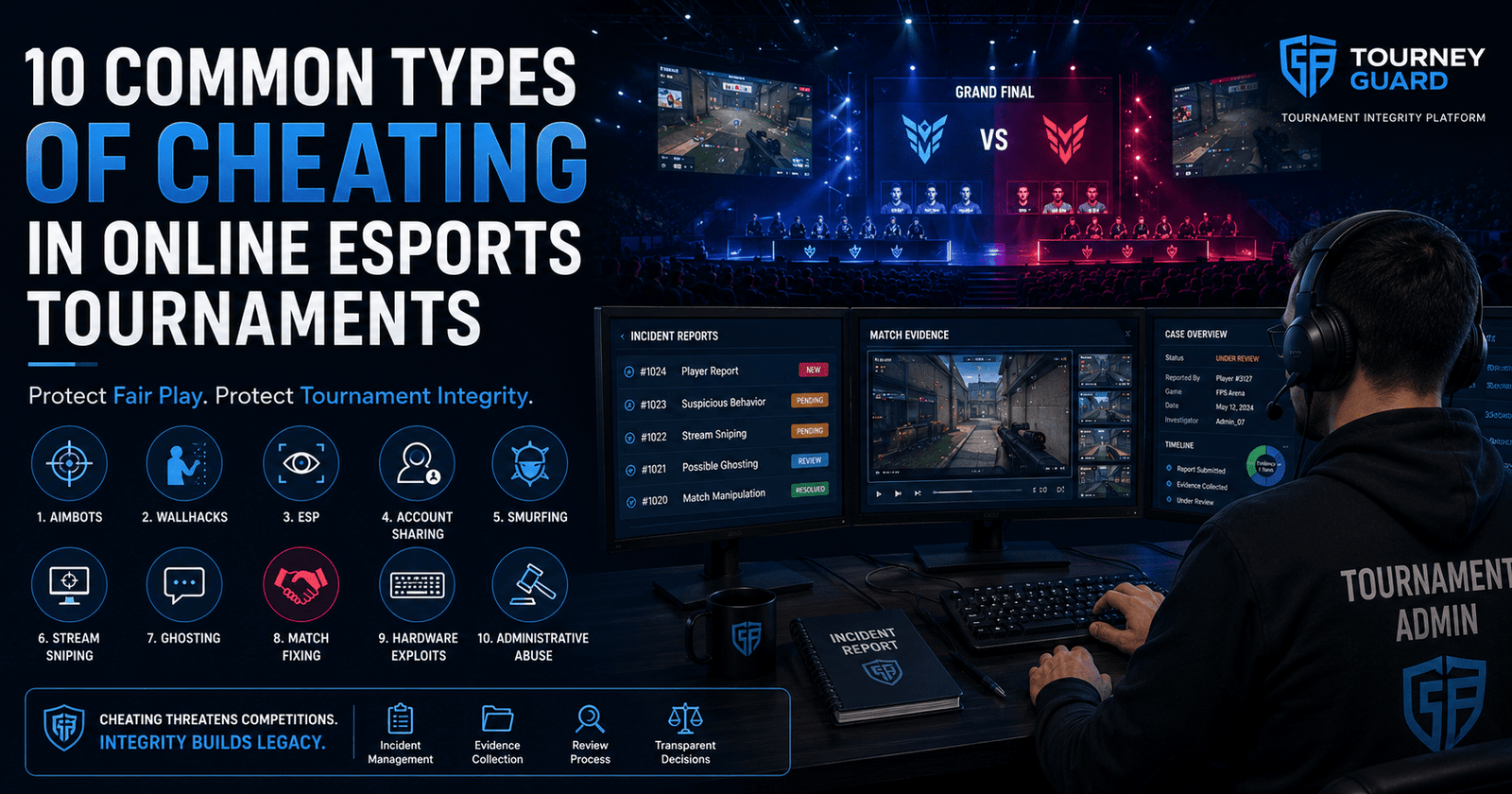
In this guide, we’ll examine the 10 most common Types of Cheating in Esports Tournaments, explain how each one affects competitive integrity, and discuss the operational practices that help organizers build fair, transparent, and trusted competitions.



Understanding the Types of Cheating in Esports Tournaments
Cheating does more than give individual players an unfair advantage.
It damages the credibility of an entire competition.
When participants lose confidence in tournament administration, several consequences follow:
- Players stop registering for future events.
- Sponsors become reluctant to invest.
- Communities question tournament results.
- Organizers spend more time resolving disputes.
- The reputation of the competition suffers.
This is why professional organizers focus on Tournament Integrity rather than simply detecting cheats.
Tournament Integrity ensures that every participant competes under the same rules, every report receives fair consideration, and every decision is supported by evidence and transparent procedures.
Understanding the different forms of cheating is the first step toward building tournaments that players, teams, and sponsors can genuinely trust.
1. Aimbots
Aimbots automatically improve a player’s aiming accuracy by using unauthorized software to target opponents with unnatural precision.
They are among the oldest and most recognized forms of cheating in competitive gaming.
Typical indicators include:
- Perfect tracking.
- Instant target acquisition.
- Unnaturally high accuracy.
- Consistent headshots.
- Impossible reaction times.
Modern anti-cheat systems can detect many aimbots, but advanced private cheats continue to evolve.
Tournament organizers should combine anti-cheat technology with replay reviews and player reports whenever suspicious gameplay is identified.
2. Wallhacks
Wallhacks allow players to see opponents through walls and other obstacles.
This information provides an enormous competitive advantage by revealing:
- Enemy positions.
- Movement paths.
- Defensive setups.
- Ambush opportunities.
Although many anti-cheat systems monitor for wallhack software, organizers should also review suspicious gameplay patterns and recorded evidence when reports are submitted.
Wallhacks remain one of the most common examples of Esports Cheating, but they are far from the only threat to Tournament Integrity.
3. ESP (Extra Sensory Perception)
ESP (Extra Sensory Perception) is another form of unauthorized software that provides players with hidden information about the game.
Unlike traditional wallhacks, ESP often displays detailed overlays showing:
- Enemy health
- Distance to opponents
- Player names
- Equipment
- Movement direction
- Loot locations (depending on the game)
Because ESP provides extensive tactical information, players can make decisions that appear legitimate while benefiting from unfair knowledge.
Although advanced anti-cheat solutions detect many ESP applications, tournament administrators should also investigate suspicious gameplay using replay analysis and evidence submitted by participants.
4. Account Sharing
Account sharing occurs when someone other than the registered competitor plays using another player’s account.
Unlike software-based cheating, account sharing is primarily an administrative integrity issue.
It creates several problems:
- Unfair competitive advantages.
- Difficulty enforcing suspensions.
- False player statistics.
- Tournament eligibility violations.
Preventing account sharing requires operational controls such as:
- Player identity verification.
- Registration validation.
- Team roster confirmation.
- Match check-in procedures.
This is a clear example of why Tournament Integrity extends beyond anti-cheat software.
5. Smurfing
Smurfing happens when highly skilled players compete using lower-ranked or newly created accounts.
Their objective is often to gain an unfair advantage over less experienced opponents.
Common consequences include:
- Unbalanced tournaments.
- Poor player experience.
- Unfair rankings.
- Increased player complaints.
Anti-cheat software generally cannot identify smurfing because no unauthorized software is involved.
Instead, organizers often rely on:
- Manual review.
- Historical player analysis.
- Ranking validation.
- Tournament eligibility rules.
6. Stream Sniping
In online tournaments, many matches are broadcast live.
Some participants exploit these broadcasts to gain real-time tactical information about their opponents.
This practice, known as stream sniping, allows players to observe:
- Enemy positions.
- Team strategies.
- Rotations.
- Remaining resources.
- Tactical decisions.
Even with broadcast delays, stream sniping remains a challenge.
Organizers can reduce this risk by implementing:
- Broadcast delays.
- Spectator restrictions.
- Tournament policies.
- Incident reporting procedures.
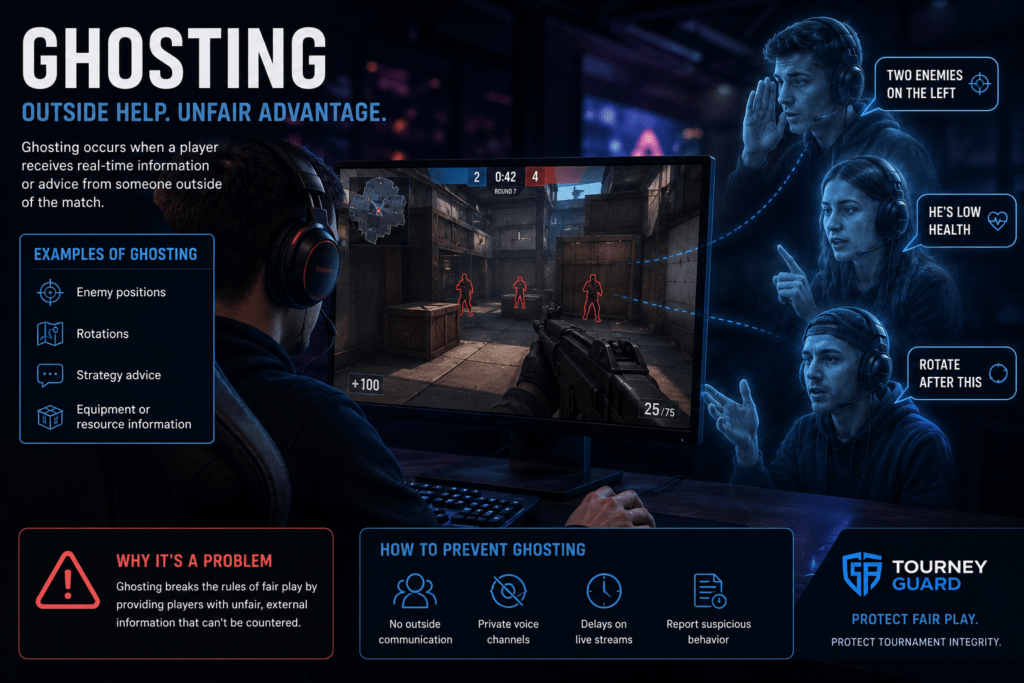
7. Ghosting
Ghosting occurs when a player receives outside assistance during an active match.
This assistance may come from:
- Spectators.
- Eliminated teammates.
- Coaches.
- Friends.
- Live chat.
Examples include:
- Revealing enemy locations.
- Suggesting tactical decisions.
- Warning about hidden opponents.
Unlike software-based cheating, ghosting is difficult for anti-cheat tools to detect.
Tournament staff often rely on:
- Evidence collection.
- Match recordings.
- Player reports.
- Communication policies.
8. Match Fixing
Match fixing represents one of the most serious threats to Competitive Integrity.
Instead of trying to win, players intentionally manipulate match outcomes.
Reasons may include:
- Gambling.
- Financial incentives.
- Team collusion.
- Bracket manipulation.
- Personal agreements.
Unlike traditional cheating, match fixing rarely involves unauthorized software.
Instead, organizers investigate:
- Betting patterns.
- Suspicious gameplay.
- Historical performance.
- Player communications.
- Match statistics.
Professional tournament governance is essential for identifying these cases.


9. Hardware and Peripheral Exploits
Not every unfair advantage comes from software.
Some competitors attempt to exploit hardware by using:
- Macro-enabled keyboards.
- Modified controllers.
- Unauthorized firmware.
- Rapid-fire devices.
- Hardware scripts.
Depending on tournament rules, some of these devices may violate competition policies.
Organizers should clearly define permitted equipment before the tournament begins.
Hardware inspections and standardized regulations help reduce disputes.
10. Administrative Abuse and Rule Violations
One of the least discussed—but most damaging—forms of tournament misconduct involves administrative inconsistencies.
Examples include:
- Inconsistent penalties.
- Lost evidence.
- Poor documentation.
- Missing incident reports.
- Unclear referee decisions.
- Failure to follow tournament procedures.
Even when no player cheats, poor administration can undermine the credibility of an event.
This is why professional organizers invest in standardized operational processes.
Transparent governance protects both competitors and tournament staff.
While these are the most common Types of Cheating in Esports Tournaments, organizers should remember that new integrity threats continue to emerge as competitive gaming evolves.
Comparison Table
| Type of Cheating | Can Anti-Cheat Detect It? | Requires Tournament Operations? |
|---|---|---|
| Aimbots | ✅ Yes | ✅ Yes |
| Wallhacks | ✅ Yes | ✅ Yes |
| ESP | ✅ Yes | ✅ Yes |
| Account Sharing | ❌ No | ✅ Yes |
| Smurfing | ❌ No | ✅ Yes |
| Stream Sniping | ❌ No | ✅ Yes |
| Ghosting | ❌ No | ✅ Yes |
| Match Fixing | ❌ No | ✅ Yes |
| Hardware Exploits | ⚠️ Sometimes | ✅ Yes |
| Administrative Abuse | ❌ No | ✅ Yes |
Why Tournament Integrity Goes Beyond Anti-Cheat
Looking at these ten examples, one conclusion becomes clear:
Most integrity threats cannot be solved by anti-cheat software alone.
While anti-cheat technology remains an essential layer of tournament protection, organizers also need structured operational processes that support fair competition from registration to final results.
Tournament Integrity includes:
- Rule enforcement.
- Incident reporting.
- Evidence management.
- Investigation workflows.
- Appeals.
- Administrative transparency.
- Consistent decision-making.
Technology supports these processes—but it does not replace them.
Professional tournaments combine technical security with operational excellence to create competitions that players, teams, and sponsors can trust.
How to Prevent Types of Cheating in Esports Tournaments
Building a fair tournament requires more than reacting to problems.
Experienced organizers focus on prevention.
Some recommended practices include:
- Establish clear tournament rules.
- Verify player identities.
- Standardize incident reporting.
- Collect evidence consistently.
- Document every administrative decision.
- Maintain transparent investigation procedures.
- Review suspicious matches objectively.
- Use technology to organize tournament operations.
When these practices are applied consistently, organizers significantly reduce disputes while strengthening confidence in the competition.
How Tourney Guard Helps Tournament Organizers
Recognizing the different forms of cheating is only the first step toward protecting competitive integrity.
The real challenge begins after an incident is reported.
Tournament organizers must collect evidence, review the facts, document administrative decisions, communicate with players, and maintain a transparent history of every case. These operational responsibilities are essential for building trust, yet they are often managed through spreadsheets, messaging applications, or disconnected tools.
Tourney Guard was created to help organizers professionalize these processes.
Rather than focusing exclusively on cheat detection, Tourney Guard supports the operational side of Tournament Integrity, helping administrators establish structured workflows that improve consistency, transparency, and accountability.
With Tourney Guard, organizers can:
- Centralize tournament incident reports.
- Organize screenshots, videos, and match evidence.
- Document investigations from start to finish.
- Maintain complete audit trails.
- Standardize administrative workflows.
- Record referee decisions.
- Improve communication between tournament staff.
- Strengthen transparency for players, teams, and sponsors.
Tournament Integrity is built through consistent operations—not only through technical detection.
Final Thoughts
Cheating continues to evolve alongside competitive gaming.
While technologies such as anti-cheat software remain essential for detecting technical violations, they cannot address every challenge faced by tournament organizers.
Account sharing, stream sniping, ghosting, match manipulation, administrative mistakes, and inconsistent rule enforcement all require operational processes supported by evidence, governance, and transparent decision-making.
Professional esports tournaments succeed because they combine multiple layers of protection.
They invest in technology.
They establish clear rules.
They document incidents carefully.
They investigate fairly.
Most importantly, they build trust within their competitive communities.
Tournament Integrity is not about catching every cheater.
It is about creating competitions where fairness, accountability, and transparency become the standard.
Ready to Protect Your Tournament?
Strengthen tournament integrity with better incident management, evidence collection, and transparent decision-making.
Understanding the different Types of Cheating in Esports Tournaments allows organizers to create stronger policies, improve investigations, and build more trusted competitions.
Frequently Asked Questions (FAQ)
What is the most common type of cheating in esports tournaments?
Software-based cheats such as aimbots and wallhacks remain among the most recognized forms of cheating. However, operational issues like account sharing, stream sniping, ghosting, and match manipulation are increasingly significant because they are much harder to detect automatically and often require structured tournament administration.
Can anti-cheat software detect every type of cheating?
No.
Anti-cheat systems primarily detect unauthorized software and suspicious client behavior.
Many integrity threats—including account sharing, match fixing, ghosting, and administrative inconsistencies—require investigation, evidence collection, and operational procedures rather than software detection.
What is Tournament Integrity?
Tournament Integrity refers to the collection of policies, operational processes, technologies, and governance practices that ensure esports competitions remain fair, transparent, and trustworthy.
It includes much more than anti-cheat software.
Why is account sharing considered cheating?
Account sharing allows someone other than the registered competitor to participate in a tournament.
This creates an unfair competitive advantage, violates tournament rules, and undermines the credibility of the event.
Professional organizers typically prevent this through identity verification and registration controls.
How can organizers reduce cheating during online tournaments?
Organizers can strengthen tournament integrity by combining anti-cheat technology with clear tournament rules, player verification, structured incident reporting, evidence collection, transparent investigations, and consistent administrative procedures.
A layered approach provides much stronger protection than relying on technology alone.
Why is evidence collection important?
Evidence allows organizers to make objective decisions.
Screenshots, videos, replay files, server logs, referee observations, and player reports provide factual information that supports transparent investigations and reduces disputes.
Does Tournament Integrity only matter for professional events?
No.
Community tournaments, collegiate leagues, amateur competitions, and professional championships all benefit from consistent administration, fair rules, and transparent decision-making.
Strong Tournament Integrity improves player confidence regardless of tournament size.
Learn More About Esports Integrity
For additional information about competitive integrity standards, organizers should explore resources from:
- Esports Integrity Commission (ESIC)
- International Esports Federation (IESF)
These organizations provide valuable guidance on governance, fair competition, disciplinary processes, and integrity standards across the esports ecosystem.
By recognizing the most common Types of Cheating in Esports Tournaments, organizers can strengthen Tournament Integrity and create fairer competitions for everyone involved.
Suggested External Links
- Esports Integrity Commission (ESIC)
- International Esports Federation (IESF)
- Official tournament rulebooks for the specific game being discussed (Valorant, Counter-Strike 2, League of Legends, Rocket League, Fortnite, etc.)