
Introduction
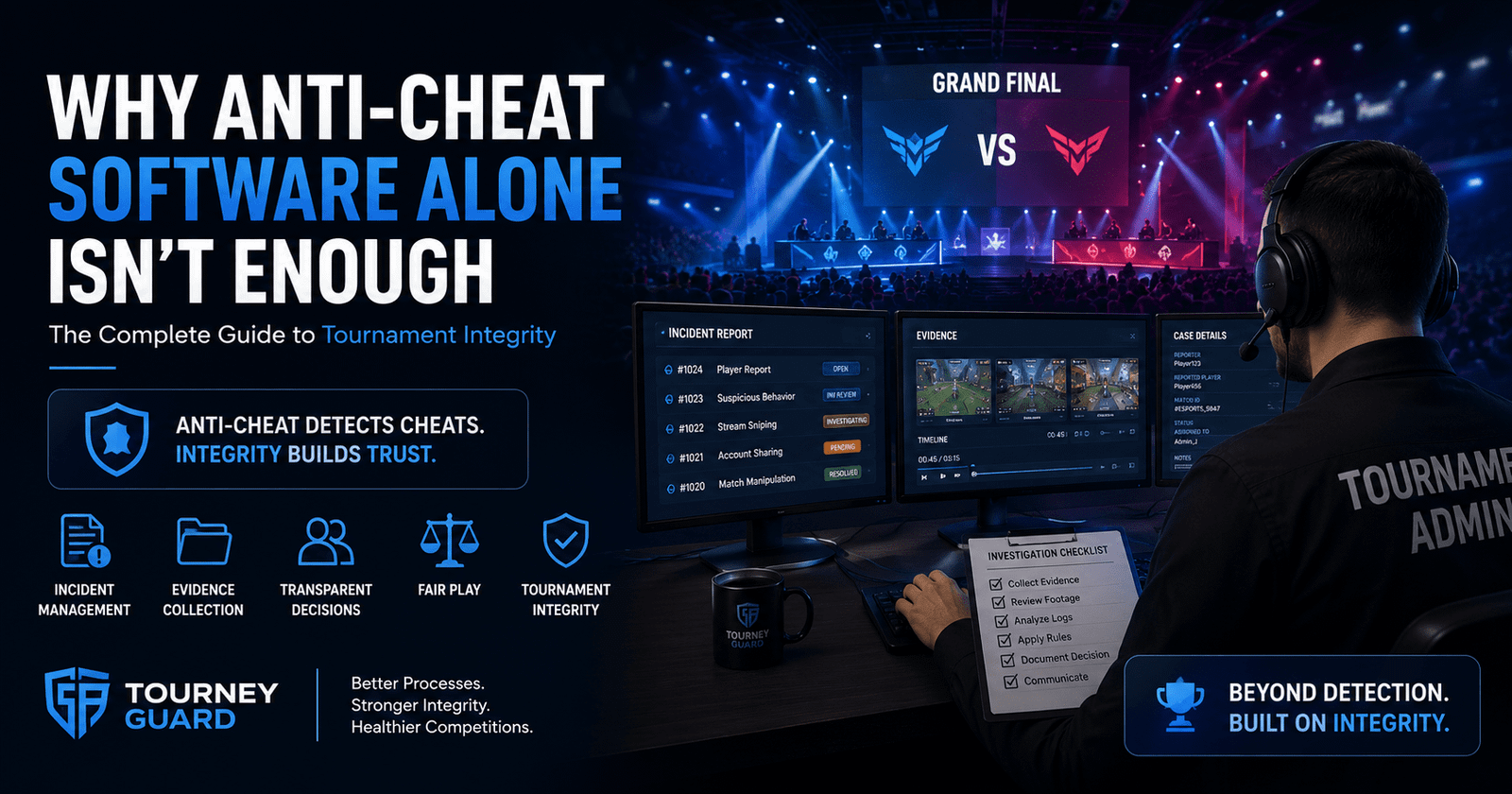
Every esports organizer wants the same outcome: fair, competitive, and trustworthy tournaments.
To achieve that goal, many organizations invest in anti-cheat software, believing it is the ultimate solution for protecting competitive events. While anti-cheat systems play an important role in detecting unauthorized software and suspicious player behavior, they represent only one piece of a much larger picture.
Modern esports tournaments face challenges that extend far beyond software-based cheating. Organizers must manage player reports, investigate incidents, collect evidence, enforce tournament rules, document decisions, and ensure that every action taken is transparent and consistent.
This broader approach is known as Tournament Integrity.
A tournament can use the most advanced anti-cheat technology available and still suffer from disputes, administrative mistakes, unfair rulings, account sharing, match manipulation, or poor incident management. These issues can damage player trust, discourage sponsors, and harm the reputation of an event—even when no cheating software is detected.
Professional tournament organizers understand that protecting competitive integrity requires more than technology. It requires structured processes, clear governance, and reliable operational workflows that support fair decision-making throughout the entire tournament lifecycle.
In this guide, we’ll explore the limitations of anti-cheat software, explain why tournament integrity extends far beyond cheat detection, and share best practices for building competitions that players, teams, and sponsors can genuinely trust.



What Does Anti-Cheat Software Actually Do?
Anti-cheat software is designed to detect and prevent players from gaining an unfair advantage through unauthorized software or system modifications. It plays a critical role in maintaining the technical fairness of online competitions and has become a standard component of many competitive games.
Depending on the game and the technology used, anti-cheat solutions can identify activities such as:
- Aimbots
- Wallhacks
- ESP (Extra Sensory Perception)
- Memory manipulation
- Unauthorized overlays
- Automation scripts
- Modified game files
- Suspicious client behavior
These systems continuously monitor player environments to detect known cheat signatures, suspicious processes, or abnormal gameplay patterns. When violations are identified, organizers or game publishers can issue warnings, remove players from matches, or apply permanent bans.
Without anti-cheat software, competitive gaming would be significantly more vulnerable to technical forms of cheating.
However, focusing exclusively on cheat detection creates a dangerous misconception: that every tournament integrity problem can be solved by anti-cheat technology.
In reality, many of the most challenging issues organizers face have little or nothing to do with software-based cheating. They involve people, processes, governance, and operational decision-making—areas where anti-cheat solutions offer little or no support.
The next section explores these limitations and explains why tournament integrity requires a much broader strategy than simply detecting cheats.
The Limitations of Anti-Cheat Systems
Anti-cheat software is one of the most valuable technologies available for competitive gaming, but it was never designed to solve every integrity challenge an esports tournament may encounter.
Its primary objective is to detect unauthorized software or suspicious activity on a player’s device. While this significantly reduces technical cheating, many tournament issues occur outside the scope of what an anti-cheat system can observe.
For example, anti-cheat software cannot determine whether:
- A player intentionally lost a match.
- Someone else played using another competitor’s account.
- Tournament officials applied the rules consistently.
- Evidence supporting a report was properly reviewed.
- An appeal followed the tournament’s official procedures.
- A referee documented a disciplinary decision correctly.
These situations directly impact Competitive Integrity, yet they require operational processes rather than software detection.
This is why experienced organizers treat anti-cheat as one layer within a broader integrity strategy—not as the strategy itself.
Tournament Integrity Is Much More Than Cheat Detection
Tournament Integrity is an operational framework that ensures competitions remain fair, transparent, and accountable from registration through the final match.
Instead of focusing only on technical violations, it considers every aspect that influences competitive fairness.
A comprehensive Tournament Integrity program typically includes:
- Clear tournament regulations.
- Player eligibility verification.
- Incident reporting procedures.
- Evidence collection standards.
- Match review workflows.
- Appeals management.
- Transparent disciplinary decisions.
- Audit trails for administrative actions.
- Consistent enforcement of tournament policies.
Each of these elements contributes to building confidence among players, teams, sponsors, and spectators.
Without these operational practices, even tournaments using excellent anti-cheat software can lose credibility.
Common Tournament Risks That Anti-Cheat Cannot Prevent
Understanding these risks helps organizers appreciate why Tournament Integrity requires more than software detection.
Account Sharing
Account sharing occurs when someone other than the registered competitor participates in a tournament.
This practice can provide unfair competitive advantages while remaining completely invisible to traditional anti-cheat systems.
Effective prevention requires:
- Identity verification
- Registration controls
- Tournament administration procedures
- Player validation before matches
Match Manipulation
Sometimes competitors intentionally influence match outcomes for personal or financial reasons.
Examples include:
- Deliberately losing matches
- Coordinating results
- Team collusion
- Bracket manipulation
Anti-cheat software cannot determine player intent.
Instead, organizers need:
- Match analysis
- Historical review
- Evidence collection
- Administrative investigations
Stream Sniping
Watching tournament broadcasts during live competition to obtain strategic information creates an unfair advantage.
Although game developers may introduce delays, tournament staff must also implement operational policies that minimize these risks.


Ghosting
Receiving unauthorized assistance from teammates, coaches, or spectators during active competition can significantly alter match outcomes.
Preventing ghosting often depends on:
- Tournament rules
- Referee supervision
- Communication policies
- Incident reporting
Not anti-cheat technology.
Smurfing
Highly skilled players entering lower-ranked tournaments damage competitive balance.
Preventing smurfing frequently requires:
- Account verification
- Ranking validation
- Manual review
- Historical player analysis
Again, these are administrative processes rather than software detection.
Administrative Errors
One of the most overlooked threats to tournament integrity is human error.
Examples include:
- Incorrect penalties
- Missing evidence
- Lost reports
- Inconsistent rulings
- Poor documentation
- Unclear communication
Even perfectly fair matches can become controversial if organizers cannot explain or justify their decisions.
Building a Complete Tournament Integrity Strategy
Protecting a tournament requires multiple layers working together.
Think of Tournament Integrity as a security ecosystem rather than a single technology.
A mature integrity strategy combines several components.
1. Clear Tournament Rules
Every participant should understand:
- Eligibility requirements
- Match procedures
- Allowed software
- Reporting deadlines
- Penalties
- Appeals process
Well-written rules reduce misunderstandings before they become disputes.
2. Identity Verification
Knowing who is actually competing protects tournaments against:
- Account sharing
- Unauthorized substitutions
- Fake registrations
- Impersonation
Identity verification becomes increasingly important as prize pools grow.
3. Structured Incident Reporting
Players need an easy way to report concerns.
A standardized report should include:
- Match ID
- Player information
- Description of the incident
- Evidence submitted
- Time of occurrence
- Supporting files
Standardization improves investigation quality.
4. Evidence Collection
Tournament decisions should rely on facts rather than opinions.
Useful evidence includes:
- Match recordings
- Screenshots
- Replay files
- Chat logs
- Referee notes
- System logs
Proper evidence management improves transparency and consistency.
5. Investigation Workflow
Every report should follow a repeatable process.
For example:
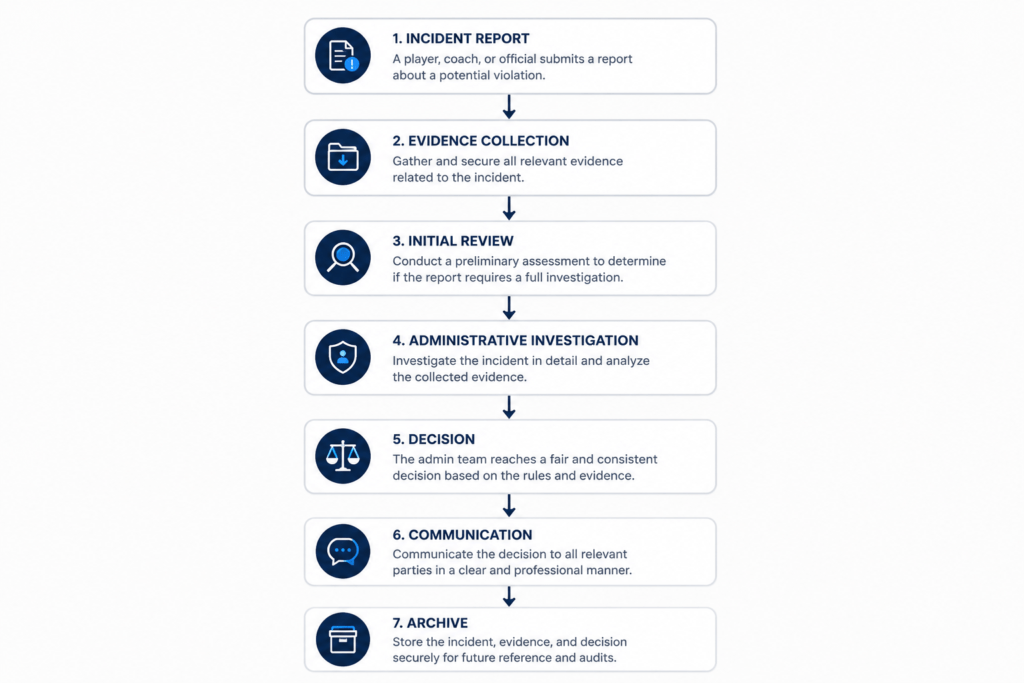
A consistent workflow ensures similar situations receive similar treatment.
6. Decision Documentation
Every administrative decision should answer four questions:
- What happened?
- What evidence was reviewed?
- Which tournament rule applied?
- Why was this decision made?
Documenting these answers builds trust and simplifies future reviews.
7. Appeals Process
Mistakes happen.
Players should have access to a fair and transparent appeals process.
An effective appeals system protects:
- Tournament credibility
- Player confidence
- Administrative accountability
Technology Supports the Process—It Doesn’t Replace It
Technology should empower tournament administrators rather than replace their judgment.
The best platforms help organizers:
- Organize incident reports
- Store evidence securely
- Track investigations
- Maintain audit logs
- Document referee decisions
- Improve communication
- Ensure procedural consistency
Human expertise remains essential, but technology makes those processes more efficient, transparent, and scalable.
Why Trust Matters More Than Detection
The ultimate goal of Tournament Integrity is not simply identifying cheaters.
It is building trust.
Players want confidence that every match follows the same standards.
Sponsors want assurance that their brand is associated with professional competitions.
Referees need reliable tools that support objective decision-making.
Communities expect transparency when disputes arise.
Trust is earned through consistency, documentation, and fairness—not merely through software that detects cheats.
This distinction separates well-managed tournaments from competitions that struggle with credibility, regardless of the technology they use.
How Tourney Guard Helps Tournament Organizers
Maintaining tournament integrity requires more than responding to incidents—it requires structured operations that promote consistency, transparency, and accountability throughout the competition.
Tourney Guard is designed to support tournament organizers by providing a centralized platform for managing the operational aspects of competitive integrity.
Rather than focusing solely on cheat detection, Tourney Guard helps organizers establish standardized processes that improve tournament administration from beginning to end.
With Tourney Guard, organizers can:
- Centralize tournament incident reports.
- Organize evidence in a structured repository.
- Track investigations throughout their lifecycle.
- Document referee and administrator decisions.
- Maintain complete audit trails.
- Standardize incident review workflows.
- Improve transparency across tournament operations.
- Strengthen player and sponsor confidence.
By combining operational best practices with modern tournament management tools, organizers can create competitions that are not only secure—but also trusted.
Final Thoughts
Anti-cheat software remains an essential component of competitive gaming, but it should never be considered the complete solution for protecting esports tournaments.
The reality is that many of the most significant threats to competitive integrity—such as account sharing, match manipulation, inconsistent rule enforcement, poor documentation, and inadequate incident management—cannot be prevented through software detection alone.
Professional tournament organizers understand that integrity is built through a combination of technology, governance, operational discipline, and transparent decision-making.
By implementing structured tournament workflows, documenting every important decision, and managing incidents consistently, organizers create competitions where players feel respected, sponsors feel confident, and communities trust the results.
Tournament Integrity is not simply about catching cheaters.
It is about creating an environment where fairness becomes the foundation of every competition.
Ready to Protect Your Tournament?
Strengthen tournament integrity with better incident management, evidence collection, and transparent decision-making.
Frequently Asked Questions (FAQ)
Is anti-cheat software enough to protect an esports tournament?
No. Anti-cheat software primarily detects unauthorized software and technical cheating. However, tournament integrity also requires incident management, evidence collection, player verification, rule enforcement, and transparent administrative processes.
What is the difference between anti-cheat software and Tournament Integrity?
Anti-cheat software focuses on detecting technical cheating, while Tournament Integrity covers the entire operational framework required to ensure fair competition, including policies, investigations, evidence management, and administrative transparency.
Can anti-cheat software detect account sharing?
In most cases, no. Preventing account sharing generally requires identity verification, registration controls, administrative review, and tournament policies rather than cheat detection technology.
Why is incident management important in esports tournaments?
Incident management ensures that player reports are handled consistently, evidence is properly reviewed, and tournament decisions are documented transparently. This strengthens trust among players, referees, and sponsors.
What are the biggest threats that anti-cheat software cannot prevent?
Some of the most common risks include:
- Account sharing
- Match manipulation
- Ghosting
- Stream sniping
- Administrative errors
- Inconsistent rule enforcement
- Poor evidence management
These issues require operational processes rather than technical detection.
How can organizers improve Tournament Integrity?
Tournament organizers should establish clear rules, verify participants, standardize incident reporting, collect evidence consistently, document decisions, provide appeals processes, and use technology that supports transparent tournament operations.
Does Tournament Integrity benefit small community tournaments?
Absolutely.
Whether a tournament has 16 players or 10,000 participants, consistent administration, fair rules, and transparent incident management improve player confidence and create a more professional competitive experience.





One Comment