
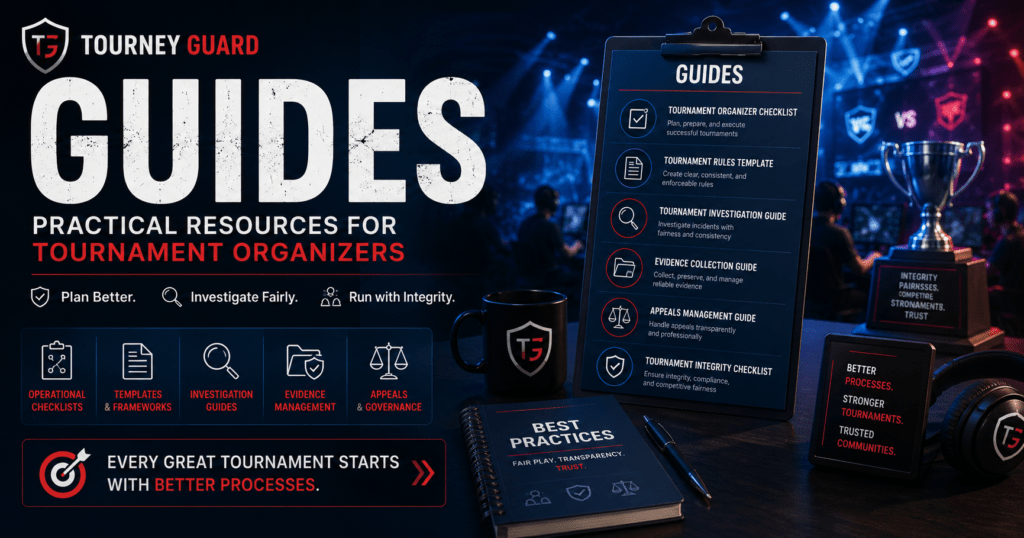
Practical Resources for Tournament Organizers
Whether you’re organizing your first community tournament or managing a professional esports competition, success depends on more than creating brackets and scheduling matches. Behind every well-run tournament are structured operational processes, consistent rule enforcement, clear communication, and transparent decision-making.
The Tourney Guard Guides section brings together practical, step-by-step resources designed specifically for tournament organizers, referees, administrators, integrity officers, and esports communities.
Unlike news articles or opinion pieces, these guides focus on actionable processes that can be implemented before, during, and after a tournament. Each guide is written to help organizers strengthen Tournament Operations, improve Tournament Integrity, and deliver fair, professional competitions.
As the Tourney Guard Knowledge Hub continues to grow, this section will become a comprehensive library of operational playbooks, checklists, templates, and best practices for esports tournament management.


Why Practical Guides Matter
Running an esports tournament requires balancing competition, administration, communication, and governance.
Organizers often face questions such as:
- How should tournament rules be written?
- What information should be collected during registration?
- How should tournament incidents be investigated?
- What evidence should administrators preserve?
- How should player appeals be reviewed?
- How can tournaments improve after every event?
These are operational challenges rather than technical ones.
The purpose of this Guides section is to answer those questions with structured, practical resources based on Tournament Operations and Tournament Integrity principles.
Featured Guides
Tournament Organizer Checklist
Status: Coming Soon
A complete operational checklist covering planning, staffing, scheduling, communications, Tournament Integrity, and post-event review.
Tournament Rules Template
Status: Coming Soon
Learn how to create clear, enforceable tournament rules that reduce disputes and improve administrative consistency.
Tournament Investigation Guide
Status: Coming Soon
A step-by-step framework for conducting administrative investigations while preserving fairness, documentation, and procedural consistency.
Evidence Collection Guide
Status: Coming Soon
Discover best practices for identifying, preserving, documenting, and managing evidence during tournament investigations.
Appeals Management Guide
Status: Coming Soon
Understand how structured appeal procedures strengthen transparency, consistency, and participant confidence.
Tournament Integrity Checklist
Status: Coming Soon
Review the operational controls that help organizers build fair, transparent, and trusted esports competitions.
Tournament Organizer Learning Path
If you’re new to Tournament Operations, we recommend exploring the Knowledge Hub in the following order:
Step 1
Learn the foundations of Tournament Integrity.
Understand why integrity is essential for fair competition and how it influences every operational decision.
Step 2
Explore Tournament Operations.
Learn how tournaments are planned, administered, monitored, and continuously improved.
Step 3
Understand Incident Management.
Discover how tournament incidents should be reported, investigated, documented, and resolved.
Step 4
Master Evidence Collection.
Learn how reliable evidence supports investigations, appeals, and transparent administrative decisions.
Step 5
Apply Practical Guides.
Use the templates, checklists, and operational playbooks published in this section to improve your own tournaments.
Why These Guides Are Different
Many online tournament resources focus exclusively on gameplay, brackets, or software platforms.
The Tourney Guard Guides take a different approach.
Every guide emphasizes:
- Tournament Operations
- Tournament Integrity
- Governance
- Administrative consistency
- Documentation
- Evidence-based decision-making
- Continuous improvement
Our objective is to help tournament organizers develop repeatable operational processes that scale from community events to professional competitions.
Explore the Knowledge Hub
These guides are designed to complement the Tourney Guard Knowledge Hub.
Recommended starting points include:
- What Is Tournament Integrity?
- Tournament Integrity vs Competitive Integrity
- Types of Cheating
- Anti-Cheat Isn’t Enough
- Tournament Operations
- Incident Management
- How to Run a Tournament
- Evidence Collection
Together, these resources provide a structured learning path covering the operational, administrative, and integrity aspects of esports tournaments.


Professional tournaments are built on repeatable operational processes rather than improvisation.
As new guides are published, this section will continue to expand with practical frameworks, templates, operational checklists, and educational resources that help tournament organizers strengthen Tournament Integrity through better Tournament Operations.
Whether you organize local competitions or professional circuits, the Tourney Guard Guides are designed to help you build tournaments that are fair, transparent, and trusted.
Frequently Asked Questions
Who are these guides for?
Tournament organizers, referees, administrators, esports communities, educational institutions, leagues, and anyone responsible for managing esports competitions.
Are these guides specific to one game?
No.
The operational principles described throughout the Guides are applicable across multiple esports titles and tournament formats.
Are the guides free?
Yes.
The educational content published in the Tourney Guard Knowledge Hub is intended to help organizers improve their Tournament Operations and Tournament Integrity practices.
Will more guides be added?
Absolutely.
This library will continue growing with practical resources covering tournament governance, investigations, compliance, evidence collection, checklists, templates, and operational best practices.
Conclusion
Great tournaments are not created by chance—they are built through preparation, consistency, and well-defined operational processes.
The Tourney Guard Guides bring together practical knowledge that helps organizers transform Tournament Operations into repeatable workflows that support fairness, transparency, and Tournament Integrity.
Whether you are planning your first community event or refining an established competitive circuit, these resources are designed to help you organize better tournaments with confidence.
Recommended External Resources
The following organizations provide valuable guidance for tournament organizers and operational professionals:
- Esports Integrity Commission (ESIC) – Standards, codes of conduct, investigations, and integrity initiatives.
- International Olympic Committee (IOC) – Integrity frameworks applicable to competitive sports governance.
- International Betting Integrity Association (IBIA) – Best practices for integrity monitoring.
- NIST Cybersecurity Framework – Guidance for security governance and risk management.
- ISO 37301 Compliance Management Systems – International compliance management principles.
- World Anti-Doping Agency (WADA) – Governance and disciplinary process principles applicable beyond traditional sports.
Suggested Internal Links
Strengthen your internal linking strategy by connecting this article with: