
Introduction
Competitive gaming has evolved into a global industry where professional players, tournament organizers, publishers, sponsors, and communities all depend on one essential principle: fair competition. Regardless of whether an event is a local LAN tournament or an international championship, participants expect every match to be decided by skill, teamwork, preparation, and strategy—not by unfair advantages.
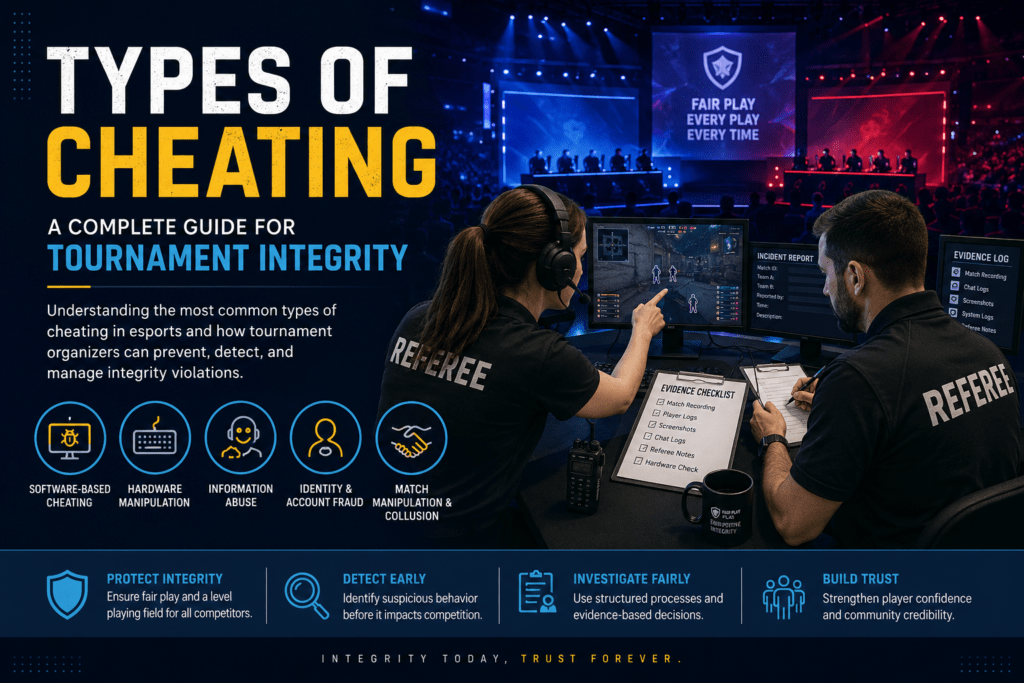
Understanding the different Types of Cheating is therefore one of the most important responsibilities for tournament organizers and administrators. Cheating is no longer limited to obvious software modifications. Modern esports events face a broad range of integrity risks that include hardware manipulation, unauthorized assistance, information leaks, identity fraud, collusion, and administrative misconduct.
For organizers, recognizing these threats is only the first step. Maintaining Tournament Integrity requires consistent governance, transparent incident management, structured investigations, proper evidence collection, and documented decision-making processes. These operational practices help preserve competitive fairness while protecting the reputation of tournaments and the trust of players and spectators.
This guide explains the most common Types of Cheating found in esports competitions, why they matter, how they affect tournament operations, and what organizers can do to minimize risks before, during, and after every event.



Key Takeaways
- Cheating extends far beyond software hacks.
- Tournament Integrity depends on governance, not only technology.
- Incident management should follow standardized procedures.
- Evidence collection is essential before disciplinary decisions.
- Transparent investigations improve trust among players and communities.
- Preventive policies are significantly more effective than reactive enforcement.
- Every tournament should establish documented integrity workflows before competition begins.
Executive Summary
The esports ecosystem has become increasingly sophisticated, creating new opportunities for competitive excellence but also introducing more complex integrity risks. While many people associate cheating exclusively with unauthorized software, tournament organizers regularly encounter multiple forms of misconduct that can compromise competitive fairness.
This guide classifies the primary Types of Cheating affecting esports competitions, explains their operational impact, and presents practical recommendations for tournament administrators. Rather than focusing on technical detection methods, the article emphasizes governance, evidence management, administrative investigations, and transparent decision-making—core elements of sustainable Tournament Integrity.
Main Guide
What Are Types of Cheating?
Types of Cheating are the different methods competitors or participants use to gain an unfair advantage by violating tournament rules or competitive standards.
Cheating is any intentional action that compromises competitive fairness. While the techniques vary between games and tournament formats, they all undermine the integrity of competition by giving one participant an advantage that other competitors cannot legitimately obtain.
For tournament organizers, understanding these categories is essential because every type of misconduct requires different operational responses, investigation procedures, and disciplinary actions.
Why It Matters
Tournament Integrity depends on participant confidence. Players, sponsors, publishers, broadcasters, and audiences expect results to reflect legitimate competition. When cheating incidents are poorly managed—or ignored entirely—trust deteriorates quickly.
Beyond competitive fairness, unresolved integrity issues can lead to:
- Reputational damage
- Community distrust
- Sponsor concerns
- Appeals and disputes
- Administrative delays
- Loss of competitive credibility
Benefits of Understanding Cheating Categories
| Benefit | Operational Impact |
|---|---|
| Faster investigations | Incidents can be classified immediately |
| Better evidence collection | Investigators know what evidence to preserve |
| Consistent rulings | Similar violations receive similar penalties |
| Improved governance | Policies become easier to enforce |
Common Mistake
Many organizers assume every integrity incident is a technical problem. In reality, numerous violations involve operational failures, inadequate procedures, or human misconduct rather than software abuse.
Practical Example
A tournament administrator receives a complaint that a player repeatedly leaves voice communications during matches.
Instead of assuming technical issues, the investigation reviews communications, timing, referee reports, and tournament rules. The incident ultimately reveals unauthorized coaching rather than connection problems.
Suggested Internal Link
Incident Management in Esports
Related Topic
Competitive Integrity
Why Tournament Integrity Depends on Understanding Types of Cheating
Tournament Integrity is strengthened when organizers recognize how different forms of cheating affect competitive operations and establish consistent response procedures.
Preventing unfair competition is only one aspect of integrity management. Organizers must also ensure that every allegation receives a structured, transparent, and evidence-based review.
Different categories of misconduct present different operational risks:
| Category | Primary Risk |
| Software abuse | Unfair gameplay advantage |
| Information leaks | Strategic imbalance |
| Identity fraud | Ineligible participation |
| Match manipulation | Competition credibility |
| Administrative misconduct | Governance failure |
Organizations that classify incidents consistently can develop standardized investigation workflows, reducing subjectivity and improving transparency.
Best Practices
- Define prohibited behaviors before registration opens.
- Publish tournament integrity policies.
- Train referees on incident reporting.
- Preserve evidence before making decisions.
- Maintain investigation documentation.
- Establish an appeals process.
Common Mistake
Applying inconsistent penalties for similar violations creates uncertainty and damages community confidence, even when the original investigation was correct.
Practical Example
Two separate tournaments encounter accusations of unauthorized coaching. One organizer issues immediate disqualifications without investigation, while another collects communications, referee observations, and player statements before reaching a documented decision.
The second approach is more likely to withstand appeals because the process—not only the outcome—is transparent.
Suggested Internal Link
Administrative Investigations
Related Topic
Evidence Collection
Categories of Types of Cheating in Esports
Most Types of Cheating fall into several operational categories, each requiring different prevention strategies and investigation methods.
Rather than treating every incident equally, tournament administrators should classify misconduct according to its characteristics.
| Category | Description | Investigation Priority |
| Software-Based | Unauthorized software or game modifications | High |
| Hardware-Based | Physical device manipulation | High |
| Information Abuse | Receiving restricted information | High |
| Identity Fraud | Account or player misrepresentation | Medium |
| Match Manipulation | Predetermined outcomes or collusion | Critical |
| Administrative Misconduct | Abuse of tournament authority | High |
This classification helps investigators identify appropriate evidence sources, determine affected stakeholders, and apply consistent disciplinary procedures.
Ready to Protect Your Tournament?
Strengthen tournament integrity with better incident management, evidence collection, and transparent decision-making.
Software-Based Cheating
Software-based cheating involves unauthorized applications or modifications that provide an unfair gameplay advantage.
Although software abuse is one of the most recognized Types of Cheating, it represents only one part of the broader Tournament Integrity landscape.
Examples include:
- Unauthorized game modifications
- Automated gameplay assistance
- Memory manipulation
- Input automation
- Script-based actions
- Unauthorized overlays
Benefits of Clear Policies
Clearly documented software policies reduce disputes because participants understand prohibited behavior before competition begins.
Challenges
Software investigations often require collaboration with publishers, platform operators, or technical staff while maintaining procedural fairness.
Best Practices
- Publish prohibited software lists.
- Require official tournament clients when applicable.
- Record administrative actions.
- Preserve logs and reports.
- Document every investigation step.
Common Mistake
Relying solely on accusations without collecting supporting evidence can result in inconsistent disciplinary decisions and unnecessary appeals.
Practical Example
During an online qualifier, referees receive multiple reports about unusual player behavior. Rather than issuing an immediate sanction, officials collect replay data, match logs, participant statements, and administrative records before initiating a formal integrity review.
Suggested Internal Link
Evidence Collection in Esports Investigations
Related Topic
Tournament Governance
Hardware Manipulation
Hardware manipulation involves the use of physical devices or equipment modifications that provide an unfair competitive advantage.
While discussions about cheating often focus on software, hardware-based violations remain a significant concern for both online and LAN tournaments. Some devices or configurations may bypass tournament policies while still providing measurable competitive benefits.
Examples include:
- Unauthorized input devices
- Modified controllers
- Macro-enabled keyboards
- Rapid-fire peripherals
- Hardware adapters that emulate legitimate devices
- Unapproved monitor or display configurations
Hardware manipulation can be difficult to detect without standardized equipment inspections and documented pre-match procedures.
Why It Matters
Unlike software-based violations, hardware manipulation may not leave obvious digital evidence. Tournament administrators must therefore rely on equipment inspections, referee observations, device inventories, and documented tournament policies.
Benefits of Standardized Hardware Controls
| Practice | Benefit |
|---|---|
| Equipment inspections | Reduces unauthorized devices |
| Approved hardware list | Simplifies compliance |
| Device registration | Improves traceability |
| Random inspections | Discourages intentional violations |



Common Mistake
Allowing players to replace equipment during a match without documenting the change creates uncertainty if an integrity incident occurs later.
Practical Example
A player requests to replace a malfunctioning mouse during playoffs. Instead of allowing an immediate swap, officials verify the replacement device, document its serial number, notify both teams, and update the match record before competition resumes.
Suggested Internal Link
Tournament Equipment Policies
Related Topic
Tournament Operations
Information Abuse
Information abuse occurs when competitors gain access to information they should not legitimately possess during a tournament.
Competitive decisions should be based solely on skill, communication, and game knowledge. Any external source of restricted information undermines competitive fairness.
Common examples include:
- Unauthorized coaching during live matches
- Stream sniping
- Spectator information leaks
- Observer abuse
- Referee information leaks
- Unauthorized communication with eliminated teammates
Why It Matters
Many integrity investigations involve information abuse rather than technical cheating. These incidents often require reviewing communication logs, broadcast delays, referee reports, and witness statements.
Best Practices
- Establish spectator restrictions.
- Use broadcast delays when appropriate.
- Limit observer permissions.
- Clearly define coaching windows.
- Record official communications.
Common Mistake
Failing to define what constitutes “outside assistance” before the tournament begins.
Practical Example
During a streamed online event, officials notice a suspicious pattern of perfect rotations immediately after public broadcasts reveal opponent positions. Investigators compare timestamps, broadcast delays, and communication records before determining whether competitive information was improperly obtained.
Suggested Internal Link
Tournament Rules and Competitive Integrity
Related Topic
Incident Management
Identity and Account Fraud
Identity fraud occurs when a participant competes under false credentials or uses an account that violates tournament eligibility requirements.
Tournament organizers rely on accurate participant identification to enforce eligibility, rankings, age restrictions, regional requirements, and disciplinary actions.
Identity-related violations include:
- Account sharing
- Smurfing in restricted competitions
- False identity registration
- Ineligible player substitution
- Banned player participation through another account
Benefits of Strong Verification
| Verification Method | Integrity Benefit |
|---|---|
| Identity verification | Confirms eligibility |
| Team roster approval | Prevents unauthorized substitutions |
| Check-in procedures | Confirms participation |
| Audit logs | Supports investigations |
Challenges
Online tournaments frequently involve remote participants, making identity verification more complex than at LAN events.
Common Mistake
Verifying player identity only during registration instead of throughout the event.
Practical Example
A team qualifies for playoffs but fields a substitute who was never registered. Tournament officials compare roster submissions, match records, and check-in logs before determining whether the substitution violated competition rules.
Suggested Internal Link
Tournament Administration Best Practices
Related Topic
Governance
Match Manipulation and Collusion
Match manipulation occurs when competitors intentionally influence the outcome of a match for reasons unrelated to legitimate competition.
This category represents one of the most serious threats to Tournament Integrity because it directly attacks the credibility of competitive results.
Examples include:
- Match fixing
- Intentional losses
- Bracket manipulation
- Collusion between teams
- Coordinated tie arrangements
- Prize distribution agreements that violate tournament rules
Why It Matters
Unlike accidental rule violations, match manipulation is intentional and often organized. Investigations require substantial evidence, confidentiality, and procedural consistency.
Best Practices
- Document suspicious patterns.
- Preserve communication evidence.
- Separate allegations from conclusions.
- Conduct structured administrative investigations.
- Maintain an appeals process.
Common Mistake
Publicly accusing participants before an investigation is completed.
Practical Example
Tournament officials observe statistically unusual gameplay between two teams competing for bracket positioning. Instead of issuing immediate sanctions, investigators review match footage, communication records, previous encounters, and tournament incentives before reaching a documented conclusion.
Suggested Internal Link
Administrative Investigations
Related Topic
Evidence Collection
Best Practices
The most effective Tournament Integrity programs focus on prevention rather than reaction.
Checklist 1 — Tournament Preparation
- ☐ Publish Tournament Rules before registration.
- ☐ Define prohibited conduct.
- ☐ Train referees.
- ☐ Establish evidence procedures.
- ☐ Create an appeals policy.
- ☐ Verify player eligibility.
- ☐ Document hardware requirements.
- ☐ Prepare incident reporting forms.
Checklist 2 — During Competition
- ☐ Record integrity incidents immediately.
- ☐ Preserve evidence.
- ☐ Avoid premature conclusions.
- ☐ Maintain investigation logs.
- ☐ Apply rules consistently.
- ☐ Notify affected participants.
- ☐ Document final decisions.
Common Mistakes
Organizations frequently weaken Tournament Integrity through operational errors rather than inadequate rules.
The most common mistakes include:
- Investigating incidents without documented procedures.
- Failing to preserve evidence.
- Applying inconsistent penalties.
- Ignoring appeals.
- Communicating decisions without supporting documentation.
- Allowing undocumented referee discretion.
- Maintaining incomplete incident histories.
Avoiding these issues significantly improves both competitive fairness and organizational credibility.
Decision Framework
| Situation | Immediate Action | Investigation Required |
|---|---|---|
| Suspicious software | Preserve logs | Yes |
| Hardware complaint | Inspect device | Yes |
| Identity concern | Verify participant | Yes |
| Stream sniping allegation | Review timing | Yes |
| Match manipulation | Preserve all evidence | Critical |
| Rule misunderstanding | Clarify regulations | Case dependent |
Tournament administrators should avoid making disciplinary decisions until sufficient evidence has been collected and reviewed according to documented procedures.
Practical Examples
Scenario 1 — Unauthorized Coaching
During an online playoff match, referees receive reports that a coach continues providing strategic advice outside the permitted coaching window.
Investigation includes communication recordings, referee observations, and tournament rules.
Lesson Learned: Clearly defined coaching policies reduce disputes.
Scenario 2 — Hardware Replacement
A player replaces a peripheral during a semifinal without notifying officials.
Administrators inspect the replacement device, verify compliance, document the equipment change, and resume play only after approval.
Lesson Learned: Equipment changes should always be documented.
Scenario 3 — Identity Verification
Following a championship match, organizers receive credible information suggesting a substitute player competed under another participant’s account.
Officials compare registration records, check-in documentation, roster approvals, and match history before determining whether tournament eligibility requirements were violated.
Lesson Learned: Identity verification should continue throughout the tournament, not only during registration.
Visual Checklist
Tournament Integrity Readiness Checklist
Use the following checklist before launching any esports tournament.
Governance
- ☐ Tournament rules are publicly available.
- ☐ Eligibility requirements are clearly defined.
- ☐ Disciplinary procedures are documented.
- ☐ Appeals process has been published.
Operations
- ☐ Referees have completed integrity training.
- ☐ Incident reporting procedures are standardized.
- ☐ Match officials understand escalation protocols.
- ☐ Communication channels are documented.
Evidence Management
- ☐ Match recordings are enabled.
- ☐ Logs are retained according to policy.
- ☐ Screenshots and reports can be securely stored.
- ☐ Chain of custody procedures are documented.
Competitive Fairness
- ☐ Coaching rules are communicated.
- ☐ Equipment policies are enforced.
- ☐ Identity verification is completed.
- ☐ Broadcast delay policies are configured when required.
Learn More About Esports Integrity
To learn more about integrity standards and professional esports governance, explore resources from:
These organizations publish guidance on fair competition, governance, disciplinary procedures, and integrity standards used across the esports industry.
Suggested Internal Links
Strengthen your internal linking strategy by connecting this article with:
- What Is Tournament Integrity? A Complete Guide for Esports Organizers
- Why Anti-Cheat Software Alone Isn’t Enough for Esports Tournaments
- 10 Common Types of Cheating in Esports Tournaments


