Introduction
Video Evidence Investigations is one of the most valuable resources available to tournament officials when determining what actually occurred during a competitive incident. Unlike screenshots, which capture only a single moment, video recordings provide the sequence of events before, during, and after an incident, allowing investigators to reconstruct situations with greater accuracy and confidence.
As esports tournaments become increasingly professional, administrative investigations are expected to meet higher standards of fairness, consistency, and transparency. Players, teams, sponsors, and communities expect disciplinary decisions to be based on objective evidence rather than assumptions or incomplete information. Video evidence plays a central role in meeting these expectations because it allows tournament officials to observe player actions, game states, communication timelines, and contextual factors that static images often fail to capture.
However, simply possessing a video recording does not guarantee a fair investigation. Poor recording quality, incomplete footage, missing timestamps, selective editing, and inconsistent review procedures can all reduce the evidentiary value of video files. Tournament organizers therefore need standardized processes that define how video evidence is collected, preserved, analyzed, documented, and presented during investigations and appeals.
This guide explains how tournament administrators can establish professional Video Evidence in Tournament Investigations procedures, integrate video analysis into broader Tournament Integrity workflows, and ensure that every investigation is supported by reliable, defensible evidence.
What Is Video Evidence in Tournament Investigations?
Video Evidence in Tournament Investigations refers to the collection, preservation, analysis, and documentation of video recordings that help tournament officials evaluate alleged rule violations, resolve disputes, and support administrative investigations.
Video evidence may originate from several sources, including:
- Official tournament observer recordings
- Match replay systems
- Live broadcast recordings
- Player screen recordings
- Referee recordings
- Spectator recordings (when permitted)
- Tournament streaming archives
- Practice or scrimmage recordings (where applicable)
Unlike isolated screenshots, video recordings provide temporal continuity, allowing investigators to understand how an incident developed over time.
Rather than asking only “What does this image show?”, investigators can examine:
- What happened before the incident?
- What triggered the incident?
- How did participants respond?
- What happened immediately afterward?
- Does the sequence support or contradict witness statements?
- Were tournament rules applied correctly?
This broader perspective significantly improves the quality of administrative decision-making.
The Role of Video Evidence Within Evidence Collection
Video recordings should not replace other forms of evidence.
Instead, they form one component of a comprehensive evidence collection strategy.
A mature investigation may combine:
- Video recordings
- Match replay files
- Screenshots
- Chat logs
- Server logs
- Tournament platform records
- Referee observations
- Witness statements
- Incident reports
- Rules documentation
Professional investigations rely on multiple independent evidence sources rather than a single recording.
When several sources lead investigators toward the same conclusion, confidence in the administrative decision increases substantially.
Types of Video Evidence Used in Esports Investigations
Different recordings provide different investigative value.
Understanding these distinctions helps investigators choose the most appropriate evidence.
Official Observer Recordings
Observer recordings are often considered among the most reliable evidence sources because they are produced under tournament supervision.
Advantages include:
- Consistent quality
- Controlled recording environment
- Reliable timestamps
- Standardized camera perspectives
- Official custody
Limitations include:
- Observer may not capture every player simultaneously.
- Certain incidents may occur outside the observer’s current view.
Match Replay Files
Many competitive games provide replay systems that reconstruct matches using game data.
Replay files offer investigators:
- Multiple camera perspectives
- Timeline navigation
- Frame-by-frame review
- Player switching
- Event reconstruction
Replay systems are frequently stronger investigative resources than broadcast footage because they allow investigators to examine incidents from multiple viewpoints.
Player Recordings
Players increasingly record their own gameplay.
These recordings may capture:
- Individual perspective
- Communication overlays
- Local user interface
- Input timing
- Player reactions
However, investigators should recognize that player recordings represent only one participant’s viewpoint.
Broadcast Archives
Tournament broadcasts provide valuable historical documentation.
Benefits include:
- Independent recording source
- Public transparency
- Professional production
- Commentary timeline
- Observer perspectives
However, broadcasts often prioritize entertainment over investigation.
Important details may not always appear on stream.
Spectator Recordings
Some tournaments permit spectators to submit recordings.
These may provide useful supplementary context but require careful authentication because tournament officials typically do not control their creation or preservation.
Why Video Evidence Matters
Professional tournament governance depends on objective evidence.
Video recordings strengthen investigations for every stakeholder involved.
For Tournament Organizers
Video evidence supports:
- Consistent disciplinary decisions
- Improved investigation quality
- Greater administrative transparency
- Better documentation
- Reduced dispute resolution time
Standardized video review procedures improve organizational credibility.
For Tournament Officials
Officials benefit from:
- Clear incident reconstruction
- Multiple review opportunities
- Frame-by-frame analysis
- Better evidence correlation
- Reduced reliance on memory
Instead of making immediate judgments during live competition, investigators can carefully review recordings before reaching conclusions.
For Players
Players deserve confidence that disciplinary actions are based on reliable evidence.
Professional video review procedures promote:
- Equal treatment
- Fair investigations
- Consistent rulings
- Transparent appeals
- Reduced investigator bias
Players are more likely to accept difficult decisions when they understand those decisions are supported by objective evidence.
For Sponsors and Tournament Partners
Sponsors invest in competitions that demonstrate professionalism.
Consistent use of video evidence reflects:
- Operational maturity
- Governance standards
- Transparent investigations
- Fair competition
Strong investigative practices help protect the reputation of both tournament organizers and commercial partners.
For the Esports Community
Communities expect tournament administrators to resolve disputes fairly and objectively.
Video evidence helps reduce speculation by allowing investigators to rely on documented events rather than rumors, social media discussions, or public pressure.
This strengthens long-term confidence in tournament governance and reinforces the credibility of competitive ecosystems.
Core Principles of Video Evidence in Tournament Investigations
Professional video analysis should always follow documented investigative principles rather than individual interpretation.
The following principles establish a reliable foundation for evidence-based decision-making.
1. Authenticity
Investigators should verify that the recording accurately represents the original event.
Whenever possible, authenticity should be strengthened through:
- Original video files
- Recording source verification
- Timestamp validation
- File integrity checks
- Corroboration with replay data
Authenticity should always be established before substantive analysis begins.
2. Completeness
Partial recordings may omit critical context.
Investigators should determine whether the video captures:
- Events before the incident
- The incident itself
- Events immediately afterward
If important portions are missing, additional evidence should be collected before reaching conclusions.
3. Context
Video evidence should never be interpreted in isolation.
Investigators should consider:
- Tournament rules
- Match progression
- Previous warnings
- Communication history
- Player responsibilities
- Referee observations
Context prevents accurate footage from being interpreted incorrectly.
4. Preservation
Original recordings should remain unchanged throughout the investigation.
Recommended preservation practices include:
- Secure storage
- Original file retention
- Access controls
- Evidence identifiers
- Audit logging
- Backup procedures
Preservation protects evidentiary integrity during investigations and appeals.
5. Corroboration
Even high-quality video recordings should be supported by additional evidence whenever possible.
Investigators should compare recordings with:
- Match replays
- Server logs
- Chat records
- Screenshots
- Incident reports
- Referee notes
- Witness statements
Independent verification strengthens confidence in administrative findings.
6. Objectivity
Investigators should evaluate what the recording demonstrates—not what they expect to see.
Personal opinions, public pressure, team popularity, and social media discussions should never influence evidence analysis.
Every recording should be reviewed using the same documented standards regardless of the tournament stage or the individuals involved.
7. Consistency
Every investigation should follow an identical review methodology.
Consistent procedures help ensure that similar incidents receive similar treatment across different tournaments, investigators, and competitive divisions.
Standardization is one of the defining characteristics of professional tournament governance and is essential for maintaining trust in competitive integrity.
Establishing a Standardized Video Evidence Workflow
Professional tournament investigations require more than simply watching a recording. They require a documented workflow that ensures every video is collected, reviewed, and preserved using consistent procedures.
A recommended workflow consists of seven stages.
Stage 1 — Incident Reporting
Every investigation begins with an official incident report.
The report should include:
- Match identifier
- Tournament name
- Stage of competition
- Date and time
- Teams or players involved
- Description of the alleged violation
- Individual submitting the report
- Applicable tournament rule (if known)
At this stage, investigators should focus on documenting facts rather than drawing conclusions.
Stage 2 — Video Collection
Investigators should gather every relevant recording before beginning analysis.
Potential sources include:
- Official observer recordings
- Broadcast archives
- Match replay systems
- Player POV recordings
- Referee recordings
- Tournament production recordings
- Spectator recordings (if permitted)
Collecting multiple perspectives significantly improves the reliability of later findings.
Stage 3 — Evidence Preservation
Original recordings should be preserved immediately after collection.
Recommended preservation procedures include:
- Store original files in a secure repository.
- Assign a unique evidence identifier.
- Record submission date and time.
- Record evidence source.
- Restrict modification permissions.
- Maintain redundant backups.
Investigators should never overwrite or edit the original recording.
Instead, maintain separate versions:
- Original Recording
- Working Copy
- Annotated Analysis Copy
This approach protects evidentiary integrity throughout the investigation lifecycle.
Stage 4 — Context Collection
Video rarely provides the complete picture by itself.
Investigators should gather supporting information before beginning detailed review.
Supporting evidence may include:
- Tournament rules
- Incident reports
- Match replay files
- Screenshots
- Chat logs
- Referee notes
- Server logs
- Player statements
- Witness interviews
A comprehensive evidence package reduces the risk of incomplete conclusions.
Stage 5 — Structured Video Analysis
Rather than watching a recording only once, investigators should perform multiple review passes.
For example:
First Review
Understand the overall sequence of events.
Second Review
Focus on the reported incident.
Third Review
Evaluate surrounding context.
Fourth Review
Compare observations against other evidence sources.
Final Review
Confirm investigative findings before documenting conclusions.
Multiple review passes improve consistency while reducing confirmation bias.
Stage 6 — Corroboration
Every significant observation should be compared with independent evidence.
Investigators should verify:
- Replay timestamps
- Match logs
- Screenshots
- Referee observations
- Witness statements
- Administrative records
The objective is not to collect more evidence than necessary but to establish confidence in the findings.
Stage 7 — Investigation Documentation
The final investigation record should include:
- Evidence reviewed
- Timeline reconstruction
- Relevant tournament rules
- Analysis methodology
- Supporting evidence
- Administrative findings
- Recommended disciplinary actions
- Responsible investigator
- Date of review
Comprehensive documentation strengthens transparency and supports future appeals.
A Practical Framework for Video Analysis
Professional investigators benefit from following a structured evaluation framework rather than relying on intuition.
Step 1 — Verify Authenticity
Determine whether the recording appears authentic.
Questions include:
- Is this the original recording?
- Has it been edited?
- Does the timeline appear complete?
- Are timestamps consistent?
- Can the recording source be verified?
Authenticity should always be established before interpreting the content.
Step 2 — Identify the Reported Incident
Determine precisely which event is under investigation.
Clearly define:
- Alleged rule violation
- Participants involved
- Relevant timestamps
- Applicable tournament rules
Well-defined investigative scope prevents unnecessary analysis.
Step 3 — Build a Timeline
Rather than reviewing isolated moments, reconstruct the sequence of events.
Document:
- Events before the incident
- Incident initiation
- Player actions
- Referee actions
- Match continuation
- Events after the incident
Timeline reconstruction often reveals details that isolated observations miss.
Step 4 — Compare Multiple Perspectives
Whenever possible, compare recordings from different viewpoints.
Examples include:
- Observer camera
- Player perspective
- Replay system
- Broadcast footage
Different perspectives frequently reveal information unavailable from a single recording.
Step 5 — Correlate with Supporting Evidence
Investigators should compare video observations against:
- Chat records
- Match logs
- Screenshots
- Referee reports
- Witness statements
- Tournament administration records
Evidence consistency increases confidence in the investigation.
Step 6 — Evaluate Evidentiary Weight
Not every recording provides the same investigative value.
A practical classification model includes:
| Evidence Level | Description |
|---|---|
| High | Original recording corroborated by multiple independent evidence sources. |
| Medium | Recording supports the incident but requires additional verification. |
| Low | Recording lacks sufficient context or clarity. |
| Unreliable | Recording appears altered, incomplete, or inconsistent with other evidence. |
Applying the same classification model across investigations improves consistency.
Best Practices for Collecting Video Evidence
Tournament participants and officials can improve investigation quality by following standardized recording practices.
Preserve the Original Recording
Always retain the original file exactly as captured.
Avoid:
- Re-encoding
- Compression
- Trimming
- Cropping
- Speed adjustments
Preserving the original recording protects evidentiary integrity.
Record Before and After the Incident
Investigators benefit from additional context.
Whenever possible, recordings should include:
- Several seconds before the incident
- Entire incident
- Immediate aftermath
Context often determines whether a rule violation actually occurred.
Maintain Original Resolution and Frame Rate
Lower-quality recordings may obscure:
- Player names
- Interface elements
- Timers
- Scoreboards
- Cursor movement
- UI notifications
Original quality supports more accurate analysis.
Record Audio When Tournament Policies Permit
Audio may provide valuable context during investigations involving:
- Team communication
- Observer announcements
- Administrative instructions
- Public communications
However, organizers should ensure audio collection complies with tournament rules, privacy requirements, and applicable laws.
Synchronize Time References
Whenever feasible, recordings should display or be associated with:
- Match timer
- Replay timestamp
- Tournament round
- Server time
- System clock
Time synchronization simplifies evidence correlation.
Submit Recordings Promptly
Delayed submissions may reduce investigative value.
Early reporting allows investigators to:
- Preserve replay files
- Collect witness statements
- Retrieve server logs
- Verify administrative records
Prompt reporting improves investigation accuracy.
Practical Investigation Scenarios
Understanding how video evidence supports real investigations helps tournament officials apply consistent review standards.
Scenario 1 — Alleged Stream Sniping
A team reports suspicious player behavior during an online tournament.
Video review should include:
- Player recording
- Broadcast delay
- Observer recording
- Match replay
- Player decision timeline
Investigators should avoid conclusions based solely on unusual gameplay.
Scenario 2 — Disputed Pause Procedure
A player claims an opponent continued playing after an authorized pause.
Relevant evidence includes:
- Observer recording
- Referee recording
- Replay timeline
- Tournament logs
- Administrative communications
Video reconstruction helps establish the exact sequence of events.
Scenario 3 — Unsportsmanlike Conduct
A recording appears to show inappropriate player behavior.
Investigators should additionally examine:
- Events preceding the behavior
- Chat history
- Referee observations
- Tournament rules
- Previous incidents
Context determines whether disciplinary action is appropriate.
Scenario 4 — Incorrect Administrative Decision
Following a disputed ruling, organizers review video recordings.
Investigators compare:
- Original incident
- Referee actions
- Rulebook
- Timeline reconstruction
- Administrative documentation
Comprehensive review supports fair appeals.
Common Mistakes
Reviewing Only One Recording
Multiple perspectives almost always improve investigation quality.
Whenever possible, collect additional viewpoints.
Ignoring Events Before the Incident
Many rule violations cannot be understood without examining earlier events.
Always review sufficient pre-incident footage.
Relying on Broadcast Footage Alone
Broadcast productions prioritize viewer experience rather than investigations.
Replay systems and observer recordings often provide stronger evidence.
Editing Original Evidence
Investigators should never annotate, crop, or modify the only available recording.
Maintain separate analysis copies.
Confirmation Bias
Investigators should avoid searching only for evidence that supports the initial allegation.
Professional investigations consider evidence that both supports and contradicts reported claims.
How Technology Supports Video Evidence Management
As tournaments expand across multiple regions, divisions, and competitive titles, manually managing video evidence quickly becomes impractical. Hundreds of recordings may need to be organized, reviewed, correlated with incidents, and retained for future appeals.
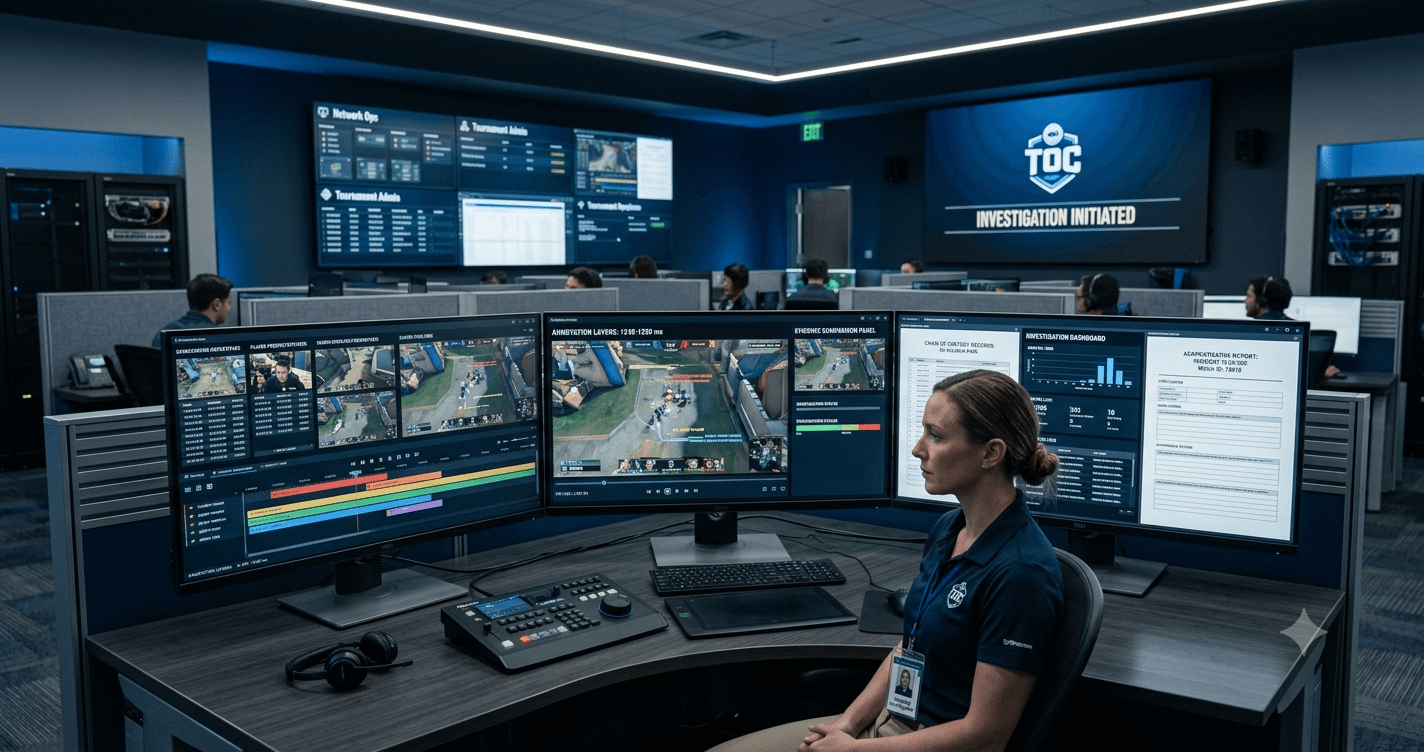
Modern Tournament Integrity Platforms simplify this process by providing centralized video evidence management.
These systems can help tournament administrators:
- Store original recordings securely.
- Associate videos with specific incidents and matches.
- Link recordings to screenshots, replay files, and referee reports.
- Generate investigation timelines.
- Record reviewer notes and findings.
- Track investigator activity through complete audit logs.
- Maintain role-based access controls.
- Preserve evidence throughout the appeals process.
Rather than replacing investigator expertise, technology enables consistent application of investigative procedures at scale. By standardizing evidence handling, tournament organizers can improve operational efficiency, reduce administrative errors, and strengthen confidence in the fairness and transparency of every investigation.
KPIs for Video Evidence Management
Establishing measurable Key Performance Indicators (KPIs) allows tournament organizers to continuously improve how video evidence is collected, analyzed, and incorporated into administrative investigations. Monitoring these metrics helps identify operational bottlenecks, evaluate investigator performance, and ensure investigations remain consistent as tournaments grow.
The following KPIs provide a strong foundation for evidence management programs.
| KPI | Description | Recommended Target |
|---|---|---|
| Video Submission Rate | Percentage of applicable incidents accompanied by video evidence. | >80% |
| Original Video Preservation Rate | Percentage of recordings preserved without modification. | 100% |
| Multi-Source Corroboration Rate | Percentage of investigations where video evidence is supported by at least one independent evidence source. | >95% |
| Average Video Review Time | Average time required to complete structured video analysis. | Continuously improving |
| Investigation Completion Time | Average duration from incident report to final administrative decision. | Defined by tournament SLA |
| Evidence Integrity Compliance | Percentage of investigations following documented preservation procedures. | 100% |
| Appeal Reversal Rate | Percentage of disciplinary decisions reversed due to insufficient video evidence. | <5% |
| Documentation Completeness | Percentage of investigations with complete evidence analysis and decision records. | >95% |
Tracking these indicators allows tournament organizers to refine operational procedures, improve investigator training, and strengthen confidence in disciplinary decisions.
Video Evidence Collection Checklist
Use the following checklist whenever video recordings are collected during tournament investigations.
✓ Obtain the original recording whenever possible.
✓ Record the source of the video.
✓ Assign a unique evidence identifier.
✓ Preserve the original recording without modification.
✓ Create separate working and annotated copies.
✓ Document submission date and time.
✓ Associate the recording with the correct match and incident.
✓ Verify timestamps and match identifiers.
✓ Collect additional evidence such as replay files, screenshots, chat logs, and referee notes.
✓ Compare multiple camera perspectives when available.
✓ Document every investigator who reviews the recording.
✓ Record all analysis findings objectively.
✓ Preserve recordings throughout any appeals process.
✓ Maintain secure access controls and audit logs.
✓ Archive evidence according to tournament retention policies.
Consistently applying this checklist improves evidence quality while reducing administrative inconsistencies across tournament investigations.
Frequently Asked Questions
1. Is video evidence always more reliable than screenshots?
Not necessarily. Video recordings generally provide greater context because they capture events over time, but they can still be incomplete, edited, or limited to a single perspective. The strongest investigations combine video evidence with screenshots, replay files, server logs, referee observations, and witness statements to build a comprehensive understanding of the incident.
2. Should investigators rely on player-recorded videos?
Player recordings can provide valuable insight into an incident, particularly when they capture first-person perspectives or communication overlays. However, they should not automatically be considered definitive evidence. Tournament officials should verify their authenticity and compare them with independent sources such as observer recordings, replay systems, and official tournament logs before reaching conclusions.
3. Can edited video recordings be used during investigations?
Investigators should always request the original recording whenever possible. Edited or clipped videos may be useful for highlighting relevant moments during analysis, but administrative decisions should be based on preserved original recordings to maintain evidentiary integrity and reduce the risk of missing important contextual information.
4. How long should tournament organizers retain video evidence?
Retention policies should be defined within the tournament’s governance framework. At a minimum, video evidence should remain available until all disciplinary actions and appeal periods have concluded. Professional tournament organizers may retain recordings for longer periods to support future investigations, auditing activities, investigator training, or policy reviews.
5. How does technology improve video evidence investigations?
Modern tournament administration platforms centralize video storage, organize recordings by incident, maintain audit trails, link evidence across multiple sources, and document investigator activity. These capabilities reduce administrative workload while improving consistency, transparency, and scalability for tournament integrity operations.
Conclusion
Implementing Video Evidence in Tournament Investigations is about establishing a structured investigative process rather than simply collecting recordings. High-quality video provides tournament officials with the ability to reconstruct events, understand context, and evaluate alleged rule violations with greater confidence than isolated evidence alone.
However, even the clearest recording should never be viewed in isolation. Professional investigations depend on combining video evidence with replay analysis, screenshots, server logs, referee observations, incident reports, and tournament rules to build objective, well-supported conclusions.
By standardizing evidence collection, preserving original recordings, documenting analytical findings, and applying consistent review methodologies, tournament organizers can improve fairness, strengthen administrative transparency, and increase trust among players, officials, sponsors, and the competitive community.
As esports continues to evolve into a highly professional industry, disciplined video evidence management is becoming an essential component of effective tournament governance and competitive integrity.
Apply Professional Video Evidence Management at Scale
Understanding Video Evidence in Tournament Investigations is only the beginning. As tournaments expand across multiple regions, game titles, and competitive divisions, managing large volumes of recordings, replay files, investigator notes, and supporting evidence quickly becomes a significant operational challenge. Without standardized processes, organizers often struggle with scattered evidence, inconsistent documentation, manual investigation workflows, and limited auditability during appeals.
Tourney Guard helps tournament organizers standardize these operational processes through a centralized Tournament Integrity Platform, Evidence Management Platform, Incident Management Platform, and Tournament Administration Platform. By organizing video evidence alongside incident reports, screenshots, replay files, chain of custody records, and investigation timelines, tournament staff can conduct more consistent, transparent, and defensible investigations.
If your organization is ready to professionalize tournament investigations and implement the best practices discussed throughout this guide, explore how Tourney Guard can support your operations.
👉 Start Your 30-Day Free Trial →
Recommended External Resources
These organizations publish guidance that supports professional Tournament Integrity programs:
- Esports Integrity Commission (ESIC) – Standards, codes of conduct, investigations, and integrity initiatives.
- International Olympic Committee (IOC) – Integrity frameworks applicable to competitive sports governance.
- International Betting Integrity Association (IBIA) – Best practices for integrity monitoring.
- NIST Cybersecurity Framework – Guidance for security governance and risk management.
- ISO 37301 Compliance Management Systems – International compliance management principles.
- World Anti-Doping Agency (WADA) – Governance and disciplinary process principles applicable beyond traditional sports.
Suggested Internal Links
Strengthen your internal linking strategy by connecting this article with: