Introduction
Incident Classification in Esports is the foundation of effective tournament governance. Before tournament officials can investigate, prioritize, or resolve an issue, they must first understand what kind of incident they are dealing with. Without a structured classification system, every report becomes subjective, making investigations inconsistent, response times unpredictable, and disciplinary actions difficult to standardize.
As esports competitions continue to grow in size and complexity, tournament organizers are expected to handle a wide variety of incidents—from cheating allegations and technical failures to player misconduct and administrative errors. Treating every report with the same urgency wastes valuable resources, while failing to recognize critical incidents early can compromise tournament integrity and damage participant trust.
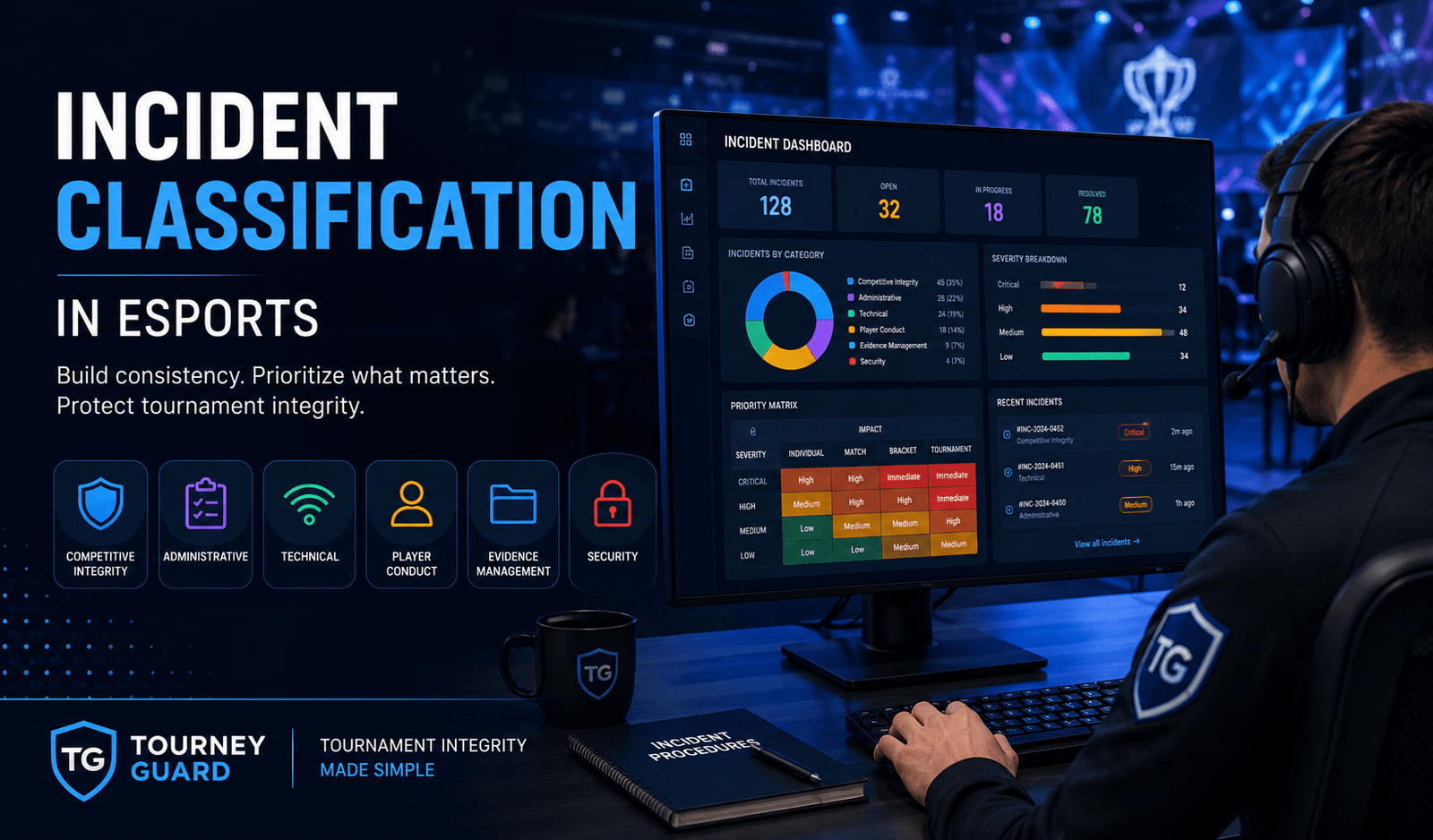
An Incident Classification framework provides a common language for tournament administrators. It helps officials categorize reports according to their nature, severity, operational impact, and required response. This enables organizers to allocate resources more effectively, establish investigation priorities, define service-level expectations, and ensure similar incidents are handled consistently across every tournament.
More importantly, classification transforms incident management from a reactive process into a structured governance practice. Rather than making decisions based on intuition or pressure, administrators follow predefined criteria that improve transparency, accountability, and fairness throughout the tournament lifecycle.
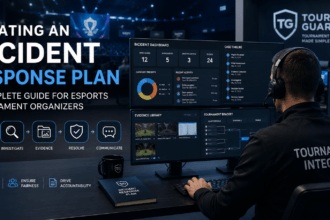
This guide explains how esports organizations can build an effective Incident Classification framework, the categories every tournament should define, and the operational principles that support professional incident management.
What Is Incident Classification in Esports?
Incident Classification in Esports is the process of categorizing tournament incidents according to predefined criteria so they can be managed through standardized operational procedures.
Instead of viewing every report as a unique problem, organizers assign incidents to established categories that determine:
- Investigation priority
- Response procedures
- Responsible personnel
- Evidence requirements
- Escalation paths
- Communication protocols
- Resolution timelines
Classification creates consistency across tournament administration by ensuring similar incidents receive similar treatment.
For example, a suspected cheating case should not follow the same workflow as a scheduling conflict, even though both require administrative attention.
Likewise, a server outage affecting an entire playoff bracket deserves a different priority than a minor roster correction before group-stage matches begin.
By classifying incidents correctly from the outset, tournament staff can focus on applying the appropriate procedures rather than debating how serious the issue might be.
Incident Classification vs. Incident Prioritization
These concepts are closely related but serve different purposes.
| Incident Classification | Incident Prioritization |
|---|---|
| Defines what type of incident occurred | Defines how urgently it should be handled |
| Groups incidents into operational categories | Determines response order |
| Guides investigation procedures | Guides resource allocation |
| Remains relatively stable | May change as circumstances evolve |
| Supports governance consistency | Supports operational efficiency |
For example:
Classification
- Competitive Integrity
- Technical
- Administrative
Priority
- Critical
- High
- Medium
- Low
A Competitive Integrity incident may be classified as High Priority during a live final but Medium Priority if reported after the tournament has concluded.
Classification determines what the incident is.
Prioritization determines how quickly it must be addressed.
Why Incident Classification Matters
Without a classification system, tournament administration quickly becomes inconsistent.
Different administrators may interpret the same report differently, resulting in varying investigation methods, response times, and disciplinary decisions.
A structured classification framework provides benefits for every stakeholder in the competitive ecosystem.
For Players
Players expect incidents to be handled fairly regardless of who receives the report.
Classification helps ensure that:
- Similar cases follow similar procedures.
- Investigations are proportional to the incident.
- Response expectations are clear.
- Decisions are based on established processes.
This consistency strengthens confidence in tournament governance.
For Tournament Officials
Administrators often manage dozens—or even hundreds—of reports during a competitive season.
Classification allows officials to:
- Identify urgent cases quickly.
- Assign investigations efficiently.
- Standardize evidence requirements.
- Reduce administrative confusion.
- Improve coordination across staff.
Rather than starting every investigation from scratch, officials can rely on predefined workflows tailored to each incident category.
For Tournament Organizers
From an operational perspective, classification improves scalability.
As tournaments grow, organizers can no longer depend on individual experience to determine how incidents should be handled.
A standardized taxonomy enables organizations to:
- Measure incident trends.
- Allocate staff effectively.
- Automate administrative workflows.
- Improve reporting.
- Develop consistent governance policies.
This transforms incident management into a repeatable organizational capability rather than an ad hoc activity.
For Sponsors and Partners
Professional governance reduces reputational risk.
Sponsors are more likely to support tournaments that demonstrate structured incident management rather than relying on informal or inconsistent decision-making.
A documented classification framework signals operational maturity and a commitment to competitive integrity.
For the Community
Communities may disagree with individual decisions, but they are more likely to trust tournaments that apply consistent standards.
When organizers can explain that an incident followed a predefined classification and investigation process, public confidence increases—even when outcomes are unpopular.
Transparency begins with consistency.
Core Principles of Incident Classification
An effective Incident Classification framework should be based on governance principles rather than arbitrary labels.
The following principles ensure the system remains useful as tournaments evolve.
1. Clarity
Every incident category should have a clear definition.
Administrators should never have to guess whether a report belongs in one category or another.
Each category should include:
- Definition
- Scope
- Typical examples
- Exclusions
- Responsible personnel
Clear definitions reduce inconsistent classifications across different tournament staff members.
2. Consistency
Two administrators reviewing the same incident should reach the same classification.
Consistency is achieved by using documented criteria instead of personal judgment.
Organizations should periodically review historical cases to verify that similar incidents continue to be classified consistently across tournaments.
3. Scalability
Classification systems should work equally well for:
- Small community tournaments
- Regional leagues
- National championships
- International esports events
A scalable framework allows new incident types to be introduced without redesigning the entire governance model.
For example, organizers may later add categories for AI-assisted cheating, biometric verification issues, or emerging tournament technologies without affecting existing workflows.
4. Actionability
A category should immediately tell administrators what happens next.
Classification should trigger:
- Investigation procedures
- Evidence collection requirements
- Notification rules
- Escalation processes
- Resolution timelines
If classification does not influence operational decisions, it provides little practical value.
5. Flexibility
No framework can anticipate every possible incident.
Organizers should include procedures for handling exceptional or hybrid cases while maintaining consistent governance principles.
For example:
- A server failure caused by unauthorized software could involve both Technical and Competitive Integrity classifications.
Rather than forcing incidents into a single category, mature organizations allow multiple classifications when appropriate.
6. Continuous Improvement
Incident Classification should evolve alongside the tournament ecosystem.
After each tournament, organizers should analyze completed investigations to identify:
- Frequently occurring incident categories.
- Emerging integrity threats.
- Categories that are too broad or too narrow.
- Misclassified cases.
- Opportunities to improve administrative workflows.
Historical data often reveals trends that can guide future governance improvements.
A classification framework should be considered a living operational document—one that grows with the organization’s experience and helps establish increasingly mature tournament administration practices.
Building an Incident Classification Framework
An Incident Classification framework should provide tournament officials with a clear method for evaluating every report from the moment it is received.
Instead of relying on subjective opinions, administrators should classify incidents using a consistent set of criteria that determines:
- What type of incident occurred
- How serious it is
- Who should investigate it
- Which evidence is required
- How quickly action is needed
- Whether escalation is necessary
The objective is not merely to organize reports—it is to standardize decision-making throughout the entire incident management process.
The Four Dimensions of Incident Classification
A mature classification system evaluates incidents across multiple dimensions rather than assigning a single label.
The four most important dimensions are:
Incident Report
        ↓
Category
        ↓
Severity
        ↓
Operational Impact
        ↓
Priority
        ↓
Investigation Workflow
Each dimension answers a different operational question.
| Dimension | Question |
|---|---|
| Category | What type of incident is this? |
| Severity | How serious is it? |
| Operational Impact | Who or what is affected? |
| Priority | How quickly must it be addressed? |
Using multiple dimensions enables tournament organizers to allocate resources more effectively while maintaining governance consistency.
Dimension 1: Incident Category
The first step is identifying the nature of the incident.
A practical classification model for esports includes the following categories.
Competitive Integrity Incidents
These incidents directly threaten fair competition.
Examples include:
- Cheating allegations
- Unauthorized software
- Hardware modifications
- Account sharing
- Smurfing
- Match fixing
- Ghosting
- Stream sniping
- Collusion
- Exploiting game bugs
These incidents generally require detailed evidence collection and formal investigations because they can affect tournament results.
Administrative Incidents
Administrative incidents involve tournament operations rather than gameplay.
Examples include:
- Registration errors
- Incorrect roster submissions
- Eligibility disputes
- Seeding mistakes
- Scheduling conflicts
- Rule interpretation questions
- Tournament configuration errors
Although these incidents may not involve misconduct, they can significantly disrupt tournament operations if left unresolved.
Technical Incidents
Technical incidents originate from systems, infrastructure, or equipment failures.
Examples include:
- Server outages
- Match lobby failures
- Replay recording failures
- Streaming interruptions
- Platform instability
- Network connectivity problems
- Hardware malfunctions during LAN events
Technical incidents often require close coordination between tournament administrators and technical support teams.
Player Conduct Incidents
These involve participant behavior outside of gameplay mechanics.
Examples include:
- Harassment
- Offensive language
- Threats
- Unsportsmanlike conduct
- Abuse toward officials
- Discrimination
- Toxic behavior
Player conduct investigations often require witness statements, communication logs, and contextual analysis.
Evidence Management Incidents
Sometimes the incident concerns the evidence itself.
Examples include:
- Missing replay files
- Corrupted recordings
- Altered screenshots
- Incomplete submissions
- Unverified media
- Missing timestamps
Without trustworthy evidence, even legitimate investigations become more difficult.
Security Incidents
Security-related incidents affect tournament systems or participant accounts.
Examples include:
- Account compromise
- Credential sharing
- Unauthorized administrator access
- Data leaks
- Credential theft
- Unauthorized API usage
As tournaments become increasingly digital, security incidents deserve their own operational procedures.
Dimension 2: Severity Levels
Not every incident within the same category has the same impact.
Severity measures the potential consequences if the incident is confirmed.
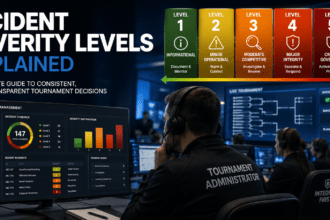
A four-level model works well for most tournaments.
Critical
Critical incidents threaten the legitimacy of the tournament.
Examples include:
- Match fixing
- Organized cheating
- Server compromise
- Bracket manipulation
- Large-scale evidence tampering
Typical response:
- Immediate investigation
- Senior administrator involvement
- Possible suspension of matches
- Executive review
High
High-severity incidents affect competitive fairness but usually remain isolated.
Examples include:
- Individual cheating allegation
- Serious harassment
- Identity fraud
- Unauthorized coaching
Response expectations:
- Investigation begins immediately.
- Evidence preserved.
- Priority investigator assigned.
Medium
Medium-severity incidents require investigation but rarely threaten tournament continuity.
Examples include:
- Rule interpretation disputes
- Minor technical failures
- Scheduling issues
- Roster corrections
These incidents can typically be resolved without interrupting tournament operations.
Low
Low-severity incidents have minimal competitive impact.
Examples include:
- Minor reporting errors
- Documentation corrections
- Non-critical administrative questions
- Informational requests
These should still be documented but generally require fewer resources.
Dimension 3: Operational Impact
Two incidents with identical severity may affect different parts of the tournament.
Operational impact measures how broadly the incident influences the event.
Individual Impact
Affects only one participant.
Examples:
- Incorrect player registration
- Individual misconduct warning
- Account verification issue
Match Impact
Affects one specific match.
Examples:
- Replay unavailable
- Player disconnect
- Rule dispute during competition
Bracket Impact
Affects tournament progression.
Examples:
- Incorrect match result
- Seeding error
- Invalid player advancement
Tournament-Wide Impact
Impacts the entire competition.
Examples:
- Platform outage
- Major rule interpretation error
- Security breach
- Multiple cheating allegations
Tournament-wide incidents often require executive oversight and coordinated communication.
Dimension 4: Priority Assignment
Priority combines all previous dimensions to determine response urgency.
A simple matrix can help administrators assign priorities consistently.
| Severity | Operational Impact | Typical Priority |
|---|---|---|
| Critical | Tournament-wide | Immediate |
| Critical | Bracket | Immediate |
| High | Match | High |
| High | Individual | High |
| Medium | Match | Medium |
| Medium | Individual | Medium |
| Low | Individual | Low |
Using a matrix reduces subjective decision-making and ensures similar incidents receive similar response times.
Operational Workflow for Incident Classification
Classification should occur before formal investigation begins.
A recommended workflow is:
Incident Report
        ↓
Initial Review
        ↓
Assign Category
        ↓
Assign Severity
        ↓
Evaluate Operational Impact
        ↓
Assign Priority
        ↓
Create Investigation Case
        ↓
Assign Investigator
This workflow ensures every case enters the investigation process with consistent administrative information.
Classification Decision Tree
Tournament officials can simplify early decision-making with a structured decision tree.
Does the incident affect fair competition?
│
├── Yes
│      ↓
│ Competitive Integrity
│
└── No
       ↓
Does it affect tournament operations?
│
├── Yes
│      ↓
│ Administrative
│
└── No
       ↓
Does it involve technology?
│
├── Yes
│      ↓
│ Technical
│
└── No
       ↓
Does it involve participant behavior?
│
├── Yes
│      ↓
│ Player Conduct
│
└── Security / Evidence Management
Decision trees improve consistency, particularly for newer tournament staff.
Real-World Classification Examples
Example 1: Suspected Aim Assistance
Report:
A player is accused of using unauthorized aiming software during the semifinals.
Classification:
- Category: Competitive Integrity
- Severity: High
- Operational Impact: Match
- Priority: High
Required evidence:
- Match replay
- Anti-cheat logs (if available)
- Observer footage
- Player statement
- Referee report
Example 2: Tournament Server Failure
Report:
The tournament server crashes during the grand final.
Classification:
- Category: Technical
- Severity: Critical
- Operational Impact: Tournament-wide
- Priority: Immediate
Required evidence:
- Server logs
- Infrastructure monitoring
- Match timeline
- Platform diagnostics
Example 3: Incorrect Roster Submission
Report:
A team accidentally registers the wrong substitute player.
Classification:
- Category: Administrative
- Severity: Medium
- Operational Impact: Individual
- Priority: Medium
Required evidence:
- Registration records
- Tournament deadlines
- Team communications
Common Mistakes in Incident Classification
Even experienced organizers can weaken their governance by applying inconsistent classification practices.
Mistake 1: Creating Too Many Categories
An overly complex taxonomy becomes difficult to learn and apply consistently.
Instead, create broad, clearly defined categories with specific subtypes when necessary.
Mistake 2: Confusing Severity with Priority
Severity measures potential impact.
Priority measures operational urgency.
These concepts should always be evaluated independently before determining response timelines.
Mistake 3: Reclassifying Incidents Without Documentation
Sometimes investigations reveal that an incident belongs to another category.
When this happens, administrators should document:
- Original classification
- Updated classification
- Reason for change
- Date of modification
Maintaining this history preserves transparency and strengthens the audit trail.
Mistake 4: Ignoring Historical Trends
If the same incident category appears repeatedly across multiple tournaments, organizers should investigate the underlying operational causes rather than treating each case in isolation.
Trend analysis often reveals opportunities to improve tournament rules, procedures, or participant education.
Best Practices for Incident Classification
Organizations with mature tournament governance typically follow these practices:
- Define incident categories before registrations open.
- Publish classification criteria internally for tournament staff.
- Train administrators using realistic case studies.
- Standardize terminology across all documentation.
- Review classifications during post-tournament retrospectives.
- Periodically audit historical cases for consistency.
- Maintain a classification handbook alongside the tournament rulebook.
- Allow multiple classifications when incidents span different operational areas.
- Use historical data to refine category definitions over time.
- Integrate classification into every incident reporting workflow from the very first report.
These practices help transform classification from a simple labeling exercise into a cornerstone of consistent tournament governance.
How Technology Supports Incident Classification
As the number of tournaments and reported incidents grows, manually classifying cases becomes increasingly difficult.
Modern tournament administration platforms can assist by:
- Automatically assigning case identifiers.
- Presenting standardized classification forms.
- Suggesting categories based on incident type.
- Applying predefined severity matrices.
- Routing incidents to the appropriate investigators.
- Tracking classification history and changes.
- Generating analytics by category and severity.
- Identifying recurring trends across multiple tournaments.
- Supporting audit trails for every classification decision.
Technology does not replace administrative judgment. Instead, it helps tournament organizers apply their Incident Classification framework consistently, ensuring every report follows the same governance standards regardless of who receives it.
KPIs for Measuring Incident Classification Effectiveness
An Incident Classification framework should be continuously evaluated to ensure it supports consistent and efficient tournament operations. Measuring performance allows organizers to identify weaknesses in their governance model, improve staff training, and refine classification criteria over time.
The following KPIs provide meaningful insights into the effectiveness of an Incident Classification process.
| KPI | Why It Matters |
|---|---|
| Classification Accuracy Rate | Measures how often incidents are correctly classified during the initial assessment. |
| Incident Reclassification Rate | Indicates whether categories are clearly defined or frequently misunderstood. |
| Average Classification Time | Tracks how quickly administrators categorize new reports. |
| Incidents by Category | Reveals trends in tournament operations and competitive integrity. |
| Incidents by Severity | Helps evaluate tournament risk levels. |
| Priority Assignment Accuracy | Measures whether response urgency aligns with organizational standards. |
| Average Time to Investigator Assignment | Evaluates operational efficiency after classification. |
| Cases Escalated | Identifies incidents requiring senior administrative review. |
| Repeat Incident Trends | Highlights recurring governance issues that may require preventive measures. |
| Classification Consistency Between Administrators | Ensures similar incidents receive the same classification regardless of who reviews them. |
Organizations that monitor these KPIs can continuously improve both operational efficiency and tournament governance.
Incident Classification Checklist
Before the tournament begins, verify that your Incident Classification framework includes the following elements.
✓ Incident categories are clearly documented.
✓ Every category includes a formal definition.
✓ Examples are provided for each category.
✓ Severity levels are standardized.
✓ Operational impact criteria have been defined.
✓ Priority assignment rules are documented.
✓ Classification workflows are available for tournament staff.
✓ Escalation procedures are documented.
✓ Category-specific evidence requirements have been established.
✓ Staff members have received Incident Classification training.
✓ Historical incident records are available for reference.
✓ Classification decisions are included in every investigation record.
✓ Classification changes require documented justification.
✓ Post-event reviews include classification accuracy analysis.
✓ Incident statistics are collected for continuous improvement.
Completing this checklist before each tournament helps ensure that every reported incident enters the investigation process with consistent administrative information.
Frequently Asked Questions
1. What is Incident Classification in esports?
Incident Classification is the process of categorizing tournament incidents using predefined criteria such as category, severity, operational impact, and response priority. It allows tournament organizers to apply consistent investigation procedures, allocate resources effectively, and improve competitive integrity through standardized governance.
2. Why is Incident Classification important?
Without a classification framework, similar incidents may be handled differently depending on which administrator receives the report. Classification promotes fairness, transparency, consistent investigations, efficient resource allocation, and reliable reporting across all tournaments.
3. How many incident categories should a tournament have?
There is no universal number, but most tournaments benefit from five to seven broad categories, such as Competitive Integrity, Administrative, Technical, Player Conduct, Evidence Management, and Security. Categories should be comprehensive enough to cover common situations without becoming overly complex.
4. Can one incident belong to multiple categories?
Yes. Some incidents naturally span multiple operational areas. For example, a compromised tournament account that alters match results may be classified as both a Security Incident and a Competitive Integrity Incident. Allowing multiple classifications provides a more accurate representation of complex cases.
5. How often should an Incident Classification framework be reviewed?
The framework should be reviewed after every tournament or competitive season. Organizers should analyze historical incidents, identify recurring trends, evaluate classification consistency, and update definitions or workflows as esports operations evolve.
Conclusion
An effective Incident Classification in Esports framework is one of the cornerstones of professional tournament governance.
Classification is much more than organizing reports into folders or assigning labels. It establishes a common operational language that enables tournament staff to investigate incidents consistently, prioritize resources appropriately, and make transparent, defensible decisions.
By combining clearly defined incident categories with standardized severity levels, operational impact assessments, and response priorities, organizers create a governance model that scales from small community events to international esports championships.
Most importantly, a mature classification framework improves trust. Players understand how incidents will be handled, administrators work with greater consistency, sponsors gain confidence in tournament operations, and communities recognize that decisions follow documented procedures rather than subjective opinions.
As esports continues to mature, structured Incident Classification will remain an essential capability for organizations committed to maintaining competitive integrity and delivering professionally managed tournaments.
Ready to Standardize Incident Classification Across Your Tournaments?
Designing an Incident Classification framework is only the beginning. As tournaments grow, maintaining consistent classifications across multiple administrators, investigations, and competitive seasons becomes increasingly difficult. Manual spreadsheets, disconnected reporting channels, scattered documentation, and inconsistent categorization can quickly reduce the effectiveness of even the best governance framework.
Tourney Guard helps tournament organizers operationalize Incident Classification through a centralized Tournament Integrity Platform, Incident Management Platform, Tournament Administration Platform, and Governance Platform. By standardizing incident reporting, classification workflows, evidence management, audit trails, and investigation processes, organizers can apply the same governance standards across every tournament with greater consistency and transparency.
If you’re ready to move beyond manual incident tracking and implement repeatable operational workflows, explore how Tourney Guard can support your tournament operations.
👉 Start Your 30-Day Free Trial →
Recommended External Resources
These organizations publish guidance that supports professional Tournament Integrity programs:
- Esports Integrity Commission (ESIC) – Standards, codes of conduct, investigations, and integrity initiatives.
- International Olympic Committee (IOC) – Integrity frameworks applicable to competitive sports governance.
- International Betting Integrity Association (IBIA) – Best practices for integrity monitoring.
- NIST Cybersecurity Framework – Guidance for security governance and risk management.
- ISO 37301 Compliance Management Systems – International compliance management principles.
- World Anti-Doping Agency (WADA) – Governance and disciplinary process principles applicable beyond traditional sports.
Suggested Internal Links
Strengthen your internal linking strategy by connecting this article with: