Introduction
How to Investigate a Tournament Incident is one of the most important skills every tournament organizer, referee, and integrity administrator should master. Every disciplinary action, competitive ruling, or administrative decision is only as strong as the investigation behind it. When investigations are inconsistent, incomplete, or biased, they can damage player trust, create unnecessary disputes, and undermine the integrity of the entire competition.
Tournament incidents can range from suspected cheating and player misconduct to technical disputes, rule violations, roster issues, and match administration errors. Regardless of the incident type, organizers need a structured process that ensures every case is handled objectively, transparently, and according to established tournament rules.
Professional investigations are not about proving someone guilty as quickly as possible. They are about collecting reliable evidence, verifying facts, applying tournament policies consistently, and reaching decisions that can withstand scrutiny from players, teams, sponsors, and the wider esports community.
This guide explains how tournament organizers should investigate incidents using a structured methodology that improves fairness, strengthens governance, and protects competitive integrity throughout every stage of the tournament.
What Is a Tournament Incident Investigation?
A tournament incident investigation is the formal process of examining a reported event to determine what happened, what evidence supports the available facts, whether tournament rules were violated, and what administrative action—if any—should be taken.
An investigation is much more than reviewing a replay or reading a player complaint.
It involves gathering multiple sources of information, evaluating their reliability, documenting findings, and applying tournament policies consistently.
The objective is not simply to resolve a dispute quickly but to reach a decision that is:
- Fair
- Objective
- Evidence-based
- Consistent
- Transparent
- Defensible
Professional investigations reduce the likelihood of arbitrary decisions and strengthen confidence in tournament administration.
Incident Reporting vs. Incident Investigation
These two processes are closely related but serve different purposes.
| Incident Reporting | Incident Investigation |
|---|---|
| Documents what was observed | Determines what actually happened |
| Usually completed immediately | May require hours or days |
| Records facts and available evidence | Analyzes evidence and applies tournament rules |
| Initiates the workflow | Produces the administrative decision |
| Performed by reporters or officials | Performed by investigators or tournament administrators |
A high-quality investigation depends on a well-documented incident report, but the investigation itself extends far beyond the initial report.
Why Investigating Tournament Incidents Matters
For Tournament Organizers
A structured investigation process helps organizers:
- Make consistent disciplinary decisions.
- Reduce administrative disputes.
- Protect the credibility of the tournament.
- Improve governance standards.
- Build documented precedents for future cases.
Without a repeatable investigation process, similar incidents may receive different outcomes, creating perceptions of unfairness.
For Players
Players expect tournament officials to evaluate incidents impartially.
Professional investigations ensure that:
- Allegations receive proper review.
- Evidence is evaluated objectively.
- Decisions are based on facts rather than opinions.
- Every participant receives equal treatment under the rules.
This strengthens confidence in the competitive environment.
For Tournament Officials
Referees and administrators benefit from standardized investigations because they provide:
- Clear investigative procedures.
- Defined responsibilities.
- Better documentation.
- Reduced decision-making uncertainty.
- Stronger collaboration between officials.
Rather than relying on personal judgment alone, officials follow an established governance framework.
For Sponsors and Partners
Sponsors increasingly value operational maturity alongside audience size.
Consistent investigations demonstrate that organizers:
- Protect competitive integrity.
- Manage disputes professionally.
- Reduce reputational risks.
- Maintain fair competition.
Strong governance contributes to long-term organizational credibility.
For the Esports Community
Transparent investigations help reduce speculation and misinformation.
When organizers explain that decisions follow documented investigative procedures, communities are more likely to trust the outcome—even when they disagree with the final ruling.
Trust is built through process, not simply through results.
Core Principles of Tournament Incident Investigations
Every investigation should follow a set of fundamental principles that prioritize fairness over speed.
1. Impartiality
Investigators must remain neutral throughout the process.
They should avoid:
- Personal biases.
- Community pressure.
- Public opinion.
- Organizational favoritism.
- Assumptions about a player’s history.
Every case should be evaluated independently based on its own evidence.
2. Evidence Before Conclusions
Investigators should never begin with a predetermined outcome.
Instead, they should:
- Collect evidence.
- Verify information.
- Compare multiple sources.
- Evaluate credibility.
- Reach conclusions only after reviewing all relevant material.
Good investigations allow evidence to drive decisions—not the other way around.
3. Consistency
Similar incidents should follow similar investigative procedures.
Consistency improves:
- Fairness.
- Administrative transparency.
- Staff training.
- Historical comparisons.
- Appeals management.
Standardized investigations also reduce the perception of arbitrary decision-making.
4. Documentation
Every investigative action should be documented.
Maintain records of:
- Evidence reviewed.
- Witness interviews.
- Timeline updates.
- Rule references.
- Internal findings.
- Final decisions.
Comprehensive documentation supports accountability and simplifies future appeals.
5. Confidentiality
Investigations often involve sensitive information.
Access should be limited to authorized personnel until the investigation concludes.
Premature disclosure can:
- Influence witness statements.
- Damage reputations.
- Compromise evidence.
- Undermine confidence in the process.
Professional organizers balance transparency with appropriate confidentiality.
6. Due Process
Every participant should have a reasonable opportunity to respond when appropriate.
Depending on the nature of the incident, investigators may:
- Request player statements.
- Clarify disputed facts.
- Review additional evidence.
- Consider mitigating circumstances.
Due process helps ensure that decisions are not based on incomplete information.
7. Traceability
Investigations should produce a complete audit trail.
Organizations should always know:
- When the investigation started.
- Who conducted it.
- Which evidence was reviewed.
- Which findings were documented.
- Why the final decision was reached.
Traceability strengthens governance and simplifies administrative reviews.
8. Proportionality
Not every incident requires the same investigative effort.
Minor procedural issues may be resolved quickly, while allegations involving cheating, match manipulation, or serious misconduct require more comprehensive investigations.
The depth of the investigation should be proportional to the potential impact on tournament integrity.
By following these principles, tournament organizers create investigations that are not only fair but also defensible, repeatable, and trusted by players, officials, and the broader esports community.
The Tournament Incident Investigation Workflow
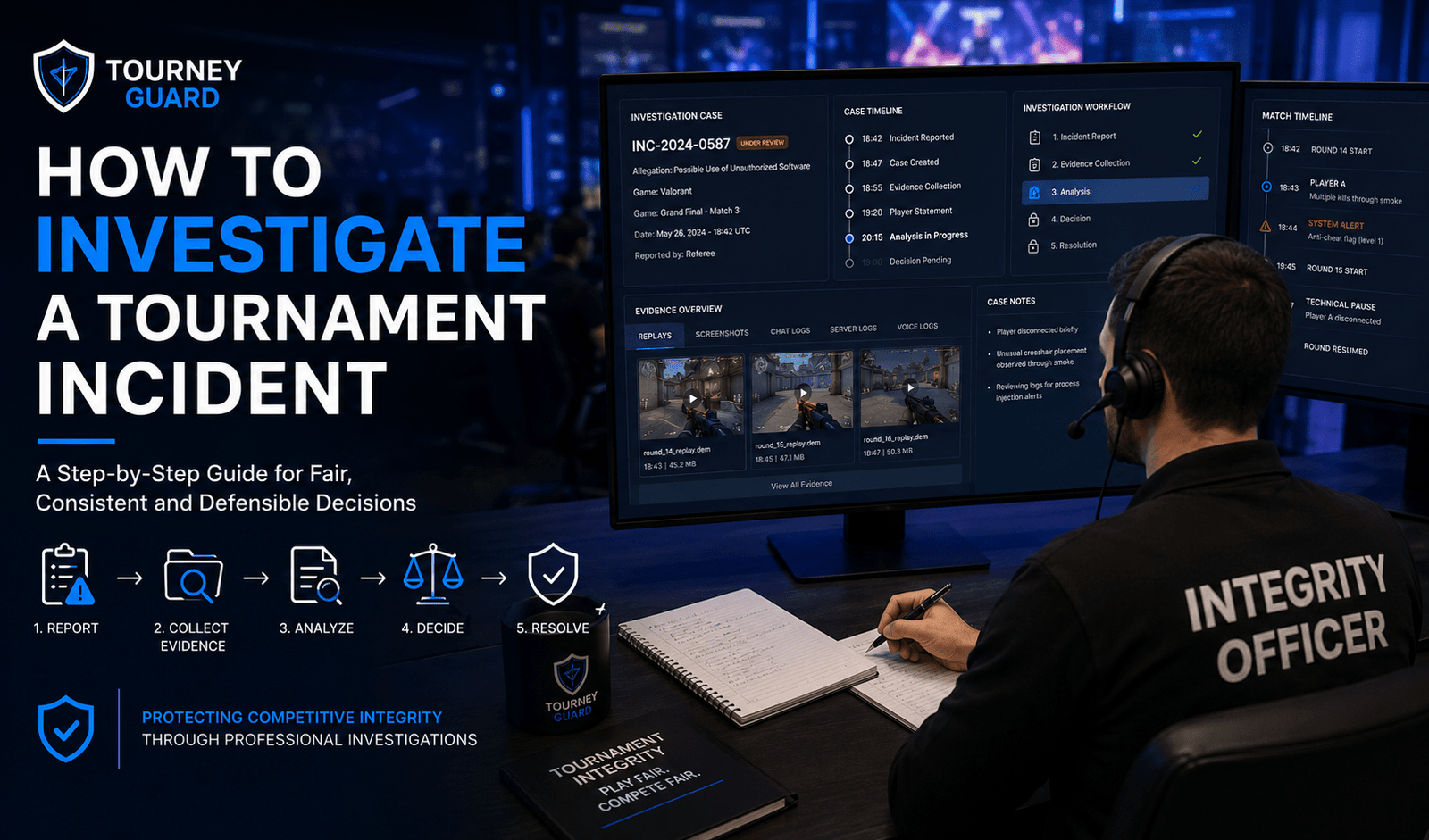
Professional investigations should follow a repeatable workflow rather than relying on intuition or personal experience. A structured process ensures that every case receives the same level of diligence while minimizing bias and administrative errors.
A recommended investigation workflow consists of the following stages:
- Receive the incident report.
- Verify the report’s completeness.
- Preserve all available evidence.
- Define the scope of the investigation.
- Collect additional evidence.
- Interview relevant participants when necessary.
- Compare findings against tournament rules.
- Evaluate possible outcomes.
- Document conclusions.
- Issue and communicate the final decision.
- Archive the investigation for future reference.
Each stage builds upon the previous one, creating a documented chain of evidence that supports transparent and defensible administrative decisions.
Step 1: Verify the Initial Incident Report
Every investigation begins with the incident report, but not every report contains sufficient information to proceed immediately.
Before collecting additional evidence, investigators should confirm that the report includes:
- Tournament name
- Match identifier
- Date and time
- Individuals involved
- Description of the incident
- Available evidence
- Reporter information
- Relevant tournament stage
If essential information is missing, investigators should request clarification before advancing to the next stage.
A complete report reduces delays and prevents misunderstandings later in the investigation.
Step 2: Preserve Evidence Immediately
Evidence preservation is one of the most time-sensitive responsibilities during an investigation.
Digital evidence can disappear quickly due to overwritten game replays, deleted chat logs, temporary server data, or expired streaming archives.
Investigators should secure all available evidence before beginning detailed analysis.
Common evidence includes:
- Match replays
- Game demos
- Tournament broadcasts
- Server logs
- Screenshots
- Video clips
- Voice communications
- Chat history
- Referee observations
- Player submissions
Whenever possible, maintain original copies before creating annotated or working versions.
This practice preserves authenticity and supports future appeals.
Step 3: Define the Scope of the Investigation
Not every investigation needs to examine every aspect of a match.
Investigators should clearly define:
- What allegation is being investigated?
- Which rules may apply?
- Which players are involved?
- What evidence is relevant?
- What questions must be answered?
A clearly defined scope prevents unnecessary work and keeps the investigation focused.
For example, an allegation of stream sniping does not require reviewing unrelated player conduct earlier in the tournament unless new evidence expands the investigation.
Step 4: Collect Additional Evidence
The initial report rarely contains every piece of information required.
Investigators should gather evidence from multiple independent sources.
Potential sources include:
Tournament Systems
- Match history
- Tournament platform records
- Registration information
- Administrative logs
Game Data
- Replay files
- Server events
- Round timelines
- Kill feeds
- Spectator recordings
Broadcast Assets
- Live production footage
- Observer perspectives
- Commentary recordings
- Highlight clips
Broadcast recordings often capture information unavailable to players.
Communications
Review official communication channels when relevant.
Examples include:
- Tournament Discord
- Official ticket systems
- Referee communications
- Player support requests
Private communications should only be reviewed according to tournament policies and applicable legal requirements.
Step 5: Evaluate the Quality of Evidence
Not all evidence carries the same weight.
Professional investigators evaluate evidence based on several factors.
Authenticity
Is the evidence genuine?
Verify that files have not been altered or edited in ways that could misrepresent events.
Reliability
Does the evidence consistently represent what occurred?
For example, an official server replay generally carries greater reliability than a short social media clip.
Relevance
Only consider evidence directly related to the allegation.
Irrelevant information introduces unnecessary complexity and increases the risk of bias.
Corroboration
Strong investigations rely on multiple independent sources.
For example:
- Replay
- Server log
- Referee observation
- Broadcast footage
When these sources support the same conclusion, confidence in the findings increases significantly.
Step 6: Interview Relevant Participants
Some investigations require direct input from those involved.
Potential interviewees include:
- Reported player
- Reporting player
- Referees
- Tournament administrators
- Witnesses
- Technical staff
The purpose is not to obtain confessions but to clarify facts that may not be evident from available evidence.
Good interview questions are:
- Open-ended
- Neutral
- Specific
- Non-leading
For example:
Instead of:
“Why did you intentionally disconnect?”
Ask:
“Can you describe what happened immediately before the disconnect?”
Neutral questioning helps investigators gather reliable information without influencing responses.
Step 7: Compare the Evidence Against Tournament Rules
Evidence alone does not determine the outcome.
Investigators must interpret findings within the context of the tournament rulebook.
Consider:
- Which rule applies?
- What elements must be proven?
- Are there exceptions?
- Does precedent exist?
- Are mitigating circumstances relevant?
This stage transforms factual findings into administrative conclusions.
Without clear rule references, even accurate investigations may produce inconsistent decisions.
Decision-Making Framework
A useful approach is to separate the investigation into three distinct questions.
Question 1
What happened?
Establish the facts using available evidence.
Question 2
Which rule applies?
Identify the relevant tournament policy.
Question 3
What administrative action is appropriate?
Determine the proportional response based on:
- Severity
- Intent
- Competitive impact
- Previous precedents
- Tournament regulations
Separating these questions reduces emotional decision-making.
Practical Investigation Scenarios
Scenario 1: Suspected Unauthorized Software
Evidence collected:
- Match replay
- Anti-cheat notification
- Server logs
- Referee observations
- Player statement
Investigation focus:
Determine whether multiple independent sources support the allegation before applying tournament sanctions.
No single indicator should automatically determine guilt.
Scenario 2: Offensive Player Behavior
Evidence:
- Chat logs
- Voice recordings
- Screenshots
- Witness statements
Investigators compare the communications against the tournament’s code of conduct to determine whether the behavior violates published policies.
Scenario 3: Technical Pause Dispute
Evidence:
- Server logs
- Network diagnostics
- Referee timeline
- Broadcast footage
The investigation seeks to determine whether the pause complied with tournament procedures and whether competitive fairness was affected.
Common Investigation Mistakes
Beginning with a Conclusion
One of the most damaging mistakes is deciding the outcome before reviewing the evidence.
Professional investigations remain open until all relevant information has been evaluated.
Relying on a Single Source
Investigations based solely on:
- One screenshot
- One witness
- One replay clip
- One social media post
are significantly more vulnerable to error.
Always seek corroborating evidence whenever possible.
Ignoring Exculpatory Evidence
Investigators should actively look for evidence that both supports and contradicts the allegation.
Ignoring evidence that favors the reported player creates confirmation bias and weakens the credibility of the investigation.
Failing to Document the Investigation
Even if the final decision is correct, poor documentation creates problems during appeals.
Investigators should record:
- Evidence reviewed
- Findings
- Rule references
- Reasoning
- Final outcome
Documentation is often as important as the investigation itself.
Applying Rules Inconsistently
Two similar incidents should not produce dramatically different outcomes without a documented explanation.
Consistency strengthens tournament governance and increases player confidence.
Best Practices for Tournament Investigations
Professional organizers should adopt the following practices:
- Use standardized investigation workflows.
- Maintain clear chains of evidence.
- Separate facts from opinions.
- Preserve original evidence.
- Record every investigative action.
- Reference tournament rules explicitly.
- Use consistent decision-making criteria.
- Review historical precedents.
- Protect confidential information.
- Archive completed investigations for future learning.
These practices improve operational quality while reducing disputes and strengthening administrative transparency.
How Technology Supports Tournament Investigations
As tournaments scale, investigations become increasingly difficult to manage using spreadsheets, email threads, and messaging platforms.
Modern tournament integrity platforms help organizers standardize investigations by providing structured workflows that centralize every stage of the process.
Technology can support investigations by enabling:
- Centralized case management
- Secure evidence repositories
- Automated audit trails
- Timeline reconstruction
- Investigation assignment workflows
- Rule reference libraries
- Role-based permissions
- Status tracking
- Historical case search
- Investigation analytics
Technology should not replace investigative judgment. Instead, it provides the operational structure needed to ensure investigations remain organized, consistent, transparent, and fully documented throughout their lifecycle.
KPIs for Measuring Investigation Performance
A mature tournament operation should evaluate not only the outcomes of investigations but also the effectiveness of the investigation process itself. Tracking meaningful Key Performance Indicators (KPIs) helps organizers improve consistency, reduce delays, and strengthen tournament governance over time.
1. Average Investigation Completion Time
Measures the average time between receiving an incident report and issuing the final decision.
Formula
Total Investigation Time ÷ Number of Completed Investigations
A shorter resolution time is desirable, provided investigations remain thorough and fair.
2. Investigation Backlog
Tracks the number of open investigations awaiting review or completion.
A growing backlog may indicate:
- Insufficient staffing
- Inefficient workflows
- Poor prioritization
- Excessive administrative workload
Keeping the backlog manageable helps maintain player confidence and operational efficiency.
3. Evidence Completeness Rate
Measures the percentage of investigations that include all required supporting evidence before reaching a decision.
Examples of required evidence may include:
- Match replay
- Incident report
- Screenshots
- Server logs
- Witness statements
High completeness rates generally lead to more defensible decisions.
4. Appeal Reversal Rate
Tracks how many investigation outcomes are modified or overturned during the appeals process.
Formula
Reversed Decisions ÷ Total Appeals
A consistently high reversal rate may indicate weaknesses in the investigation process, insufficient evidence, or inconsistent rule interpretation.
5. Average Evidence Collection Time
Measures how long investigators spend gathering all relevant evidence after an incident is reported.
Reducing this metric helps preserve volatile digital evidence and accelerates case resolution.
6. Investigation Consistency
Measures whether similar incidents receive similar outcomes across different tournaments and investigation teams.
Organizations can periodically review completed cases to identify inconsistencies in:
- Rule interpretation
- Penalty severity
- Investigation procedures
- Documentation quality
Consistency is one of the strongest indicators of a mature tournament governance program.
7. Documentation Quality Score
Many organizations use internal audits to assess whether investigation records include:
- Investigation timeline
- Evidence references
- Rule citations
- Findings
- Final rationale
- Administrative decision
Well-documented investigations simplify appeals, historical reviews, and staff training.
8. Repeat Incident Analysis
Historical investigations provide valuable operational insights.
By analyzing completed cases, organizers can identify recurring issues such as:
- Frequently misunderstood rules
- Common technical failures
- Repeat player misconduct
- Operational bottlenecks
- Staff training needs
Trend analysis transforms investigations into a continuous improvement mechanism rather than a purely reactive process.
Tournament Investigation Checklist
Use this checklist to ensure every investigation follows a consistent and defensible process.
✓ Confirm the incident report is complete.
✓ Preserve all available evidence immediately.
✓ Define the investigation scope.
✓ Assign an investigator or investigation team.
✓ Collect additional evidence from multiple independent sources.
✓ Verify the authenticity and reliability of each piece of evidence.
✓ Conduct interviews when necessary.
✓ Separate verified facts from assumptions.
✓ Compare findings against the tournament rulebook.
✓ Review similar historical cases for consistency.
✓ Document every investigative action.
✓ Record the reasoning behind the final decision.
✓ Notify affected parties according to tournament procedures.
✓ Preserve all investigation records for future reference and appeals.
Following a standardized checklist helps ensure that investigations remain transparent, repeatable, and fair regardless of the tournament’s size or complexity.
Frequently Asked Questions
1. Who should investigate tournament incidents?
The investigation should be conducted by trained tournament administrators, integrity officers, or designated investigation teams who are independent from the incident whenever possible. Avoid assigning investigators who may have conflicts of interest, such as referees directly involved in the disputed match. Independence strengthens the credibility and impartiality of the investigation.
2. How much evidence is enough to reach a decision?
There is no universal quantity of evidence required. The objective is to gather sufficient reliable information to establish the facts with reasonable confidence under the tournament’s rules. Whenever possible, investigators should rely on multiple independent sources rather than a single replay, screenshot, or witness statement.
3. Should every incident receive the same level of investigation?
No. Investigations should be proportional to the seriousness and potential competitive impact of the allegation. Minor procedural issues may require only a brief review, while allegations involving cheating, match manipulation, or severe misconduct often justify comprehensive investigations involving multiple evidence sources and participant interviews.
4. What if the available evidence is inconclusive?
When evidence does not support a reliable conclusion, investigators should avoid speculation. Depending on tournament policies, organizers may request additional information, continue monitoring future matches, or determine that the allegation cannot be substantiated. Administrative decisions should always be based on evidence rather than assumptions.
5. Why is documentation so important after an investigation is complete?
Complete documentation provides transparency, supports appeals, preserves organizational knowledge, and allows tournament organizers to review historical decisions for consistency. It also improves staff training by creating real-world examples that demonstrate how similar incidents have been investigated and resolved in the past.
Conclusion
Investigating tournament incidents is not simply about identifying rule violations—it is about protecting the integrity of the entire competition. A structured investigation process ensures that every allegation is evaluated objectively, evidence is preserved and analyzed appropriately, and administrative decisions are based on documented facts rather than assumptions or public pressure.
By following standardized workflows, maintaining comprehensive documentation, and applying tournament rules consistently, organizers create a governance framework that players, officials, sponsors, and communities can trust. Over time, these practices strengthen operational maturity, reduce disputes, improve decision quality, and establish a culture of fairness that benefits every tournament.
Professional investigations are ultimately an investment in credibility. Every well-executed investigation reinforces competitive integrity and demonstrates that tournament administration is guided by process, accountability, and respect for fair competition.
Ready to Build More Consistent Tournament Investigations?
Understanding how to investigate a tournament incident is only the beginning. As tournaments become larger and more competitive, maintaining consistent investigations across multiple administrators, matches, and events becomes increasingly challenging.
Managing investigations through spreadsheets, email chains, shared folders, and chat applications often leads to scattered evidence, inconsistent documentation, duplicated work, and incomplete audit trails.
Tourney Guard helps tournament organizers standardize investigation workflows, centralize evidence, document findings, maintain complete audit histories, and manage administrative decisions within a platform built specifically for esports tournament integrity and governance.
Start with a 30-day free trial and discover how structured investigation workflows can improve consistency, transparency, and confidence in every competitive decision.
👉 Start Your 30-Day Free Trial →
Recommended External Resources
These organizations publish guidance that supports professional Tournament Integrity programs:
- Esports Integrity Commission (ESIC) – Standards, codes of conduct, investigations, and integrity initiatives.
- International Olympic Committee (IOC) – Integrity frameworks applicable to competitive sports governance.
- International Betting Integrity Association (IBIA) – Best practices for integrity monitoring.
- NIST Cybersecurity Framework – Guidance for security governance and risk management.
- ISO 37301 Compliance Management Systems – International compliance management principles.
- World Anti-Doping Agency (WADA) – Governance and disciplinary process principles applicable beyond traditional sports.
Suggested Internal Links
Strengthen your internal linking strategy by connecting this article with: