Introduction
Incident Reporting Best Practices are the foundation of every effective incident management process in esports. Before tournament officials can investigate, evaluate evidence, or make fair disciplinary decisions, someone must accurately report what happened. A poor report can delay investigations, weaken evidence, create inconsistencies, and ultimately undermine trust in a tournament’s competitive integrity.
Whether the incident involves cheating allegations, player misconduct, rule violations, technical disputes, or administrative errors, the quality of the initial report directly affects the quality of every decision that follows.
Many tournament organizers invest significant effort into creating rulebooks and staffing events but overlook the importance of standardized reporting procedures. As events grow larger and involve multiple administrators, referees, moderators, and volunteers, inconsistent reporting quickly becomes one of the biggest operational risks.
This guide explains the principles, workflows, and best practices behind professional incident reporting. You’ll learn how leading tournament operations structure reports, what information should always be collected, common mistakes to avoid, and how standardized reporting supports transparent investigations, fair decisions, and long-term tournament integrity.
What Are Incident Reporting Best Practices?
Incident Reporting Best Practices are standardized procedures used to document tournament incidents consistently, accurately, and objectively.
Rather than relying on informal conversations or memory, professional tournaments establish clear reporting standards that define:
- Who should report incidents
- When incidents must be reported
- What information must be included
- Which evidence should accompany reports
- How reports move through the investigation process
- Who is responsible for reviewing them
The objective is not merely to collect information but to preserve the integrity of the investigation from the very beginning.
Every investigation starts with information. If that information is incomplete, biased, or inconsistent, even experienced investigators may struggle to reach reliable conclusions.
Effective incident reporting therefore acts as the first layer of tournament governance.
Incident Reporting vs. Incident Investigation
These terms are often confused, but they represent different stages of incident management.
| Incident Reporting | Incident Investigation |
|---|---|
| Documents what happened | Determines what actually occurred |
| Usually completed immediately after the incident | May take hours or days |
| Focuses on facts and observations | Evaluates evidence and applies rules |
| Performed by witnesses, referees, or staff | Performed by administrators or integrity officials |
| Starts the workflow | Produces the final decision |
A well-written report does not attempt to prove guilt. Its purpose is to preserve accurate information for investigators.
Why Incident Reporting Matters
Professional reporting benefits every stakeholder involved in an esports competition.
For Tournament Organizers
Standardized reports allow organizers to:
- Respond consistently to incidents
- Reduce administrative confusion
- Improve operational efficiency
- Demonstrate transparency
- Maintain historical records
- Defend disciplinary decisions if questioned
Without reliable reports, organizers often rely on fragmented conversations and incomplete recollections.
For Tournament Officials
Referees and administrators benefit from structured reporting because it:
- Removes uncertainty about required information
- Reduces subjective interpretation
- Creates accountability
- Simplifies handovers between staff members
- Supports collaborative investigations
Officials spend less time reconstructing events and more time evaluating evidence.
For Players
Players gain confidence when tournaments use professional reporting procedures.
They know that:
- Every report follows the same process.
- Decisions rely on documented evidence.
- Investigations are conducted fairly.
- Similar incidents receive consistent treatment.
- Appeals can reference complete records.
Transparency strengthens trust in tournament administration.
For Sponsors and Partners
Sponsors increasingly evaluate operational professionalism alongside audience reach.
Reliable incident reporting demonstrates that tournaments:
- Protect competitive integrity
- Manage risks responsibly
- Resolve disputes professionally
- Maintain a healthy competitive environment
This operational maturity enhances organizational credibility.
For the Esports Community
Communities often judge tournaments based on how controversial incidents are handled.
When reports are well documented:
- Rumors decrease.
- Decisions become easier to explain.
- Public communication becomes more consistent.
- Confidence in tournament governance improves.
Good reporting supports long-term community trust.
Core Principles of Effective Incident Reporting
Professional incident reporting is built on several guiding principles.
1. Accuracy
Reports should describe observable facts.
Instead of writing:
“The player was obviously cheating.”
Write:
“The player repeatedly aimed at opponents through smoke without visible information. Three rounds demonstrating this behavior are attached.”
Facts are significantly more valuable than conclusions.
2. Timeliness
Reports should be submitted as soon as practical after an incident occurs.
Waiting several hours introduces risks such as:
- Forgotten details
- Lost evidence
- Missing witnesses
- Inconsistent timelines
- Delayed investigations
Organizations should establish reporting deadlines appropriate for their tournament format.
3. Objectivity
Reports should remain neutral.
Avoid:
- Emotional language
- Personal opinions
- Assumptions
- Speculation
- Character judgments
The report documents observations—not verdicts.
4. Completeness
Incomplete reports force investigators to spend valuable time collecting missing information.
Every report should answer fundamental questions such as:
- What happened?
- When did it happen?
- Where did it happen?
- Who was involved?
- Who witnessed it?
- What evidence exists?
- Which tournament rule may apply?
A structured reporting template significantly improves completeness.
5. Consistency
Every official should follow the same reporting format.
Consistency enables:
- Faster reviews
- Easier auditing
- Better historical analysis
- More reliable statistics
- Fairer investigations
Without standardized templates, every report becomes unique—making comparisons difficult.
6. Traceability
Every report should be traceable throughout its lifecycle.
Administrators should know:
- Who submitted it
- When it was created
- Who modified it
- Which evidence was added
- Which investigator reviewed it
- When decisions were issued
Maintaining this chain of documentation improves accountability.
7. Evidence-Driven Documentation
A report should reference evidence whenever possible.
Examples include:
- Match recordings
- Server logs
- Screenshots
- Voice communications
- Player submissions
- Referee observations
- Broadcast footage
- Anti-cheat notifications (when applicable)
The report itself is not evidence—it is the structured record that connects all available evidence.
8. Standardization Across Events
Large tournament operators often manage dozens or hundreds of events every year.
Using identical reporting standards across all competitions allows organizations to:
- Train staff more effectively
- Reduce onboarding time
- Compare incident trends
- Improve governance policies
- Build institutional knowledge
Standardization transforms reporting from an administrative task into a strategic operational asset.
Building an Effective Incident Reporting Workflow
Having a reporting form is only one part of the process. Professional tournament organizers establish a complete workflow that ensures every report is handled consistently from submission to resolution.
A standardized workflow minimizes delays, prevents reports from being overlooked, and creates accountability throughout the incident management lifecycle.
A typical reporting workflow includes the following stages:
- Incident occurs.
- Initial report is submitted.
- Supporting evidence is attached.
- Report is reviewed for completeness.
- Investigation is assigned.
- Additional evidence is collected if necessary.
- Findings are documented.
- Administrative decision is issued.
- Appeal window (if applicable).
- Incident is archived for future reference.
This structured approach ensures that every report follows the same operational path regardless of the tournament size.
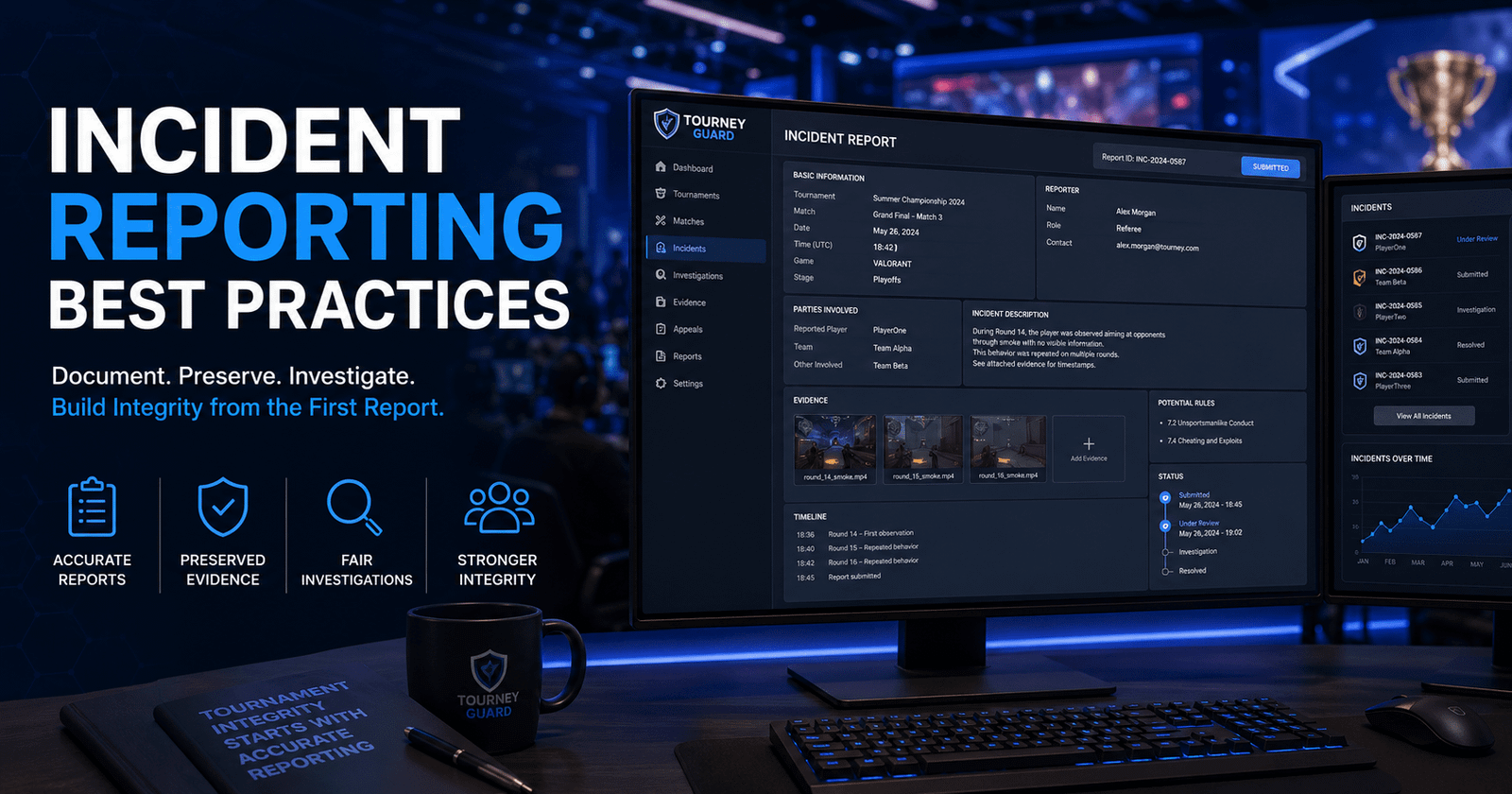
What Every Incident Report Should Include
One of the biggest causes of investigation delays is incomplete reporting.
Professional reports should always capture the essential facts without requiring investigators to repeatedly contact staff or players for clarification.
Event Information
Every report should begin with basic tournament information, including:
- Tournament name
- Season or stage
- Match identifier
- Date
- Time (including time zone)
- Game title
- Competition format
- Server or lobby identifier (if applicable)
These details provide the necessary context for locating logs, match recordings, and other supporting information.
Reporter Information
Every report should identify who submitted it.
Include:
- Name
- Role
- Organization
- Contact information
- Reporting timestamp
Knowing the reporter’s role helps investigators understand the perspective from which the observations were made.
For example, a referee, administrator, player, or spectator may each witness different aspects of the same incident.
Parties Involved
Clearly identify everyone connected to the incident.
This may include:
- Reported player
- Reporting player
- Teams
- Coaches
- Referees
- Witnesses
- Broadcast staff
- Tournament administrators
Avoid vague descriptions such as “one player” or “someone on Team B.”
Specific identification prevents confusion during later investigations.
Description of the Incident
This section should answer a simple question:
What happened?
Keep the narrative chronological.
Describe:
- What was observed
- What actions occurred
- When they occurred
- Who was involved
Avoid interpreting intentions.
Instead of writing:
“The player intentionally disconnected.”
Write:
“The player disconnected during Round 14 after requesting a technical pause.”
Observable facts are significantly more valuable than assumptions.
Timeline of Events
Whenever possible, include precise timestamps.
Example:
| Time | Event |
|---|---|
| 18:42 | Match begins |
| 18:56 | Player requests pause |
| 18:58 | Player disconnects |
| 19:01 | Match resumes |
| 19:18 | Incident reported |
Accurate timelines help investigators correlate reports with server logs, broadcast recordings, and communication records.
Evidence References
Professional reports should never rely solely on written descriptions.
Reference all available evidence, including:
- Video clips
- Match demos
- Screenshots
- Server logs
- Replay files
- Chat logs
- Voice recordings
- Broadcast timestamps
- Referee notes
Rather than embedding evidence directly into the report, many organizations store evidence separately and reference it using identifiers.
This improves organization and preserves evidence integrity.
Applicable Rules
If known, reference the relevant tournament rules.
For example:
- Unsportsmanlike Conduct
- Match Manipulation
- Player Harassment
- Unauthorized Software
- Roster Violation
If the applicable rule is uncertain, investigators can determine it later.
The report should never force a rule classification without sufficient information.
Best Practices for Writing High-Quality Incident Reports
Use Objective Language
Objectivity is perhaps the most important reporting skill.
Avoid emotionally charged words such as:
- Obviously
- Clearly
- Definitely
- Suspicious
- Malicious
- Intentional
Instead, describe observable behaviors.
Good reporting allows investigators to draw conclusions independently.
Record Facts Before Opinions
Facts should always appear before interpretations.
Poor example:
“The player cheated because their aim looked unnatural.”
Better example:
“The player tracked opponents through visual obstructions on three consecutive rounds. Match replay timestamps are attached.”
Facts create stronger investigations than opinions.
Write Chronologically
Chronological reports reduce confusion.
Readers should be able to reconstruct the incident exactly as it occurred.
Avoid jumping between different moments of the match.
A simple sequence improves readability and investigative efficiency.
Include Only Relevant Information
Not every observation belongs in the report.
Avoid unrelated commentary such as:
- Player reputation
- Previous conflicts
- Social media discussions
- Community rumors
Focus only on information directly related to the incident.
Distinguish Facts from Witness Statements
Witness accounts are valuable but should be clearly identified.
For example:
Referee Observation
The player disconnected during overtime without prior notice.
Player Statement
The player stated that their internet connection failed.
Separating observations from statements improves clarity.
Preserve Original Evidence
Never edit screenshots or recordings to strengthen a case.
If annotations are necessary, create copies while preserving the original files.
Original evidence maintains credibility throughout investigations and appeals.
Incident Reporting Framework for Tournament Organizers
Organizations often benefit from using a standardized reporting framework.
One practical model is the REPORT Framework.
R — Record Immediately
Capture information as soon as possible while memories remain accurate.
E — Explain Objectively
Describe observable facts without assumptions.
P — Preserve Evidence
Secure all supporting material before it is lost or overwritten.
O — Organize Information
Follow standardized templates rather than free-form reports.
R — Reference Rules
Identify potentially relevant tournament policies without making disciplinary conclusions.
T — Transfer for Investigation
Submit the completed report to the designated investigation team through the established workflow.
Real-World Reporting Scenarios
Scenario 1: Suspected Cheating
Poor report:
Player looked suspicious.
Professional report:
- Match ID included
- Replay timestamps attached
- Referee observations documented
- Anti-cheat notification referenced
- Screenshots included
- Relevant rule identified
The second report enables investigators to begin reviewing evidence immediately.
Scenario 2: Player Misconduct
Instead of reporting:
Player was toxic.
Document:
- Exact chat messages
- Time of occurrence
- Match context
- Screenshots
- Witnesses
- Applicable conduct policy
Specific evidence is always more useful than generalized descriptions.
Scenario 3: Technical Dispute
Rather than stating:
Server lag caused the loss.
Include:
- Server identifier
- Connection logs
- Pause requests
- Technical administrator observations
- Broadcast evidence
- Player statements
This information allows investigators to distinguish between technical failures and competitive disputes.
Common Incident Reporting Mistakes
Waiting Too Long
Delayed reporting often results in:
- Lost recordings
- Forgotten details
- Missing witnesses
- Conflicting recollections
Immediate reporting significantly improves investigation quality.
Mixing Facts with Conclusions
Investigators—not reporters—determine whether rules were violated.
Reports should present evidence, not verdicts.
Incomplete Evidence
Submitting reports without supporting material creates unnecessary delays.
Whenever possible, collect evidence before submitting the report.
Using Free-Form Reports
Unstructured reports vary dramatically in quality.
Standard templates improve consistency across every event.
Ignoring Minor Incidents
Small incidents may reveal larger patterns over time.
Repeated unsportsmanlike behavior, recurring technical problems, or frequent procedural mistakes often become visible only through consistent reporting.
Every documented incident contributes to long-term operational improvement.
How Technology Improves Incident Reporting
As tournaments become more complex, manual reporting processes become increasingly difficult to manage.
Modern tournament administration platforms help standardize reporting by providing structured workflows instead of relying on emails, spreadsheets, or messaging applications.
Technology can support incident reporting by enabling:
- Standardized report templates
- Automated incident identifiers
- Secure evidence storage
- Timestamped submissions
- Role-based access controls
- Investigation assignment workflows
- Audit trails
- Searchable incident histories
- Status tracking
- Reporting analytics
These capabilities reduce administrative overhead while improving consistency across events.
It is important to recognize that technology does not replace human judgment. Tournament officials remain responsible for evaluating evidence, interpreting rules, and making disciplinary decisions. Software simply provides the structure needed to ensure that every report is documented, traceable, and accessible throughout the investigation process.
KPIs for Measuring Incident Reporting Effectiveness
Tournament organizers should regularly evaluate how well their incident reporting process performs. Measuring the right Key Performance Indicators (KPIs) helps identify bottlenecks, improve staff training, and strengthen tournament governance over time.
1. Incident Reporting Rate
Tracks how many incidents are formally reported compared to those identified through other means.
Formula
(Number of Reported Incidents ÷ Total Confirmed Incidents) × 100
A low reporting rate may indicate that staff or players are unsure when or how to report issues.
2. Average Reporting Time
Measures the time between when an incident occurs and when the report is submitted.
Goal: Reduce reporting delays while maintaining report quality.
Shorter reporting times generally result in more accurate information and better evidence preservation.
3. Report Completeness Rate
Measures how many reports contain all mandatory information on the first submission.
Track whether reports include:
- Match information
- Parties involved
- Timeline
- Evidence references
- Reporter identification
- Rule references (if known)
A high completeness rate reduces investigation delays.
4. Evidence Attachment Rate
Measures the percentage of reports submitted with supporting evidence.
Examples include:
- Match replays
- Screenshots
- Server logs
- Video clips
- Chat records
Professional tournaments should encourage evidence-supported reporting whenever possible.
5. Investigation Assignment Time
Measures how quickly new reports are assigned to an investigator or tournament administrator.
Fast assignment improves response times and prevents incidents from remaining unattended.
6. Average Investigation Resolution Time
Measures the total time from report submission to administrative decision.
Tracking this KPI helps organizers balance efficiency with procedural fairness.
7. Report Revision Rate
Measures how often reports require follow-up because essential information was missing.
A high revision rate usually indicates:
- Poor reporting templates
- Inadequate staff training
- Unclear reporting procedures
8. Repeat Incident Trends
Historical reporting allows organizers to identify recurring operational problems, such as:
- Frequently disputed rules
- Technical issues
- Repeated player misconduct
- Staffing challenges
- Communication failures
Trend analysis transforms incident reporting into a continuous improvement tool.
Incident Reporting Checklist
Use this checklist whenever documenting a tournament incident.
✓ Record the incident as soon as possible.
✓ Identify the tournament, match, and participants.
✓ Clearly identify the reporter.
✓ Describe only observable facts.
✓ Avoid assumptions or emotional language.
✓ Document events in chronological order.
✓ Include timestamps whenever available.
✓ Attach all available evidence.
✓ Reference relevant tournament rules if known.
✓ Separate witness statements from factual observations.
✓ Preserve original evidence without modification.
✓ Submit the report through the official reporting process.
✓ Ensure the report is complete before submission.
✓ Maintain confidentiality throughout the investigation.
✓ Archive the report according to tournament policies.
Following a standardized checklist improves consistency across events and reduces the likelihood of incomplete investigations.
Frequently Asked Questions
1. Who should be allowed to submit an incident report?
Tournament organizers should define clear reporting permissions based on the event’s structure. Referees, administrators, moderators, and integrity staff typically submit official reports, while players and coaches may use participant reporting channels. Regardless of who submits the report, every submission should follow the same standardized format to ensure consistency and fairness.
2. Should incident reports include conclusions about guilt?
No. The purpose of an incident report is to document facts, observations, and supporting evidence—not to determine whether a rule has been violated. Investigators are responsible for reviewing the evidence, applying tournament rules, and reaching administrative conclusions through a structured investigation process.
3. What happens if evidence is unavailable when the report is submitted?
Reports should still be submitted promptly, even if some evidence is pending. The report should clearly indicate which evidence is unavailable and whether additional materials are expected. Delaying a report solely to wait for evidence may increase the risk of losing important information or delaying the investigation unnecessarily.
4. How long should incident reports be retained?
Retention periods depend on tournament policies, legal obligations, and organizational requirements. Many organizers retain reports long enough to support appeals, recurring investigations, seasonal reviews, and historical trend analysis. Maintaining organized archives also helps improve future tournament operations by identifying recurring issues and evaluating procedural effectiveness.
5. Can software automate incident reporting?
Software can automate many administrative tasks, including report creation, evidence organization, status tracking, audit logs, and workflow management. However, technology should support—not replace—human judgment. Tournament officials remain responsible for evaluating evidence, interpreting rules, and making disciplinary decisions based on established governance procedures.
Conclusion
Incident reporting is much more than an administrative requirement—it is the starting point of every fair and transparent investigation. A well-designed reporting process ensures that incidents are documented consistently, evidence is preserved, and investigators receive the information they need to make informed decisions.
By emphasizing accuracy, objectivity, completeness, and standardization, tournament organizers create an operational environment where every report contributes to stronger governance and greater competitive integrity. Over time, consistent reporting not only improves individual investigations but also provides valuable insights into recurring issues, staff performance, and opportunities to refine tournament procedures.
Organizations that invest in professional incident reporting practices demonstrate a long-term commitment to fairness, accountability, and operational excellence—qualities that strengthen trust among players, officials, sponsors, and the wider esports community.
Ready to Professionalize Your Incident Reporting Process?
The best reporting procedures are only effective if your staff can follow them consistently.
Tourney Guard helps tournament organizers replace scattered documents and manual workflows with a centralized platform for incident reporting, evidence management, investigations, and tournament integrity operations.
Start with a 30-day free trial and discover how a structured incident management workflow can improve consistency, transparency, and confidence in every administrative decision.
✓ Standardized incident reports
✓ Centralized evidence management
✓ Investigation workflows
✓ Complete audit history
✓ Built specifically for esports tournaments.
👉 Start Your Free 30-Day Trial →
Recommended External Resources
These organizations publish guidance that supports professional Tournament Integrity programs:
- Esports Integrity Commission (ESIC) – Standards, codes of conduct, investigations, and integrity initiatives.
- International Olympic Committee (IOC) – Integrity frameworks applicable to competitive sports governance.
- International Betting Integrity Association (IBIA) – Best practices for integrity monitoring.
- NIST Cybersecurity Framework – Guidance for security governance and risk management.
- ISO 37301 Compliance Management Systems – International compliance management principles.
- World Anti-Doping Agency (WADA) – Governance and disciplinary process principles applicable beyond traditional sports.
Suggested Internal Links
Strengthen your internal linking strategy by connecting this article with: